Illustrated guide · Operating diagnostics
How can sludge bulking be distinguished from clarifier washout?
Separate poor sludge settleability from a clarifier that is hydraulically or solids-flux overloaded using synchronized settling, microscopy, load and blanket evidence.
Direct answer
Direct answer
Ask whether representative mixed liquor from the failure window still settles and compacts poorly in a quiescent cylinder. Bulking is a deterioration of sludge settling/compaction—often an open filament network—so the same sample settles slowly, occupies a high SV30/SVI or DSVI, compacts poorly and may show excessive filaments or abnormal floc. A hydraulic/solids-loading washout occurs when the sample still settles well, but peak flow, solids flux approximately (Q+RAS)×MLSS/area, unequal splitting, inlet/weir hydraulics, density currents, wind, high blanket or failed sludge removal overwhelms the real clarifier. It often follows rain or sidestream peaks, affects one parallel unit or one region and produces local billows. The mechanisms can coexist: high-SVI sludge lowers allowable solids loading, and high inventory causes hindered settling. Synchronize MLSS, SV5/10/30, SVI/DSVI, supernatant, microscopy, per-unit Q/RAS/load, blanket and effluent TSS. Also separate denitrification rising sludge—which settles then floats on nitrogen bubbles—and pin/dispersed floc, which may have normal SVI but turbid supernatant. Bulking needs ecological cause control; washout needs flow/area/split/RAS/inventory and hydraulic-mechanical correction. Do not diagnose from solids over the weir alone.
Split washout with four boundaries
High effluent solids are an outcome, not a root-cause name.
Does the same-time cylinder also fail?
Record SV5/10/30, interface velocity, compaction, supernatant and SVI/DSVI. Poor tank/good cylinder favors clarifier load or hydraulics.
All units or one region?
Biological settleability often affects shared trains; flow split, inlet, density, wind and weir defects create local or single-unit plumes.
Check surface and solids loading
SOR uses Q/area; activated-sludge clarifiers also face (Q+Qr)×MLSS/area and thickening limits.
Separate rising sludge and pin floc
Denitrification settles then floats on N₂; pin floc can settle fast yet leave cloudy supernatant; toxicity can first disrupt floc.
Twin clarifiers compare sludge that cannot settle with good sludge hydraulically washed out
The left blanket and cylinder remain bulky; the right tank billows under inlet flow while its cylinder compacts clearly.
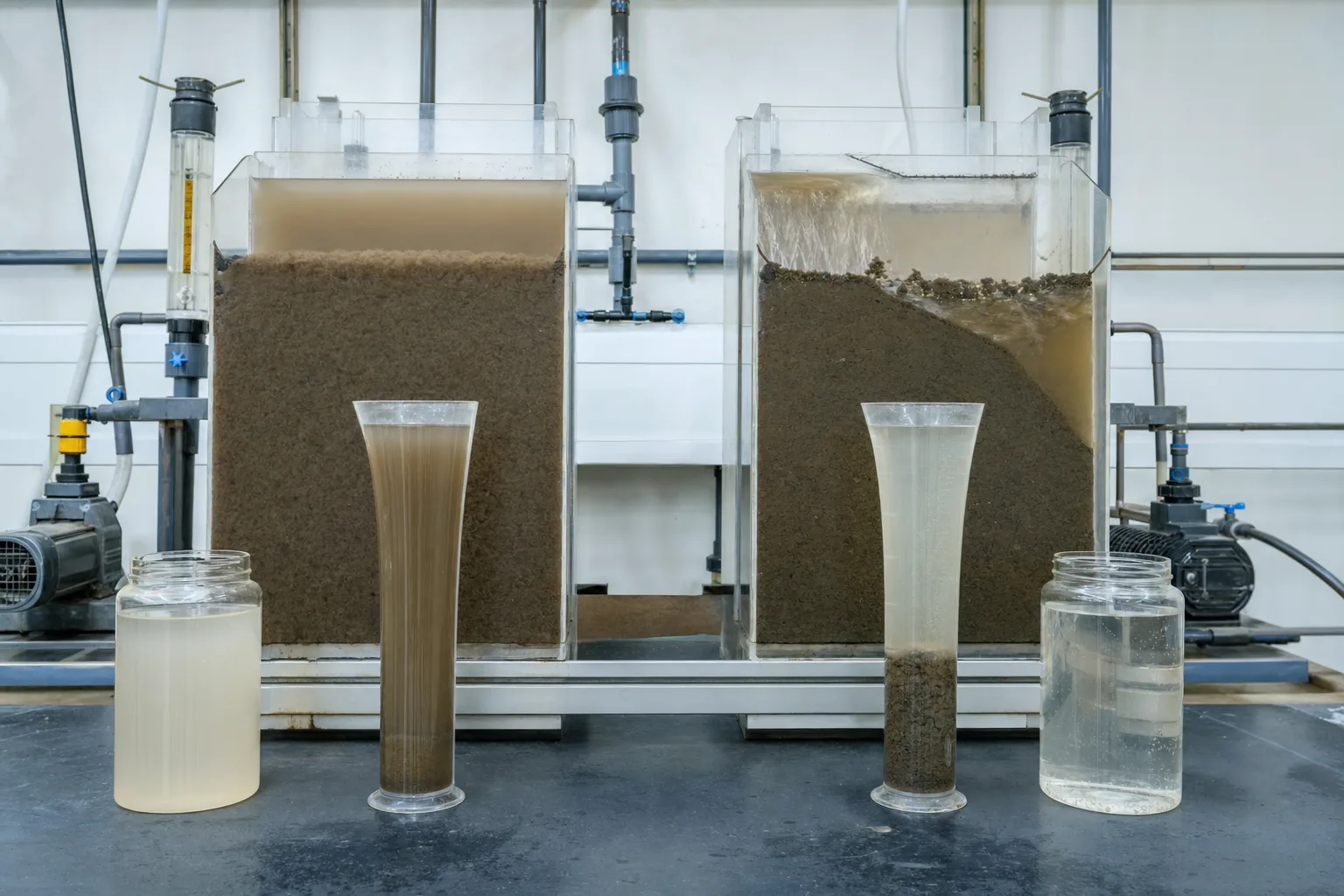 11Bulking: diffuse high blanket22Bulking sample: high SV30/poor compaction33Washout: inlet jet/local plume44Good-settling same-time sample
What to identify
- 1Bulking: diffuse high blanket
- 2Bulking sample: high SV30/poor compaction
- 3Washout: inlet jet/local plume
- 4Good-settling same-time sample
What the image proves
Identical solids-over-weir symptoms can have opposite cylinder evidence.
How to verify it
Sample before/during/after the peak and align Q, Qr, MLSS, blanket and TSS; do not substitute a recovered sample.
Settling cylinders and microscopy distinguish an open filament network from compact floc
A bulky cylinder and filament image contrast with compact settling and dense floc.
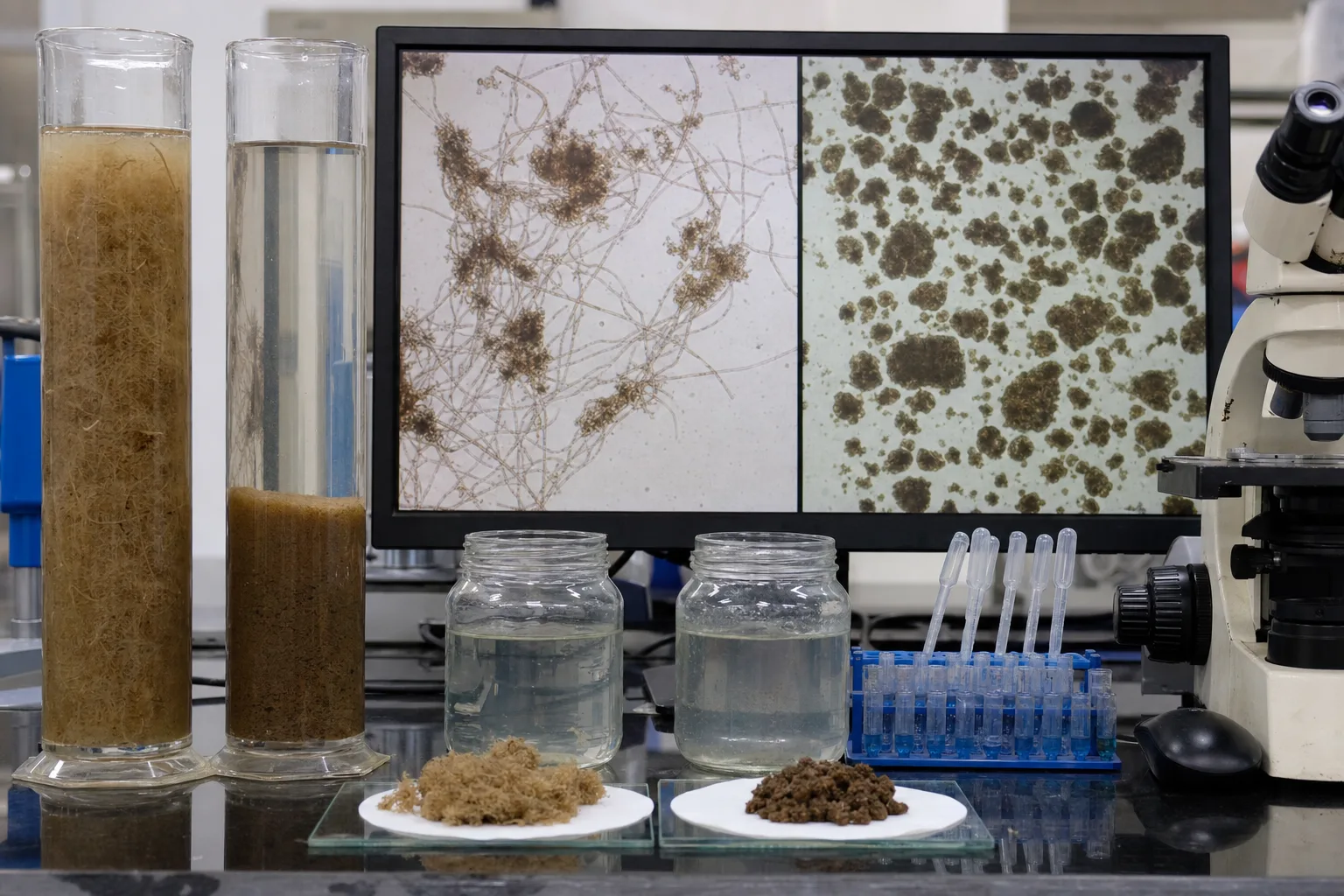 11High-volume loose settled layer22Excess filaments extending from floc33Compact floc and settled layer44Supernatant, floc and morphology samples
What to identify
- 1High-volume loose settled layer
- 2Excess filaments extending from floc
- 3Compact floc and settled layer
- 4Supernatant, floc and morphology samples
What the image proves
High SVI is a settling indicator, not filament identification; ecology is needed for control.
How to verify it
Score filament abundance/location, floc size/density, dispersed cells and biota; use DSVI if high MLSS causes hindered settling.
A hydraulic model shows that good sludge can overflow under inlet energy and excess flux
High inlet flow lifts the blanket toward the weir while the same sludge compacts in a cylinder.
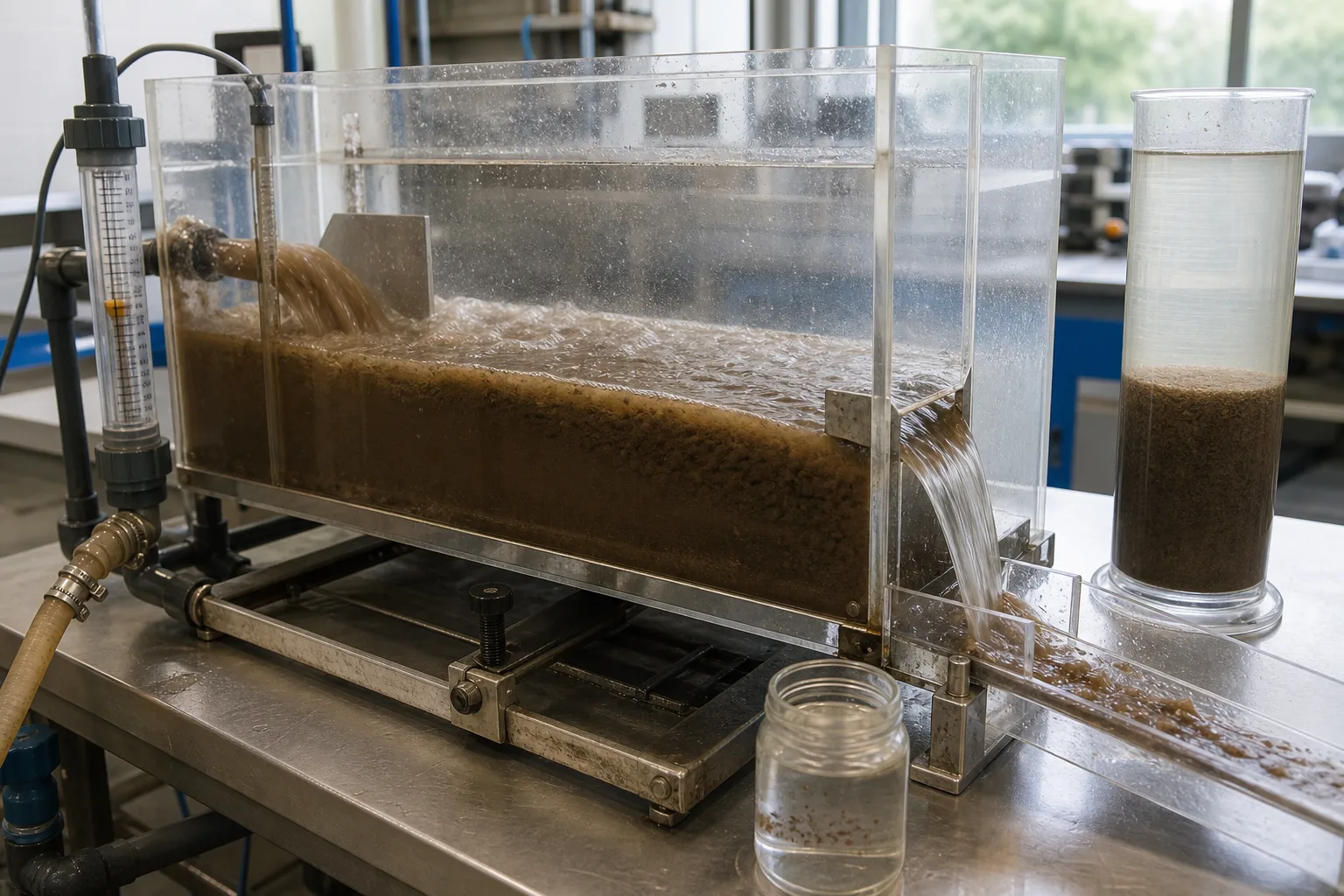 11Peak feed/recycle inlet jet22Feedwell/baffle density current33Lifted blanket and weir plume44Good-settling same-time cylinder
What to identify
- 1Peak feed/recycle inlet jet
- 2Feedwell/baffle density current
- 3Lifted blanket and weir plume
- 4Good-settling same-time cylinder
What the image proves
A clarifier must clarify and thicken; surface load, solids flux, blanket inventory and geometry can exceed capacity.
How to verify it
Compute time-varying per-unit SOR/SLR and inspect splits, blanket profiles, weir TSS and density/short-circuit flow.
Three samples separate bulking, normal settling and denitrification rising sludge
A filamentous bulky cylinder, compact cylinder and gas-lifted clumps are paired with DO/ORP and blanket instruments.
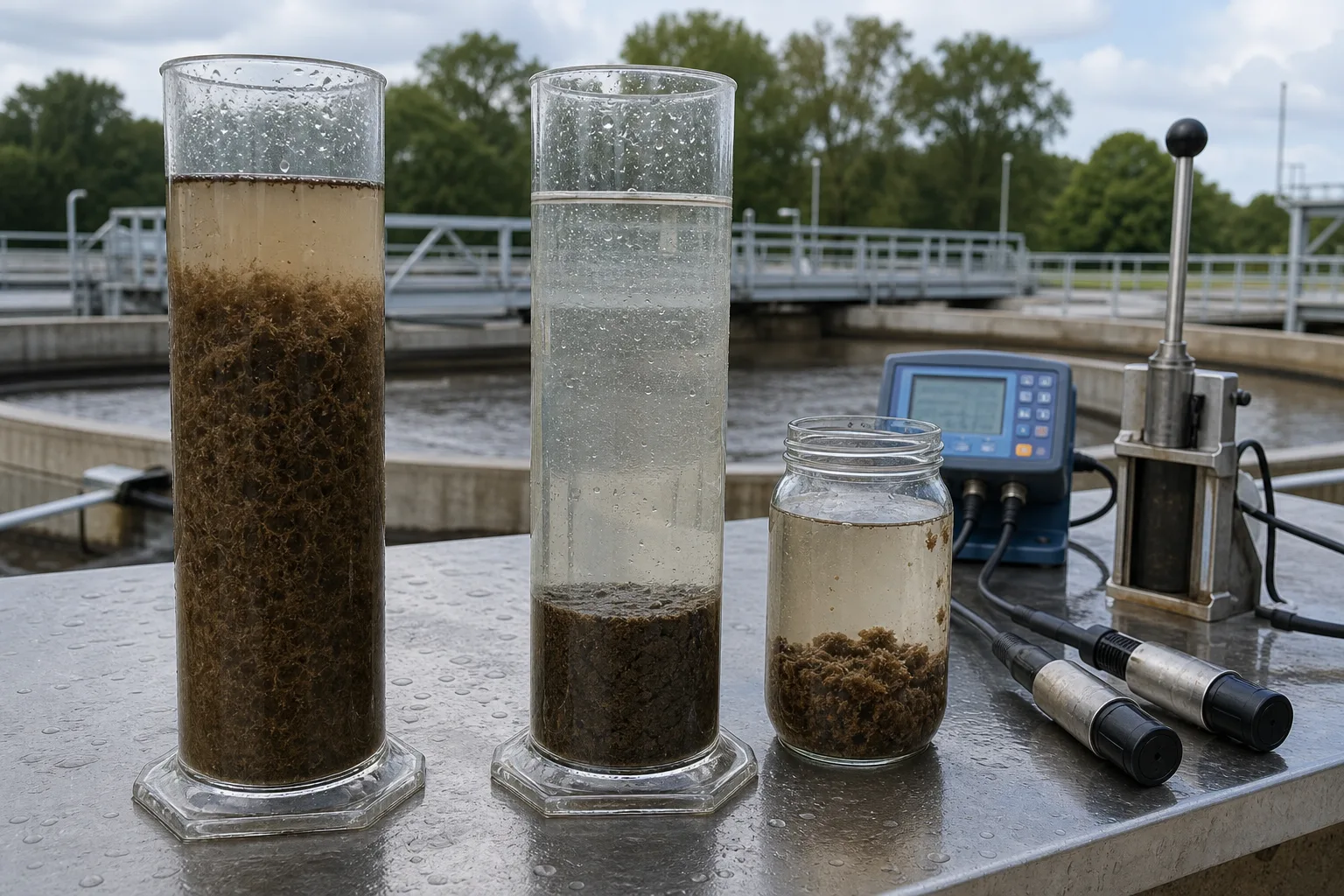 11Bulky high-SVI sample22Normal settling/compaction33N₂-bubble rising sludge clumps44DO/ORP and blanket evidence
What to identify
- 1Bulky high-SVI sample
- 2Normal settling/compaction
- 3N₂-bubble rising sludge clumps
- 4DO/ORP and blanket evidence
What the image proves
Rising sludge first settles, then floats on N₂; it is neither slow-settling bulking nor inlet washout.
How to verify it
Observe 0–120 min, inspect bubbles and NOx/DO/ORP, blanket residence and RAS/hopper performance.
Final diagnosis joins whole-tank hydraulics, blanket, solids tests and microscopy
The feedwell, collector and peripheral weir are linked to settling, MLSS, blanket, probes and microscope evidence.
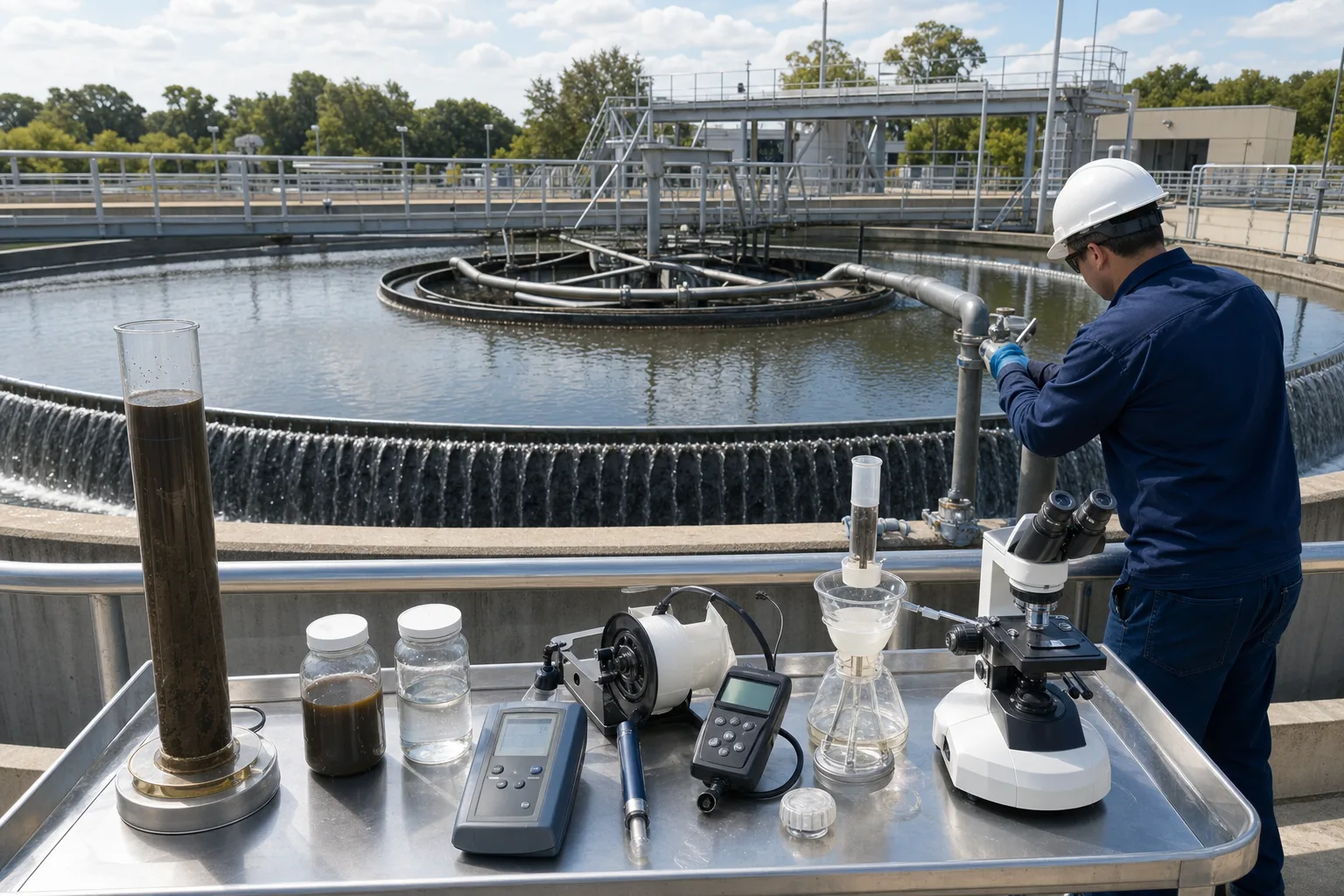 11Feedwell–blanket–peripheral weir hydraulics22Blanket depth and RAS removal33SVI/supernatant/MLSS/effluent TSS44Microscopy, DO/ORP and event trend
What to identify
- 1Feedwell–blanket–peripheral weir hydraulics
- 2Blanket depth and RAS removal
- 3SVI/supernatant/MLSS/effluent TSS
- 4Microscopy, DO/ORP and event trend
What the image proves
A root cause must explain the cylinder, the actual tank, unit-to-unit difference and recovery after correction.
How to verify it
Use a per-unit dashboard and verify one main change through the next peak event.
Nine steps from solids loss to cause
Capture the event, then separate sludge quality from clarifier capacity.
1. Define
Plume/weir TSS/clumps/pin floc
Separate visible failure modes.
2. Time-lock
TSS peak ↔ Q/rain/sidestream/RAS-WAS
Sample during failure.
3. Settle
SV5/10/30 + SVI/DSVI + supernatant
Test intrinsic settling.
4. Microscopy
Filaments + floc/biota
Identify ecological direction.
5. Loads
SOR=Q/A; SLR≈(Q+Qr)X/A
Include flow, recycle and inventory.
6. Per-unit split
Q/Qr/Xr + weir/feedwell/baffle
Find local overload/short circuit.
7. Blanket
Profile + RAS/collector/hopper
Check solids removal and clear zone.
8. Third modes
Settle-then-float + gas/NOx; pin floc
Separate rising sludge/dispersed floc.
9. Correct/verify
Ecology or hydraulics/load → peak retest
Prove TSS, blanket and inventory recovery.
Four solids-loss patterns
Cylinder, field hydraulics and time behavior all matter.
Bulking
- Settle/microscopy
- High SVI/DSVI, slow/poor compaction; often open filament network.
- Field pattern
- Shared high blanket even at normal load; supernatant may be clear.
- Priority
- Correct DO, F:M, SRT, nutrients, septicity/sulfide, selector according to ecology.
Hydraulic/solids washout
- Settle/microscopy
- Cylinder compacts; no biological abnormality sufficient to explain peak.
- Field pattern
- Tracks Q/Qr/MLSS, one unit or local inlet/weir plume.
- Priority
- Balance flow/RAS, add area, equalize peaks, reduce inventory, repair hydraulics/removal.
Denitrification rising sludge
- Settle/microscopy
- Settles, then gas-bearing clumps rise; SVI may be normal.
- Field pattern
- Clumps/ashing after blanket residence with NOx and low DO.
- Priority
- Shorten blanket residence, improve RAS/hopper and manage NOx environment.
Pin/dispersed floc
- Settle/microscopy
- SVI may be low/normal; turbid supernatant and small floc/cells.
- Field pattern
- Fine particulate effluent without wholesale high-blanket overflow.
- Priority
- Check SRT/F:M, shock/toxicity, flocculation and shear.
Allowable solids loading falls as settleability deteriorates. Calculate SVI, MLSS, Qr, area and peak Q for the same window; daily-average flow can hide a short failure.
Keep four synchronized evidence sets
Mixed-liquor quality
MLSS/MLVSS, SV curve, SVI/DSVI, supernatant, microscopy and DO/F:M/SRT/nutrients.
Per-unit loading
Q, online area, Qr/Xr, solids loading, weir loading and peak duration.
Inside clarifier
Blanket profile, feedwell/baffle/weir plume, density current, collector/hopper/RAS and wind.
Effluent/event
Per-unit/total TSS/turbidity, rain/sidestream/valves, NOx/gas and post-change peak result.
First response to four combinations
- Combined signal
- Cylinder slow/high SVI; all units high; excess filaments
- Likely direction
- Biological bulking
- First action
- Identify ecology and DO/F:M/SRT/nutrient/septic cause; avoid blind chlorine
- Combined signal
- Cylinder good; rain peak; one-unit local plume
- Likely direction
- Hydraulic overload/split/short circuit
- First action
- Balance units, add area/equalize and inspect baffle/weir
- Combined signal
- Cylinder good; MLSS, Qr and blanket high; peak SLR excessive
- Likely direction
- Solids-flux/thickening overload
- First action
- Manage inventory and RAS removal while protecting effluent
- Combined signal
- Sample settles then gas-bearing clumps float
- Likely direction
- Denitrification rising sludge
- First action
- Check NOx/ORP and blanket residence; improve RAS/hopper
Four common mistakes
Solids over weir means bulking
Hydraulics, solids flux, rising sludge and pin floc also raise effluent TSS.
Normal SVI means no clarifier problem
Good sludge can be lost by peaks, short circuits, density currents, inventory or mechanics.
More RAS always lowers blanket
Qr also enters solids loading and can increase circulation/upflow; consider Xr and mass balance.
Immediately waste hard or chlorinate
Wrong action can cut SRT, damage floc/nitrification or hide a hydraulic cause.