Illustrated guides · Biological treatment
What happens in the three zones of an A2O process?
A2O connects anaerobic, anoxic and oxic environments with nitrate-rich internal recycle, return sludge and wasting. The zones select PAOs, denitrify nitrate, and remove carbon/nitrify/take up phosphorus as one coupled C-N-P system.
Direct answer
Direct answer
The anaerobic zone has neither DO nor nitrate/nitrite; influent carbon contacts PAOs in RAS, which take up VFA, store PHA and release phosphate. The anoxic zone is unaerated but receives nitrate through internal mixed-liquor recycle, allowing heterotrophs to use remaining carbon for denitrification; DPAOs may also take up phosphorus. The oxic zone removes residual organics, nitrifies ammonia and supports excess phosphorus uptake. Nitrate-rich liquor returns from the aerobic end to the anoxic inlet, RAS returns clarifier biomass to the anaerobic front, and WAS exports solids and phosphorus. Simultaneous N/P removal depends on carbon allocation, DO/NOx leakage, recycle, SRT and solids separation—not zone names alone.
Four boundaries make the zones real
If environment, recycle direction or carbon distribution is wrong, three basins become one poorly controlled system.
The anaerobic zone excludes DO and NOx
Nitrate-rich RAS/recycle or air leakage lets denitrifiers consume VFA before PAOs. No aeration alone does not prove anaerobic conditions.
The anoxic zone receives nitrate and usable carbon
Internal recycle supplies nitrate and influent/stored carbon supplies electrons. Too little recycle bypasses nitrate; too much carries oxygen, dilutes carbon and adds hydraulics.
The oxic zone supports carbon removal, nitrification and P uptake
Residual carbon competes for oxygen; DO, alkalinity, temperature and SRT govern nitrification, while PAOs need PHA stored upstream.
Clarification, RAS and WAS close the solids loop
The clarifier retains organisms, RAS maintains biomass and WAS controls SRT and phosphorus export. Solids loss or gas lift can defeat otherwise good reactions.
From above, A2O is three environments plus two critical recycles
Dark unaerated, mixed anoxic and visibly aerated lanes lead to a clarifier while large lines carry nitrified liquor and sludge.
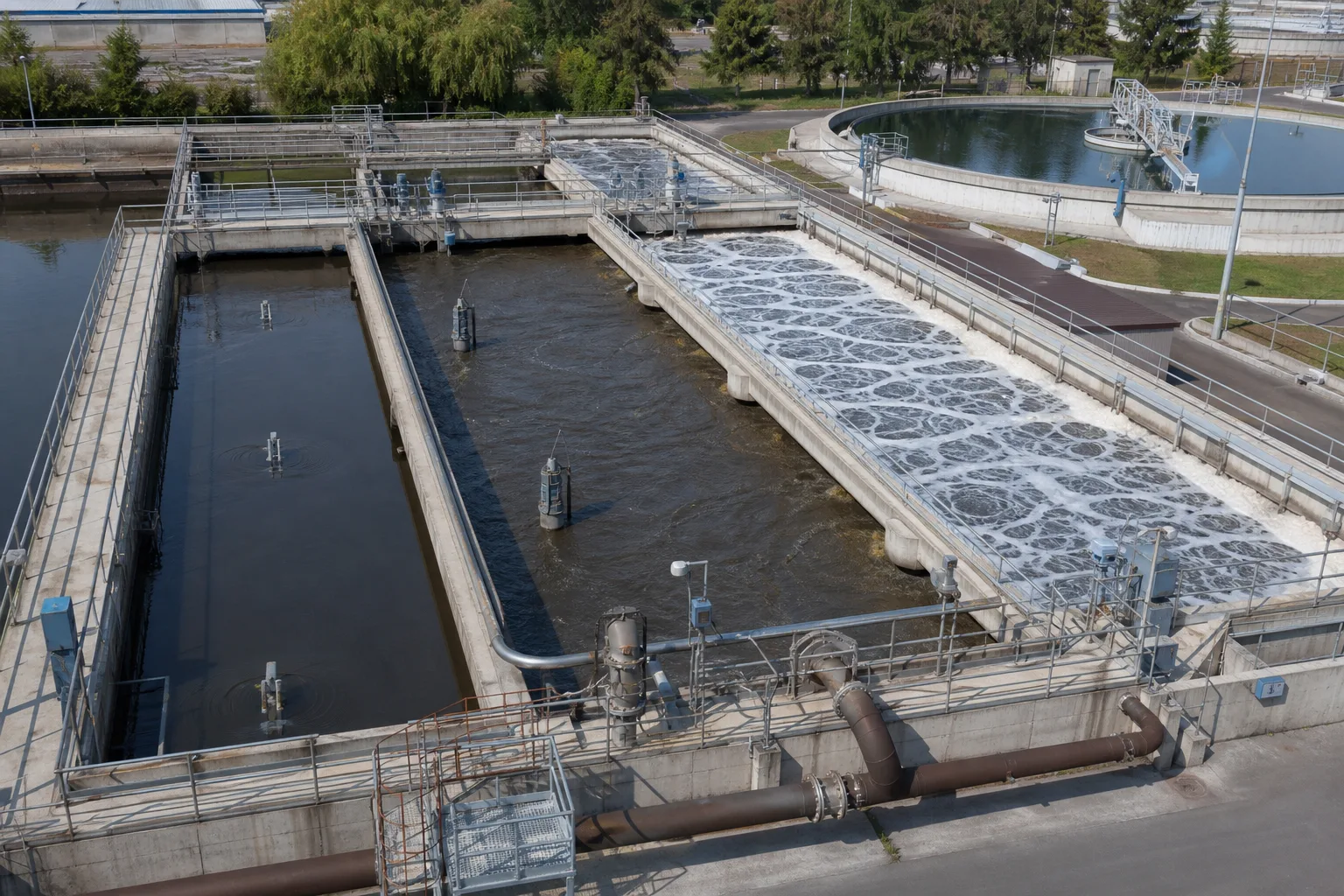 11Front anaerobic selector22Middle anoxic denitrification33Oxic nitrification/P uptake44Clarifier and two recycles
What to identify
- 1Front anaerobic selector
- 2Middle anoxic denitrification
- 3Oxic nitrification/P uptake
- 4Clarifier and two recycles
What the image proves
The tanks are only the shell. Internal recycle sends aerobic nitrate to the anoxic zone; RAS sends biomass to the front. These are different duties, not one generic recycle.
How to verify on site
Map influent, internal recycle, RAS, WAS and overflow, then measure each flow and NH₄/NO₂/NO₃-N, phosphate and DO.
One mixed community changes tasks across three environments
A warm no-acceptor side, middle nitrate/low-oxygen region and cool oxygen-rich side visualize storage, denitrification, nitrification and uptake; colors are explanatory.
 11Anaerobic PAO storage/release22Anoxic denitrifiers33Aerobic heterotrophs/nitrifiers44Aerobic P uptake and oxygen transfer
What to identify
- 1Anaerobic PAO storage/release
- 2Anoxic denitrifiers
- 3Aerobic heterotrophs/nitrifiers
- 4Aerobic P uptake and oxygen transfer
What the image proves
The system does not permanently segregate three fixed communities. Returned sludge experiences changing selection pressures; function follows the actual substrates and acceptors in each zone.
How to verify on site
Combine microscopy/activity tests with zoned VFA, NOx, DO/ORP, ammonia and phosphate; do not identify guilds by floc color.
The cutaway connects reaction zones, settling and both recycles
Influent/RAS enter the unaerated zone, nitrate recycle enters the mechanically mixed anoxic zone, diffusers aerate the oxic zone and the clarifier splits effluent from RAS/WAS.
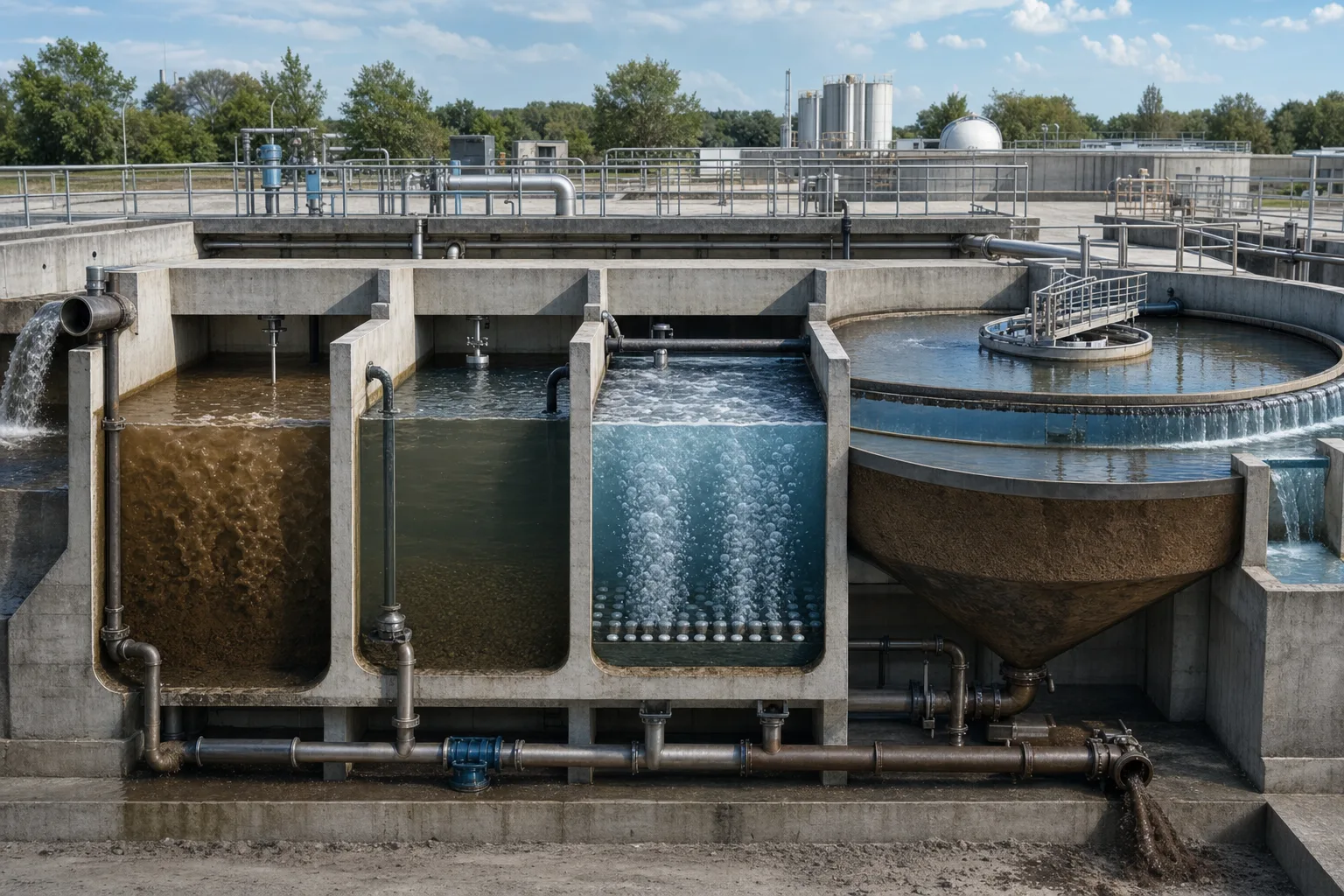 11Influent + RAS anaerobic zone22Internal recycle to anoxic zone33Oxic zone and nitrate outlet44Clarifier/RAS/WAS solids line
What to identify
- 1Influent + RAS anaerobic zone
- 2Internal recycle to anoxic zone
- 3Oxic zone and nitrate outlet
- 4Clarifier/RAS/WAS solids line
What the image proves
Carbon moves forward for PAO selection and denitrification while nitrate is returned backward from the aerobic end. A2O is organized by these opposing material paths.
How to verify on site
Build flow-weighted C/N/P balances, verify recycle ratios, effective volume, mixing/aeration coverage and short circuiting with profiles or tracing.
Carbon, recycle and acceptor leakage create different results
Parallel transparent A2O pilot trains with independent zones and probes compare carbon limitation, balanced operation and oxygen/nitrate intrusion.
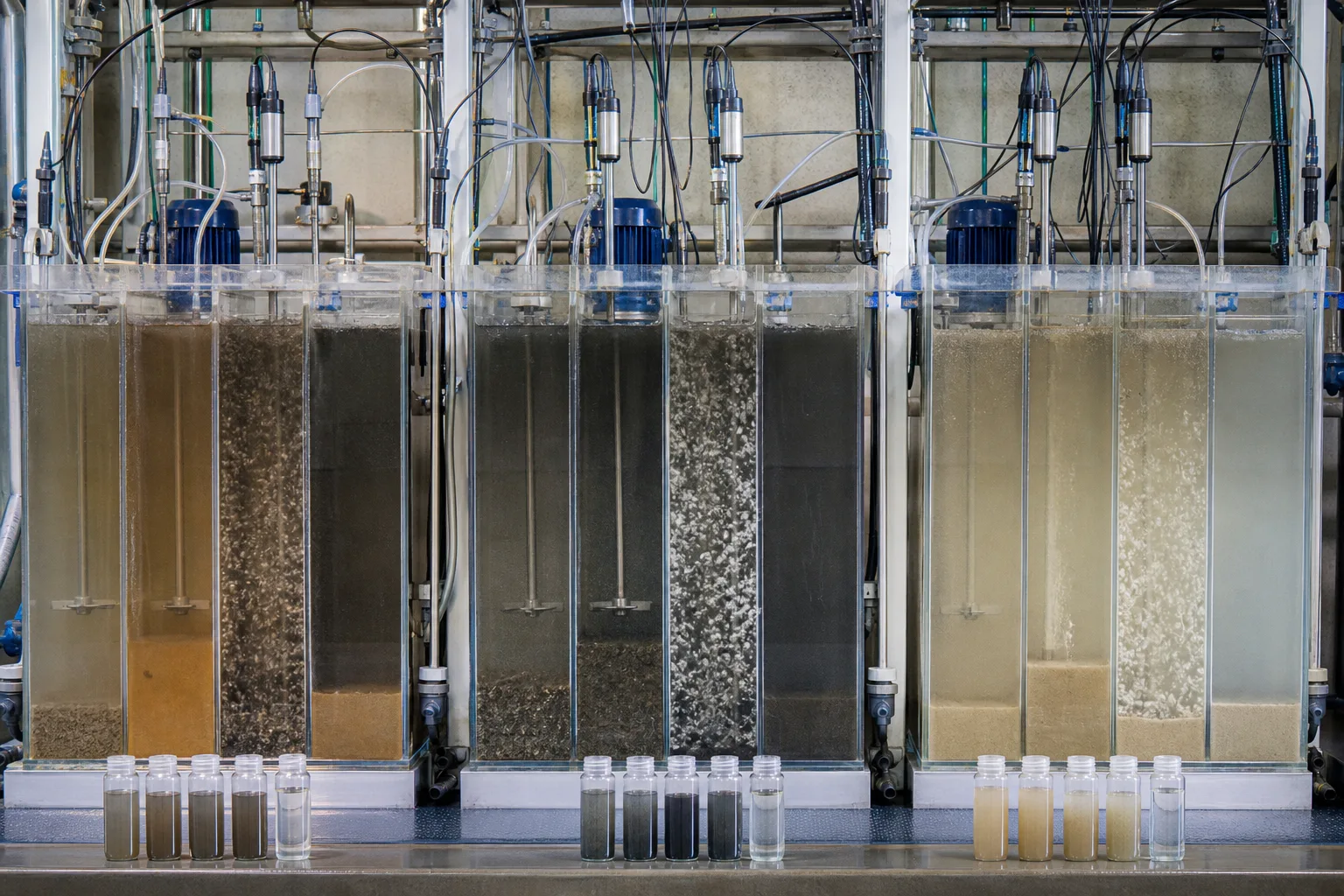 11Carbon-limited N/P removal22Balanced carbon and recycle33DO/NOx cross-zone intrusion44Zoned probes and samples
What to identify
- 1Carbon-limited N/P removal
- 2Balanced carbon and recycle
- 3DO/NOx cross-zone intrusion
- 4Zoned probes and samples
What the image proves
Higher internal recycle can reduce bypassed nitrate but carry more oxygen; using more carbon for denitrification can reduce VFA available to PAOs. Multiple targets require a plant-wide tradeoff.
How to verify on site
Compare influent rbCOD/VFA, recycle/RAS, zoned DO/ORP/NOx/phosphate, terminal ammonia/TN/TP and energy at the same time.
Diagnosis aligns three-zone samples, recycle data and sludge evidence
Samples, DO/ORP/pH probes, settling columns and microscopy sit against the three-zone train, linking environment, reaction and separation.
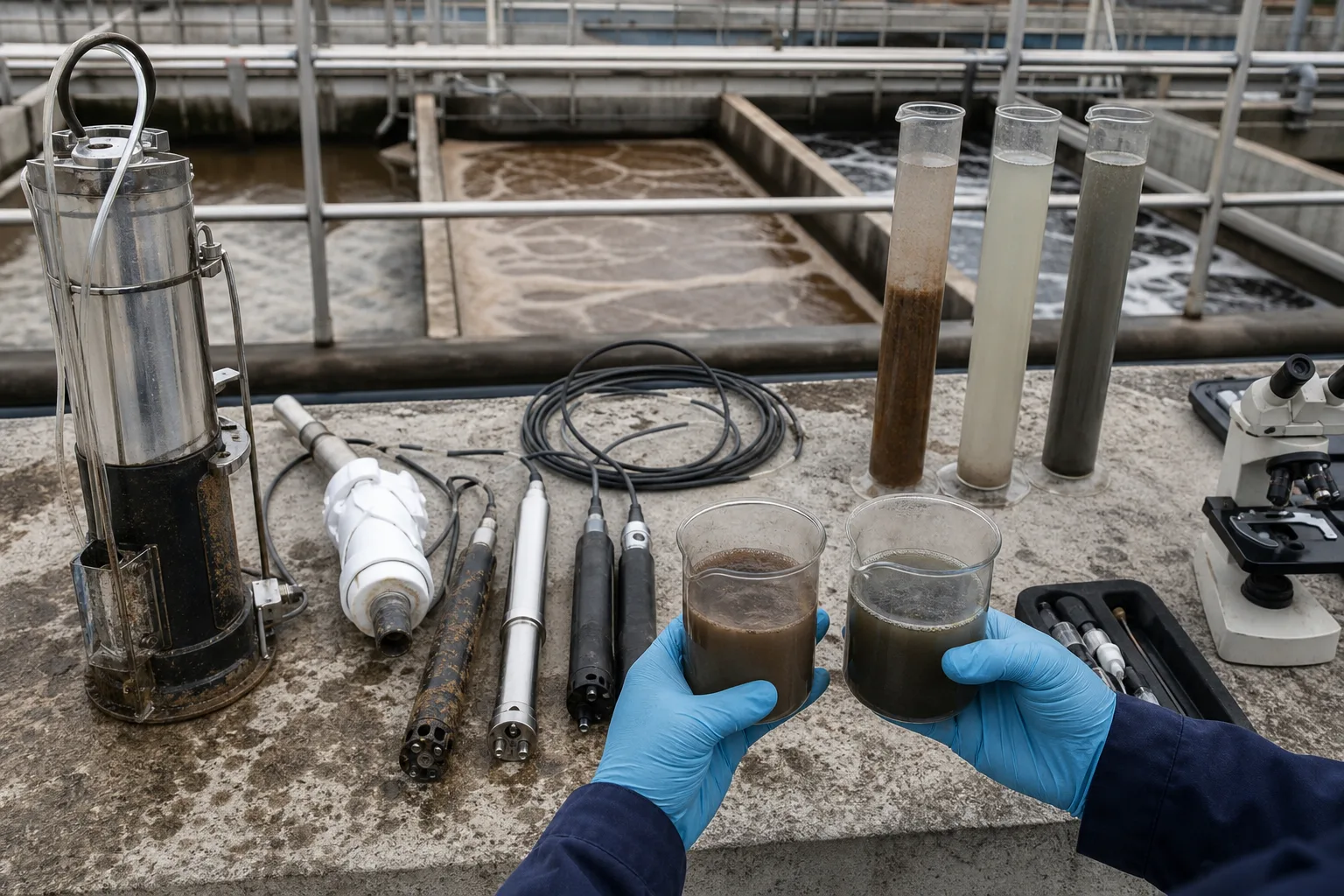 11Anaerobic/anoxic/oxic samples22Internal recycle and RAS flow33DO/ORP/pH and N/P tests44Settling, blanket and microscopy
What to identify
- 1Anaerobic/anoxic/oxic samples
- 2Internal recycle and RAS flow
- 3DO/ORP/pH and N/P tests
- 4Settling, blanket and microscopy
What the image proves
High TN and TP can come from different causes: carbon, recycle, nitrification, release/uptake or solids loss leave distinct zoned signatures. Effluent alone cannot localize them.
How to verify on site
Align zoned profiles, measured recycle, MLSS/SRT, SVI/blanket, effluent TSS/TN/TP and operating events within one shift.
Six handoffs through A2O
Follow carbon, nitrogen, phosphorus and solids together.
1 Influent and RAS enter anaerobic
VFA/rbCOD + PAO; no DO/NOx
Select PAOs, store carbon and release phosphate.
2 Flow enters anoxic
Remaining carbon + recycled NO₃-N
Denitrify to N₂ and allow some anoxic P uptake.
3 Flow enters oxic
Residual BOD + NH₄-N + O₂
Remove organics, nitrify and take up excess phosphorus.
4 Internal recycle returns
Aerobic-end NO₃-N → anoxic inlet
Bring nitrification product to carbon and low DO.
5 Clarification and RAS
Mixed liquor → effluent + return sludge
Separate water and return functional biomass.
6 WAS exports solids and P
Waste sludge → solids handling
Control SRT and remove biomass/phosphorus.
Responsibilities of zones and recycle lines
Functions overlap, but each element has distinct inputs, outputs and evidence.
Anaerobic zone
- Main duty
- PAO VFA uptake, PHA storage and phosphate release
- Typical imbalance
- DO/NOx intrusion or low VFA defeats selection
- Field evidence
- DO/ORP/NOx, VFA and phosphate-release curve
Anoxic zone
- Main duty
- Denitrification with recycled NOx and carbon; possible DPAO uptake
- Typical imbalance
- Recycle/oxygen/carbon/hydraulic mismatch leaves nitrate
- Field evidence
- Recycle load, zoned NOx, DO/ORP and rate tests
Oxic zone
- Main duty
- BOD removal, nitrification, excess P uptake and nitrate production
- Typical imbalance
- Low DO/alkalinity/SRT/temperature or shock leaves ammonia/phosphate
- Field evidence
- DO, N species, phosphate, SRT and OUR profiles
Internal recycle, RAS and WAS
- Main duty
- Move nitrate, retain biomass and export solids/P respectively
- Typical imbalance
- Wrong route/ratio, pump failure or high blanket breaks boundaries
- Field evidence
- Measured flow/load, blanket, MLSS and solids balance
Real plants use step feed, multiple anoxic zones, pre/post-anoxic stages, recycle-point changes and chemical-P backup. Identify A2O by its anaerobic-anoxic-oxic functions and material paths, not an exact basin count.
Track three evidence groups
Zoned environment
DO/ORP, nitrate/nitrite, VFA/rbCOD, phosphate, pH/alkalinity and temperature in all zones.
Recycle and solids
Measured internal recycle, RAS/WAS flow/concentration, MLSS/MLVSS, SRT, blanket and SVI.
Whole-process outcomes
Influent/effluent and zoned COD/BOD, N species, TN, phosphate, TP, TSS, aeration and pumping energy.
How do common signals map to zones?
- Signal combination
- No anaerobic phosphate rise with measurable nitrate or DO
- First suspicion
- RAS/recycle/air carries acceptors into the anaerobic zone
- Next action
- Locate recycle discharge and oxygen/NOx load, restore true anaerobic conditions, then reassess PAOs
- Signal combination
- Low aerobic ammonia but high effluent nitrate/TN
- First suspicion
- Nitrification works; anoxic carbon, recycle or effective volume limits denitrification
- Next action
- Check nitrate recycle load, anoxic DO/ORP, rbCOD/VFA and profiles; do not blindly raise recycle
- Signal combination
- High aerobic ammonia with low nitrate
- First suspicion
- Nitrification limited by SRT, DO, temperature, alkalinity, toxicity or washout
- Next action
- Restore nitrifier conditions and biomass; anoxic recycle cannot solve TN without nitrate production
- Signal combination
- Soluble N/P reasonable but effluent TN/TP/TSS rise together
- First suspicion
- Clarifier solids loss, denitrification lift or hydraulic shock
- Next action
- Check blanket, RAS/WAS, SVI, surface loading and microscopy; separate reaction from separation
Four misconceptions
A2O is simply three tanks in series
Without correct DO/NOx boundaries, internal recycle, RAS and wasting, similar-looking tanks do not perform A2O.
More internal recycle always lowers TN
Excess recycle carries oxygen, dilutes carbon and raises hydraulic/energy load; match it to nitrate load and anoxic capacity.
Anaerobic and anoxic mean the same thing
Anaerobic has neither DO nor NOx; anoxic has low DO but needs NOx as an electron acceptor.
The zones separately handle P, N and COD
C, N and P remain coupled: the aerobic zone nitrifies and takes up P, the anoxic zone consumes carbon, and anaerobic selection sets later P removal.