Illustrated guides · Biological treatment
What is the difference between COD and BOD?
Both report an oxygen-equivalent demand, but COD uses a specified chemical oxidant and digestion, whereas BOD measures dissolved oxygen consumed biologically under specified time, temperature and incubation conditions.
Direct answer
Direct answer
COD is a chemically determined oxygen equivalent. In dichromate methods such as EPA 410.4, a sample is digested under strong acidic, heated conditions and the result is converted to mg/L as O₂. It includes many chemically oxidizable organics and may include contributions from some reducing inorganics. BOD₅ is calculated from dissolved oxygen loss in a sample or dilution incubated in the dark at 20°C for five days, with dilution, seed and blank corrections. It describes oxygen demand actually exerted by the test microorganisms under those conditions. COD is faster and broader; BOD₅ is closer to biodegradability but is sensitive to seed, toxicity, nitrification, dilution and incubation quality. A fixed conversion is not valid; BOD₅/COD is useful only as a local trend built from reliable paired data for the same wastewater and methods.
Four boundaries to separate first
The same unit does not mean the same measurand, reaction time or error source.
Oxygen equivalent, not the oxygen already in the water
COD consumes chemical oxidant and converts it to oxygen equivalent; BOD measures the decrease in dissolved oxygen during incubation.
Chemically oxidizable is not biologically degradable
COD includes readily and slowly degradable material plus some reducing inorganics; BOD₅ captures demand exerted by microbes within five days.
BOD₅ may include nitrification
Without inhibition, ammonia oxidation adds nitrogenous demand. CBOD₅ uses a nitrification inhibitor to focus more closely on carbonaceous demand.
The ratio is local, not a universal conversion
Waste type, solids, industrial toxicity, seed, chloride and method details change the relationship. Another plant's factor is not transferable.
One laboratory, two different analytical chains
Representative samples sit at left, digestion/photometry equipment is in front, and the incubator plus amber BOD bottles are at right; the plant outside is where results return to process decisions.
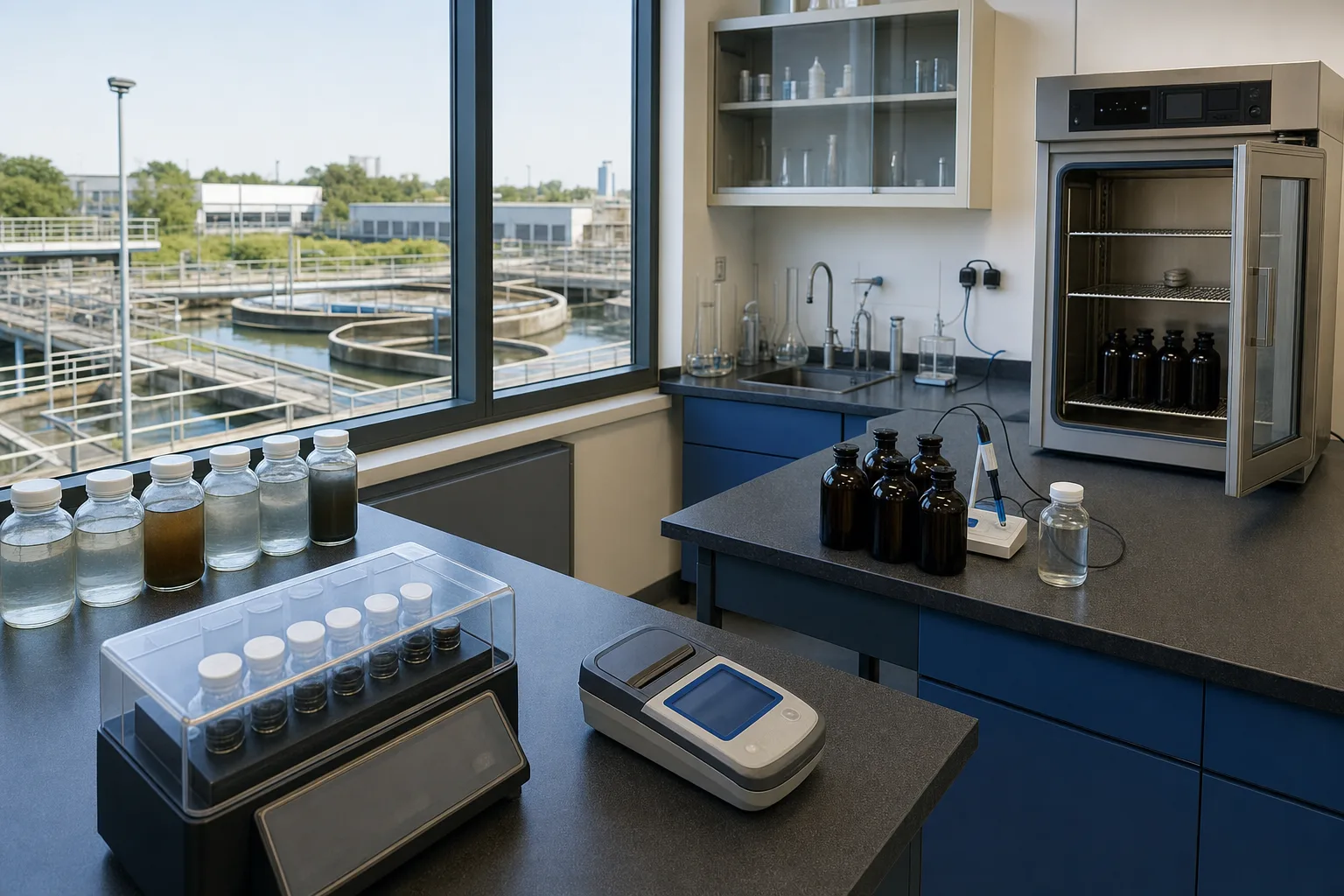 11Representative plant samples22COD digestion and photometry33BOD temperature-controlled incubator44Amber BOD bottles
What to identify
- 1Representative plant samples
- 2COD digestion and photometry
- 3BOD temperature-controlled incubator
- 4Amber BOD bottles
What the image proves
The same sampling event can feed both tests, but aliquoting, preservation, preparation, reaction and QC differ. Two instruments do not create a conversion factor.
How to verify on site
Match point, time, mixing and preservation; confirm method number, filtered or total sample, COD range, BOD₅ versus CBOD₅, dilution and seed.
Chemical oxidation and microbial respiration see different boundaries
The left vessel represents chemical oxidant reacting with oxidizable matter; the larger right vessel shows flocs and biomass using only substrates available to the microbial community.
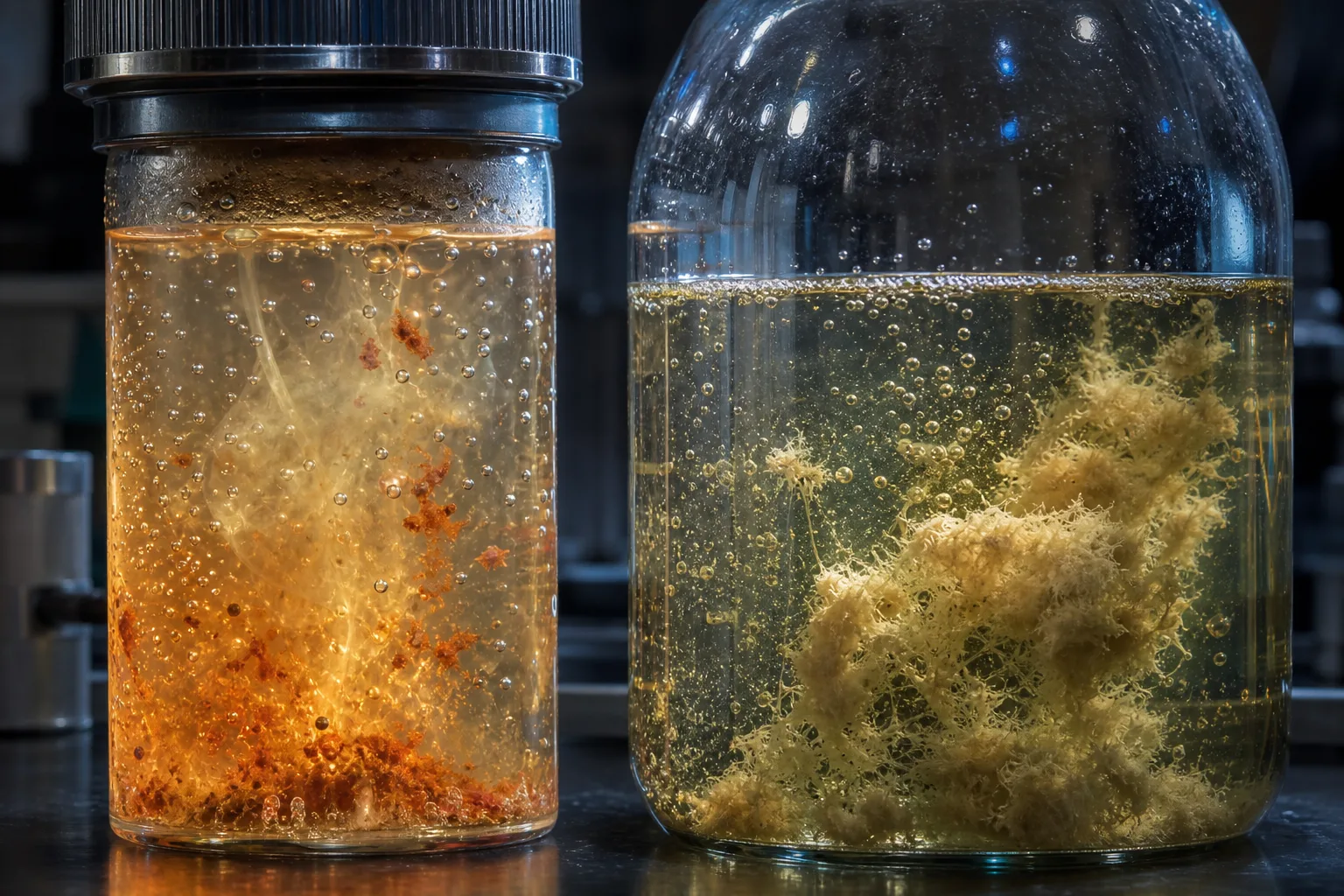 11Chemical oxidation liquor22Chemically oxidizable matter33Microbial floc or seed44Bioavailable substrate
What to identify
- 1Chemical oxidation liquor
- 2Chemically oxidizable matter
- 3Microbial floc or seed
- 4Bioavailable substrate
What the image proves
COD asks how much oxidizes under specified chemistry. BOD₅ asks how much oxygen this microbial test consumes in five days. Refractory matter can enter COD but not fully appear in BOD₅.
How to verify on site
When COD is high and BOD₅ low, check toxicity, seed activity and dilution QC before assigning the difference to refractory organics.
The two workflows have different control points
The analyst prepares mixing, dilution and DO work at left; COD digestion and photometry are centered; grouped BOD bottles are held in a dark constant-temperature incubator at right.
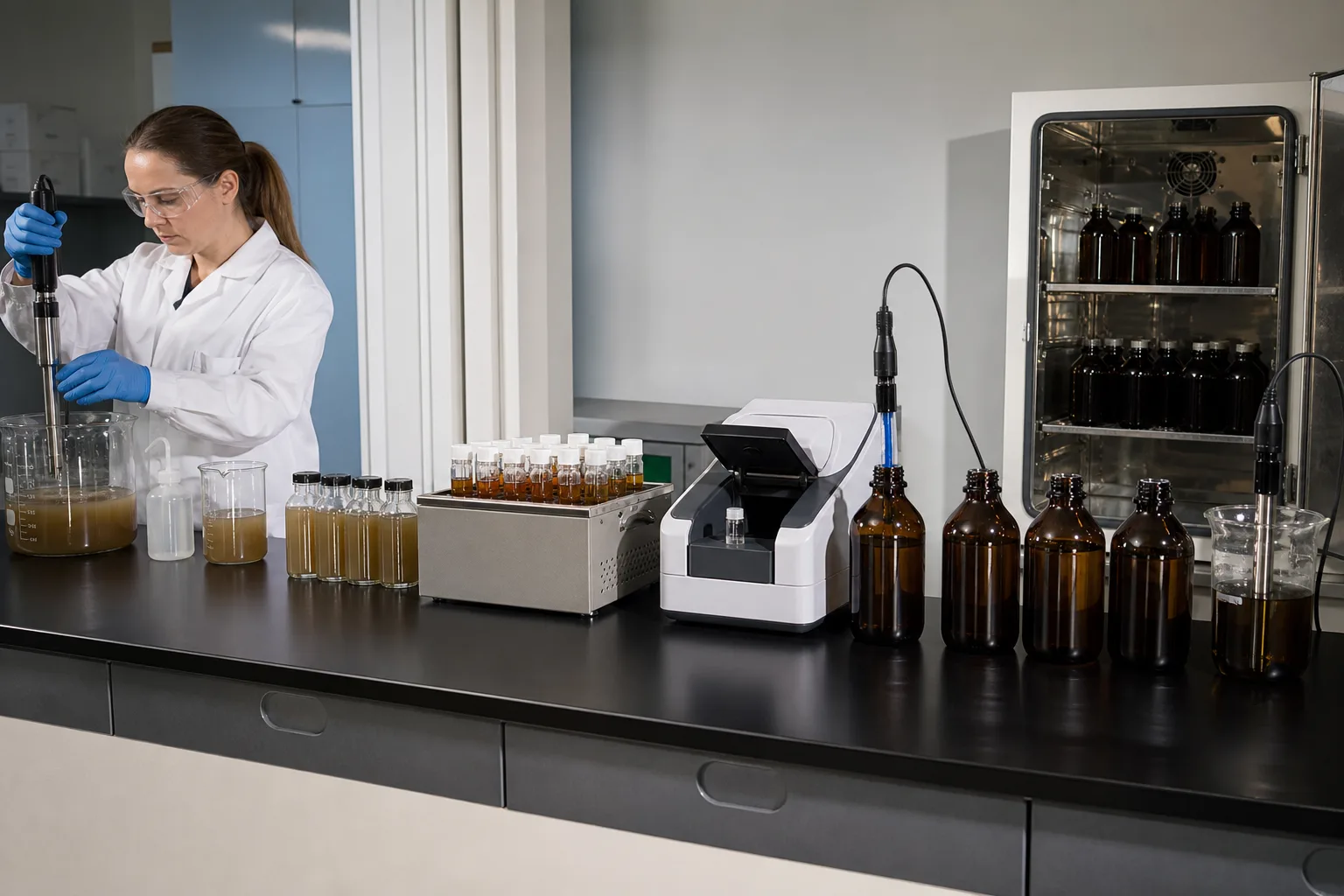 11Mixing, dilution and seeding22COD heated digestion block33COD photometric measurement44BOD dark bottle incubation
What to identify
- 1Mixing, dilution and seeding
- 2COD heated digestion block
- 3COD photometric measurement
- 4BOD dark bottle incubation
What the image proves
COD risk centers on digestion, range, blanks and chloride/color interference. BOD risk centers on initial/final DO, dilution, seed, blank, temperature, time, toxicity and nitrification.
How to verify on site
For COD review blanks, standards, digestion and range. For BOD review dilution-water blank, seed correction, initial/final DO and method acceptance limits.
BOD comes from bottle differences and corrections, not one instant probe reading
Three closed-bottle groups represent samples or dilution levels from turbid to dark to clear. Each needs initial DO and endpoint DO after five days at 20°C in darkness.
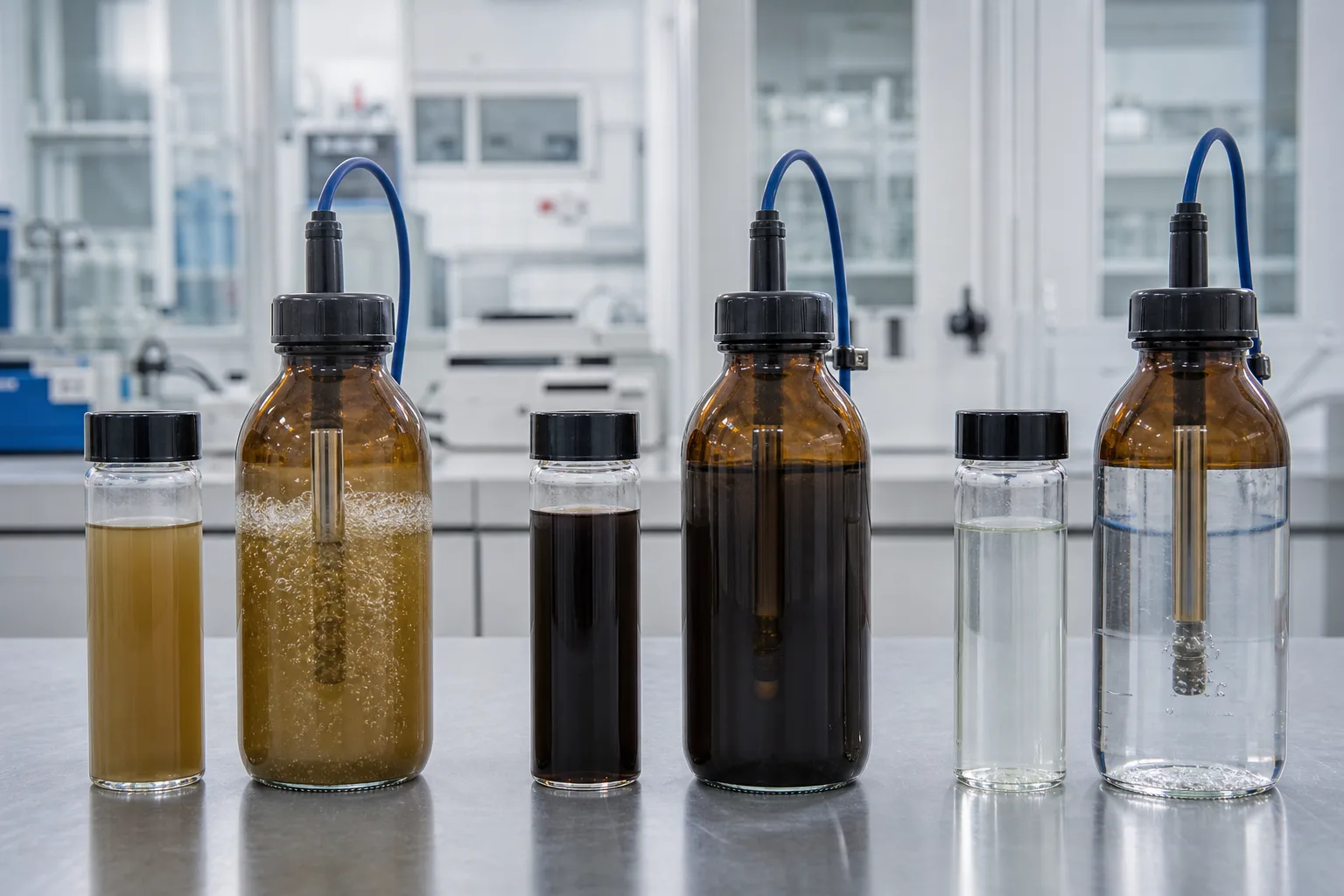 11Sample and dilution series22Initial DO reading3320°C dark incubation44Final DO and blank correction
What to identify
- 1Sample and dilution series
- 2Initial DO reading
- 320°C dark incubation
- 4Final DO and blank correction
What the image proves
A bottle that depletes all oxygen, or produces almost no measurable loss, cannot yield reliable BOD. Color itself does not determine BOD; the validated DO difference does.
How to verify on site
Prepare several dilutions for unknown samples; record seed and dilution-water blank, verify temperature and darkness, exclude bubbles and use only acceptable bottles.
Sample heterogeneity and interference can dominate the result
The bench shows suspended solids, algal biomass, settled material, clear and dark samples plus replicates—differences that affect representative aliquots, reactions and readings.
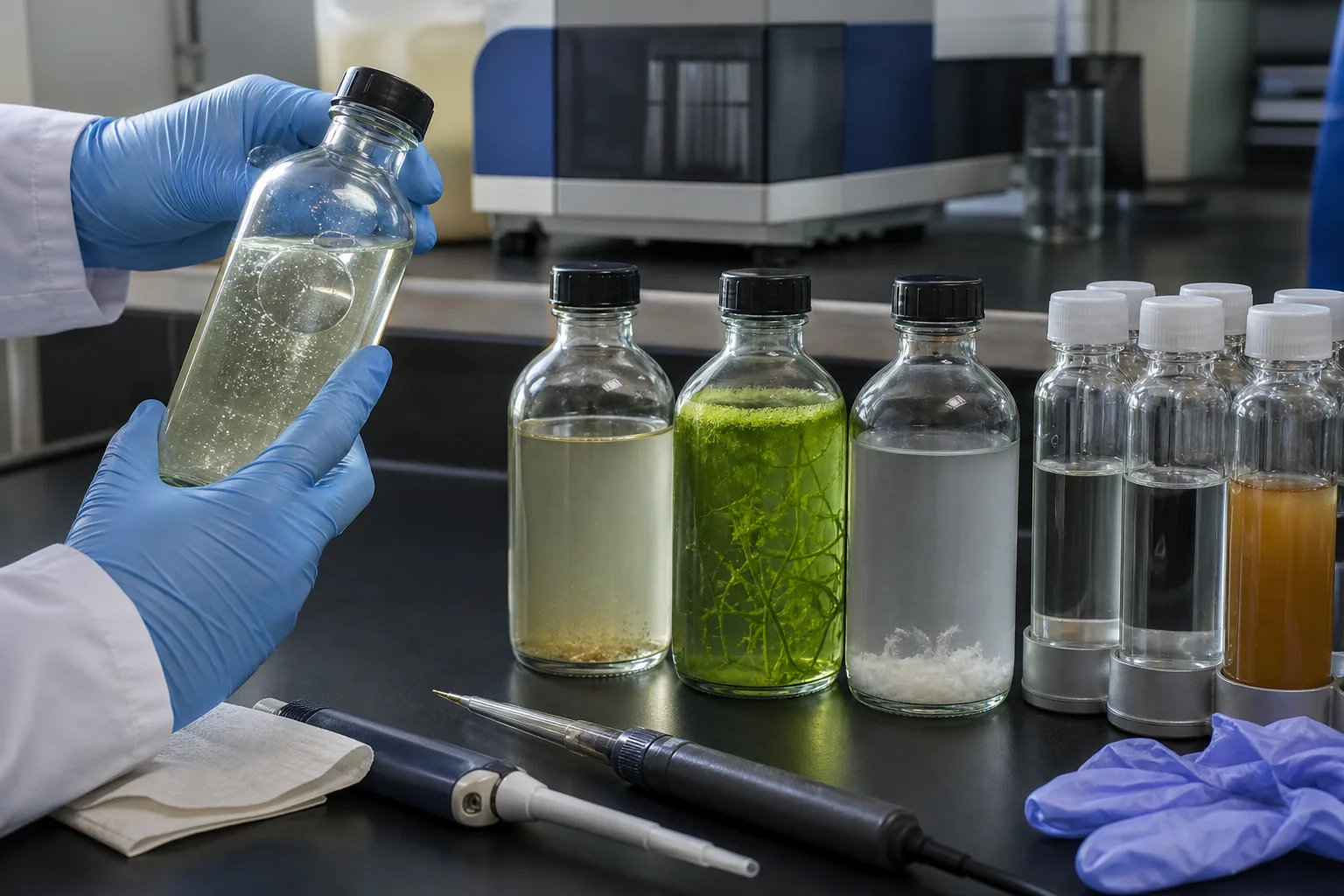 11Suspended-solids sample22Algal or biomass sample33Settled and layered sample44Color, blanks and replicates
What to identify
- 1Suspended-solids sample
- 2Algal or biomass sample
- 3Settled and layered sample
- 4Color, blanks and replicates
What the image proves
Both tests amplify errors when different fractions are subsampled. COD also faces reducing inorganic, chloride and optical effects; BOD faces toxicity, weak seed and nitrification.
How to verify on site
Mix and split promptly as required, run blanks, standards/spikes and replicates, and verify method applicability for saline, colored, disinfected or industrial samples.
How one sampling event yields two comparable results
Paired interpretation starts only after both analytical chains pass QC.
1 Representative sample
Same point/time → mix and preserve
Reduce bias from settling, continuing reactions and separate batches.
2 Split and set QC
COD + BOD aliquots + blanks/standards/replicates
Meet the independent requirements of digestion and incubation.
3 COD digestion
Sample + dichromate/acid → specified heat and time
Translate chemically oxidizable load into oxidant consumption.
4 COD quantitation
Digest → colorimetry/titration → mg/L O₂
Apply blank, standard and range controls.
5 BOD₅ incubation
Dilution/seed/DO₀ → 20°C dark 5 d → DO₅
Measure biological dissolved-oxygen loss under defined conditions.
6 Joint interpretation
COD, BOD₅/CBOD₅ + flow → concentration, removal and load
Track process change and build a local paired relationship.
Four indicators that are often conflated
Similar names or units do not make them substitutes.
COD
- What it measures
- Chemically oxidizable matter under the specified method, as oxygen equivalent
- Time and boundary
- Usually hours; broad coverage with reducing-inorganic and chloride interference possible
- Use and limitation
- Fast total oxidizable-load trend; not equal to biodegradable organic matter
BOD₅
- What it measures
- Dissolved oxygen consumed by microbes over five days
- Time and boundary
- 20°C dark incubation; may include carbonaceous and nitrogenous demand; seed/toxicity sensitive
- Use and limitation
- Biological oxygen load and treatment performance; slow and biologically variable
CBOD₅
- What it measures
- Five-day demand with nitrification inhibited to emphasize carbonaceous demand
- Time and boundary
- Reduces the ammonia-nitrification contribution but retains BOD test constraints
- Use and limitation
- Separates carbonaceous load where permits or process analysis require it
TOC or rapid surrogate
- What it measures
- TOC measures organic carbon; optical/sensor surrogates measure their own response
- Time and boundary
- Faster and continuous, but different chemistry and response window
- Use and limitation
- Can predict trends after local paired calibration; not a legal COD/BOD substitute by assumption
For the same sample COD is commonly higher than BOD₅ because its oxidation boundary is broader, but this is not a universal mathematical law. An unusual relationship first triggers checks of sampling, range, blanks, dilution, seed, toxicity, nitrification and interference.
Retain three evidence sets
Method and QC
Record method, total/filtered basis, COD range and digestion batch, BOD₅ or CBOD₅, dilutions, seed, blanks, standards/spikes and replicates.
Paired influent/effluent and flow
Align sampling with hydraulic residence time and use flow for mass load; concentration alone can improve by dilution.
Long-term paired trend
Build COD-BOD pairs for the same wastewater by season, operation and source. Use for warning or estimation only after a stable local relationship is demonstrated.
How to read common combinations
- Data combination
- COD and BOD₅ both rise
- Possible meaning
- Total oxidizable and biologically exerted loads both increased
- Priority check
- Calculate mass load with flow and check production discharge, bypass and sampling time
- Data combination
- COD is high while BOD₅/COD falls
- Possible meaning
- More slow/refractory matter, or toxicity, weak seed or failed BOD QC
- Priority check
- Validate BOD dilution/seed/blank and toxicity before treatability conclusions
- Data combination
- The gap between BOD₅ and CBOD₅ widens
- Possible meaning
- A larger nitrification oxygen demand or changing ammonia conditions
- Priority check
- Check ammonia, inhibitor, incubation and seed; separate carbonaceous and nitrogenous demand
- Data combination
- COD falls quickly while BOD₅ changes little
- Possible meaning
- Coagulation/adsorption removed one COD fraction, or sample/QC timing differs
- Priority check
- Align sampling, dissolved/particulate fractions and flow; verify biological load truly changed
Four misconceptions
COD is the total amount of organics
COD is oxidant consumption under a method, not a species inventory; some reducing inorganics contribute.
BOD is a bacterial count
BOD is oxygen demand during incubation, not colony count; substrate, seed and conditions all matter.
BOD equals COD times a fixed factor
The relationship changes with source, process, season and method and must come from local paired data.
A lower concentration always means better treatment
With higher flow or mismatched sampling, lower mg/L may only be dilution; use load, removal, operation and QC.