Illustrated guides · Biological treatment
How do microorganisms clean wastewater?
Activated sludge does not make pollutants vanish. It couples mass transfer, enzymatic hydrolysis, metabolism, biomass synthesis and solids separation: part of the carbon becomes carbon dioxide and water, part becomes new biomass, and settling plus sludge return/wasting separates that biomass from the treated water.
Direct answer
Direct answer
Microorganisms clean wastewater by transforming soluble and hydrolysable organic matter. Influent mixed with return activated sludge brings colloids and particles into flocs for capture and hydrolysis; soluble substrate diffuses into cells, where heterotrophs use one fraction for respiration and energy and another to synthesize cells and extracellular polymer. Aerobic treatment requires adequate oxygen, mixing, nutrients and contact time. The pollution has destinations: carbon becomes CO₂, waste sludge and a residual in the effluent. The secondary clarifier retains settleable floc, return sludge maintains biomass, and waste sludge controls solids retention time. Air alone cannot compensate for unsuitable loading, SRT, pH/temperature, settling or return-sludge control.
Four conditions must hold together
Biological reaction and solids separation are one system; failure of either degrades effluent.
Substrate must contact and become available
Readily biodegradable solutes enter cells quickly. Colloids, particles and macromolecules must first be captured and hydrolysed. Refractory or toxic material does not disappear just because air is added.
The community needs activity and adequate SRT
Temperature, pH, nutrients, toxicity and solids retention shape the community. Fast heterotrophs and slow nitrifiers require different SRT margins.
Electron acceptor, mixing and transfer must match
Aerobic carbon removal and nitrification need oxygen; denitrification needs nitrate and low DO. Aeration supplies oxygen and mixing, but more is not automatically better.
New biomass must be retained and removed
Clarification, return activated sludge and waste sludge set biomass and SRT. Poor settling or hydraulic washout loses solids even when reactions occur.
An aeration basin supplies oxygen and mixing, not cleaning bubbles
Rows of bubbles turn over mixed liquor, online probes and air piping line the basin, and secondary clarifiers are visible downstream—one continuous reaction and sludge-recycle system.
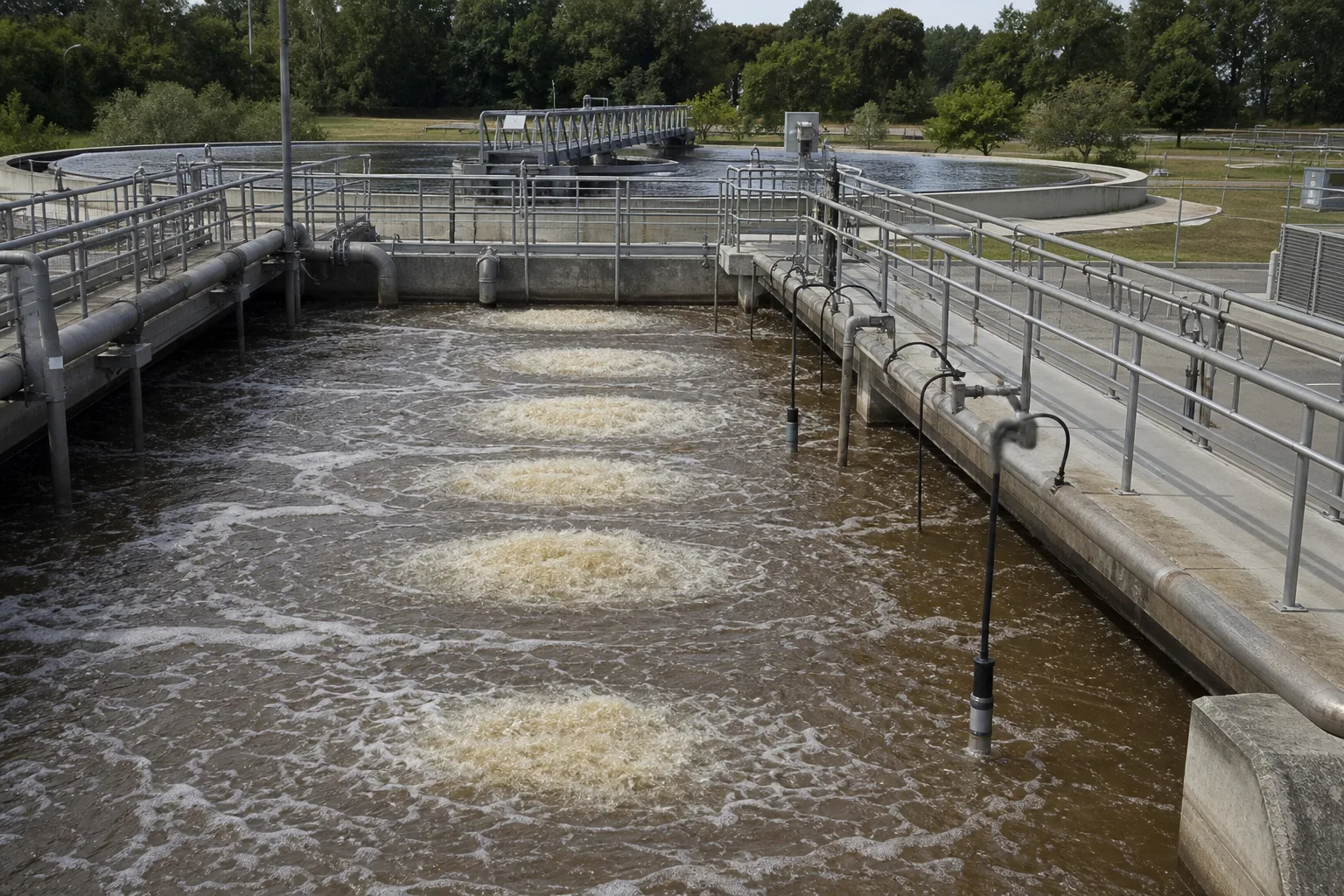 11Influent and return-sludge mixing22Aeration bubbles and mixed liquor33DO and process probes44Downstream secondary clarifier
What to identify
- 1Influent and return-sludge mixing
- 2Aeration bubbles and mixed liquor
- 3DO and process probes
- 4Downstream secondary clarifier
What the image proves
Bubbles transfer oxygen and suspend floc; biochemical reactions in and around flocs perform the removal. Airflow must match load, oxygen demand and transfer, not surface whiteness.
How to verify on site
Profile DO, ammonia/COD and mixing by zone; verify air distribution and valves, and reconcile energy with load, DO control and effluent results.
One activated-sludge floc is a micro-reactor
The close view shows bacteria, protozoa, small particles and water pores held by extracellular polymer; oxygen and solutes diffuse inward and products diffuse outward.
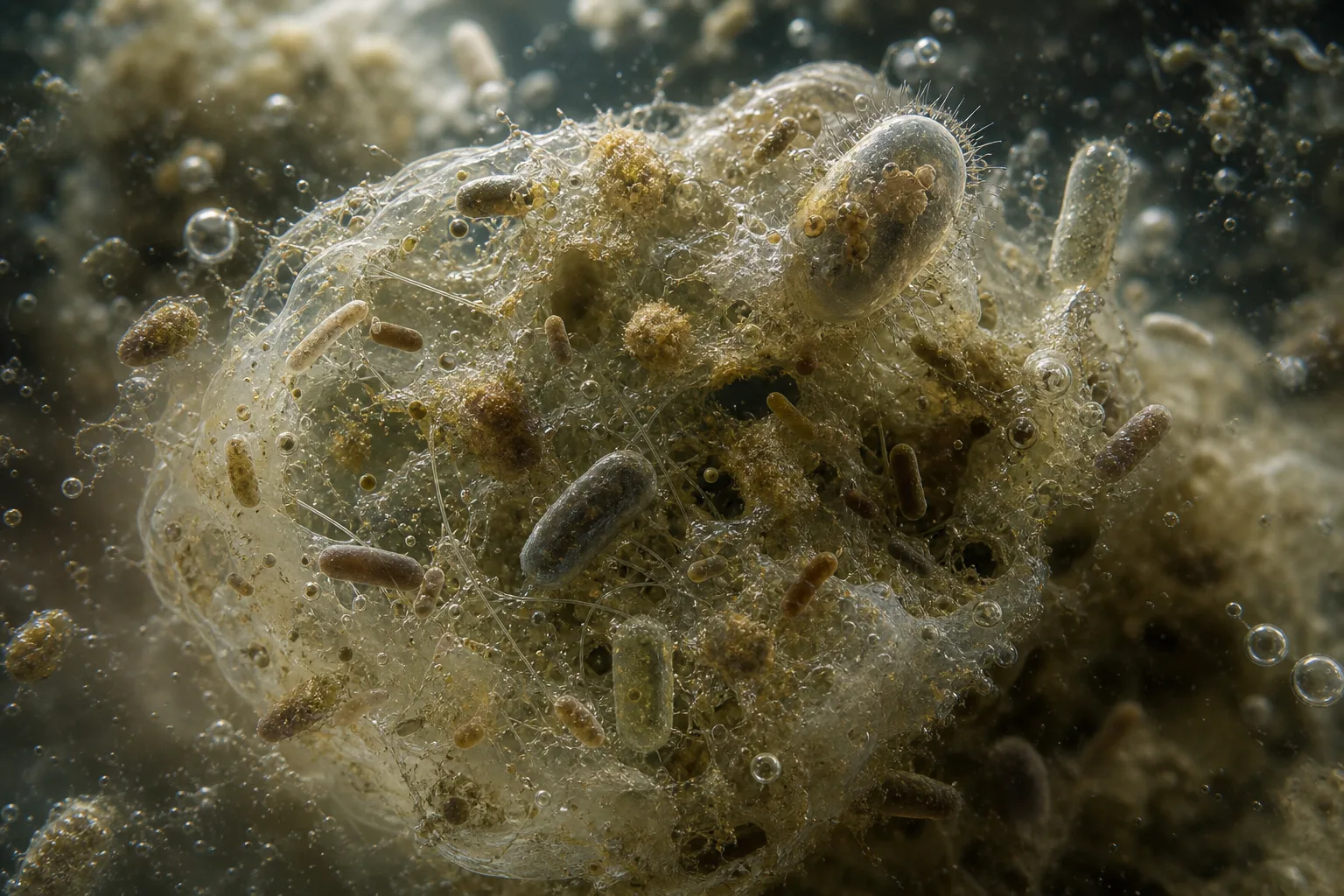 11EPS structural matrix22Heterotrophic bacteria33Protozoa and grazers44Organic particles and water pores
What to identify
- 1EPS structural matrix
- 2Heterotrophic bacteria
- 3Protozoa and grazers
- 4Organic particles and water pores
What the image proves
A floc is a structured community, not one bacterium. Transfer is faster outside and low-oxygen microzones may form inside; capture is followed by hydrolysis, diffusion and metabolism.
How to verify on site
Assess floc size/density, filaments and protozoa with microscopy, then combine with OUR/SOUR, DO, soluble COD and settling—not one image alone.
The process closes through reaction, settling, return and wasting
The cutaway shows influent/return mixing at left, an aerated bioreactor in the center, secondary separation at right and bottom piping for returned and wasted sludge.
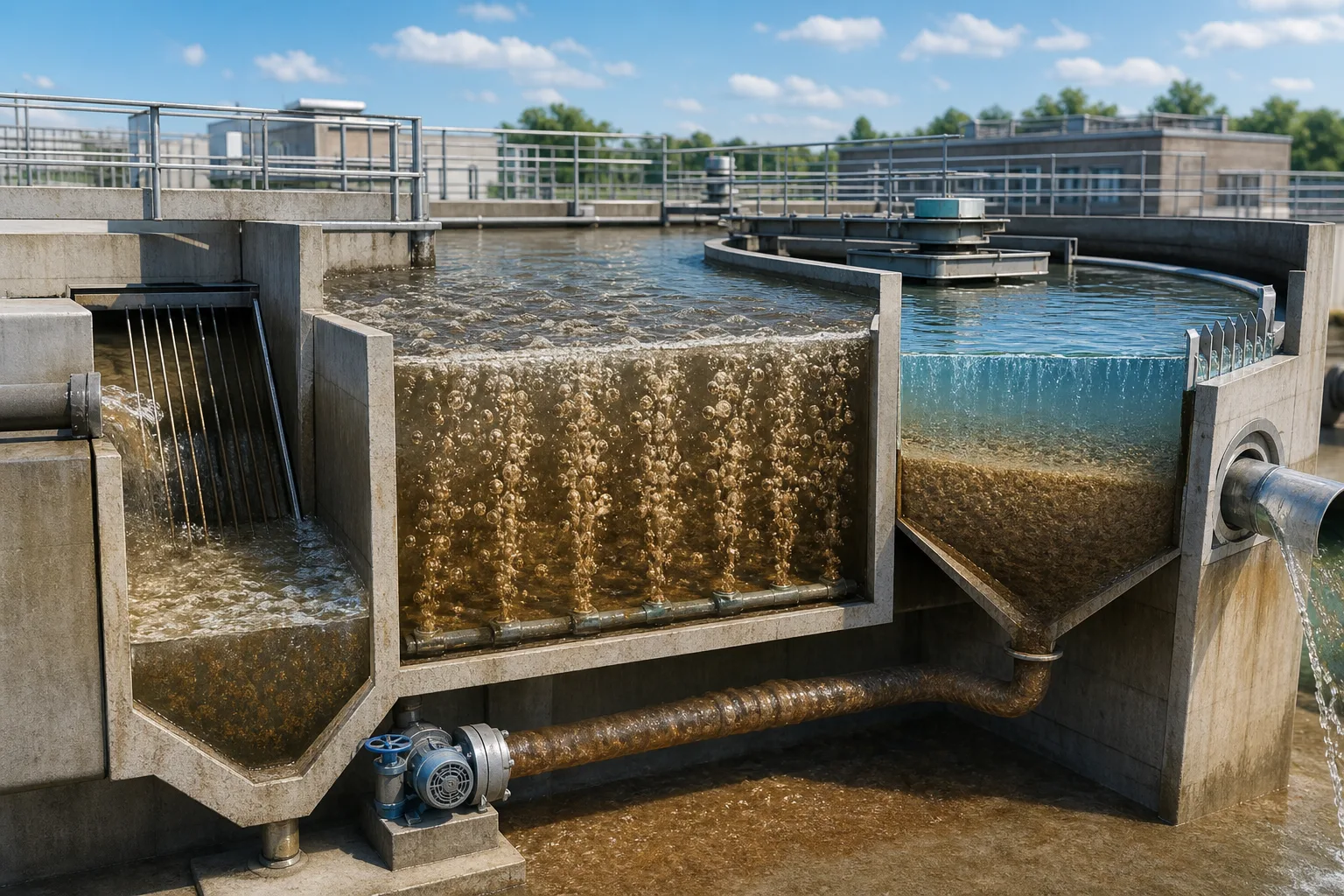 11Influent and RAS mixing22Aerobic biological reaction33Clarifier clear-water zone44Return and waste sludge lines
What to identify
- 1Influent and RAS mixing
- 2Aerobic biological reaction
- 3Clarifier clear-water zone
- 4Return and waste sludge lines
What the image proves
Biomass remains longer than the hydraulic pass because return sludge creates a longer SRT. Too little wasting causes old/accumulated sludge; too much wasting removes organisms faster than they grow.
How to verify on site
Balance influent/effluent solids, MLSS/MLVSS and RAS/WAS flows and concentrations; calculate SRT and verify blanket and solids flux.
The same equipment behaves differently at different load and sludge states
Parallel reactors show dark high-load liquor, more balanced mature floc and low-solids/washed-out conditions; settling cylinders display the corresponding sludge-water interface.
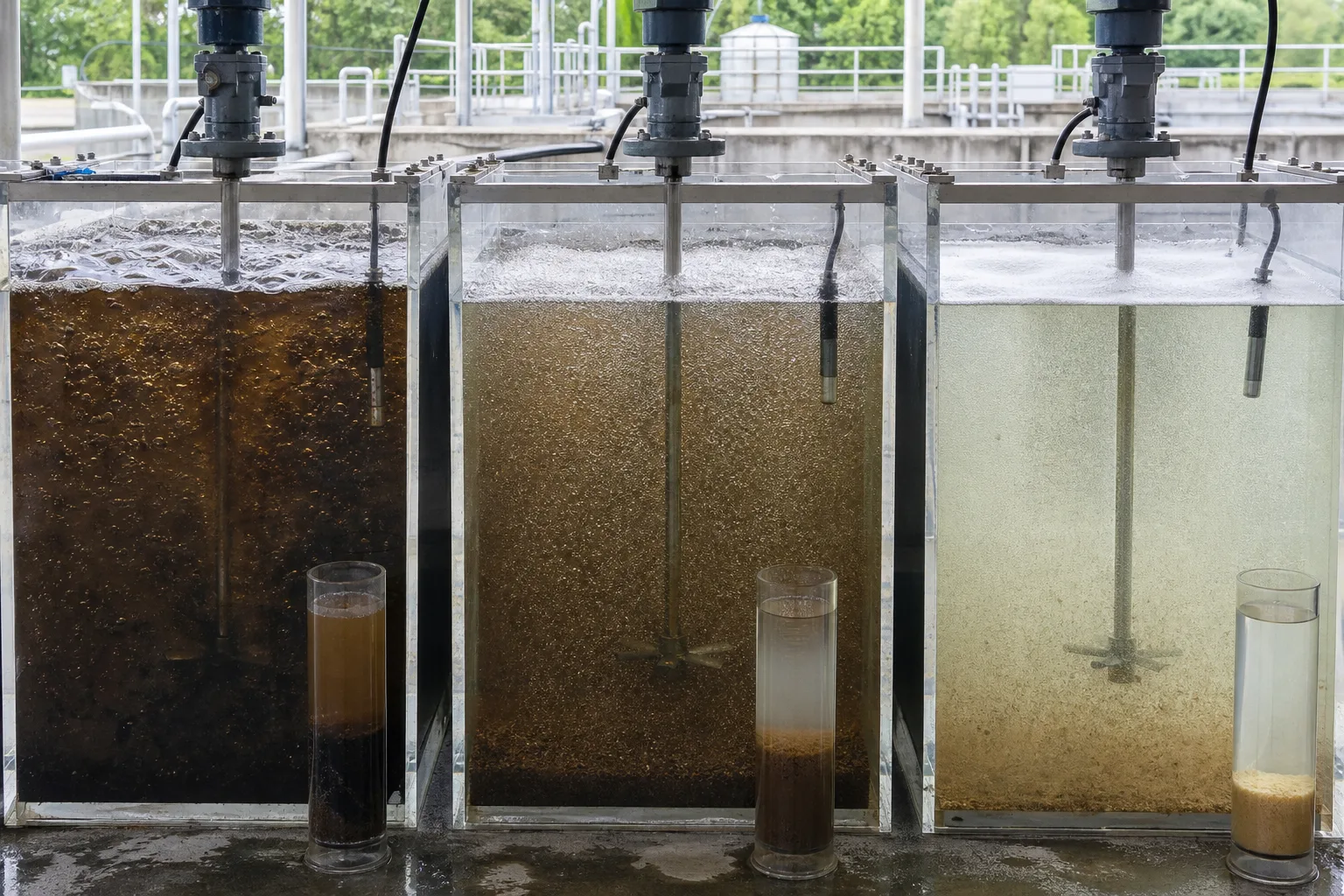 11High-load, high-F/M reactor22Balanced load and mature floc33Low biomass or washout44Settling cylinders and supernatant
What to identify
- 1High-load, high-F/M reactor
- 2Balanced load and mature floc
- 3Low biomass or washout
- 4Settling cylinders and supernatant
What the image proves
Color and clarity alone do not prove performance. High F/M can cause dispersed growth and oxygen deficit; very low F/M/long SRT can cause aging, while low MLSS may be washout.
How to verify on site
Compare F/M, SRT, MLSS/MLVSS, DO, OUR, SVI/30-minute settling, supernatant turbidity and influent/effluent load together.
Diagnosis combines basin observation, settling, chemistry and microscopy
The basin-side station contains a settleometer, mixed-liquor and supernatant samples, color/titration tubes and a microscopic floc/filament image; foam or floating sludge is visible behind.
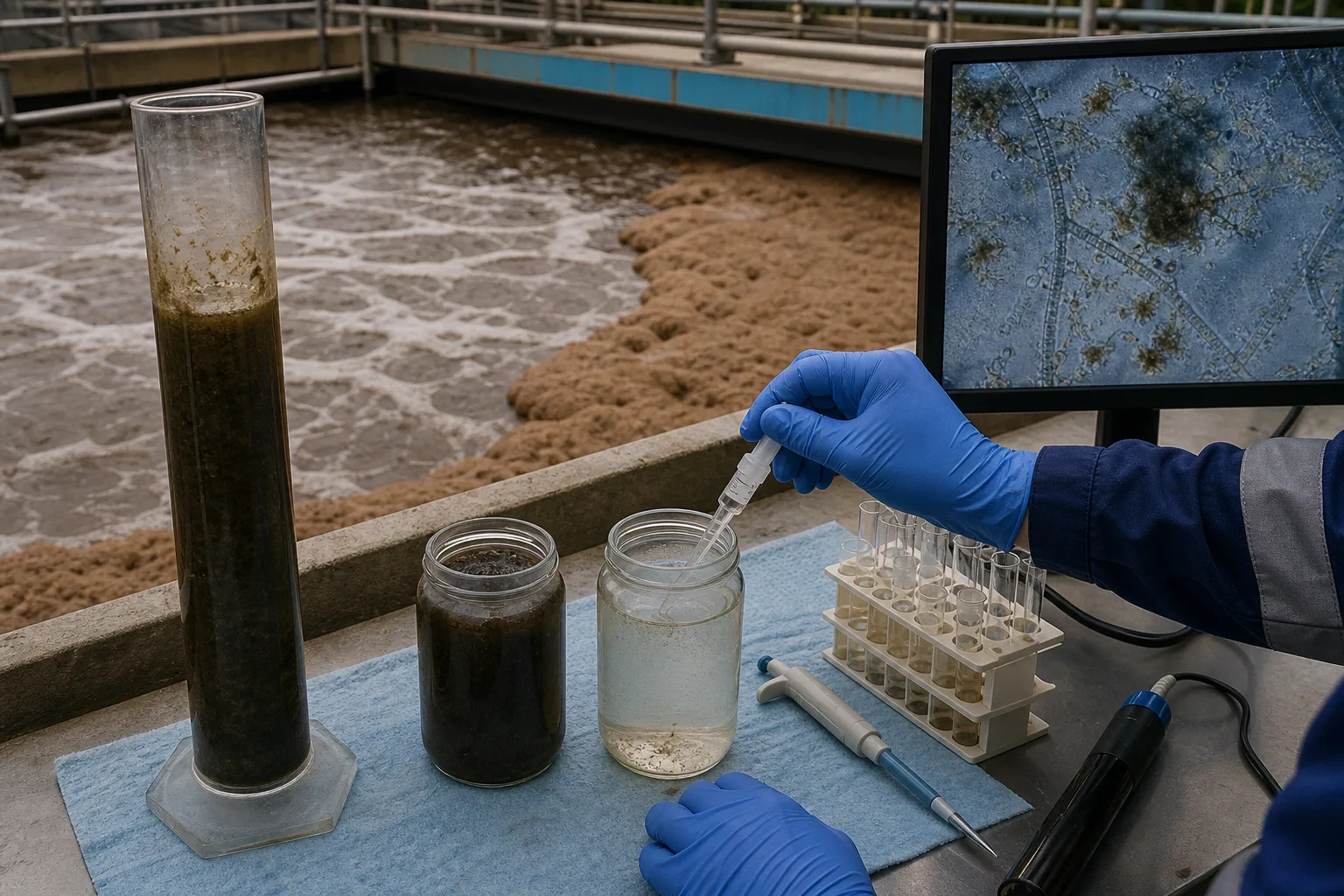 1130-minute settleometer22Mixed-liquor and supernatant samples33Colorimetric or titration tests44Floc and filament microscopy
What to identify
- 130-minute settleometer
- 2Mixed-liquor and supernatant samples
- 3Colorimetric or titration tests
- 4Floc and filament microscopy
What the image proves
Foam, floating sludge, solids loss or turbidity may come from load, DO, SRT, nutrients, filaments, denitrification or hydraulics. No single test spans them all.
How to verify on site
At one timestamp combine basin photos, DO/pH/temperature, COD/BOD/ammonia, MLSS/SVI, blanket, microscopy and operating events, then follow the causal chain.
Six destinations for an organic pollutant in activated sludge
The path explains both aeration demand and waste-sludge production.
1 Contact and mix
Influent organics + return sludge
Bring substrate, floc and electron acceptor together.
2 Capture
Particles/colloids → EPS and floc
Move part of the load from water into floc surfaces and pores.
3 Hydrolysis and transfer
Macromolecule → small molecule → cell
Extracellular enzymes release soluble substrate that diffuses into cells.
4 Respiration
Substrate + O₂ → CO₂ + H₂O + energy
Heterotrophs oxidize part of the carbon and consume oxygen.
5 Biomass synthesis
Substrate + N/P → cells and EPS
Another fraction becomes new sludge.
6 Settle, return and waste
Floc → clarifier → RAS/WAS
Return maintains biomass; wasting removes growth and controls SRT.
What do the members of a floc do?
Functions overlap and shift with operation; these are the major diagnostic roles.
Heterotrophic bacteria
- Main function
- Use biodegradable carbon for respiration and new biomass
- Sensitive conditions
- Sensitive to load, DO, pH/temperature, nutrients and toxicity; usually faster-growing than nitrifiers
- Field evidence
- BOD/soluble-COD removal, OUR/SOUR, F/M and floc activity
Hydrolysers and extracellular enzymes
- Main function
- Convert particles and polymers to molecules cells can take up
- Sensitive conditions
- Low temperature, toxicity or insufficient contact leaves slow substrate behind
- Field evidence
- Particulate/soluble COD fractions, respiration curves and supernatant change
EPS and floc formers
- Main function
- Build the adhesive matrix, capture particles and create settleable aggregates
- Sensitive conditions
- High F/M, nutrient imbalance, shear or excessive filaments degrade settling
- Field evidence
- Floc form, SVI, supernatant turbidity, effluent TSS and microscopy
Protozoa and metazoa
- Main function
- Graze dispersed bacteria, aid clarification and indicate community maturity
- Sensitive conditions
- Toxicity, low oxygen, shock load and extreme SRT shift populations
- Field evidence
- Interpret microscopy with DO, load, SRT and effluent—not alone
Organic removal does not equal complete nitrogen and phosphorus removal. Biomass assimilates some nutrients, but stable total-N and total-P removal needs nitrification, denitrification, biological phosphorus removal, chemical routes or sludge wasting with explicit mass paths.
Track three evidence groups
Load and reaction conditions
Influent COD/BOD and flow, F/M, DO, pH, temperature, ammonia, alkalinity and nutrient balance describe food and environment.
Biomass and SRT
MLSS/MLVSS, RAS/WAS flow and concentration, SRT and OUR/SOUR show how much active sludge is retained and its state.
Settling and effluent
SVI/settling curve, blanket, supernatant turbidity, effluent TSS/COD/BOD/ammonia and microscopy test both reaction and separation.
Where should common abnormalities lead?
- Signal combination
- Soluble COD/BOD rises while DO is low
- First suspicion
- Organic shock load, insufficient oxygen/mixing or toxicity
- Next action
- Check flow/load, airflow and DO profile, OUR, pH/temperature and industrial discharge events
- Signal combination
- Reactor removal is reasonable but effluent TSS/turbidity rises
- First suspicion
- Clarifier solids/hydraulic load, dispersed floc, bulking or equipment fault
- Next action
- Check blanket, SVI/curve, RAS, surface load and microscopy; separate reaction from separation
- Signal combination
- BOD/COD removal is normal but ammonia rises
- First suspicion
- Insufficient nitrifier SRT, low temperature, low DO/alkalinity or inhibition
- Next action
- Check SRT, temperature, zone DO, pH/alkalinity and ammonia/nitrite trends
- Signal combination
- SVI is high, blanket rises and filaments dominate
- First suspicion
- Filamentous bulking selected by low DO, low F/M, nutrient deficit or specific substrates
- Next action
- Identify conditions and filament type before changing selection pressure; do not rely on chemical settling aid alone
Four misconceptions
More air always makes microbes work faster
Beyond oxygen and transfer demand, extra air adds energy and shear and may damage anoxic zones. Control to load and DO.
Higher MLSS always means more capacity
High MLSS may be old, oxygen-transfer-limited and overload the clarifier; activity, SRT, load and separation govern capacity.
A clearer aeration basin is better
An aeration basin should contain mixed-liquor solids; unusual clarity may mean washout, failed return or insufficient biomass.
Microbes make pollution disappear
Carbon becomes CO₂, cells and waste sludge; nitrogen and phosphorus also need explicit destinations and mass balance.