Illustrated guide · Equipment cutaway
How does a centrifuge use rotation to separate sludge and water?
Trace centrifugal settling in a high-speed bowl, stationary feed and acceleration, differential-speed scroll conveying, pond/weirs, conical beach dewatering, continuous discharge and torque–vibration diagnosis.
Direct answer
Direct answer
Sludge dewatering commonly uses a horizontal solid-bowl scroll decanter. The high-speed bowl rotates the contents, creating radial acceleration of roughly ω²r. Denser sludge particles migrate toward the outer bowl wall and form a sediment layer; the lighter liquid remains nearer the axis as a concentric pond. A stationary feed tube delivers conditioned sludge into a feed zone inside the scroll, where it is accelerated smoothly toward bowl speed to limit floc shear, shock and wear. Bowl and scroll rotate rapidly in the same direction but with a small differential speed. This difference does not create the main separation; it continuously conveys settled solids along the wall, up the conical beach, out of the pond for further compaction, and through the small-end solids ports. Clarified liquid moves to the large end and spills over adjustable weirs or exits through power tubes. Bowl speed sets centrifugal-field magnitude; differential speed sets conveying, solids residence and scroll torque; pond depth trades clarification volume against dry-beach length; feed rate and solids set load; polymer determines whether fine particles form settleable, shear-resistant flocs. More bowl speed does not automatically maximize both capture and cake dryness, and it raises power, wear, vibration and allowable-density concerns. Trend feed Q/TS, active polymer dose, bowl/differential speed, torque, pond, vibration/bearing temperature together with cake dry solids, centrate SS/turbidity and energy per dry solids.
Four coupled controls produce clear centrate and stable cake
A decanter is not simply ‘faster is better’; separation, conveying, pond geometry and conditioning must balance at the same solids load.
Use enough—but not excessive—bowl speed
Separation depends on speed, radius, effective settling area and particle behaviour. Obey nameplate maximum speed, temperature and compacted wet-solids density. Higher speed increases driving force but also power, noise, wear and imbalance risk.
Match differential speed to solids load and torque
High differential conveys solids quickly and can reduce compaction; very low differential can increase residence but builds inventory and torque toward plugging. Torque-based control often adjusts differential dynamically.
Trade pond depth against dry-beach length
A deep pond increases liquid residence and settling volume but shortens exposed beach. A shallow pond lengthens the beach but reduces clarification volume and may lose fine solids. Follow OEM procedures for weir adjustment.
Build settleable, shear-resistant flocs
Feed Q, TS, temperature and sludge properties change load. Underdose loses solids; overdose can create sticky cake, foam, cost and recycle impacts. Dose point and mixing must preserve floc through acceleration.
The dewatering hall links enclosed decanters, cake chutes and downstream conveyors
Two horizontal units run in parallel. Bowl and scroll are fully enclosed; cake drops from an end chute to a screw conveyor while centrate returns through closed piping.
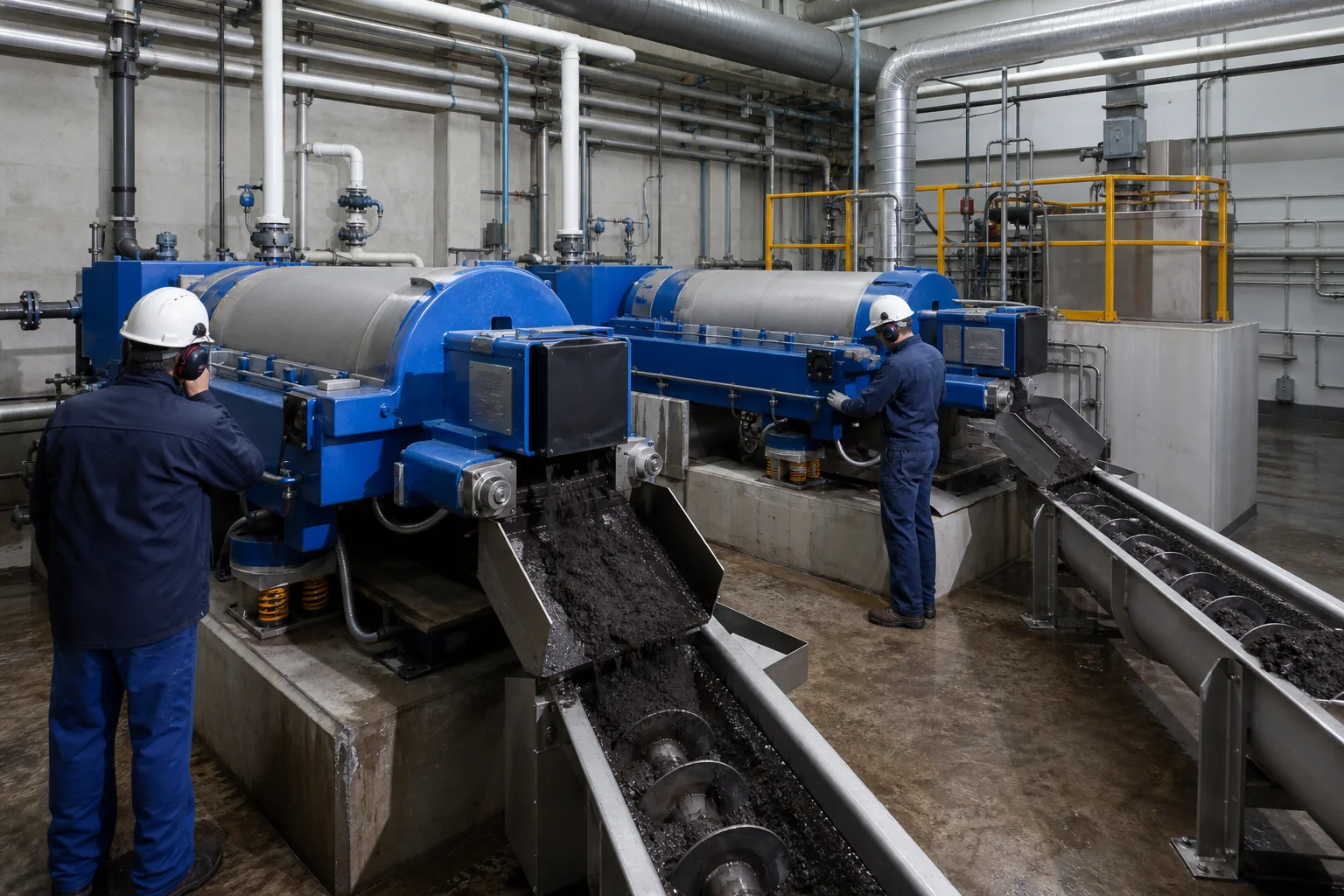 11Enclosed bowl / scroll assembly22Parallel duty or standby unit33Cake discharge chute44Downstream screw conveyor
What to identify
- 1Enclosed bowl / scroll assembly
- 2Parallel duty or standby unit
- 3Cake discharge chute
- 4Downstream screw conveyor
What this proves
A decanter accepts feed and discharges two products continuously, unlike a batch filter press. The hood controls liquid, odour and noise and is also the high-speed rotor safety boundary; never open it while rotating.
Field check
Map feed/polymer, centrate and cake destinations. For each unit trend P/Q, bowl/differential speed, torque, vibration, temperature and power; sample feed, centrate and cake at the same time and keep unit IDs.
The cutaway reveals stationary feed, solid bowl, internal scroll and conical beach
Feed enters through the axial stationary tube. The cylindrical section holds the pond; scroll flights convey wall sediment toward the right-hand cone, while the gearbox/backdrive maintains a small speed difference.
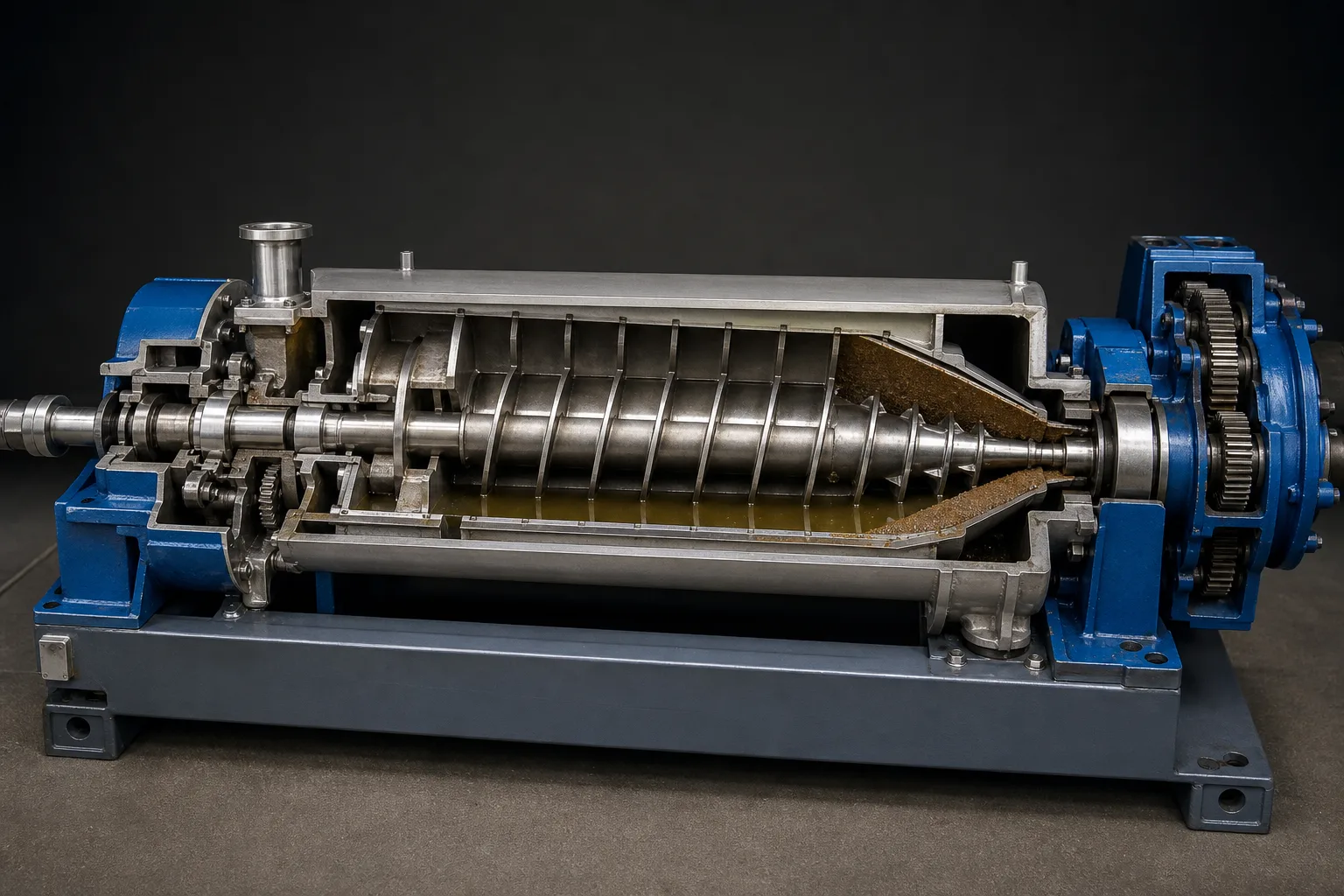 11Stationary feed and acceleration zone22Cylindrical bowl / concentric pond33Scroll flights and settled solids44Conical beach, bearings and differential drive
What to identify
- 1Stationary feed and acceleration zone
- 2Cylindrical bowl / concentric pond
- 3Scroll flights and settled solids
- 4Conical beach, bearings and differential drive
What this proves
Two motions are essential: common high speed creates settling; a small differential creates axial solids transport. That small difference directly controls residence, capacity and torque.
Field check
Confirm relative direction, ratio and torque limit from the OEM. Verify bowl/differential feedback and trend backdrive load. Sawtooth torque, repeated protective speed changes or interrupted solids discharge point to inventory/conveying.
A transparent slow model shows wall sediment, inner pond and both outlets
Clear liquid occupies the inner layer, brown solids lie against the wall and the scroll moves them to the cone. Centrate is collected left and wet solids right.
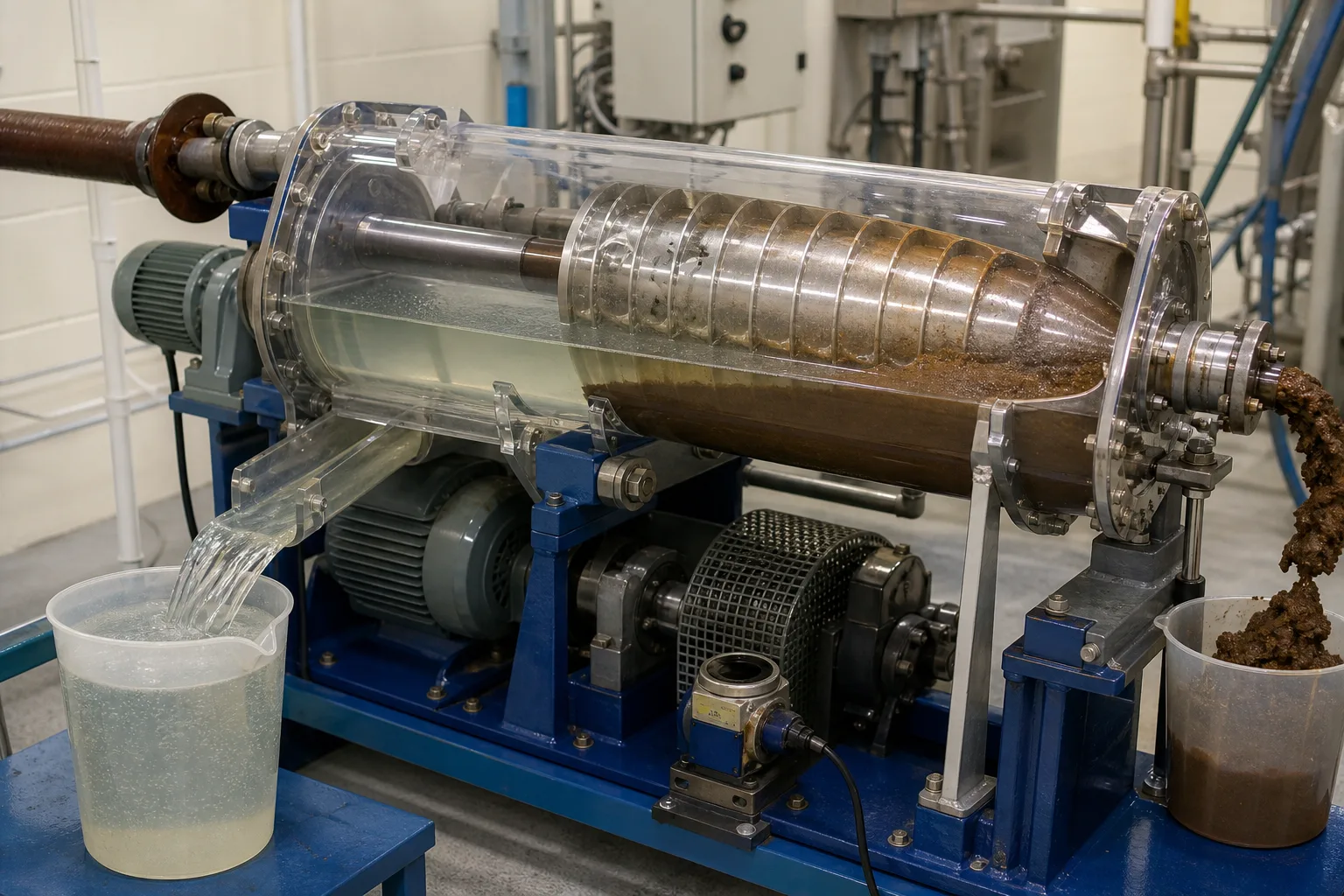 11Main drive and rotating train22Pond and solids–liquid interface33Wall solids layer / scroll conveying44Centrate and solids outlets
What to identify
- 1Main drive and rotating train
- 2Pond and solids–liquid interface
- 3Wall solids layer / scroll conveying
- 4Centrate and solids outlets
What this proves
The visible top/bottom split is an orientation artifact. At operating speed, ‘down’ is radially outward and heavy solids settle around the full 360° wall; gravity coordinates do not explain the working rotor.
Field check
Verify pond radius/weir setting at shutdown or with an online mechanism. Run steady step tests, changing one of feed, polymer, differential or bowl speed and waiting for internal inventory before comparing centrate SS and cake DS.
Parallel centrifuge tests compare products, but machine topology still matters
These vertical disc-stack machines are not decanters; they can illustrate controlled outcome comparisons in centrate clarity, recovered solids and mixed phases, but their settings cannot be copied to a scroll decanter.
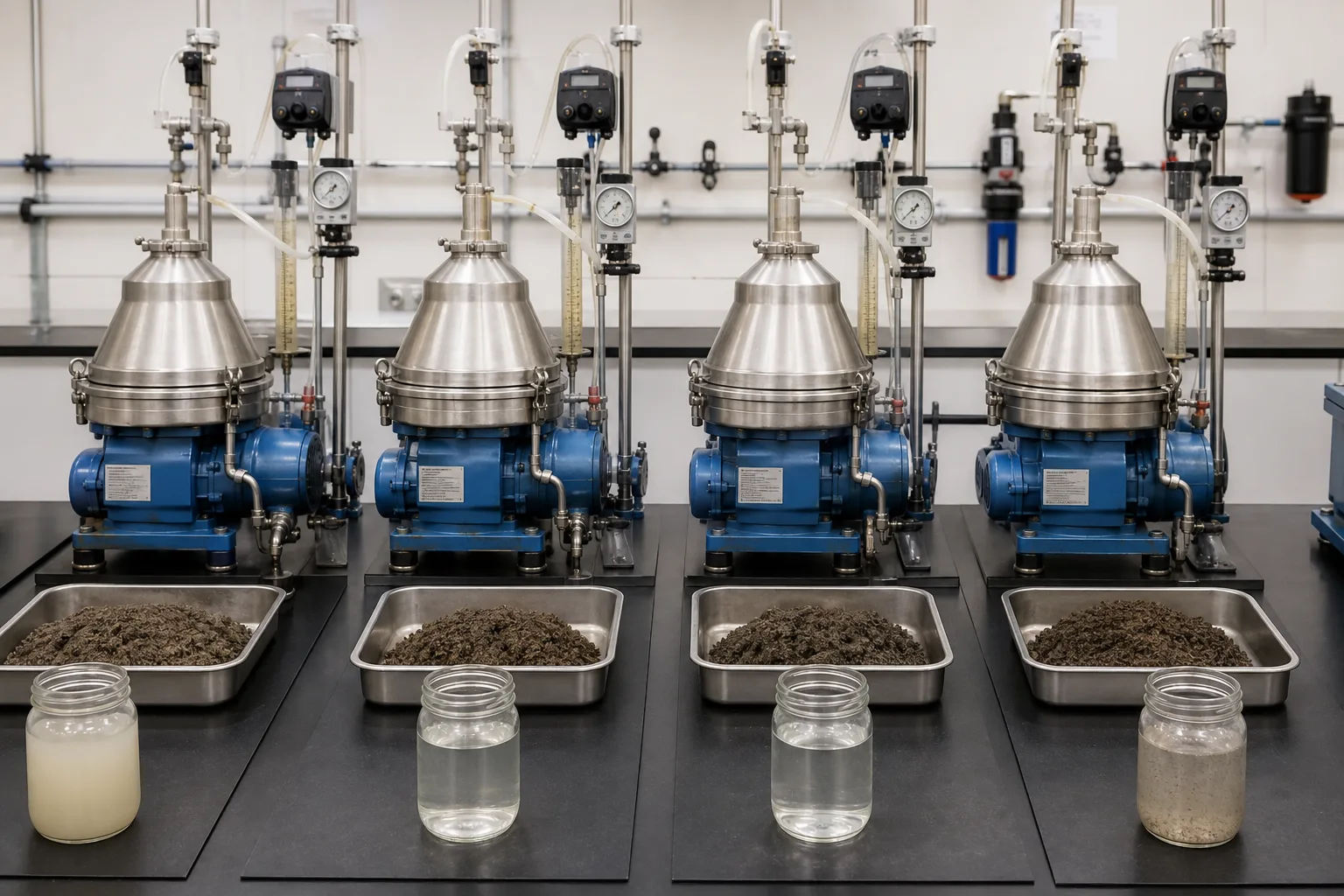 11Cloudy liquid result22Clearer liquid control A33Clearer liquid control B44Solids carryover / mixed result
What to identify
- 1Cloudy liquid result
- 2Clearer liquid control A
- 3Clearer liquid control B
- 4Solids carryover / mixed result
What this proves
‘Centrifuge’ covers different flow paths. Attribute a test only with identical feed, sampling and material balances. A clearer jar may cost more polymer, reduce throughput or yield wetter cake.
Field check
Record feed mass/DS, active polymer, duration, liquid volume/SS, recovered solids mass/DS. Close the dry-solids balance before choosing the best total condition rather than the clearest jar.
Teardown focuses on scroll wear, bowl wall, bearings/seals and condition monitoring
With the scroll withdrawn, technicians inspect flight leading edges and wear tiles, bowl and discharge abrasion, bearings, seals, lubricant sample and vibration/speed sensing.
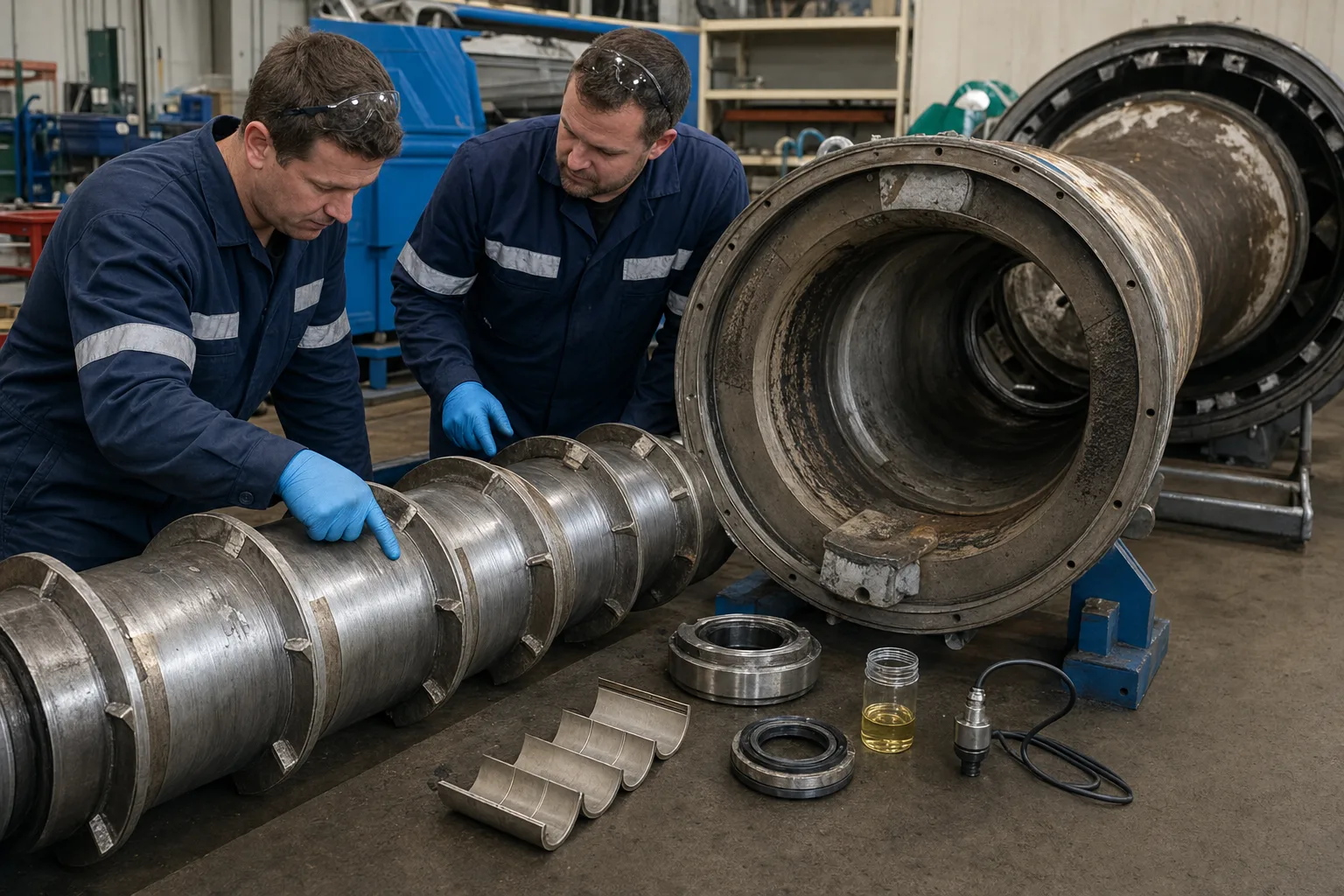 11Scroll leading edge / wear tiles22Bowl wall and discharge wear zone33Bearings, seals and lubrication parts44Oil sample and vibration/speed sensor
What to identify
- 1Scroll leading edge / wear tiles
- 2Bowl wall and discharge wear zone
- 3Bearings, seals and lubrication parts
- 4Oil sample and vibration/speed sensor
What this proves
Wear at feed, flights, discharge and bowl changes clearances, conveying and balance. Uneven deposits, wear or bearing deterioration can become severe vibration at operating speed.
Field check
Follow OEM risk controls: stop feed, flush, complete shutdown, verify zero speed and apply electrical/mechanical/process LOTO. Measure wear, clearances, bearings/seals and oil; rebalance and test after qualified repair.
Seven continuous steps from conditioned sludge to two products
Centrifugal settling and scroll transport occur together but require separate evidence.
1 Condition/meter
Thickened sludge + polymer → feed tube
Create settleable floc and quantify solids load and active dose.
2 Accelerate
Stationary tube → feed zone → near bowl speed
Limit shock, foam, floc breakage and inlet wear.
3 Settle
Particles → outer wall; liquid → inner pond
Use density difference and ω²r acceleration for radial layering.
4 Convey
Wall sediment → differential scroll → cone
Move solids at controlled residence and torque.
5 Dewater beach
Solids leave pond → conical discharge
Remove free water during limited exposed length and time.
6 Discharge
Centrate → weir/tube; cake → chute
Continuously remove both phases while stabilizing pond inventory.
7 Feedback
Centrate SS + cake DS + capture → controls
Optimize with a solids balance rather than one product alone.
Five variables govern different physical stages
One adjustment can improve one metric while sacrificing another.
Bowl speed / G
- Normal duty
- Drive particles radially to the wall
- Mismatch
- Low capture; or excess power, wear, vibration/density limit and shear
- Evidence
- rpm, radius/OEM G, power, vibration, centrate SS and feed
Differential / torque
- Normal duty
- Convey solids and control compaction residence
- Mismatch
- High differential wet cake; low differential torque/plug/inventory oscillation
- Evidence
- differential rpm, torque/backdrive, trips, cake rate/DS and lag
Pond/weir/beach
- Normal duty
- Divide clarification volume and exposed drying zone
- Mismatch
- Deep pond wet cake; shallow pond lost fines/capacity
- Evidence
- weir/tube setting, pond radius, centrate SS, cake DS and throughput
Feed/polymer
- Normal duty
- Turn variable sludge into stable separable load
- Mismatch
- Q/TS shock, underdose loss, overdose sticky/foam/recycle, shear
- Evidence
- feed Q/TS/VS/temp, active kg/tDS, floc test and products
Bearings/wear/monitoring
- Normal duty
- Maintain clearances, balance and predictable rotor life
- Mismatch
- temperature/lube, wear, deposits, imbalance or interlock fault
- Evidence
- multiaxis vibration, temperature, oil/grease, wear/clearance and shutdown log
Calculate capture on dry solids, not clarity alone: feed dry solids ≈ cake dry solids + centrate suspended solids. G, maximum speed, permitted solids density, differential/torque, pond and opening conditions are machine- and medium-specific OEM limits.
Align three data groups to solids load and residence
Feed and conditioning
Feed Q, TS/VS, pH/temperature/source, polymer type/active strength/makeup and ageing, active kg/tDS, injection point and mixing.
Machine and control
Bowl/differential rpm, scroll torque/backdrive power, pond/weir, main power, vibration, bearing temperature, lubrication, flushing and protective actions.
Products and cost
Centrate flow/SS/turbidity/recycle load, cake flow/wet mass/DS/capture, energy and polymer per feed or dry solids, and hauled wet mass.
Diagnose with torque–vibration–centrate–cake
- Signal
- Centrate clouds as feed Q/TS rises or polymer fails to follow
- Suspect first
- Solids-load shock, low active dose/makeup fault or acceleration-zone floc shear
- Next step
- Align Q×TS and active kg/tDS/makeup; stabilize load and conditioning before changing bowl/pond
- Signal
- Torque rises, control increases differential and cake flow pulses
- Suspect first
- Solids inventory, feed concentration spike, low differential, cone/outlet restriction or sticky debris
- Next step
- Reduce feed under control logic and preserve conveying; check torque/differential/discharge, then flush/inspect at safe stop
- Signal
- Centrate is clear but cake wets, torque is low and differential high
- Suspect first
- Solids leave too quickly, dry-beach residence is short, pond too deep or feed dilute
- Next step
- Confirm feed TS/weirs; make small step changes and wait for inventory, then measure cake DS, capture and torque together
- Signal
- Vibration or bearing temperature rises rapidly despite acceptable products
- Suspect first
- Deposit imbalance, bearing/lube problem, rotor/scroll wear or foreign material—mechanical safety priority
- Next step
- Follow alarm/trip logic, stop feed and coast safely; do not open until zero-speed LOTO and qualified inspection/balance
Four common misconceptions
Higher rpm always means drier cake and clearer centrate
Speed strengthens only the field; differential, pond, load, conditioning and bound water still govern, while risk and power rise.
The scroll spins much faster than the bowl
Both usually co-rotate at high speed; the small difference transports solids and carries major process torque.
A transparent centrate jar is enough for tuning
It may use more polymer, lower throughput or wet cake; close dry-solids capture and cost balances.
A power-off rotor is immediately safe
Its inertia can sustain rotation for a long time. Never open before verified zero speed and full LOTO.