Illustrated guide · Operating diagnostics
Does high permeate conductivity always mean membrane damage?
Separate measurement, feed and normalized operating effects, CO₂/pH chemistry, permeate-side seal bypass and true membrane chemical or mechanical damage.
Direct answer
Direct answer
No. Higher RO permeate conductivity only says that the aggregate response of conductive ions in product water has increased. Verify the online cell, temperature compensation, units, full-flow/bubble-free sampling and grab sample first. Then compare feed and concentrate conductivity, temperature, pH, recovery, pressure and flow: more saline feed, warmer water, higher recovery/concentration polarization or weak-acid/base speciation can raise apparent passage. Dissolved CO₂ can cross RO comparatively readily and establish carbonic equilibrium in low-mineral permeate, lowering pH and increasing conductivity without a membrane hole. Hardware failures include leaking product-side O-rings, interconnectors or adapters that bypass saline feed/concentrate into the permeate tube, and oxidation, out-of-limit pH/temperature, abrasion, glue-line or membrane-sheet rupture. Water hammer, axial element movement and telescoping can damage both seals and elements. Normalize permeate flow and solute passage to reference temperature, salinity, pressure and recovery, then inspect spatial and event patterns: all trains moving with feed favors conditions; a sudden single-vessel change after maintenance favors seals; sustained normalized passage increase with chemical or integrity evidence supports membrane damage. Confirm with train sampling, permeate-tube localization, seal/connector inspection and membrane testing.
Exclude four false 'membrane failures' first
Conductivity is sensitive but nonspecific; measurement and chemistry come before teardown.
Validate cell, compensation, units and sample line
Do not mix µS/cm with mS/cm, 25°C-compensated with raw, or flowing with stagnant samples. Bubbles, scale, standards or brine in the line create false highs.
Use normalized passage, not raw Cp
Temperature, feed salinity, pressure, recovery and permeate backpressure change water and salt transport. Compare normalized trends with a clean baseline.
Separate ions from CO₂/pH chemistry
RO rejects ions well but dissolved gases and un-ionized weak species behave differently; CO₂ can form H⁺/HCO₃⁻ in permeate without a physical breach.
Localize by space and event
Combined permeate dilutes a local fault. Maintenance, CIP, hammer, oxidant breakthrough and pH/T excursions plus train profiles are more diagnostic than one average.
Field troubleshooting combines common trends, train samples, end seals and independent conductivity
Online train instruments, a portable meter, an opened vessel and location-coded samples separate measurement, system and local faults.
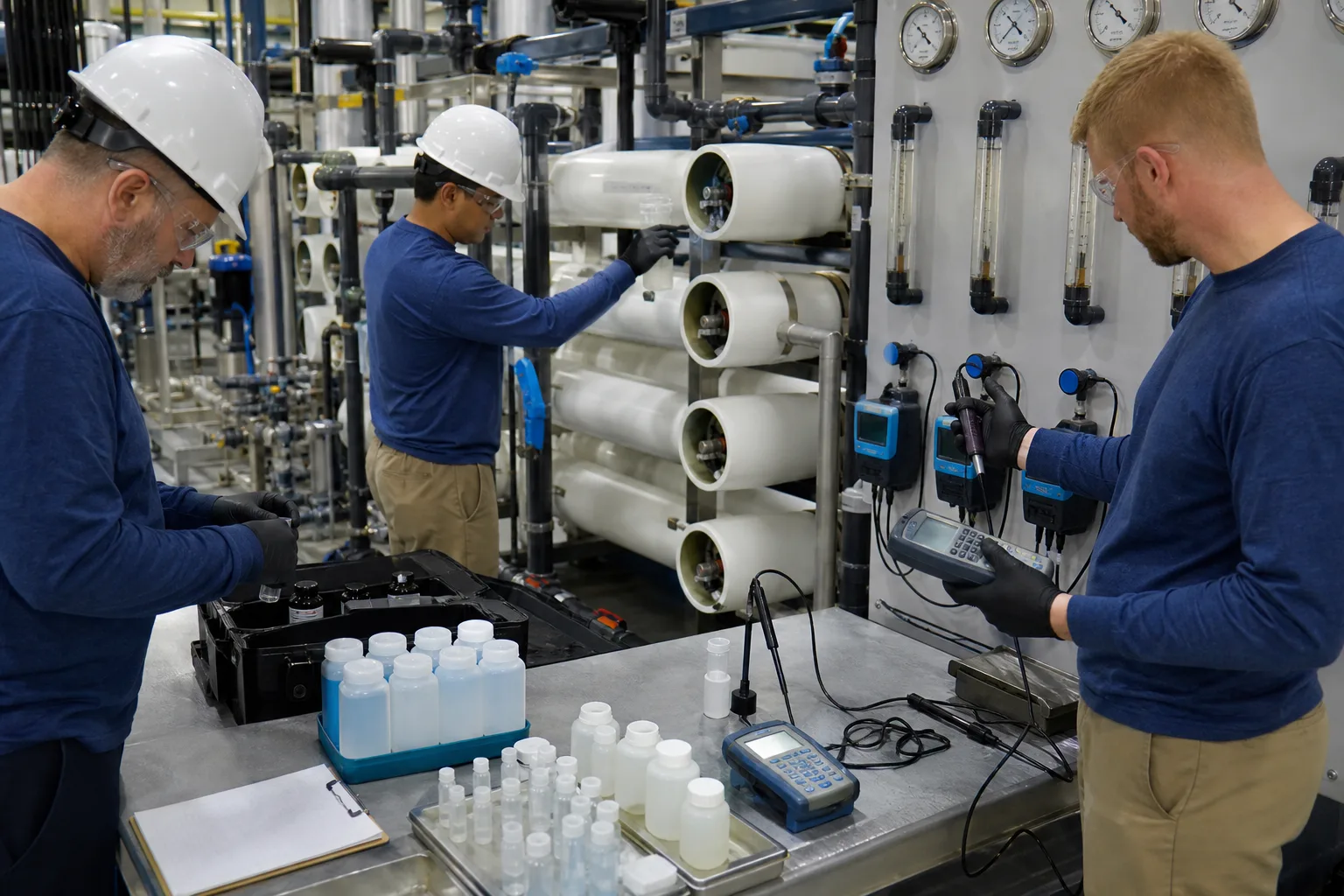 11Train conductivity/flow and pressure trend22Calibrated portable and same-point probe33Open-vessel connector/adapter interface44Feed/permeate/concentrate and train samples
What to identify
- 1Train conductivity/flow and pressure trend
- 2Calibrated portable and same-point probe
- 3Open-vessel connector/adapter interface
- 4Feed/permeate/concentrate and train samples
What the image proves
Determine whether the anomaly is measurement, system-wide conditions or one train before removing elements.
How to verify it
At stable operation record Cf/Cp/Cc, T/pH, Q, recovery and P; cross-check the same point and sample every train.
Laboratory comparisons separate oxidation, seal leakage, mechanical breakage and dirty sensors
A discolored roll, end parts and O-rings, a broken end and clean/dirty probes represent four paths to the same alarm.
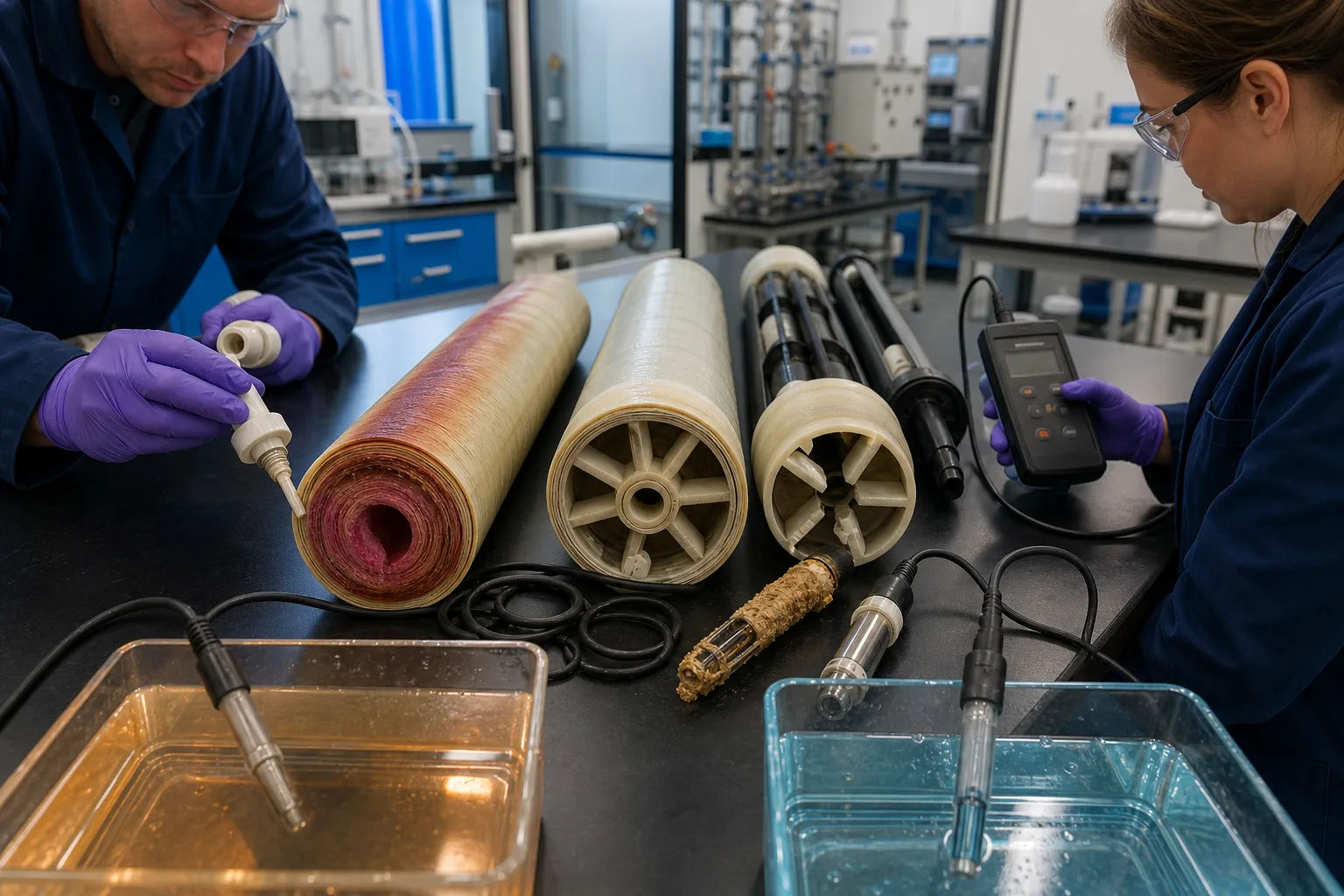 11Discolored sheet and chemical/oxidant exposure22Interconnector, adapter and O-ring seals33Broken end/center tube and mechanical damage44Clean/dirty probes and standard samples
What to identify
- 1Discolored sheet and chemical/oxidant exposure
- 2Interconnector, adapter and O-ring seals
- 3Broken end/center tube and mechanical damage
- 4Clean/dirty probes and standard samples
What the image proves
Higher Cp can come from greater membrane passage, saline bypass or measurement bias; each requires a different repair.
How to verify it
Review oxidant/ORP, CIP pH/T, seal material/installation, cracks and standards; never diagnose from color alone.
A transparent four-element vessel localizes a conductivity step along the permeate path
Each element/connector zone has a sample tube, meter and bottle so a mixed-header alarm can be assigned to a location.
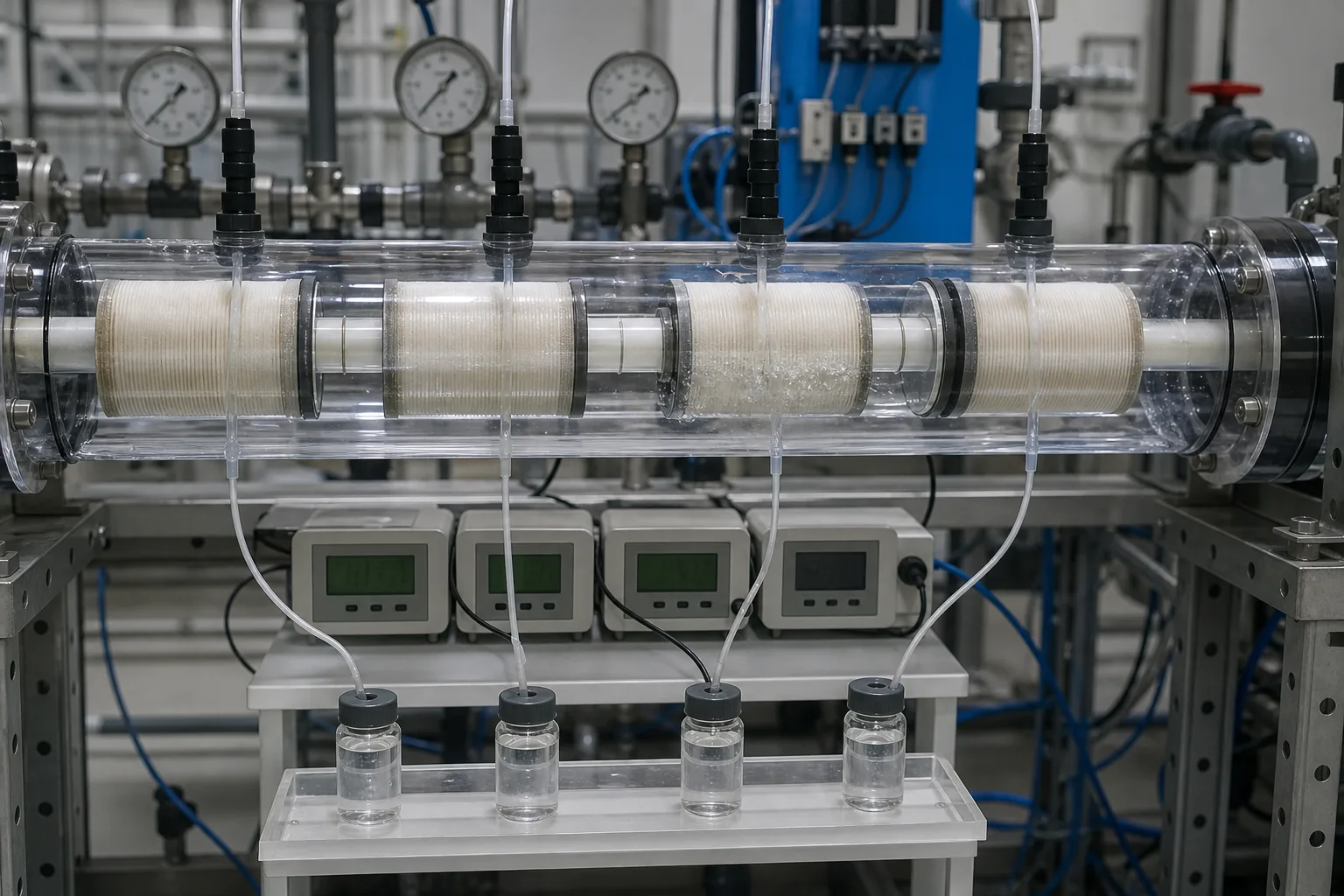 11Element permeate localization taps22Interconnector and O-ring interfaces33Point conductivity under one condition44Four samples and the step boundary
What to identify
- 1Element permeate localization taps
- 2Interconnector and O-ring interfaces
- 3Point conductivity under one condition
- 4Four samples and the step boundary
What the image proves
A step after one connection supports a seal/adapter leak; a smooth rise everywhere favors conditions, CO₂ or common membrane chemistry.
How to verify it
Use the equipment supplier's safe localization procedure at stable P-Q, correct sample lag, repeat the step, then depressurize before inspection.
Open-vessel checks confirm seal, mechanical and membrane layers separately
Portable conductivity, end plate/O-rings, element end and a coupon test prevent one repair from being assumed to solve all causes.
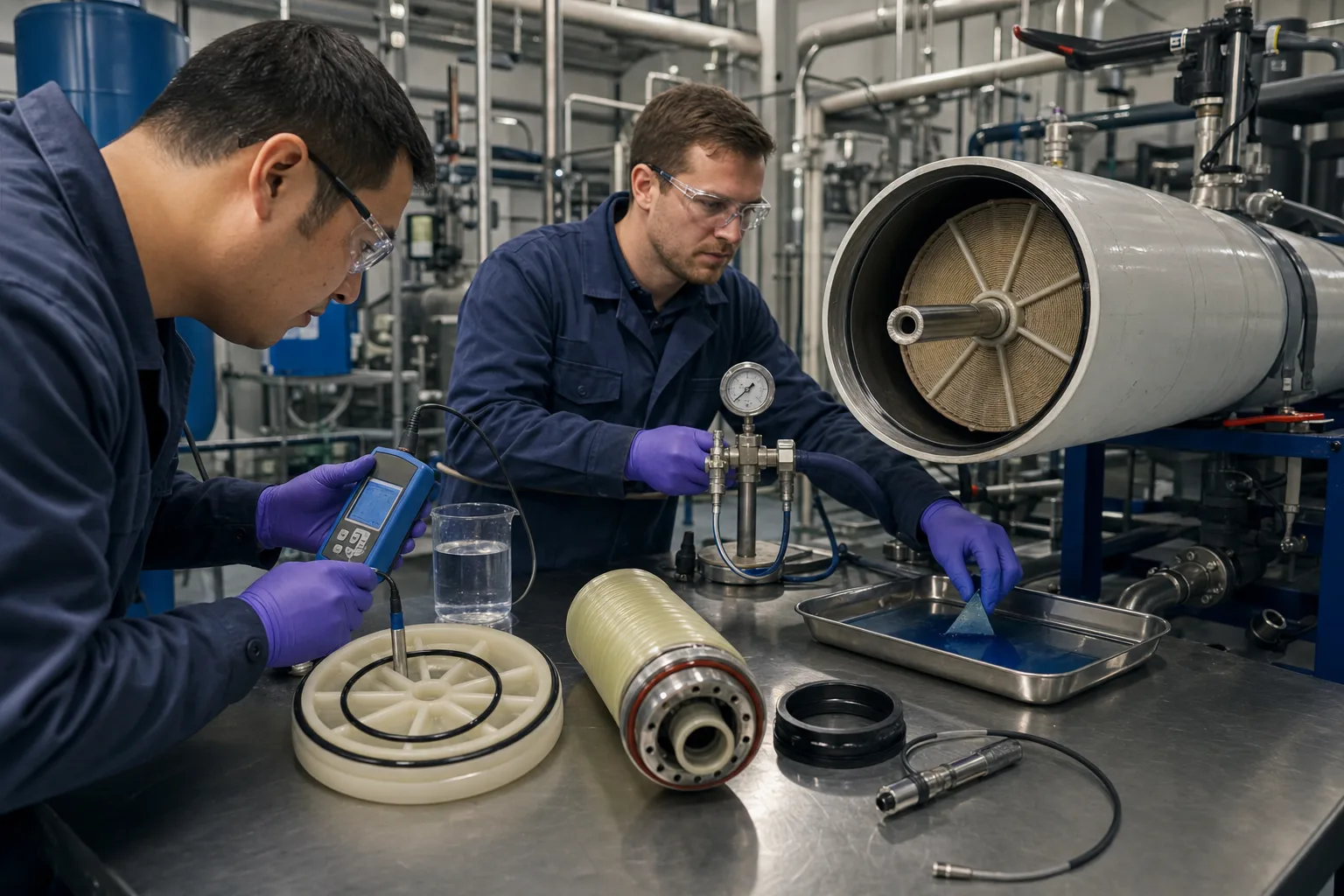 11Portable conductivity and local permeate22End plate, adapter and O-ring chain33Element end/center-tube integrity44Coupon dye/bench selectivity test
What to identify
- 1Portable conductivity and local permeate
- 2End plate, adapter and O-ring chain
- 3Element end/center-tube integrity
- 4Coupon dye/bench selectivity test
What the image proves
A seal can leak while the membrane sheet is healthy; new O-rings cannot restore an oxidized or torn selective layer.
How to verify it
Inspect missing, cut, twisted or swollen seals and axial shimming; compare suspect coupons for flow/passage and suitable chemistry.
Final teardown closes the case with dimensions, seals, water testing, samples and membrane analysis
Element geometry, coded seals/end parts, submerged adapters, conductivity samples and coupon tests are retained by position.
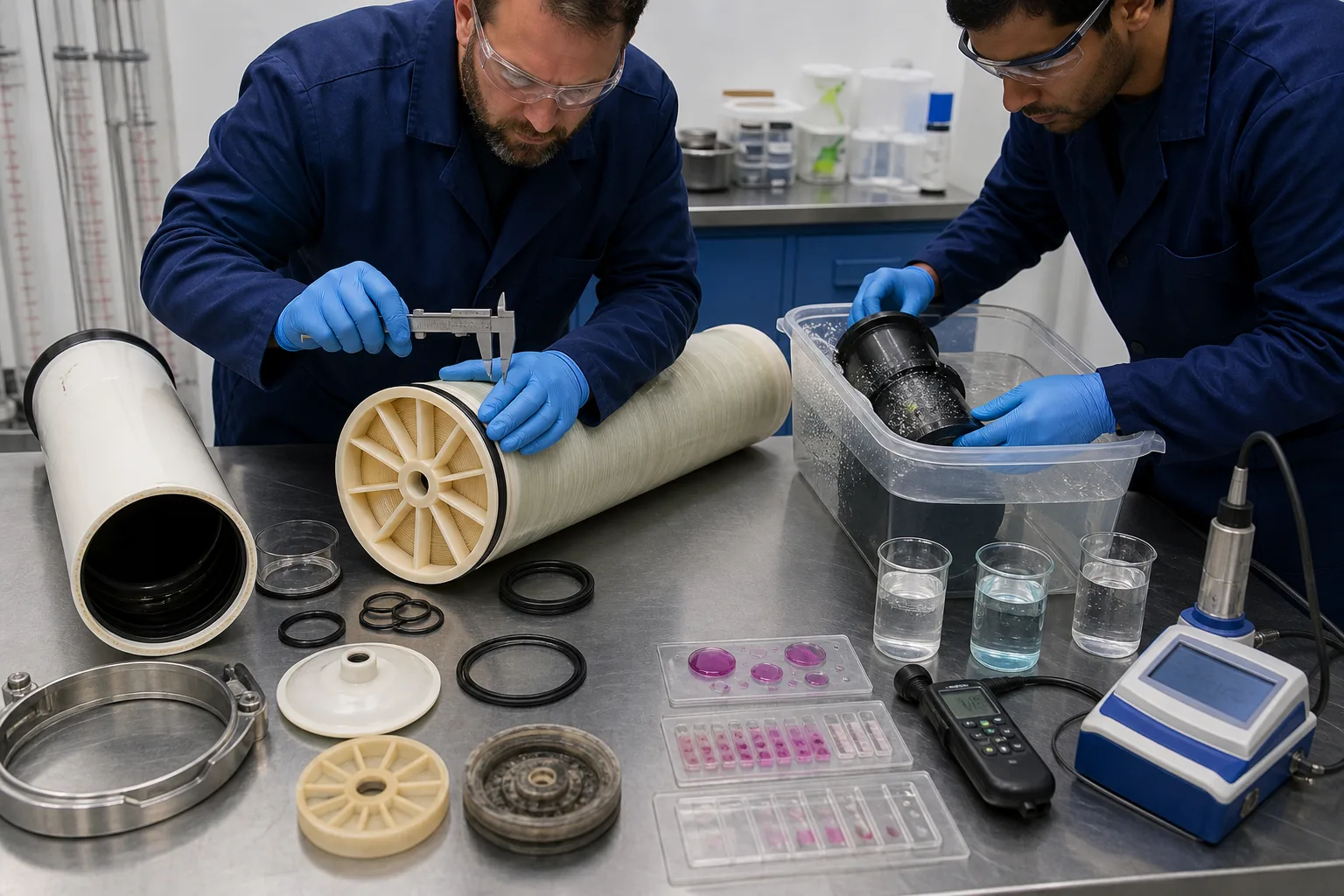 11Element length/end-face and telescoping measurement22O-rings, connectors, end plate and shims33Adapter water/leak and crack inspection44Point conductivity, samples and coupon chemistry
What to identify
- 1Element length/end-face and telescoping measurement
- 2O-rings, connectors, end plate and shims
- 3Adapter water/leak and crack inspection
- 4Point conductivity, samples and coupon chemistry
What the image proves
Chemical, mechanical and measurement faults can overlap, so a single apparent fix may recur unless the event chain is closed.
How to verify it
Preserve load order/direction, code every component/sample and combine dimensions, leakage, coupon performance, chemical evidence and timeline.
Nine steps from alarm to fault location
Converge through measurement, operation, chemistry, space, mechanics and membrane evidence.
1. Confirm alarm
Online Cp → same-point portable/lab
Align units, T compensation, flow and time.
2. Build stream context
Cf, Cp, Cc + T/pH
See whether salt load and concentration moved together.
3. Align operation
P + Q + recovery + permeate backpressure
Remove temperature, pressure and polarization effects.
4. Normalize
Qp/passage → reference T, salinity, P, recovery
Test true selectivity and permeability change.
5. Check weak species
pH, alkalinity, inorganic carbon/CO₂
Separate ionic leak from gas/acid-base response.
6. Localize
Header → stage/train → permeate-tube points
Find common movement or a connection step.
7. Inspect seals/mechanics
Adapters/connectors/O-rings/tube/shims
Find bypass, wear, swelling, hammer or telescoping.
8. Test membrane
Coupon/flow/passage/dye/microscopy/chemistry
Confirm oxidation, hydrolysis, abrasion or rupture.
9. Verify repair
Repair/replace/calibrate → stable Cp and normalized trend
Prove total and point quality recovered.
Distinguish four high-conductivity sources
Time, space and normalized flow/passage patterns provide specificity.
Measurement/sampling
- Typical pattern
- One instrument jumps while portable/lab and process do not.
- Common trap
- Low-conductivity water is highly sensitive to contamination, CO₂, temperature and grounding.
- Confirm with
- Standards, same-point meters, vented flow cell, T element, flushed line and blank.
Feed/operation/chemistry
- Typical pattern
- Trains move together with Cf, T, recovery, pH/CO₂ or P; normalization reduces the change.
- Common trap
- Raw Cp rise is not necessarily normalized passage rise.
- Confirm with
- Cf/Cc, T/pH/carbon, Q/recovery/P, normalization and ion speciation.
Permeate-seal bypass
- Typical pattern
- One train or a step after one connection, often after loading, maintenance, hammer or seal exposure.
- Common trap
- Membrane coupons may be healthy and header mixing hides the peak.
- Confirm with
- Train/tube localization, seal/adapter water check and loading/shim record.
Selective-layer/mechanical damage
- Typical pattern
- Sustained normalized passage increase with oxidant/pH/T, hammer, telescoping or integrity evidence.
- Common trap
- Fouling may raise or lower passage; material and cleaning response still matter.
- Confirm with
- Exposure record, coupon/integrity, dye/microscopy/surface analysis and deformation.
Conductivity is a mixed-ion response, not speciation and not TOC, microbial or particle quality. High-purity service may also need resistivity, carbon/pH, silica, boron, sodium and use-specific release tests.
Synchronize four evidence sets
Measurement QA
Online/portable/lab Cp, sample T/compensation, standards, flow/bubbles, flushing and units.
Streams/operation
Cf/Cp/Cc, pH/T, Qf/Qp/Qc, recovery, stage P, permeate backpressure and source batch.
Space/events
Stage/train/tube points, loading/CIP/start/hammer, oxidant/ORP and pH/T excursion timeline.
Physical/chemical
Seals/connectors/dimensions, coupon performance, dye/microscopy/elemental/oxidation evidence and recovery.
Use synchrony, location and normalized trends
- Signal
- Online Cp jumps; portable/lab normal
- Likely direction
- Probe, T compensation, flow cell, grounding or sample line
- First action
- Clean, vent, calibrate and repeat same point; do not open vessels
- Signal
- All trains track Cf/T/recovery
- Likely direction
- Feed/operation or CO₂ chemistry
- First action
- Normalize passage and check pH, carbon, P and Q
- Signal
- One train/point jumps after maintenance
- Likely direction
- O-ring, connector, adapter or center-tube bypass
- First action
- Repeat localization, depressurize and inspect that interface/shim
- Signal
- Normalized passage rises with oxidant/excursion evidence
- Likely direction
- Selective-layer chemical or sheet/glue damage
- First action
- Test/analyze a representative element and eliminate exposure
Four misconceptions
High Cp means a torn membrane
Measurement, conditions, CO₂/pH and product-side bypass come first.
Portable and online must match exactly
Compensation, flowing/stagnant samples, CO₂ uptake, range and calibration differ.
New O-rings always fix it
They fix seal bypass, not oxidized, abraded or ruptured membrane.
Combined permeate locates the fault
Header mixing hides local defects; profile by train/point and event.