Illustrated guides · Physicochemical treatment
How does chemical precipitation remove heavy metals?
Chemical precipitation adjusts oxidation state and pH and adds hydroxide, sulfide, or another precipitant to convert dissolved metal ions into low-solubility solids, then separates and dewaters those solids.
Direct answer
Direct answer
Chemical precipitation does not destroy a metal element; it changes the metal's aqueous form. In hydroxide precipitation, base raises pH and dissolved metal ions react with OH⁻ to form lower-solubility metal hydroxides. Carbonate, sulfide, or iron coprecipitation may be selected for a particular wastewater. The primary precipitate is often fine, so controlled reaction time, coagulation/flocculation, clarification, flotation, or filtration is still required, followed by dewatering and proper management of metal-bearing sludge. Every metal and precipitate has a minimum-solubility window. Many hydroxides are amphoteric: too little pH leaves the ion soluble, while excessive pH can form soluble complexes and redissolve it; mixed-metal wastewater may need a compromise or staged precipitation. Chelants, ammonia, cyanide, organics, high salinity, and competing ions change treatability, and an oxidation state such as Cr(VI) may first need reduction to the more precipitable Cr(III). The real control train is segregation/equalization, speciation and redox assessment, treatability selection of reagent and pH, rapid mixing and reaction, flocculation and solids separation, paired total/dissolved verification, and a controlled sludge destination. Color, online pH, or visual clarity alone cannot prove compliance.
Four links determine whether metal actually leaves the water phase
Visible floc is only a candidate solid; dissolved metal must fall, solids must be captured, and sludge must leave the system.
Identify oxidation state, complexes, and incompatible streams
Different valence states behave differently, and chelants keep metals dissolved. Concentrated acid/base, cyanide, or chromium streams may need segregation, complex destruction, or redox pretreatment.
Create a low-solubility solid at the right pH and dose
The reagent needs rapid dispersion and reaction time. Low pH leaves ions soluble; excessive pH can redissolve amphoteric metals, and no single-stage pH is optimal for every mixed metal.
Grow fine precipitate into separable floc
Fresh hydroxide or sulfide particles can be tiny and charged. Coagulant/polymer, shear, temperature, salinity, and a coprecipitation carrier set floc size, strength, settling, and filtration.
Capture and manage the metal-bearing solids
Clarification, filtration, and pressing transfer metal into sludge. High total but low dissolved metal often means solids carryover; the sludge remains contaminated and needs characterization and controlled recovery or disposal.
The full train connects segregation, precipitation, separation, and dewatering
Colored front tanks represent segregated/equalized feeds, agitated vertical vessels handle reagent and pH reaction, central flocculation/clarification concentrates solids, and the press dewaters chemical sludge.
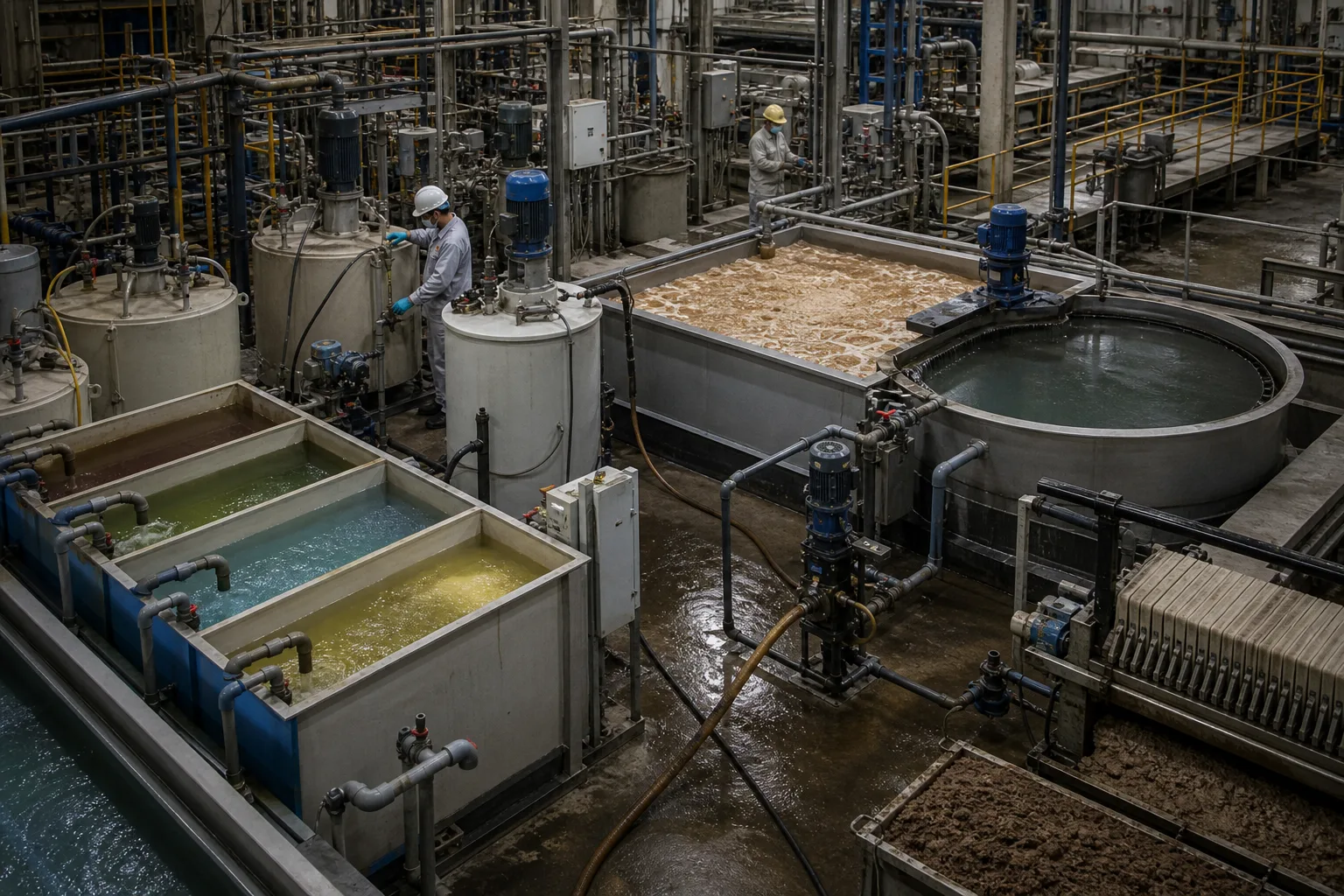 11Segregated collection/equalization22pH and precipitation reactors33Flocculation and clarification44Filter press and metal-bearing cake
What to identify
- 1Segregated collection/equalization
- 2pH and precipitation reactors
- 3Flocculation and clarification
- 4Filter press and metal-bearing cake
Figure takeaway
A pH setpoint completes only part of the chemistry. If mixing, reaction, flocculation, clarification, filtration, or sludge withdrawal fails, metal remains as dissolved species or suspended solids.
How to verify it in the field
Map each stream's source, flow, metals, and complexants. Trend pH/ORP, reagent mass rate, mixing/residence, floc, paired total/dissolved effluent, sludge quantity, and cake destination.
A beaker reactor shows why dosing, pH, and nucleation must be controlled together
A dropper adds base or precipitant, a probe reads pH, the impeller disperses reagent, and colored fine solids represent metal compounds or coprecipitates forming.
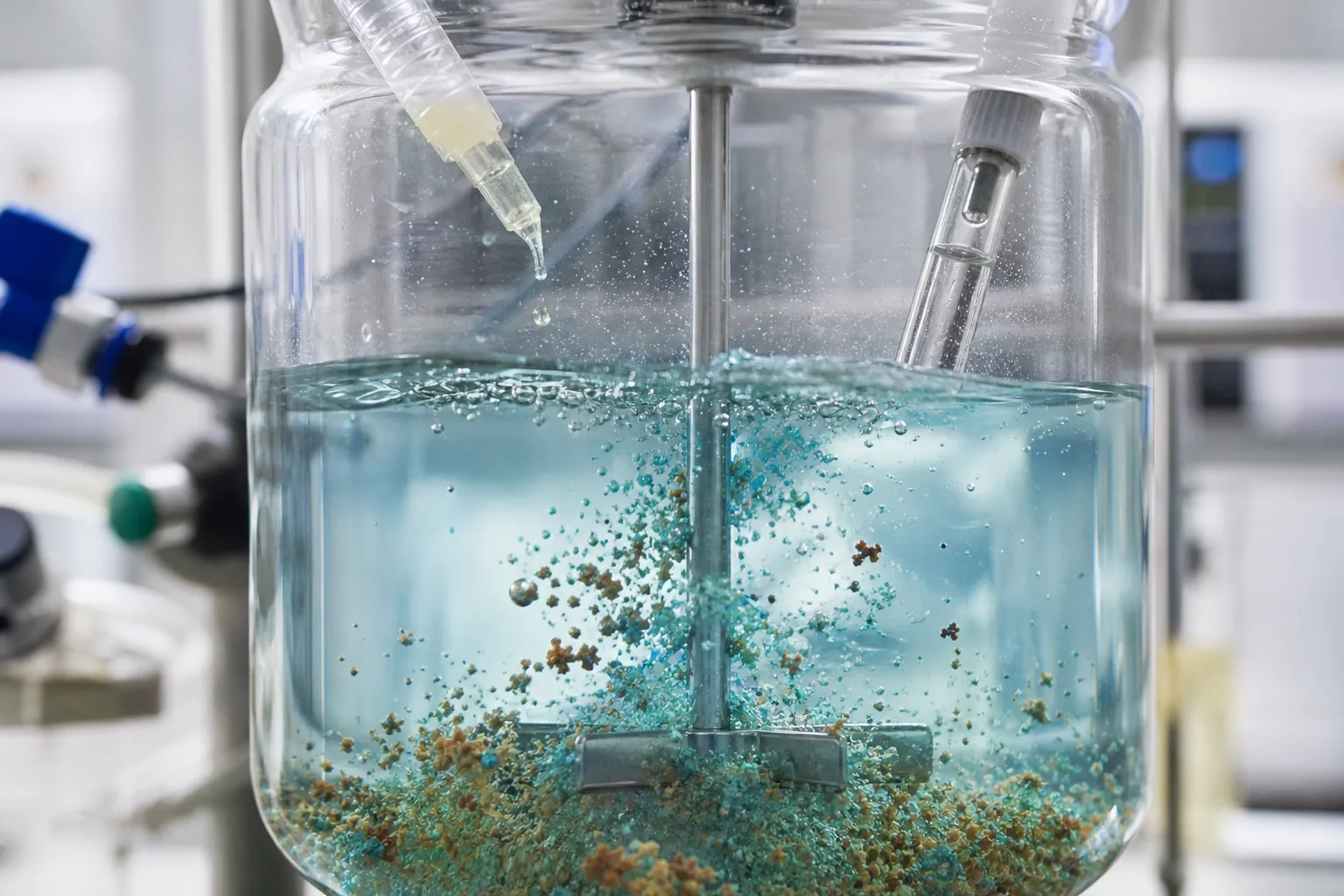 11Base or precipitant addition22Calibrated pH probe33Rapid mixing and nucleation zone44Fine metal-bearing precipitate
What to identify
- 1Base or precipitant addition
- 2Calibrated pH probe
- 3Rapid mixing and nucleation zone
- 4Fine metal-bearing precipitate
Figure takeaway
pH controls activity and speciation; it does not replace mass dose. At the same pH, complexation, alkalinity, temperature, ionic strength, valence, and reaction time can leave different dissolved residuals.
How to verify it in the field
Calibrate pH and record temperature. Titrate a representative sample, allow reaction, filter by the defined method, and measure dissolved and total metals rather than using color as a surrogate.
A transparent pilot makes dosing, rapid reaction, flocculation, and lamella separation visible
Metering pumps feed acid/base, reductant, or precipitant; front cells equalize and react, staged cells reduce shear for floc growth, and the lamella section settles solids.
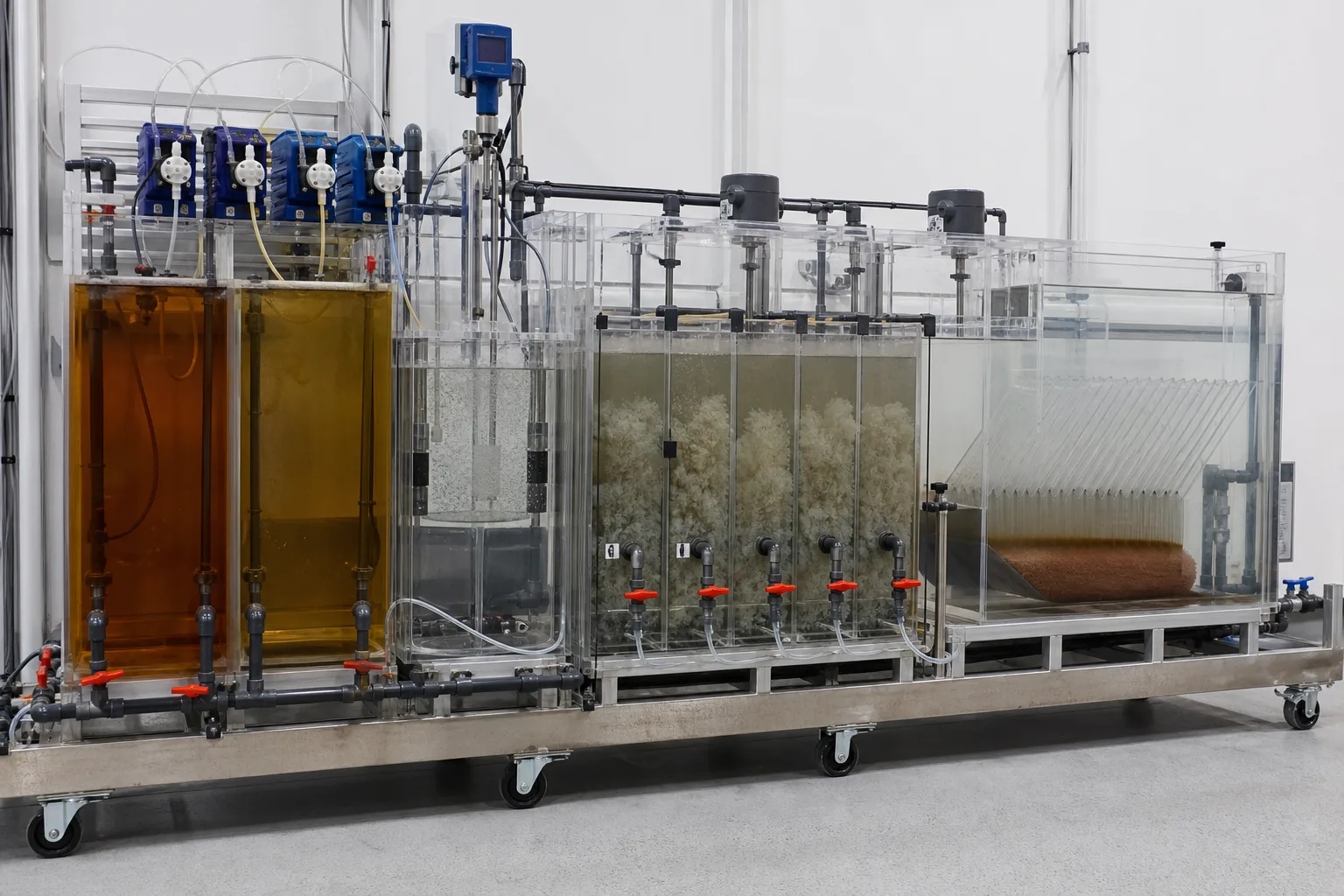 11Multiple reagent metering pumps22Equalization/redox and pH reaction33Staged flocculation cells44Lamella clarification and sludge
What to identify
- 1Multiple reagent metering pumps
- 2Equalization/redox and pH reaction
- 3Staged flocculation cells
- 4Lamella clarification and sludge
Figure takeaway
A pilot must preserve the intended dose sequence and hydraulics. Feeding every chemical at one high-shear point can defeat the distinct pH, time, and shear needs of reduction, precipitation, and flocculation.
How to verify it in the field
Verify chemical concentration, mass dose, spacing, mixing energy, and cell residence. Sample pH/ORP, dissolved metal, total metal, and solids along the train and quantify sludge volume.
Jar tests locate the shared window for low solubility and good separation
Five beakers represent pH, precipitant, or polymer candidates; some remain colored or fine, some form dense floc and clearer supernatant, and an overdose or high-pH candidate may worsen again.
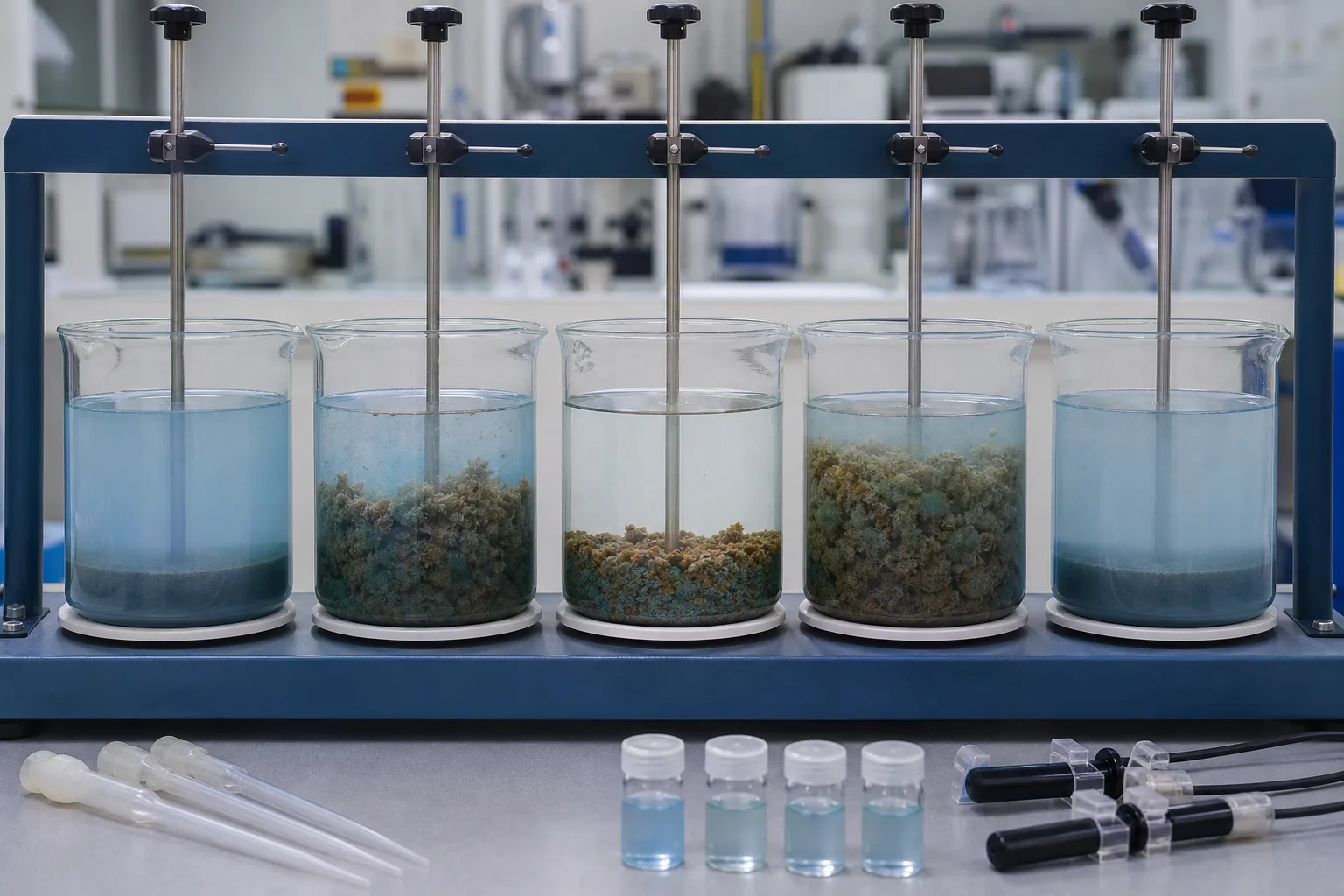 11pH and dose candidates22Large separable floc33Clearer supernatant and dense sludge44Under-treated, overdosed, or redissolved
What to identify
- 1pH and dose candidates
- 2Large separable floc
- 3Clearer supernatant and dense sludge
- 4Under-treated, overdosed, or redissolved
Figure takeaway
The largest floc is not necessarily the lowest dissolved metal, and the clearest supernatant is not automatically the lowest total metal. Compare residuals, separation, sludge, dose, and neutralization together.
How to verify it in the field
Hold feed and temperature constant; record instantaneous/equilibrium pH, ORP, dose, and mixing. After a common settling/filter method, analyze total/dissolved metals and repeat variable feeds.
A filter press reduces volume and transfers contamination; it does not detoxify it
Blue-green and brown metal-bearing cake forms between plates, filtrate is sampled, cake and liquid are retained in trays, and the rear hopper/pump handles sludge feed.
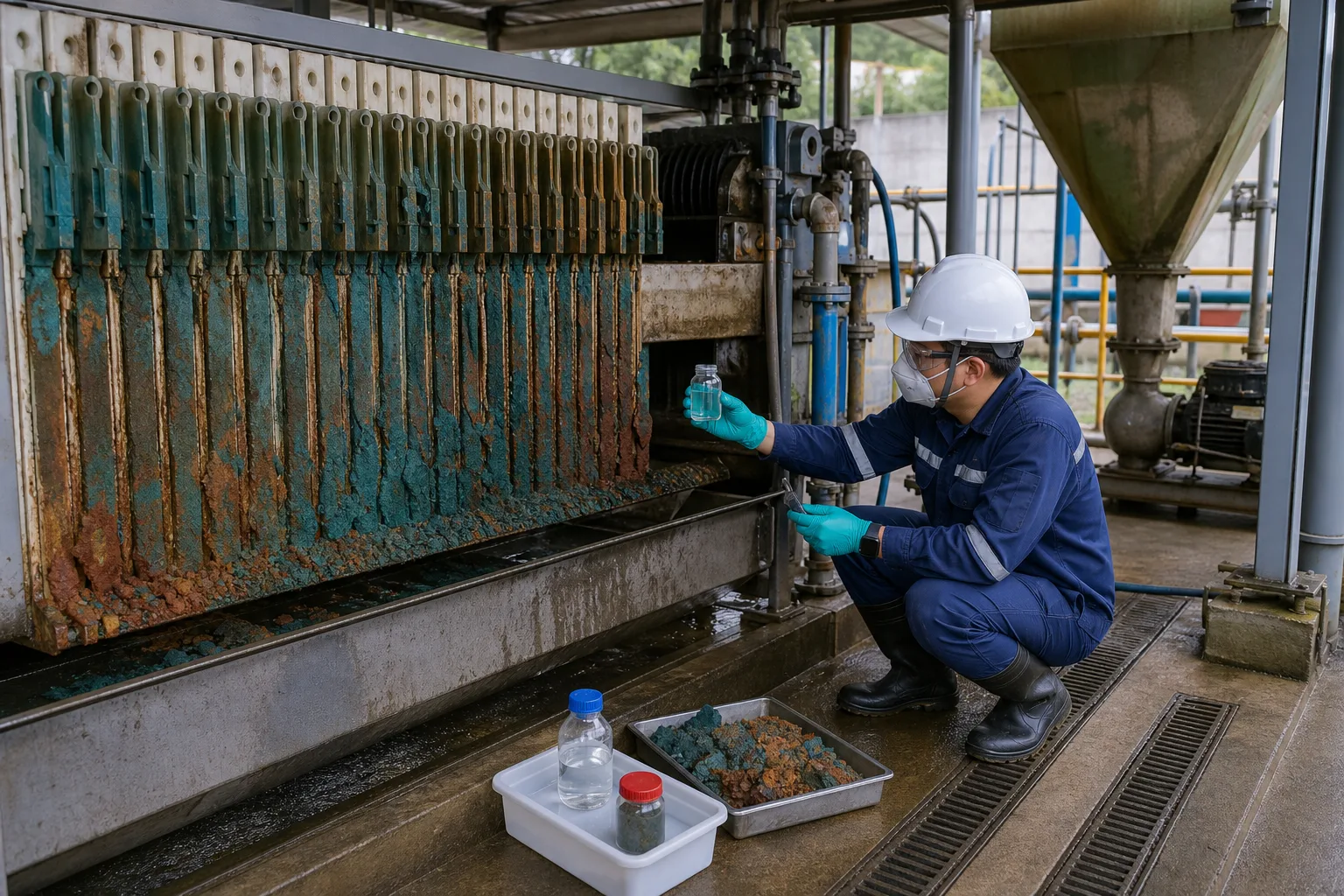 11Filter plates and metal-bearing cake22Filtrate sample and recycle decision33Cake sample and moisture44Sludge hopper/feed pump
What to identify
- 1Filter plates and metal-bearing cake
- 2Filtrate sample and recycle decision
- 3Cake sample and moisture
- 4Sludge hopper/feed pump
Figure takeaway
Pressing reduces water and recovers filtrate but concentrates metals in cake. Torn cloth or a poor cycle passes fine solids into filtrate; legal classification or recovery requires actual solid testing.
How to verify it in the field
Test filtrate total/dissolved metal and TSS; inspect cloth, pressure, feed, cycle, and wash. Weigh each cake batch, measure moisture and composition/leaching, and trace storage, transport, recovery, or disposal.
Six steps from dissolved metal to a controlled cake
Separate chemical conversion from physical removal to identify where the metal stopped.
1 Segregate/equalize
Variable streams → stable representative feed
Prevent incompatible reactions and smooth flow, concentration, and acidity.
2 Adjust redox/complexes
Difficult form → reactive metal species
Reduce Cr(VI), oxidize, or break complexes when required.
3 Precipitate
Mⁿ⁺ + OH⁻/S²⁻/CO₃²⁻ → solid
Lower dissolved solubility in a verified pH/dose window.
4 Grow floc
Fine precipitate → strong separable floc
Use controlled shear, coprecipitation, and polymer.
5 Separate solids
Floc → clarified/filtered sludge
Control both dissolved residual and suspended-solids carryover.
6 Dewater and verify
Sludge → cake/filtrate/destination
Verify water, filtrate, solids, and close the metal balance.
What four subsystems control
Oxidation state, solubility, floc, and residuals cannot be replaced by one pH number.
Segregation/equalization/redox
- Main job
- Stabilize load, identify complexes and valence, and complete required pretreatment
- Typical failure
- Incompatible mixing, unreduced Cr(VI), complexed soluble metal, or a concentration shock
- Evidence
- Source/flow log, multi-metals, pH/ORP, chelant/cyanide/ammonia, valence analysis
Precipitant and pH reaction
- Main job
- Supply reactive ion and maintain the low-solubility window and time
- Typical failure
- Under-dose, probe drift, poor mixing, low/high pH, or wrong single-stage target
- Evidence
- Calibration, reagent mass flow, field/lab pH, dissolved metals, alkalinity, treatability curves
Flocculation and clarification/filtration
- Main job
- Make strong floc and prevent solids from carrying into effluent
- Typical failure
- Fine/weak floc, shear breakage, sludge carryover, short-circuit, filter breakthrough
- Evidence
- Floc/settling, TSS, total-minus-dissolved, solids loading, blanket/outlet pattern, filtrate
Sludge dewatering and destination
- Main job
- Concentrate solids, recover filtrate, and control storage/transport/recovery/disposal
- Typical failure
- Cloth leakage, filtrate recycle load, wet cake, mixed batches, or noncompliant destination
- Evidence
- Cake mass/moisture, composition/leaching, filtrate, batch storage and transport/disposal record
Theoretical solubility curves are directional. Complexation, ionic strength, coprecipitation, kinetics, suspended solids, and analytical method make real wastewater differ from pure-water calculations; representative testing and continuous evidence must define the operating window. Sulfide use also needs specific H₂S-release, containment, ventilation, monitoring, and dosing-safety controls.
Pair three sample groups with three process states
Incoming speciation
Stream flow, total/dissolved metals, valence, pH/ORP, alkalinity, salinity, chelant/cyanide/ammonia, organics, and temperature.
Reaction and separation
Reagent concentration/mass dose, sequence, pH/ORP calibration, mixing/residence, floc, blanket, TSS, and total/dissolved profiles.
Effluent and residuals
Clarified/filtered effluent, press filtrate, and cake water/mass metal balance, cake moisture/composition/leaching, recycle, recovery, and disposal records.
Classify a high-metal effluent
- Combined signal
- Total metal is high but dissolved metal in a filtered split is low
- Suspect first
- Fine-floc carryover, clarifier/filter breakthrough, or disturbed sampling
- Next step
- Check TSS, floc, outlet pattern, sludge blanket/solids loading, and filters; standardize filtration/preservation and resample
- Combined signal
- Dissolved metal is high while reaction pH/ORP is outside its window
- Suspect first
- Reagent, probe, mixing/residence, or load peak left reaction incomplete
- Next step
- Verify calibration and mass dose onsite, inspect dose point/mixing/lag, and rerun a pH gradient on that batch
- Combined signal
- pH appears correct but one dissolved metal remains high
- Suspect first
- Wrong valence, strong complexation, amphoteric redissolution, salinity/temperature, or competition
- Next step
- Analyze valence/complexants and test staged pH, another precipitant, coprecipitation, or dedicated pretreatment
- Combined signal
- Jar tests work but full-scale total and dissolved results fluctuate
- Suspect first
- Weak segregation/equalization, scale-up dose error, nonequivalent spacing, mixing, hydraulics, or sampling
- Next step
- Recalculate mass load, profile the train, verify residence/mixing, and calibrate metering and controls
Four misconceptions
Higher pH always precipitates metals more completely
Many hydroxides are amphoteric and can redissolve beyond their minimum-solubility window; metals also have different optima.
Clear or colorless water proves compliance
Color is not analysis; clear water can contain complexed dissolved metal, while suspended fines raise total metal.
Precipitation destroys or detoxifies the metal
It concentrates metal from water into sludge. Cake and filtrate still require testing and controlled recovery or disposal.
One pH and recipe fit every feed
Metal mix, valence, complexes, salinity, and load change; mixed wastewater may need compromise or staged treatment and retesting.