Illustrated guides · Disinfection, oxidation, and micropollutants
How do chlorine dioxide and chlorine disinfection differ?
Both disinfect, but their aqueous species, pH dependence, selectivity, byproducts, residual strategy, and chemical systems are different.
Direct answer
Direct answer
Chlorine dioxide is not simply stronger chlorine. Chlorine forms mainly HOCl/OCl⁻ in water; pH shifts that balance, while ammonia and natural organic matter change demand, residual, chloramine formation, and THM/HAA risk. Its mature feed systems and durable distribution residual are practical strengths. Chlorine dioxide remains primarily a neutral dissolved molecule and selective one-electron oxidant rather than hydrolyzing through the chlorine equilibrium. Its performance is relatively less pH-dependent over common treatment ranges and it can be useful for selected odor compounds, phenols, iron, manganese, biofilm, and pathogens. Lower direct chlorination of organics does not mean no byproducts: chlorite and chlorate must be controlled, and free-chlorine impurity from poor generation can still form THMs/HAAs. Because concentrated chlorine dioxide is unstable and hazardous, it is normally generated on site; precursor metering, generator yield/purity, ventilation, gas monitoring, and residual control are part of the treatment process. There is no context-free winner. Compare organism and CT targets, pH, temperature, turbidity, NOM, ammonia, bromide, taste/odor or metals, distribution residual, byproduct limits, operator capability, safety, and lifecycle cost.
A fair comparison answers four questions
Kill rate or chemical price alone omits residual, byproducts, and generation quality.
Name the active species
Chlorine depends on HOCl/OCl⁻, demand, and chloramine formation; chlorine dioxide acts mainly as molecular ClO₂. Similar names do not imply the same pathway.
Count target removal and byproduct cost
Track THMs/HAAs and brominated species for chlorine, and chlorite/chlorate plus generator free chlorine for ClO₂.
Connect production, feed, contact, and residual
Generator purity and safety interlocks are process variables for ClO₂; chlorine still needs verified strength, demand, mixing, T10, and residual.
Select by duty, not by a universal ranking
Preoxidation, primary disinfection, taste/odor control, and distribution protection can call for different or combined strategies.
Two complete feed trains show that the difference is larger than the chemical tank
The ClO₂ train combines precursor metering, generation/reaction, and dilution; the chlorine train uses storage and metering before both connect to process water.
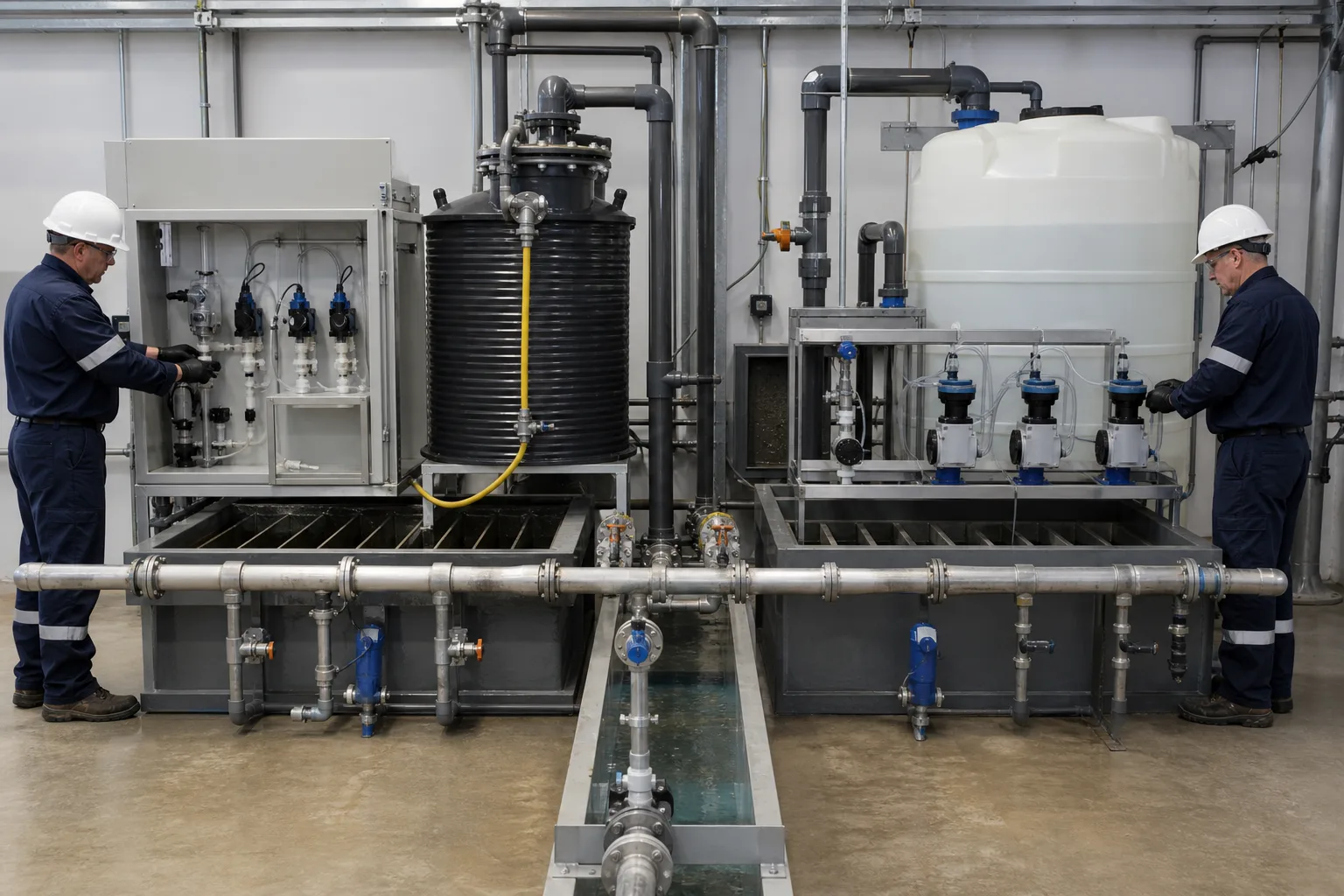 11ClO₂ precursors/generator cabinet22Reaction and dilution tank33Chlorine/hypochlorite storage and feed44Common process-water injection header
What to identify
- 1ClO₂ precursors/generator cabinet
- 2Reaction and dilution tank
- 3Chlorine/hypochlorite storage and feed
- 4Common process-water injection header
Figure takeaway
Chlorine feed is usually more direct. ClO₂ adds reliable on-site creation of the target molecule as a central unit operation; equal pump volume is not equal active dose.
How to verify it in the field
Verify active concentration, calibrated feed, water flow, mixing, and contact in both trains; also verify ClO₂ yield, purity, interlocks, and ventilation.
Parallel reactors must compare the same water and contact conditions
Matched chlorine and ClO₂ reactors use pumps, probes, culture plates, and byproduct samples to compare organisms, residual, and reaction cost together.
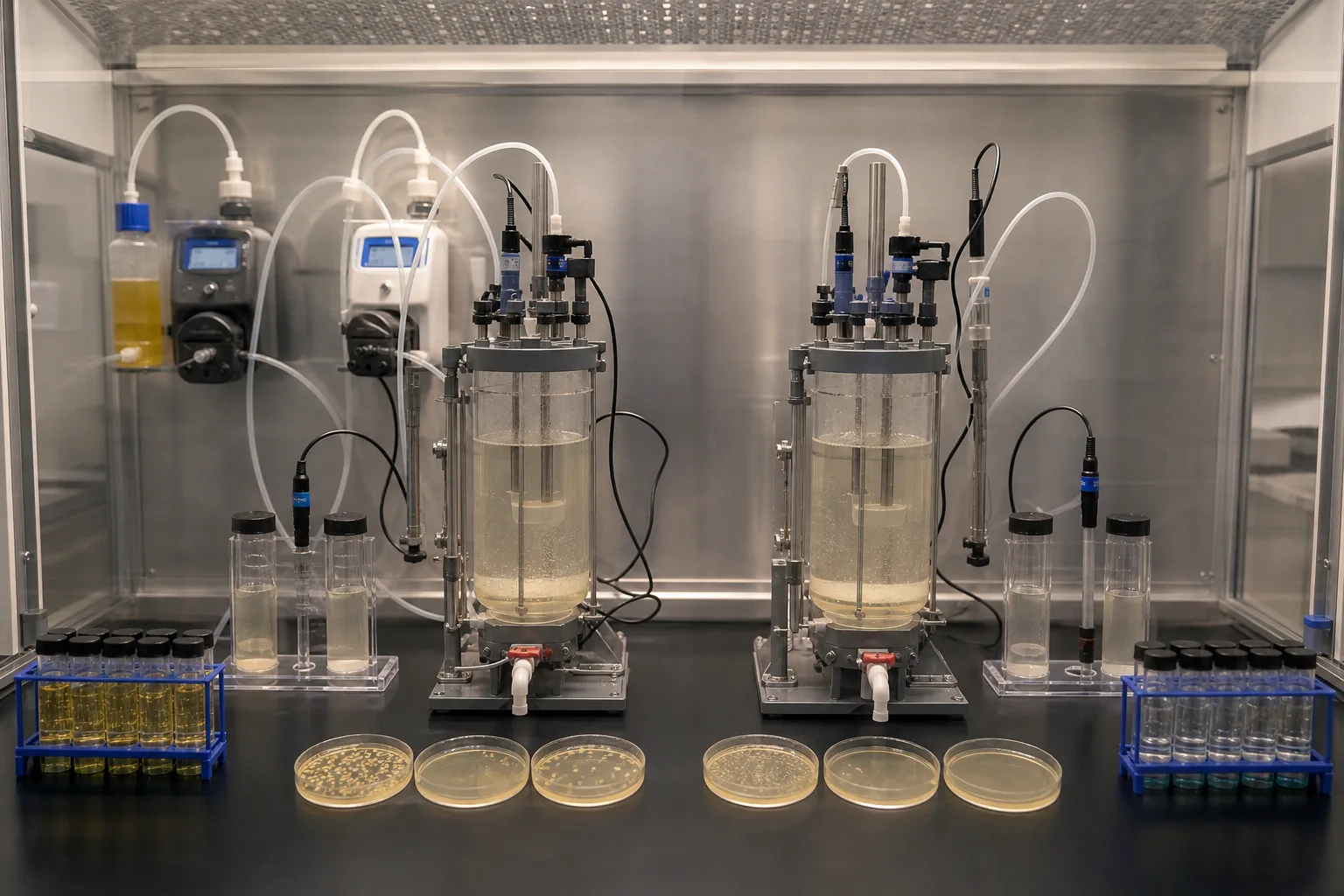 11Chlorine reactor and controls22ClO₂ reactor and controls33Paired microbial results44Residual and byproduct samples
What to identify
- 1Chlorine reactor and controls
- 2ClO₂ reactor and controls
- 3Paired microbial results
- 4Residual and byproduct samples
Figure takeaway
Only matched water, pH, temperature, dose, and time support a performance comparison. Passing microbes does not replace residual and byproduct measurements.
How to verify it in the field
Record actual disinfectant before/after contact, tracer-derived T10, pH, temperature, turbidity, log inactivation, chlorine residual, ClO₂, chlorite/chlorate, and applicable DBPs.
On-site generation quality controls the finished ClO₂ treatment
Separated precursors enter an enclosed generator through dedicated pumps; product is monitored, diluted, and injected while the operator uses respiratory and face protection.
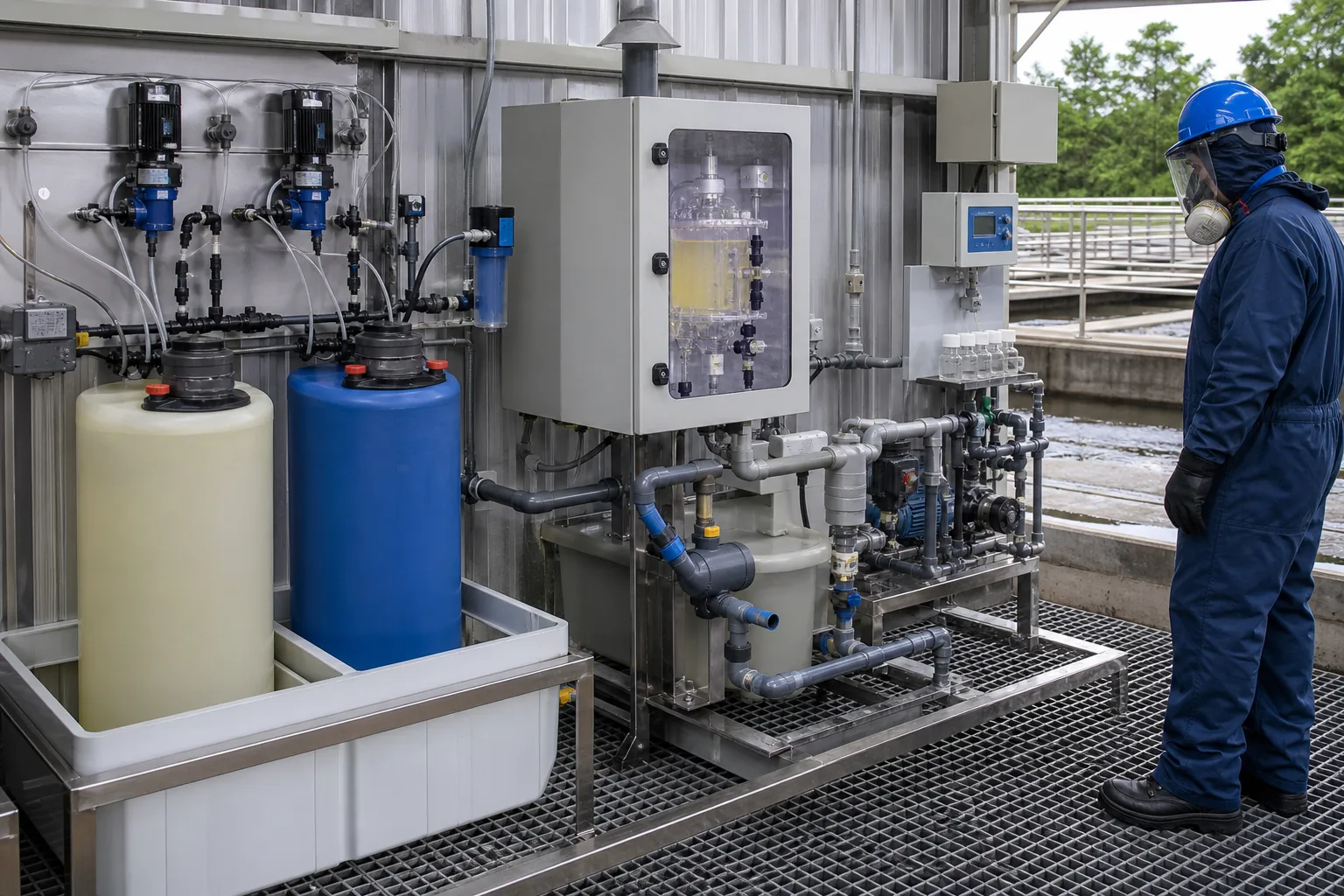 11Segregated precursor tanks22Precursor metering and flow verification33Enclosed generator/reaction chamber44Product monitoring, dilution, injection
What to identify
- 1Segregated precursor tanks
- 2Precursor metering and flow verification
- 3Enclosed generator/reaction chamber
- 4Product monitoring, dilution, injection
Figure takeaway
A generator is not a black box. Off-ratio feed can reduce yield and increase free chlorine, chlorite, or chlorate, while concentrated gas accumulation creates a safety hazard.
How to verify it in the field
Verify precursor identity/segregation, actual pump output, product strength/purity, pressure-flow interlocks, ventilation, and calibrated gas detection—not just a run lamp.
Pipe-loop appearance can illustrate selectivity, not universal superiority
Matched loops show heavier deposit/corrosion on one side and a cleaner second loop, with common feed controls and paired samples/coupons.
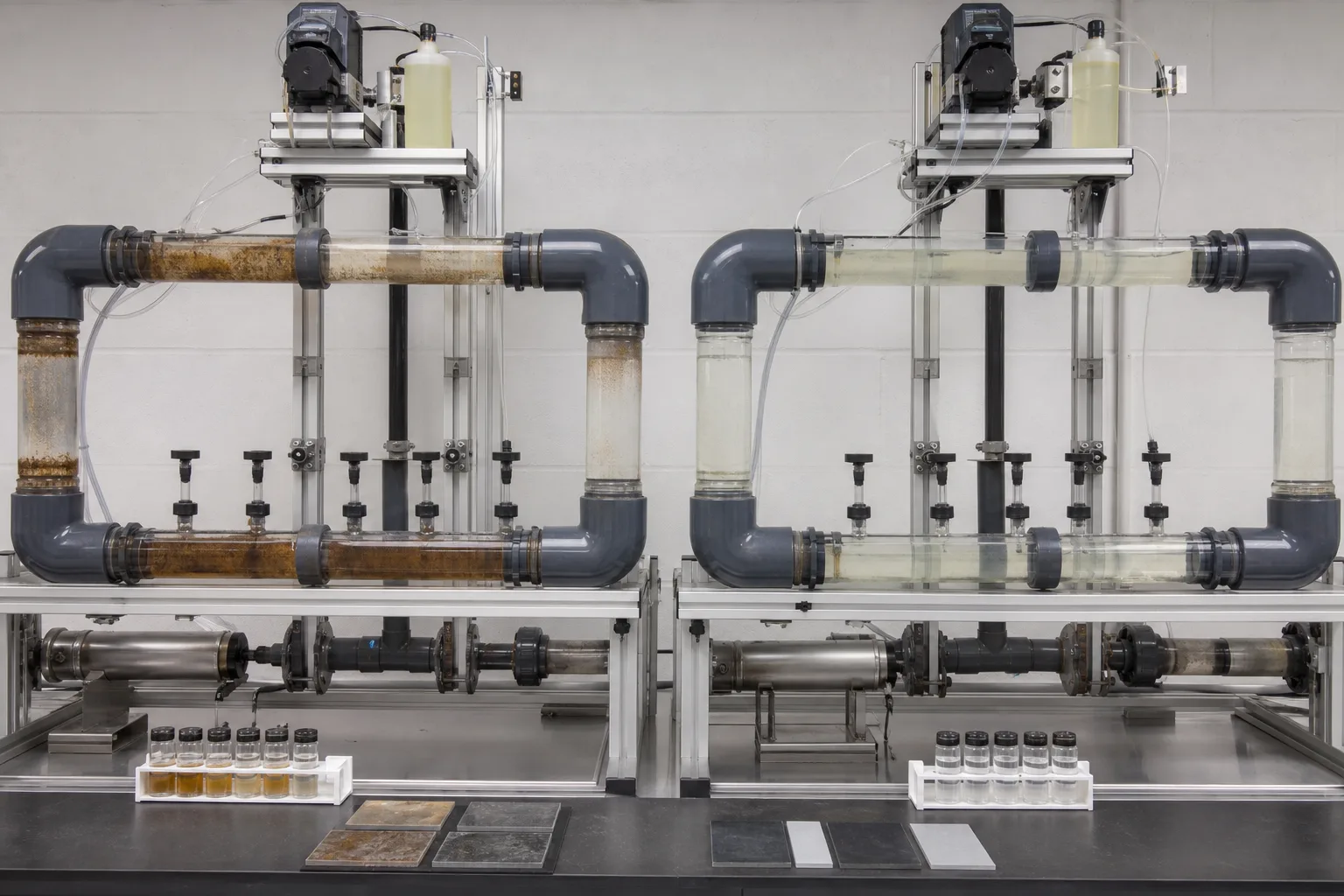 11Higher-demand/deposit chlorine loop22Relatively clean ClO₂ loop33Matched dose and flow controls44Paired samples and corrosion coupons
What to identify
- 1Higher-demand/deposit chlorine loop
- 2Relatively clean ClO₂ loop
- 3Matched dose and flow controls
- 4Paired samples and corrosion coupons
Figure takeaway
ClO₂ can help specific biofilm, iron/manganese, or odor duties, but this result applies only to the tested water, material, dose, and time. Appearance is not a corrosion measurement.
How to verify it in the field
Match material, velocity, temperature, loading, and age; then verify pressure loss, ATP/biofilm, metals, corrosion coupons, and byproduct trends.
Choosing ClO₂ adds generator operation and gas-safety duties
The operator checks precursor flowmeters, the reaction chamber, and product samples while PPE, ventilation, and monitoring manage leak and instability hazards.
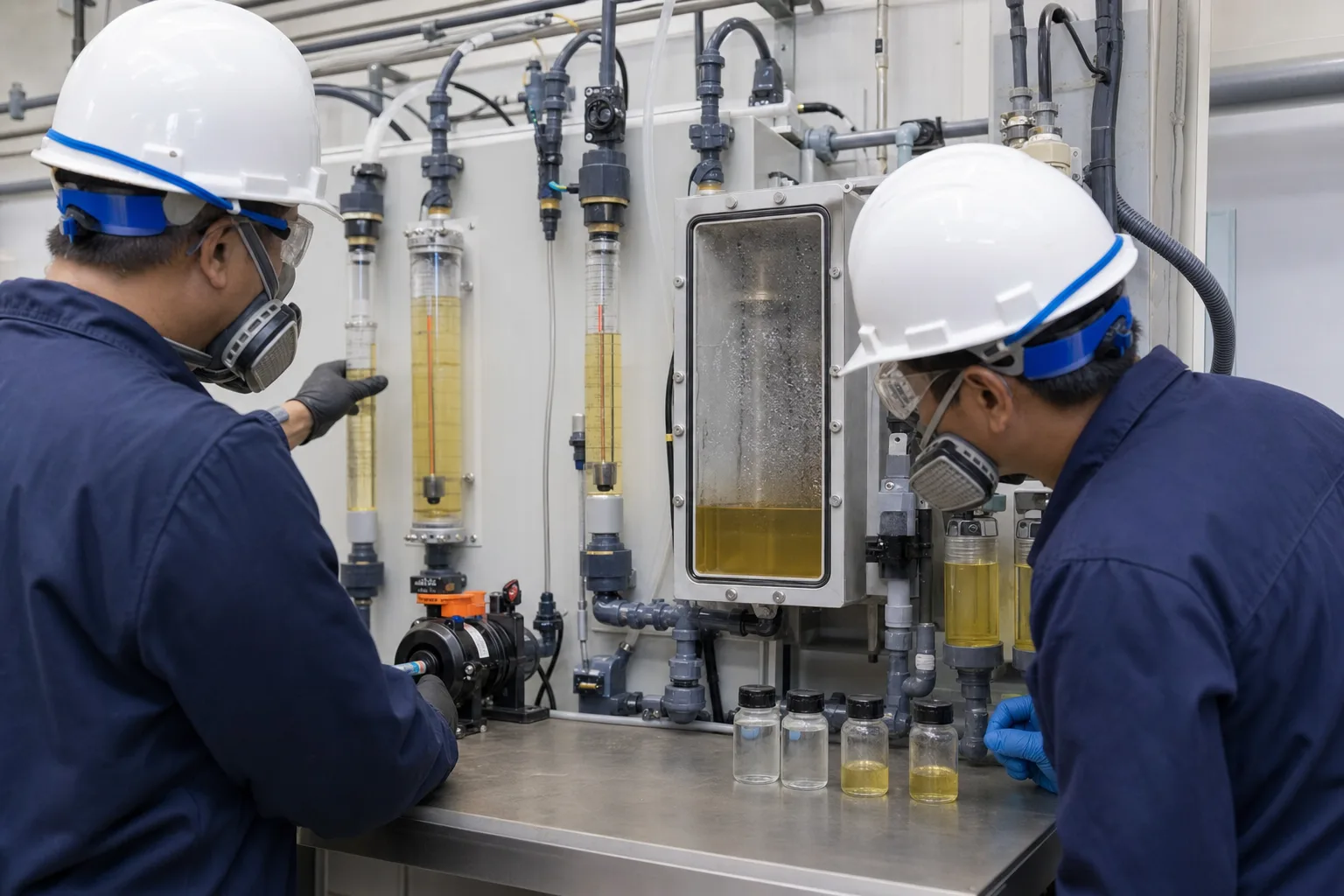 11Precursor flowmeters22Reaction chamber and sight window33Product/byproduct samples44PPE, ventilation, gas monitoring
What to identify
- 1Precursor flowmeters
- 2Reaction chamber and sight window
- 3Product/byproduct samples
- 4PPE, ventilation, gas monitoring
Figure takeaway
ClO₂ benefits depend on stable purity and controlled residual. Without trained staff, analysis, maintenance, and interlocks, the generator becomes a major process risk.
How to verify it in the field
Audit training, routine analysis, alarm/trip tests, ventilation and detector calibration, emergency response, spares, and precursor turnover.
Six decisions from water-quality goal to selection
Define the duty first, then compare complete treatment trains with the same evidence.
1 Define duty
Preoxidation / primary disinfection / odor / residual
Do not merge different treatment locations into one question.
2 Bound the water
pH, temperature, turbidity, NOM, ammonia, bromide, metals
Predict demand, species, and byproduct paths.
3 Test dose and contact
Measured strength × T10 → target response
Confirm real CT and removal.
4 Measure byproducts
THM/HAA ↔ chlorite/chlorate
Quantify the trade instead of hiding it.
5 Assess operating capacity
Storage/generation → feed → interlock → monitoring
Prove the system can sustain purity and dose.
6 Select and verify
Finished water + distribution trends
Reassess when source water or season changes.
Put the decisive differences in one table
Compare complete systems, not two chemical names.
Active species
- Chlorine
- HOCl/OCl⁻, pH-dependent; ammonia can form chloramines
- Chlorine dioxide
- Molecular ClO₂, without the same hypochlorous equilibrium
- Evidence
- pH, temperature, ammonia, free/total chlorine, ClO₂ residual
Useful duties
- Chlorine
- Mature primary disinfection and practical distribution residual
- Chlorine dioxide
- Selective oxidation of odors, phenols, Fe/Mn, biofilm, selected organisms
- Evidence
- Target, CT, real-water tests, profile residual
Byproducts
- Chlorine
- THMs, HAAs, chloramines, brominated species depend on precursors
- Chlorine dioxide
- Chlorite/chlorate; generator free chlorine can still form THMs/HAAs
- Evidence
- Full DBP suite, generator purity, seasonal trends
Operations
- Chlorine
- Chemical storage/feed, mixing, contact, residual control
- Chlorine dioxide
- Precursor segregation, on-site generation, dilution, ventilation, alarms, purity
- Evidence
- Calibration, mass balance, interlock tests, analysis, training
Drinking-water and wastewater dose, CT, residual, and byproduct requirements differ. Follow local rules and approved methods; this guide intentionally provides no generator recipe or fixed dose.
Align three evidence groups in every comparison
Water and hydraulics
Same-batch pH, temperature, turbidity, UV254/TOC, ammonia, bromide, Fe/Mn, targets, actual flow, mixing, short-circuiting, and tracer T10.
Active chemical and generation
Free/total chlorine and solution strength; ClO₂ product strength, generator yield/purity, free chlorine, chlorite/chlorate, and precursor flows.
Outcome and sustainability
Organisms, target compounds, DBPs, corrosion/biofilm, distribution residual, chemical and energy use, maintenance, downtime, and operator burden.
Separate chemistry faults from equipment faults
- Combined signal
- Stable chlorine feed but poorer free residual/inactivation as pH or ammonia rises
- Suspect first
- Lower HOCl fraction, higher demand, or chloramine conversion
- Next step
- Measure pH, ammonia, free/total chlorine, demand profile, and actual T10 before increasing feed
- Combined signal
- Generator says run, but ClO₂ strength falls while impurity/byproducts rise
- Suspect first
- Precursor flow/ratio, reaction condition, or purity failure
- Next step
- Stop/isolate per procedure; measure pumps, product strength, and purity and prove interlocks before restart
- Combined signal
- Microbes pass while THM/HAA or chlorite/chlorate approaches a limit
- Suspect first
- The controlling constraint has shifted to byproducts
- Next step
- Repeat real-water dose-contact-DBP optimization; improve pretreatment/generation or reconsider feed point/combined treatment
- Combined signal
- Plant residual is adequate but distribution endpoint decays with biofilm/odor recurrence
- Suspect first
- Network demand, age, or residual strategy—not chemical name alone
- Next step
- Profile residual, age, temperature, ATP/microbes, and wall demand and separate primary from secondary control
Four common misconceptions
Chlorine dioxide is concentrated chlorine
They are different oxidants with different aqueous species, reaction pathways, and byproducts.
ClO₂ creates no disinfection byproducts
It forms chlorite/chlorate, and generator free chlorine can still form THMs/HAAs.
A clean pipe photo proves ClO₂ is always better
Only matched water, materials, dose, and time plus biofilm, corrosion, target, and DBP data support the result.
Owning a generator means reliable ClO₂
Precursors, calibration, purity, ventilation, monitoring, interlocks, training, and residual analysis all matter.