Giải thích bằng hình · Hệ nước công nghiệp
Vì sao cáu cặn, ăn mòn và bám bẩn sinh học thường xuất hiện cùng nhau?
Theo supersaturation, electrochemical loss và EPS vào rough surface, hot spot, under-deposit microenvironment và composite feedback.
Trả lời trực tiếp
Trả lời trực tiếp
Scale, corrosion và biofouling khởi đầu khác nhau nhưng khuếch đại nhau trên cùng bề mặt. Scale là mineral layer do supersaturation, pH và wall temperature; corrosion là metal loss điện hóa chịu oxygen, chloride, pH, material và galvanic/stress; biofouling là cells và EPS bám, lớn lên, bắt organic/particles. Scale/rust tạo rough attachment/nucleation; EPS dính crystals, dust và rust; layer tăng heat resistance, giảm flow và tạo hot/low-shear zones; bên dưới hình thành gradient oxygen, pH, ions và disinfectant, gây differential-aeration, crevice/pitting và có thể MIC; rust lại làm scaffold. Deposit thật thường có slime trên, mineral/particles giữa, rust/pits dưới. Detect microbes không tự chứng minh MIC. Cần giữ location/layers và kết hợp chemistry, microbiology theo phương pháp, coupons/probes, metallography và performance. Control phải phối hợp CoC/scale inhibitor, corrosion/disinfection phù hợp material, velocity/distribution, dead-leg, side-stream solids removal và cleaning/disinfection theo risk.
Bốn điều tạo feedback
Tách initiation khỏi interaction.
Rough/sheltered substrate
Scale, weld, pit, dust và rust giảm shear, tăng nucleation/attachment.
Surface khác bulk sample
Wall T, flow, oxygen, pH, ions và residual dưới deposit khác basin.
EPS/particles/rust kết dính
Composite tăng heat/DP/demand và khó cleaning.
Control chỉ một path
Scale-only, biocide không remove deposit, acid/oxidation quá mức chuyển risk sang corrosion.
Opened tubesheet thường có white mineral, green slime, rust và blocked tubes
Các flow zones khác nhau cần sample theo location/layer.
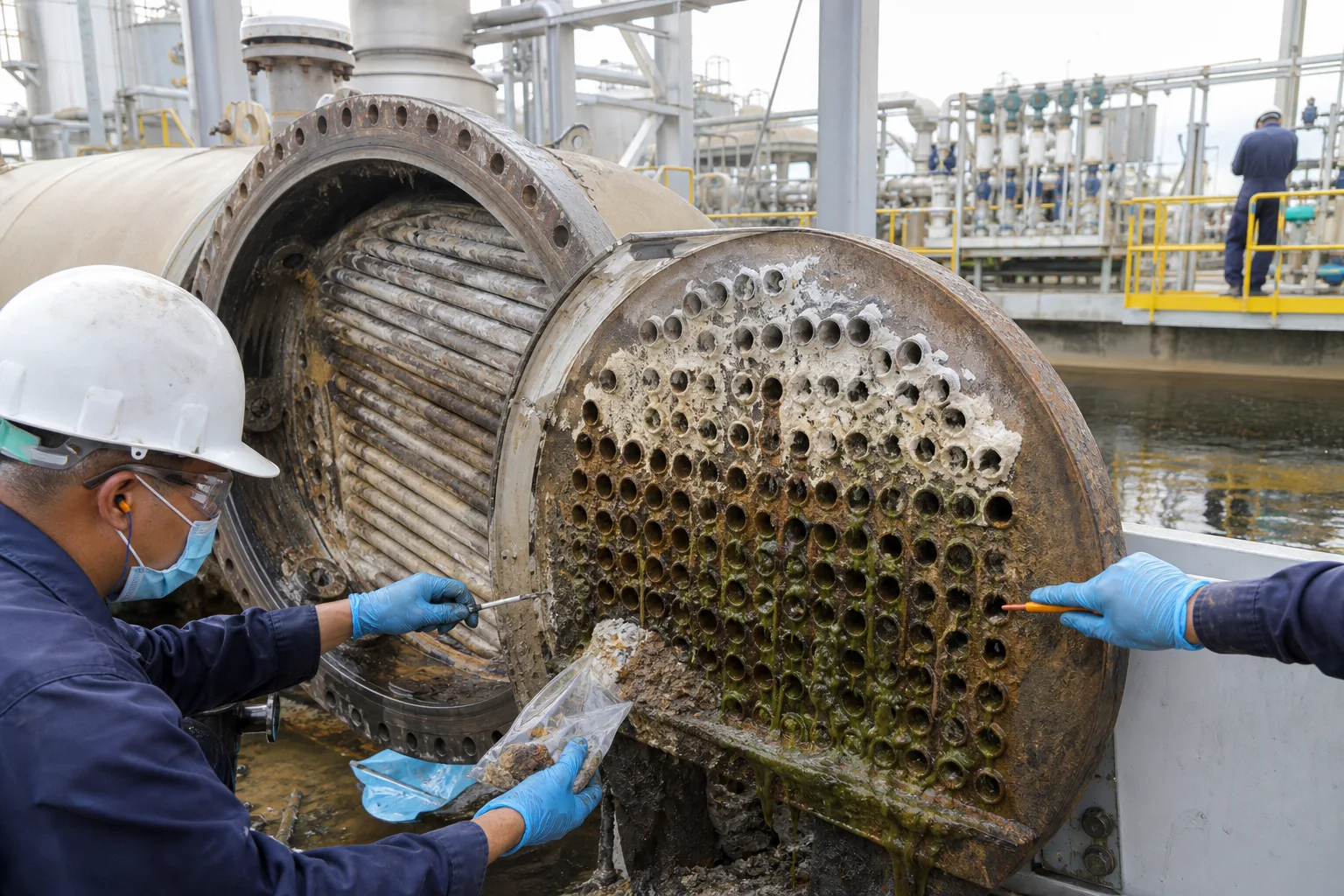 11White hard scale22Green biofilm/EPS33Brown-black rust/pits44Composite tube-mouth blockage
Điểm cần nhận ra
- 1White hard scale
- 2Green biofilm/EPS
- 3Brown-black rust/pits
- 4Composite tube-mouth blockage
Kết luận từ hình
Ba màu không phải ba failure tách rời; distribution, temperature và velocity tạo zones rồi deposits nhập lại.
Kiểm tra hiện trường
Sau isolate/depressurize/LOTO, map top/middle/bottom và inlet/outlet; giữ slime, scale, rust, substrate riêng và một mẫu undisturbed.
Cross-section cho biofilm, mineral, rust và pit trên base metal
Hướng nước và interface quan trọng như composition.
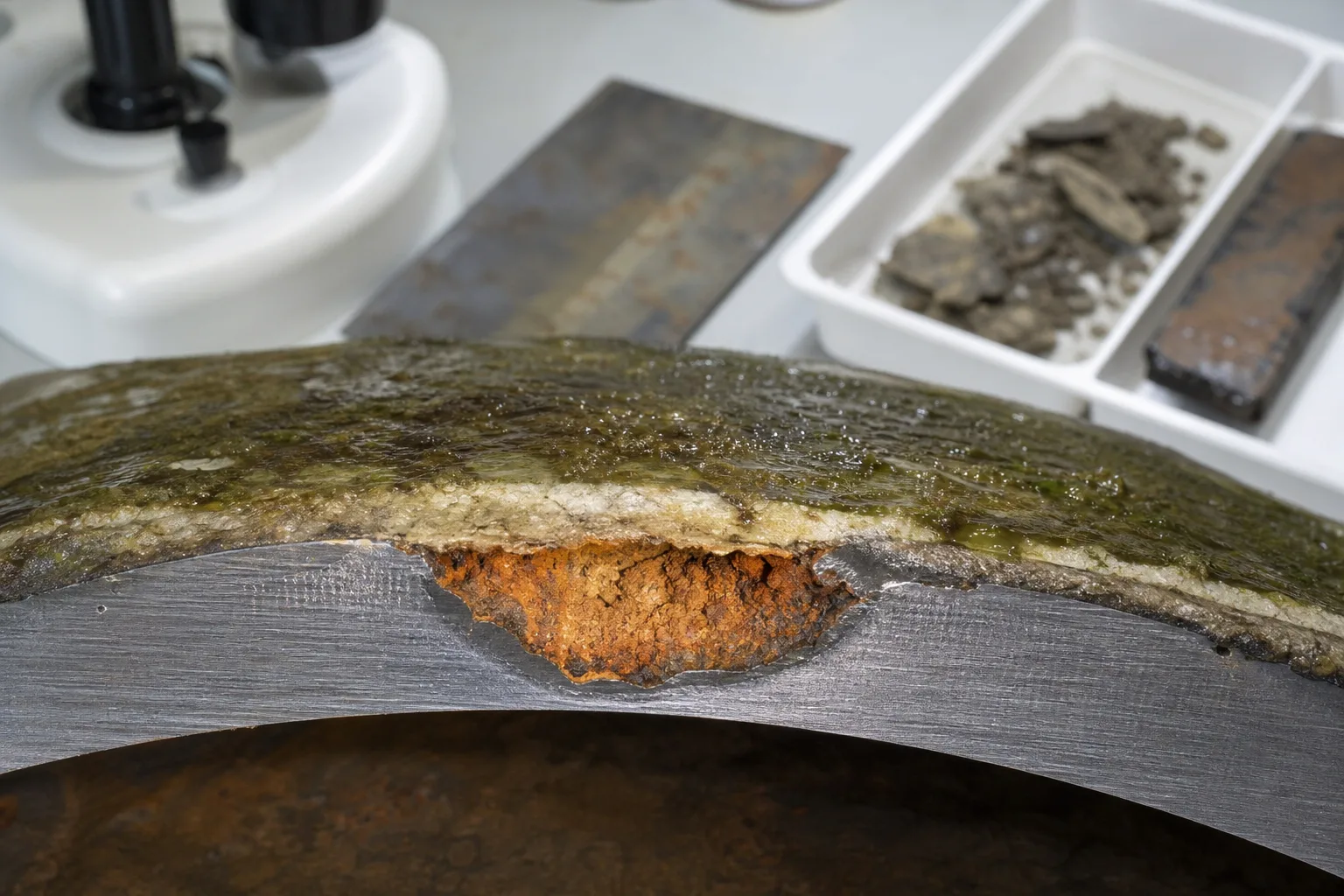 11Biofilm/EPS bề mặt22Mineral/particle layer33Under-deposit rust/pit44Base metal/pit mouth
Điểm cần nhận ra
- 1Biofilm/EPS bề mặt
- 2Mineral/particle layer
- 3Under-deposit rust/pit
- 4Base metal/pit mouth
Kết luận từ hình
Deposit tạo gradient riêng; under-deposit corrosion có thể có, nhưng MIC cần bằng chứng activity-corrosion.
Kiểm tra hiện trường
Đánh dấu orientation, phân tích layers/substrate, pit/metallography và bảo quản microbial sample đúng method.
Bốn matched loops tách scale, corrosion, biofilm và composite
So sánh chỉ đúng khi material/heat/flow/chemistry/time/treatment khớp.
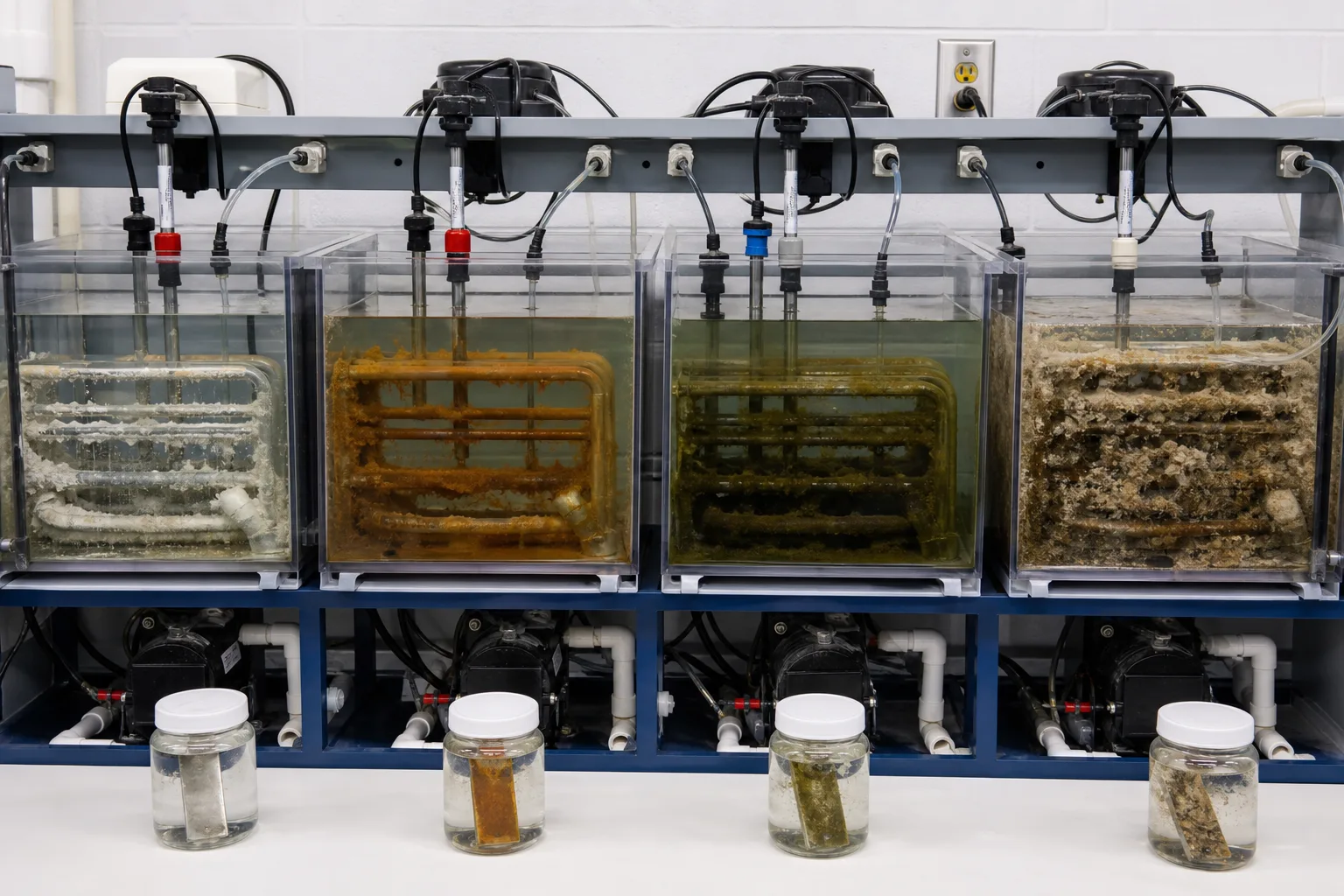 11Mineral scale22Metal loss/rust33Growth/EPS44Composite layer
Điểm cần nhận ra
- 1Mineral scale
- 2Metal loss/rust
- 3Growth/EPS
- 4Composite layer
Kết luận từ hình
Bất kỳ path nào start; composite thường gây DP, heat loss và localized metal loss lớn nhất.
Kiểm tra hiện trường
Trend chemistry/residual/T/flow/heat, biology, mass loss/probes, DP/U với blank/repeat.
Bốn exchangers cho thấy appearance chỉ là first evidence
Clean, mineral, rust và dark composite ghép với samples/probes.
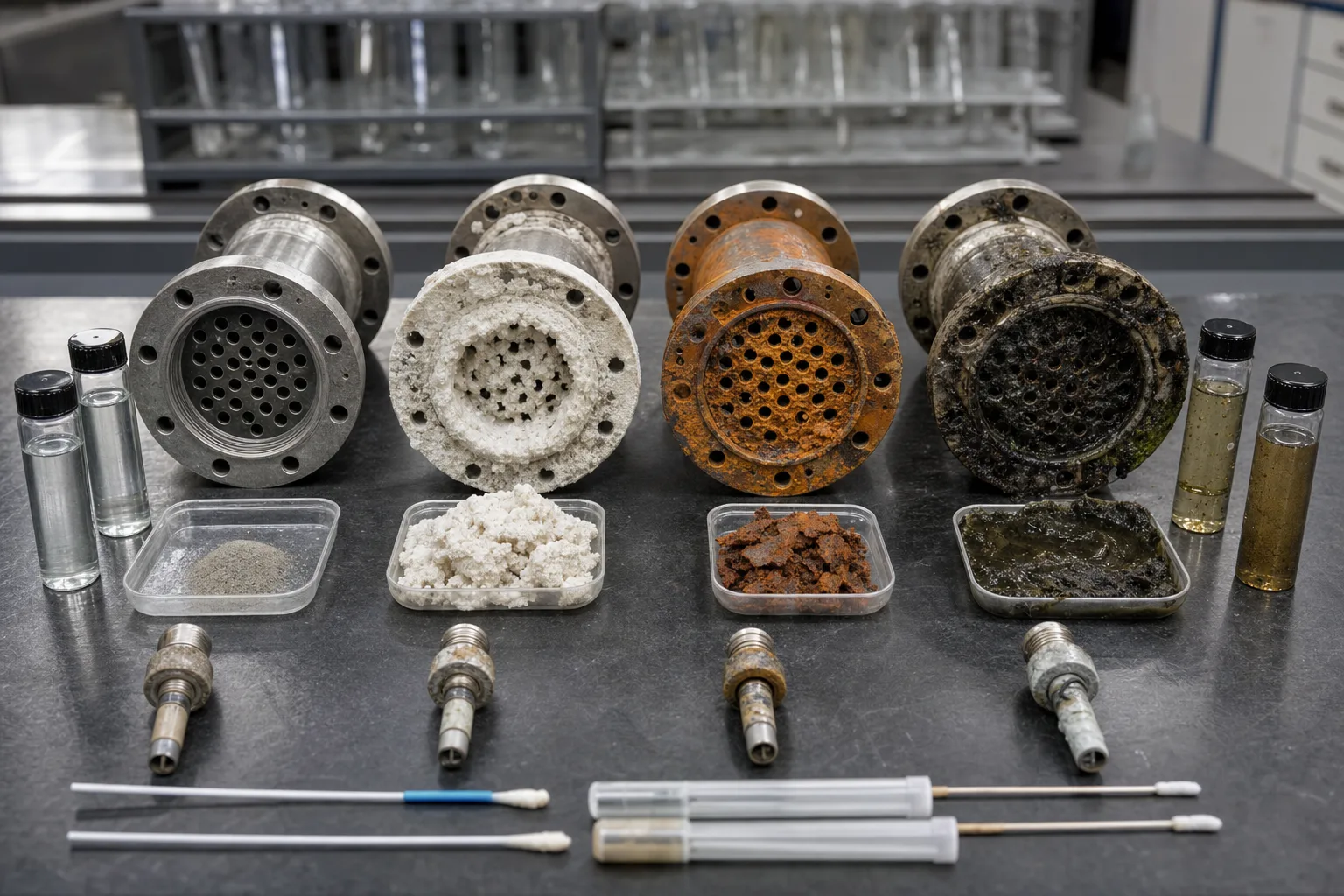 11Clean baseline22White scale33Corrosion/rust44Dark bio/composite
Điểm cần nhận ra
- 1Clean baseline
- 2White scale
- 3Corrosion/rust
- 4Dark bio/composite
Kết luận từ hình
Color không unique; cần structure, composition và performance đồng ý.
Kiểm tra hiện trường
Đo organic/mineral/element/microbiology, pit/wall/mass loss và DP/approach/recovery.
Inspection ghép borescope, tube map, layers và specimens
Location/time nối water, deposit và metal evidence.
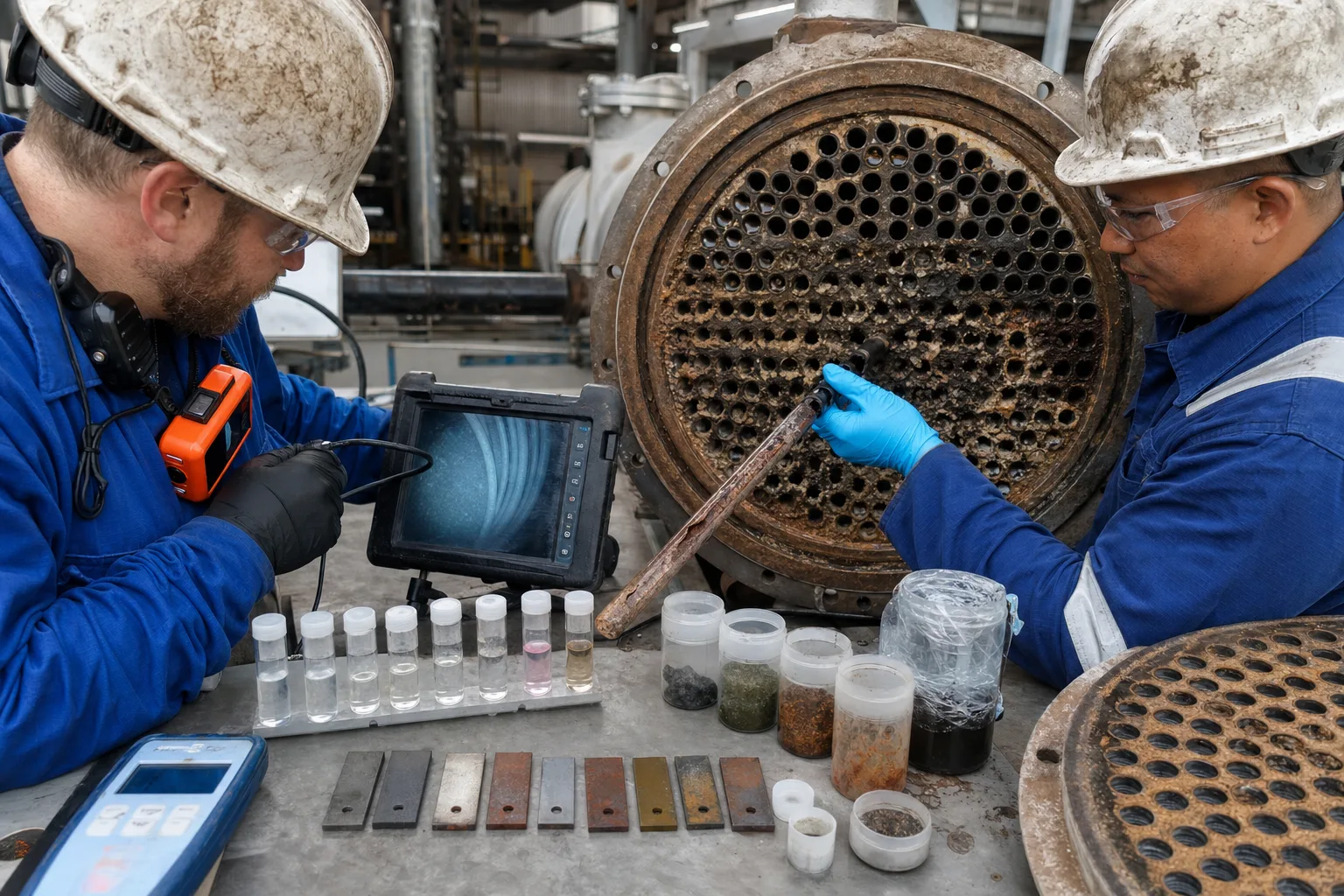 11Borescope distribution22Tube-numbered samples33Coupons/probes/substrate44Plug/pit/wall map
Điểm cần nhận ra
- 1Borescope distribution
- 2Tube-numbered samples
- 3Coupons/probes/substrate
- 4Plug/pit/wall map
Kết luận từ hình
Detected organism/element chỉ có nghĩa khi location/layer/time/performance tạo causal chain.
Kiểm tra hiện trường
Map trước cleaning; dùng cleaning phù hợp material/OEM, exposure/waste control, rồi retest leaks/performance/limits.
Bảy bước feedback
Path có thể bắt đầu ở scale, rust, solids hoặc biofilm.
1 Initiate
Supersaturation/corrosion/cells/solids
Nguồn riêng.
2 Attach
Crystals/cells/dust → rough/low flow
Coverage đầu.
3 Barrier
Layer → heat/DP/hot/low shear
Surface lệch bulk.
4 EPS capture
Biofilm → crystals/solids/rust
Composite/demand.
5 Gradient
Limited transfer → O₂/pH/ions/residual
Under-deposit risk.
6 Rust scaffold
Metal loss → oxides/pits
More trapping.
7 Verify
Heat/DP/wall/hygiene → layers
Target cause/recovery.
Chứng minh bốn mechanism
Overlap/color không lập cause.
Scale
- Effect
- Hard mineral/heat resistance
- Amplify
- Hot/pH/hardness/silica/low flow/rough
- Evidence
- Chemistry/mineral/thickness/location/heat
Corrosion
- Effect
- Metal loss/pit/crevice
- Amplify
- Deposit oxygen cell; rust traps
- Evidence
- Wall/pit/coupon/probe/metallography
Biofouling
- Effect
- Slime/demand/solid capture
- Amplify
- Scale/rust shelter; MIC possible
- Evidence
- Located slime, methods, microscopy, residual
Solids/hydraulics
- Effect
- Deposit load/location
- Amplify
- Seeds/hosts; dead zones
- Evidence
- TSS/PSD/filter/tracer/flow/history
Microbe/ATP/black deposit không tự chứng minh MIC; cần activity, pit, chemistry, corrosion rate, location/time.
Ba nhóm cùng timeline
Water/treatment
Chemistry, CoC, TSS/PSD/organic/T, residual/feed/B/filter.
Surface/layers
Tube map, photos, thickness, layered analyses, rust, pit/wall/material.
Equipment/hygiene
Approach/U/DP/power, coupons/probes, leak, recovery, dead zones, drift/WMP.
Location–layer–performance–time
- Signal
- Approach xấu, hard white crystals trên hot surface
- Nghi
- Scale do saturation/wall T
- Bước tiếp
- Full chemistry/heat/flow/mineral/thickness/CoC/inhibitor/recovery
- Signal
- Average corrosion thấp nhưng deep pits dưới deposit
- Nghi
- Under-deposit; MIC possible
- Bước tiếp
- Preserve cross-section, pits/layers/microbiology/material/trends
- Signal
- Slime/biology tăng, return residual thấp, DP nhanh
- Nghi
- EPS/dead zone/poor penetration
- Bước tiếp
- Map flow/age/residual, cleaning/disinfection/filter
- Signal
- Loose solids/TSS/DP tăng
- Nghi
- Dust/leak/rust scaffold
- Bước tiếp
- Particle/source/distribution/filter and remove
Bốn hiểu lầm
Màu xác định cause
Không; cần layers/chemistry/location/outcome.
Bulk water tốt loại trừ under-deposit
Surface có microenvironment riêng.
Detect bacteria chứng minh MIC
Cần link activity với corrosion mechanism.
Một chemical mạnh giải quyết hết
Acid/oxidant/dispersant có material/side-effect limits.