Solutions · Sustainability & ESG
Condensate Water Recovery: high-purity thermal water back to boiler makeup
Polishing condensate for lower makeup, energy, and chemical oxygen scavenger demand—simple heat balance wins.
Use this guide within its scope
This page supports technical research and option comparison and is marked 2026. Illustrative values are not a quotation, completed process design, certification conclusion, or performance guarantee. Check current regulations, feed data, tests, and OEM records.
Problem
Blowing condensate to drain wastes heat and drives extra makeup treatment.
Technology
Polishing, oxygen control, and leak detection on return headers.
Results
Fuel and chemical savings with documented mass and energy balance.
Engineering decision card
Use when
Blowing condensate to drain wastes heat and drives extra makeup treatment.
Evaluate first
Polishing, oxygen control, and leak detection on return headers.
Inputs still required
Feed source and variability, capacity, target quality, operating hours, discharge or reuse boundary, available space, and utilities.
Comparison output
Fuel and chemical savings with documented mass and energy balance. The final decision still needs feed data, mass balance, and any necessary testing.
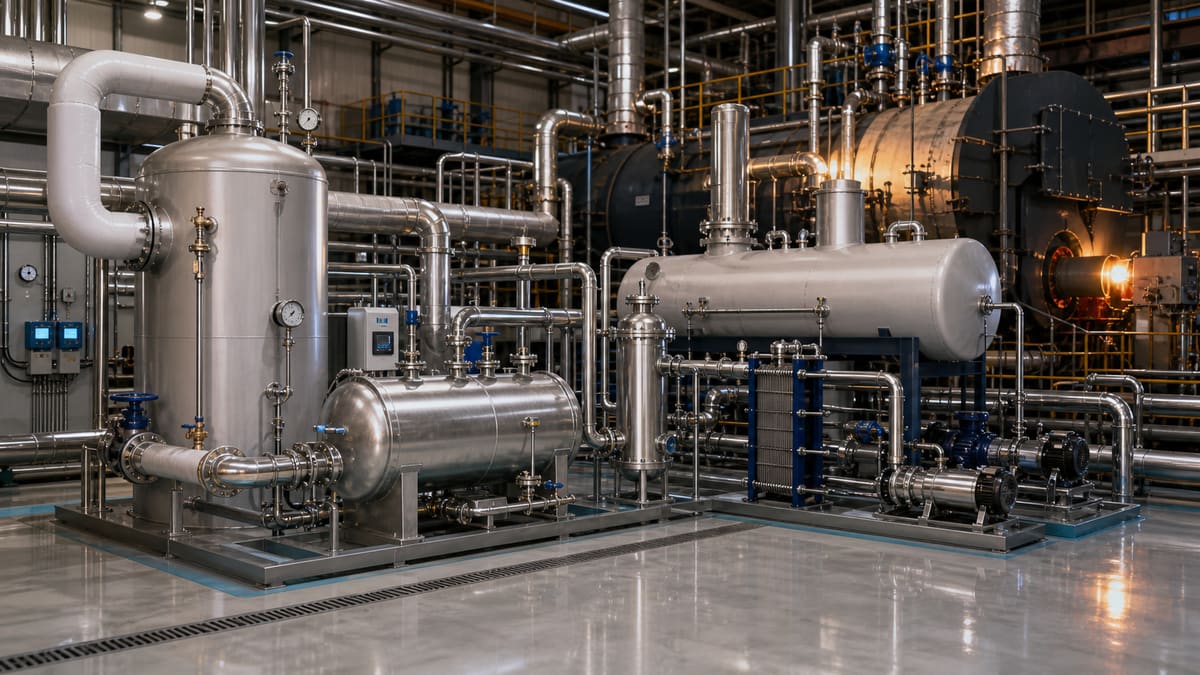
Condensate Water Recovery: high-purity thermal water back to boiler makeup
In the industrial landscape of 2026, efficient resource management is no longer merely an operational advantage—it's a critical component of corporate resilience, particularly for industries navigating stringent export-market ESG requirements in the UK and EU. At the nexus of energy and water stewardship lies condensate recovery: the strategic capture and reuse of high-purity, high-temperature water from steam systems. This isn't just about saving a drop; it's about reclaiming a vital, thermally charged resource that directly impacts your carbon footprint, reduces water withdrawal from increasingly stressed sources, and fortifies your operational independence against escalating water risks.
The steam generated in boilers and used for process heating, power generation, or humidification invariably condenses back into water. This condensate, often overlooked or discharged, represents a significant hidden asset. Its inherent purity, having been distilled, means less treatment is required compared to fresh makeup water. Crucially, its elevated temperature translates directly into substantial energy savings when returned to the boiler, bypassing the need to heat colder fresh water from scratch. For companies facing the scrutiny of supply chain sustainability assessments and CO2 reporting, optimising condensate return is a tangible, data-driven pathway to demonstrating responsible resource management and achieving ambitious decarbonisation goals.
Worked energy / carbon sketch
Illustrative Assumptions:
- Condensate flow rate: 50 cubic meters per hour (m³/h)
- Annual operating hours: 8,000 hours per year
- Average condensate return temperature: 80°C
- Average fresh makeup water temperature: 15°C
- Specific heat capacity of water: 4.18 kJ/kg·°C (approx. 1.16 Wh/kg·°C)
- Energy required for fresh water treatment (RO/demineralisation): 5 kWh/m³ (illustrative for high-purity water)
- Grid electricity carbon intensity (UK 2023 average): 0.233 kg CO₂e/kWh
Calculation of Annual Energy Savings:
-
Heat Energy Saved:
- Temperature difference: 80°C - 15°C = 65°C
- Energy saved per m³ (1000 kg): 1000 kg * 1.16 Wh/kg·°C * 65°C = 75,400 Wh/m³ = 75.4 kWh/m³
- Annual heat energy savings: 50 m³/h * 8,000 h/year * 75.4 kWh/m³ = 30,160,000 kWh/year
-
Water Treatment Energy Saved:
- Annual water treatment energy savings: 50 m³/h * 8,000 h/year * 5 kWh/m³ = 2,000,000 kWh/year
-
Total Annual Energy Savings:
- 30,160,000 kWh/year (heat) + 2,000,000 kWh/year (treatment) = 32,160,000 kWh/year
Calculation of Annual Carbon Emissions Avoided:
- Annual CO₂e avoided: 32,160,000 kWh/year * 0.233 kg CO₂e/kWh = 7,493,280 kg CO₂e/year
- Annual CO₂e avoided: 7,493 tonnes CO₂e/year
This back-of-envelope sketch illustrates that by recovering and repurposing 50 m³/h of condensate, a facility could potentially avoid over 7,000 tonnes of CO₂e annually, primarily driven by the significant heat energy savings. This figure doesn't even account for reduced chemical consumption, lower wastewater discharge costs, or the avoided cost of fresh water acquisition. These are direct, measurable impacts that resonate strongly in any ESG report.
Traditional vs engineering evaluation path
| Topic | Dump / light strainer return | Polished high-purity return (engineering evaluation path) |
|---|---|---|
| Heat | Flash losses; cold makeup reheated from scratch. | Hot, stable return; fuel and blowdown both drop. |
| Water | Extra demin water make-up and effluent. | Maximises closed steam loop; lower intake m³. |
| Proof | Sparse iron/silica trending. | Instrumented conductivity, sodium, silica for ESG files. |
Carbon savings calculator (illustrative)
Estimate annual electricity savings and avoided CO₂e when specific energy improves (e.g. after ERD, VFD tuning, or train optimization). Replace defaults with your meter data and your grid emission factor from your utility or ESG methodology.
ΔkWh/year ≈ Q(m³/h) × hours/year × (kWh/m³before − kWh/m³after) · tCO₂e ≈ ΔkWh × factor / 1000
Δ specific energy: 1.00 kWh/m³
Estimated electricity savings: 800,000 kWh/year
Indicative avoided emissions: 336 tCO₂e/year
Related equipment & product lines
These categories typically support the approach above—open any line to compare brands and models.
- Heat ExchangersThermal exchange equipment for process integration and temperature management.View category →
- Ion Exchange ResinsCation/anion and mixed bed resin solutions for demineralization and polishing.View category →
- ChemicalsAntiscalants, cleaners, and process chemicals for water treatment operations.View category →
For a closer review, use the engineering inquiry form to share feed, capacity, target, and project stage. Submission does not constitute a completed design or performance commitment.