Illustrated series · Membranes and separation
Why does residual chlorine damage RO membranes?
Most conventional RO/NF elements reject salt with an ultrathin cross-linked polyamide selective layer. Free chlorine and other strong oxidants react irreversibly with this polymer, changing its chain structure and selectivity so salt passes more easily; ordinary cleaning cannot restore it.
Direct answer
Direct answer
Residual chlorine threatens the aromatic polyamide selective layer, not the pressure vessel or support mesh. Free chlorine can chlorinate and oxidize the polymer, altering chains and cross-linking. Performance may first show lower flux, followed by higher water permeability, rising salt passage, and falling rejection. Damage depends on cumulative concentration × time and is accelerated by conditions such as pH, temperature, and catalytic transition metals including iron. A brief upset may not be obvious immediately, but the normalized trend eventually reveals it, and cleaning cannot rebuild oxidized polyamide.
Assess chlorine risk in four dimensions
A single zero reading is only one moment; protection must cover oxidant form, cumulative dose, reaction conditions, and dechlorination reliability.
Free chlorine contacts polyamide
HOCl/OCl⁻ can attack conventional polyamide composites. Chlorine dioxide, ozone, peroxide, permanganate, and other oxidants can also damage membranes when misapplied.
Dose is concentration × time
Exposure is often expressed as ppm·h, but tolerance differs by membrane and water chemistry. A value for one product is not a universal safe limit.
pH, temperature, and metals change rate
Membrane guidance reports faster attack under neutral/acid conditions, higher temperature, and with iron or other transition metals that can catalyze local degradation.
Dechlorination needs detection and fail-safe action
Activated carbon or bisulfite-type reducers remove free chlorine, but carbon breakthrough, aged solution, pump failure, poor mixing, or analyzer drift can all cause exposure.
RO protection depends on reliable dechlorination immediately upstream
A reducing-agent tank and metering pump feed the line at left; online chlorine/ORP monitoring, mixing, and guard filtration sit before the high-pressure pump and RO rack.
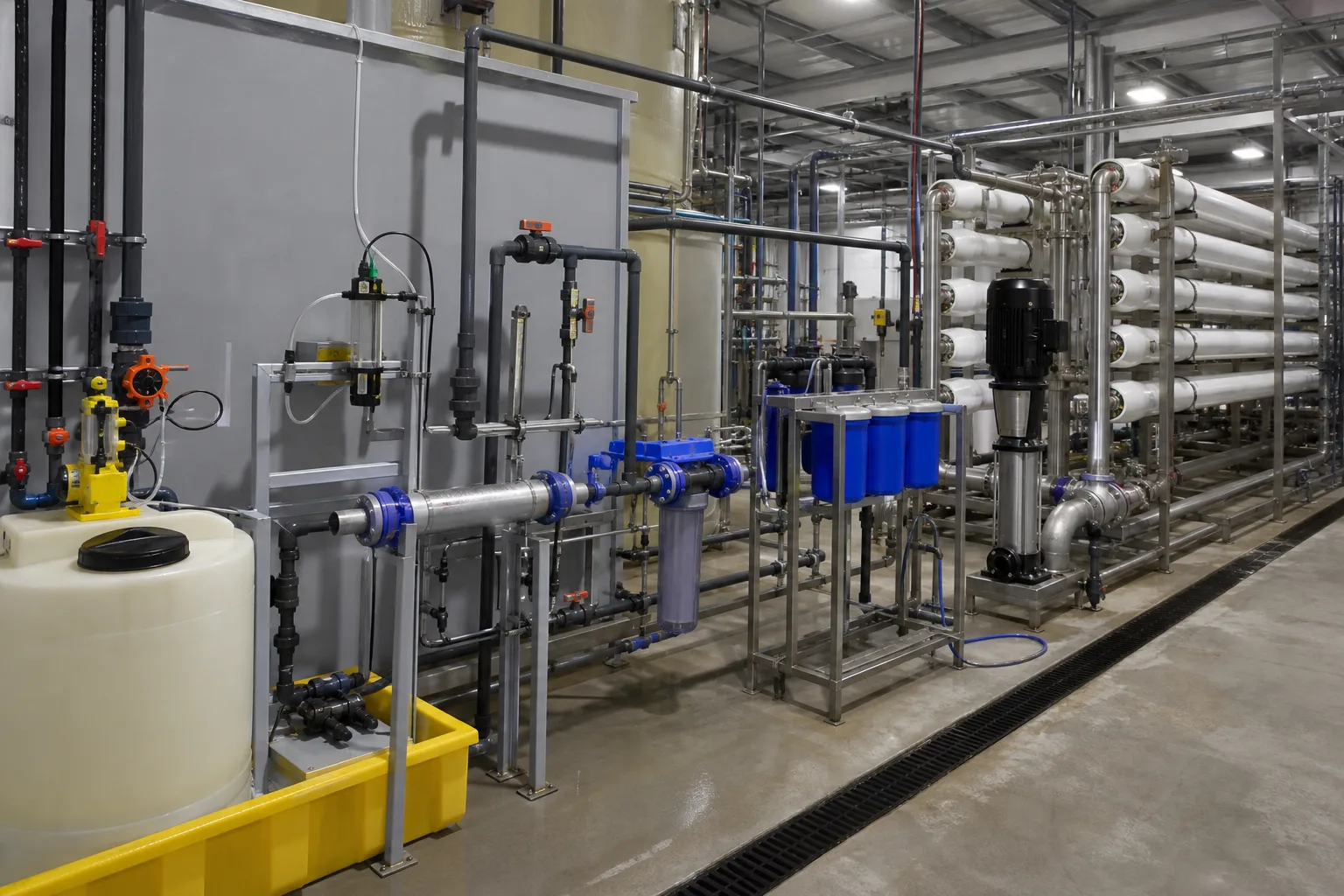 11Reducer tank and metering pump22Online chlorine/ORP monitor33Mixing and guard filtration44RO high-pressure pump and rack
What to identify
- 1Reducer tank and metering pump
- 2Online chlorine/ORP monitor
- 3Mixing and guard filtration
- 4RO high-pressure pump and rack
What the image proves
A reliable chain includes dosing, reaction/mixing, monitoring, low-level/pump interlocks, and verification at the membrane inlet. A lone dosing pump is not complete protection.
How to verify on site
Function-test pump and low-level trips; sample before dosing, after mixing, and at RO inlet; compare online data with an independent free-chlorine method and verify solution age/strength.
Chlorine attacks the nanometre-scale polyamide selective layer
The left side represents a dense intact polyamide network; the right shows a loosened defective layer after oxidation. Water still permeates, but the paths that restrict ion diffusion have changed.
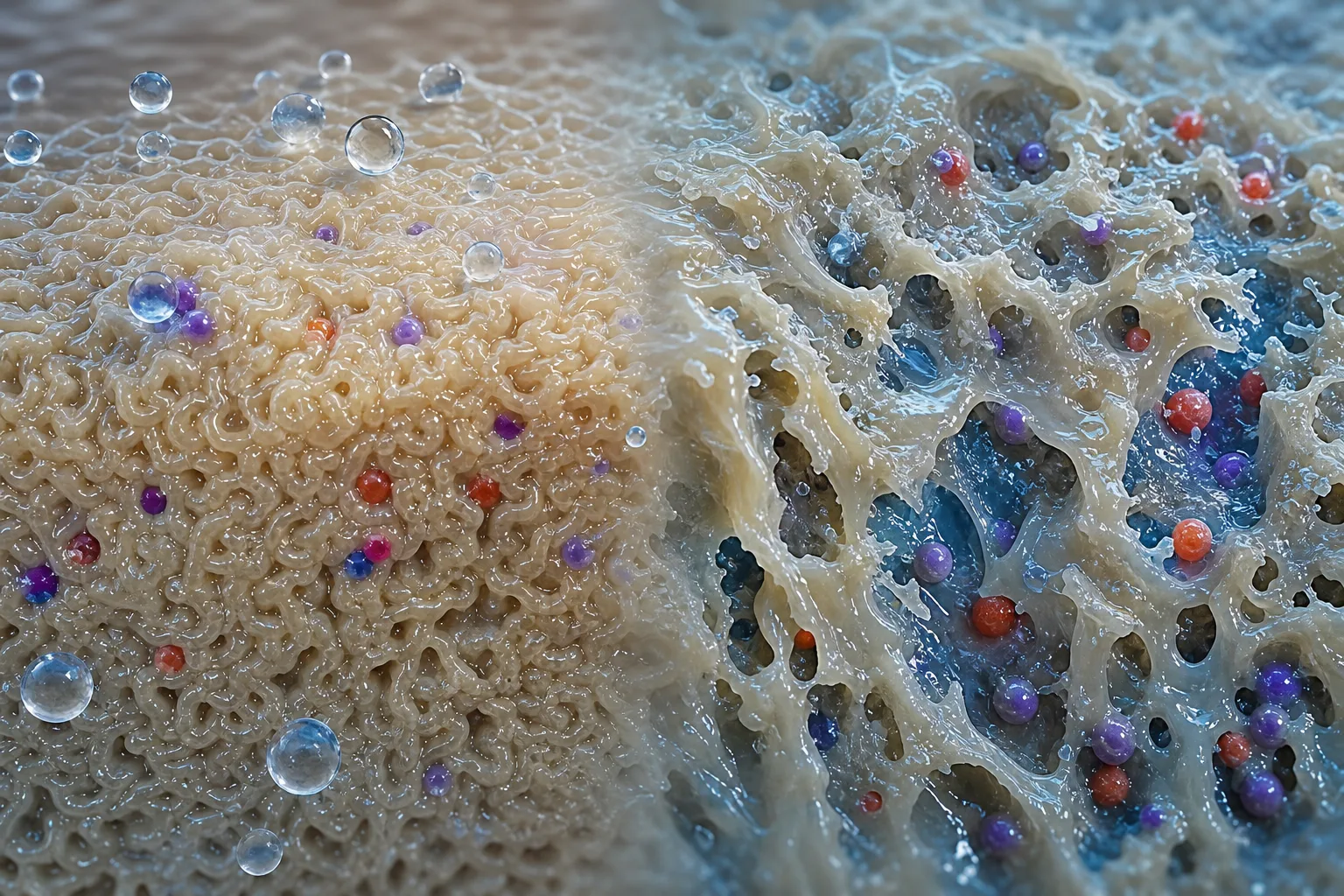 11Intact polyamide network22Oxidation reaction zone33Enlarged water transport paths44Increased salt passage
What to identify
- 1Intact polyamide network
- 2Oxidation reaction zone
- 3Enlarged water transport paths
- 4Increased salt passage
What the image proves
Oxidation need not punch a visible hole. It first changes chemistry and free volume in an ultrathin layer, so the sheet can look normal while salt rejection has fallen.
How to verify on site
Use normalized salt passage and permeate flow, not appearance alone. For attribution, combine coupon rejection and spectroscopy/elemental analysis with exposure history.
A breakthrough usually accumulates first at the lead element
In the cutaway vessel the first feed-end element is discolored while downstream elements are lighter. Upstream monitoring and guard filtration precede a central product tube that blends element permeate.
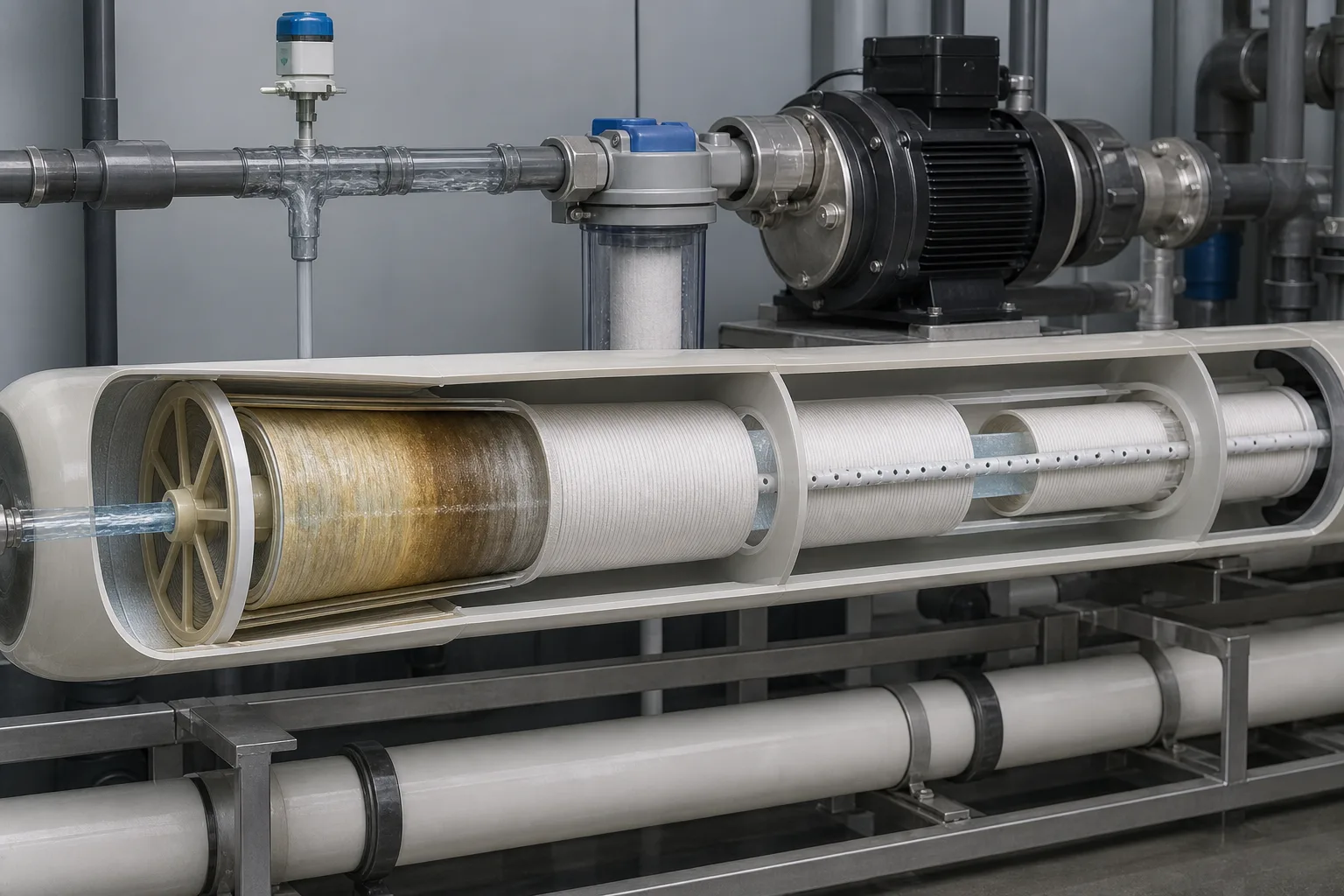 11Feed-end lead element22Lower-exposure downstream elements33Chlorine breakthrough path44Central permeate tube
What to identify
- 1Feed-end lead element
- 2Lower-exposure downstream elements
- 3Chlorine breakthrough path
- 4Central permeate tube
What the image proves
Fresh oxidant reaches the first stage and lead element first, but the common permeate header blends many elements and can dilute an early local conductivity signal.
How to verify on site
Use stage/vessel permeate sampling, vessel probing, or element testing; align the damage location with the dechlorination point, shutdown flush, and event timeline.
Higher cumulative exposure progressively erodes selectivity
Three coupons and samples represent an unexposed control, lower cumulative exposure, and severe exposure. Visual roughness or cracking is illustrative; flux and salt passage provide the quantitative result.
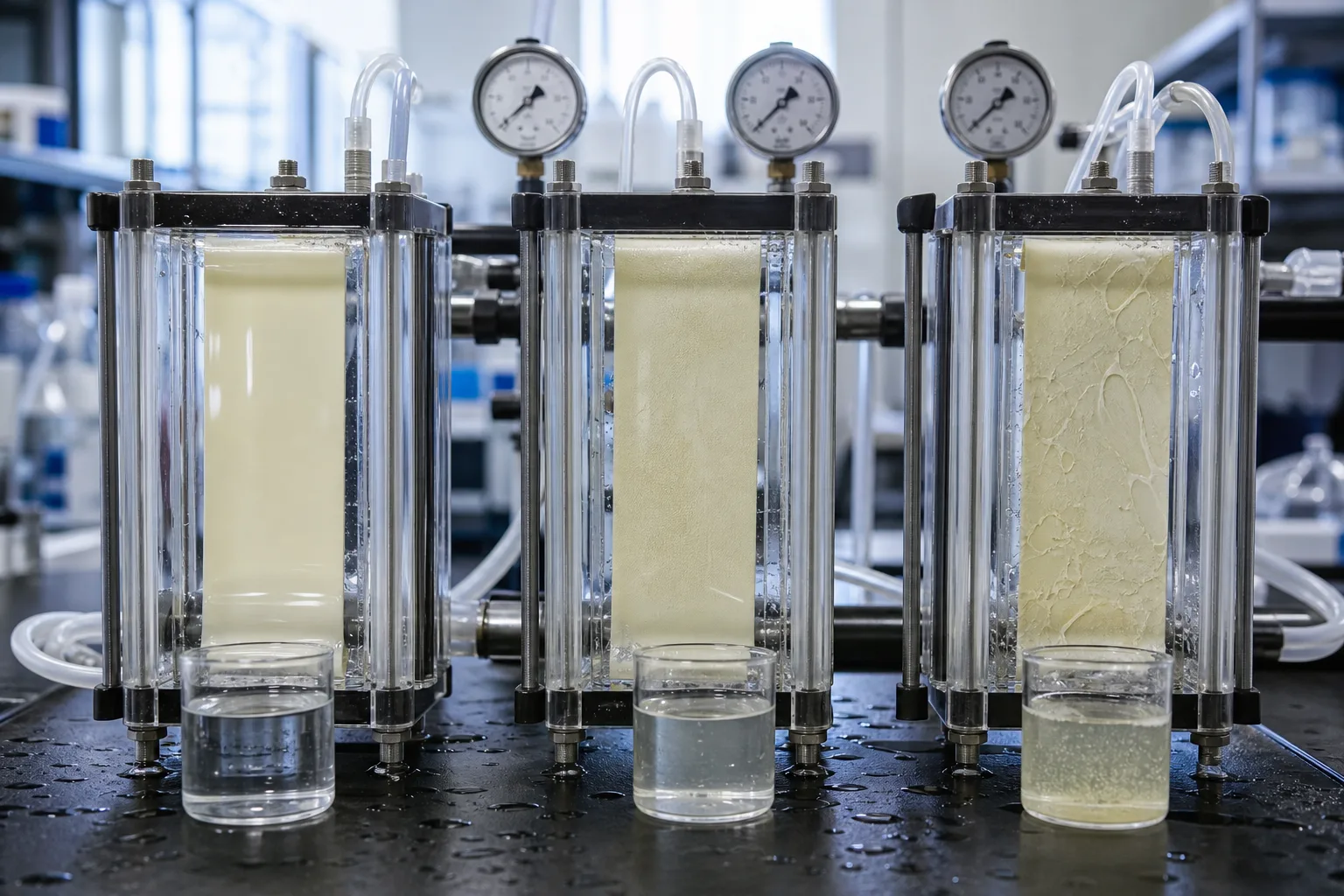 11Unexposed control coupon22Lower cumulative chlorine exposure33Severe oxidation/embrittlement44Three performance samples
What to identify
- 1Unexposed control coupon
- 2Lower cumulative chlorine exposure
- 3Severe oxidation/embrittlement
- 4Three performance samples
What the image proves
Oxidation is a continuum governed by dose and conditions, not a universal threshold followed by instant failure. Early normalized drift may precede visible material change.
How to verify on site
Test matched coupons at the same pressure and temperature. Record peak chlorine, duration, pH, temperature, iron/manganese, and not only one ORP reading.
Autopsy must separate oxidation from fouling, scale, and seal leakage
The table shows deposited feed spacers and membrane sheets, a clean reference sheet, center-tube/seal parts, and samples from different locations. Oxidation itself may lack a unique visible color.
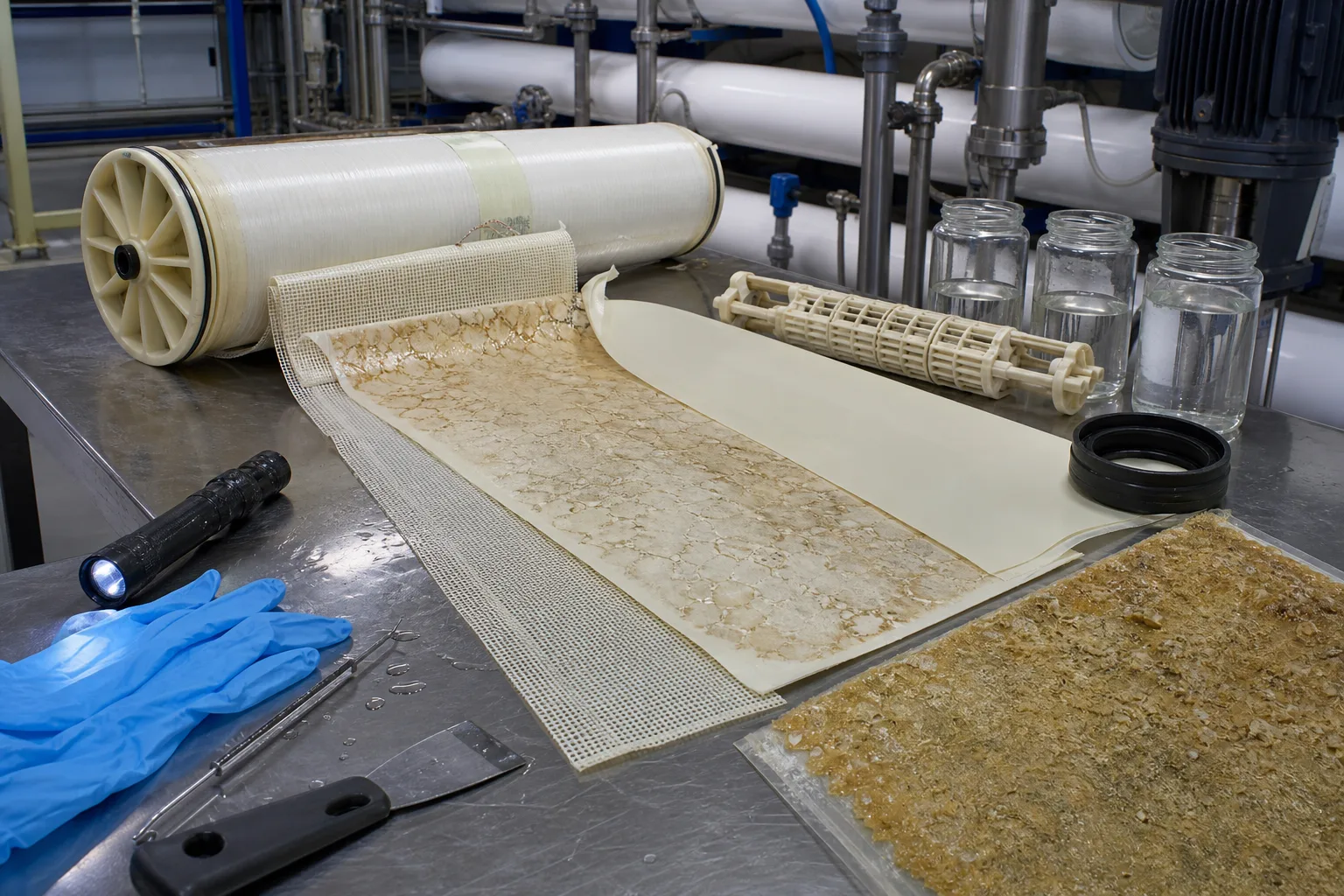 11Fouled feed spacer22Membrane coupon for analysis33Clean reference selective layer44Seals and branch samples
What to identify
- 1Fouled feed spacer
- 2Membrane coupon for analysis
- 3Clean reference selective layer
- 4Seals and branch samples
What the image proves
Deposits may explain pressure drop and low flux but do not prove chlorine attack; a seal bypass can also raise salt passage. Trends, location, chemistry, and cleaning response must agree.
How to verify on site
Preserve normalized data and vessel probing before autopsy. Analyze deposits, membrane chemistry/rejection, and O-rings/interconnectors separately rather than diagnosing by discoloration.
How does one chlorine breakthrough become irreversible damage?
This chain locates the failed protection layer. Product-specific limits, reducers, and response procedures come from the membrane manual.
1 Upstream chlorination
Raw water → disinfection/bio-control
Control organisms in intake and pretreatment without carrying oxidant into conventional polyamide RO.
2 Dechlorination
Activated carbon or reducer → mixing/reaction
Convert free chlorine to chloride and leave enough distance for reaction and verification.
3 Protection failure
Pump/carbon/solution/analyzer/interlock fault
Any single failure can deliver free chlorine to the RO inlet.
4 Lead-stage contact
Residual chlorine → lead membrane surface
Fresh oxidant hits the feed end first; deposited iron may catalyze local attack.
5 Selective-layer oxidation
Polyamide → altered chemistry
Cross-linking and transport paths change; severity grows with dose and conditions.
6 Performance reveals damage
Rejection↓; salt passage↑; flux may fall then rise
Normalized trends and branch samples detect damage earlier than one blended reading.
Higher salt passage does not automatically mean chlorine oxidation
Compare four root causes so reversible deposition is not confused with irreversible damage—or vice versa.
Oxidation
- Mechanism
- Irreversible chemical/selectivity change in the polyamide layer
- Typical distribution/behavior
- Often follows an oxidant event; salt passage keeps rising and rejection does not recover after cleaning
- Priority evidence
- Chlorine/ORP event, normalized salt passage, lead-stage pattern, coupon chemistry/rejection
Organic/bio/colloidal fouling
- Mechanism
- Deposits cover the membrane and feed spacer
- Typical distribution/behavior
- Normalized flow falls and differential pressure rises; targeted cleaning may recover performance
- Priority evidence
- DP/flow, SDI/TOC/ATP, deposit analysis, cleaning response
Mineral scale
- Mechanism
- Supersaturated carbonate, sulfate, silica, or other salts precipitate
- Typical distribution/behavior
- Often favors tail-stage concentrate; flow/DP and salt passage change, with scale-specific cleaning response
- Priority evidence
- Ion balance, saturation, stage pattern, deposit chemistry/XRD, cleaning response
Seal/interconnector bypass
- Mechanism
- O-ring, interconnector, end-plate, or permeate-tube leak bypasses the selective layer
- Typical distribution/behavior
- Can be abrupt and localized with normal total DP; probing identifies the branch
- Priority evidence
- Vessel permeate profile, seal inspection, pressure test, recovery after reassembly
Free chlorine suppresses organisms upstream, but dechlorination removes the residual downstream. Dechlorinating too early, mismanaging carbon, or overdosing reducer can increase downstream bio-risk. Oxidation protection and biofouling control must be designed as one boundary.
Daily protection needs three evidence sets
Reducer dose and solution health
Verify solution strength/age, pump stroke and calibrated flow, low level, and pump-trip interlocks. Bisulfite solutions oxidize in air, so tank level alone is not proof.
Free chlorine and ORP at the membrane inlet
Free chlorine is direct evidence. ORP is a fast surrogate for trending/trips but varies with pH, temperature, and other redox species; validate online instruments independently.
Normalized flow and salt passage
Trend normalized permeate flow, normalized salt passage, stage DP, and branch conductivity together. Raw flow can hide early damage when pressure, temperature, or feed salinity changes.
Route a suspected breakthrough in four ways
- Signal
- High-high free chlorine or ORP alarm at RO inlet
- First suspects
- Reducer pump trip, aged solution, carbon breakthrough, poor mixing, or analyzer drift
- Response order
- Trip/divert RO feed and confirm independently; flush only with verified oxidant-free water, then fix the failed layer
- Signal
- Normalized salt passage rises slowly and cleaning gives no recovery
- First suspects
- Cumulative oxidation, membrane aging, or broad selective-layer damage
- Response order
- Reconstruct chlorine/pH/temperature/metal exposure and perform stage probing plus coupon chemistry/rejection tests
- Signal
- Salt passage jumps abruptly in one vessel or element
- First suspects
- O-ring, interconnector, end hardware, or mechanical element damage is more likely than whole-train oxidation
- Response order
- Locate the vessel/element and inspect bypass/seals before chemically cleaning the whole train
- Signal
- Flow falls with rising DP and visible deposits
- First suspects
- Fouling or scale dominates, though oxidation may coexist
- Response order
- Analyze deposit and stage pattern, clean specifically, then assess residual irreversible salt passage
Four common misconceptions
One zero chlorine test proves safety
Short peaks can occur between samples. Continuous trend, trips, independent checks, and cumulative event records are needed.
ORP is the free-chlorine concentration
ORP is a combined redox signal influenced by pH, temperature, and many species; use it for trend/trips, not as the only chlorine verification.
Cleaning repairs chlorine damage
Cleaning removes deposits but cannot reconstruct oxidized polyamide cross-links. Severe selectivity loss usually requires element replacement.
Lower residual always means less biofouling
Dechlorination protects the membrane but removes downstream disinfectant residual. Location, hygienic design, and biological control remain necessary.