Solutions · Sustainability & ESG
VFD-Optimized Pumping Stations: matching flow demand and eliminating parasitic head
Affinity laws in practice: turndown, staging, and feedback so pumps do not fight valves—measurable kWh/m³ impact.
Use when
Throttling valves on fixed-speed pumps waste kWh and wear equipment.
Process options
VFD curves with minimum-flow guards, harmonics-aware drives, and instrumented verification.
Assessment output
Lower kWh and demand charges tied to real duty cycles—not nameplate optimism.
Inputs and conditions for an assessment
Collect feed variability, capacity, target quality, operating hours, discharge or reuse boundaries and installed equipment data. Compare examples on matched conditions and meter boundaries; assess a project using actual water data, equipment documentation and any necessary tests.
View the process illustration
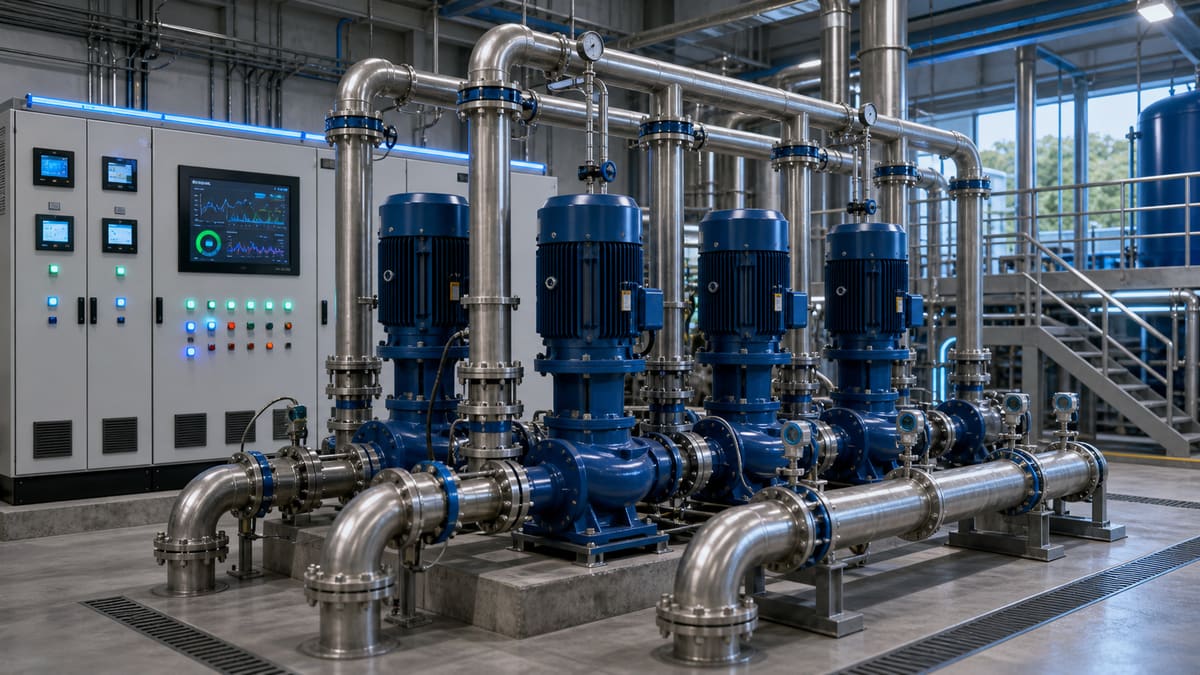
VFD-Optimized Pumping Stations: matching flow demand and eliminating parasitic head
Assess pump energy using measured duty cycles, flow, head and electric power. Variable Frequency Drives (VFDs) can reduce throttling losses where a variable-speed pump suits the hydraulic system. Minimum flow, static head, motor cooling, resonance, harmonics and control limits still matter. Lower power and carbon emissions are outcomes to measure, not automatic consequences of installing a drive or supplying a UK/EU customer.
Pumping systems are ubiquitous in industry, moving everything from raw water intake and process fluids to wastewater and cooling water. Traditionally, these systems often operate at a fixed speed, designed for peak demand. When demand is lower, flow is often controlled by throttling valves, which creates artificial resistance or "parasitic head." This method forces the pump to work harder than necessary, consuming excessive energy without contributing to useful work. Imagine driving a car with your foot on the accelerator while simultaneously pressing the brake—this is analogous to a throttled, constant-speed pump.
VFDs adjust motor revolutions per minute (RPM) to match demand within equipment limits. For a centrifugal pump of unchanged geometry at corresponding operating points and approximately constant efficiency, affinity laws give power approximately proportional to speed cubed. Reducing speed by 20% gives nearly 50% theoretical pump-power reduction under those assumptions; static head, the system curve, changed efficiency, drive losses and minimum flow can make actual electrical savings different. Speed control does not guarantee the best-efficiency point at every flow.
Beyond energy savings, VFDs offer a multitude of operational advantages:
- Extended Equipment Lifespan: Smoother operation, reduced motor and pump wear, and elimination of high-stress starts and stops contribute to longer service intervals and reduced maintenance costs.
- Improved Process Control: Precise flow and pressure regulation lead to more stable and consistent industrial processes, enhancing product quality and reducing waste.
- Reduced Noise and Vibration: Operating pumps at optimal speeds minimises mechanical stress and turbulence, leading to quieter facilities.
- Reliability Review: Monitor actual duty and condition signals, validate control integration, and investigate resonance or other adverse effects. Prediction does not guarantee avoidance of downtime.
Worked energy / carbon sketch
To illustrate the tangible benefits, consider an industrial facility operating a medium-sized process water pump without VFDs.
Illustrative Assumptions:
- Average Flow Rate (Q): 350 m³/hour
- Operating Hours (H): 7,000 hours/year (typical for continuous industrial operations)
- Specific Energy Consumption (before VFD): 0.28 kWh/m³ (assumed baseline for this example, to be replaced by measured duty data)
- Specific Energy Consumption (after VFD): 0.16 kWh/m³ (assumed trial result, corresponding to ~40% reduction per m³, not a guaranteed VFD outcome)
- Grid Emission Factor: 0.23 kg CO₂e/kWh (hypothetical calculation factor, not a current UK grid value; select the actual country, reporting year and accounting boundary).
Calculation:
-
Annual Water Volume Pumped: 350 m³/hour × 7,000 hours/year = 2,450,000 m³/year
-
Annual Energy Consumption (Before VFD): 2,450,000 m³/year × 0.28 kWh/m³ = 686,000 kWh/year
-
Annual Energy Consumption (After VFD): 2,450,000 m³/year × 0.16 kWh/m³ = 392,000 kWh/year
-
Annual Energy Savings (ΔkWh): 686,000 kWh/year - 392,000 kWh/year = 294,000 kWh/year
-
Annual Carbon Emissions Reduction (tonnes CO₂e): 294,000 kWh/year × 0.23 kg CO₂e/kWh = 67,620 kg CO₂e/year 67,620 kg CO₂e/year ÷ 1,000 kg/tonne = 67.62 tonnes CO₂e/year
Under these assumptions the arithmetic yields nearly 70 tonnes CO₂e per year. Actual savings require comparable production, calibrated metering and an appropriate emissions factor, including any extra energy or equipment impacts within the selected boundary. Treat the result as a scenario rather than a delivery promise or automatic reporting compliance.
Fixed-speed and variable-speed pumping comparison
| Topic | Fixed-speed / throttled pumping | Variable-speed pumping to assess |
|---|---|---|
| Energy | Throttling can dissipate head; confirm actual kWh/m³ and duty. | Match speed to demand within hydraulic limits; measure net kWh/m³ and applicable demand-charge savings. |
| Reliability | Frequent starts, valve wear, higher vibration. | Soft ramps, gentler hydraulics, richer signals for condition monitoring. |
| ESG data | Weak link from meter to disclosure. | Flow, pressure, and kWh aligned for CDP/AWS-style intensity metrics. |
Flow, head, kWh/m³ and operating-hour records support water and energy reporting when calibration, boundaries and production context are defined. For CDP or AWS submissions, verify the applicable framework, reporting year and supporting evidence; pump data alone does not establish certification, legal ESG compliance or export eligibility. Distinguish purchased-electricity emissions from other life-cycle impacts and document the selected factor and calculation method.
FAQ
Q1: What types of pumps or applications benefit most from VFD optimization? A1: VFDs deliver the greatest energy savings in applications where flow or pressure demands vary significantly over time. This includes cooling water loops, wastewater treatment (aeration, sludge transfer), process fluid transfer, boiler feedwater, irrigation, and HVAC systems. Any centrifugal pump operating for extended periods with fluctuating load is a prime candidate.
Q2: What is the typical Return on Investment (ROI) for installing VFDs on existing pumping systems? A2: Calculate actual investment, installation, drive losses, maintenance and verified annual net savings at the same duty. A 1-3 year payback can be a scenario to test, not a typical guarantee. Distinguish payback time from ROI and include uncertainty and any equipment replacement costs.
Q3: Are there any specific regulatory considerations for VFD installations in the UK/EU? A3: Check the actual drive/motor scope and applicable ecodesign, electrical, EMC and machinery-safety requirements in the relevant jurisdiction. Being marketed as energy-saving does not establish compliance; retain product conformity and installation/commissioning records with qualified engineering review.
References
Carbon savings calculator (illustrative)
Estimate annual changes in electricity use and CO₂e emissions from specific energy before and after a change. Replace defaults with site meter data and the grid emission factor required by your utility or ESG methodology.
Annual electricity reduction = flow × annual operating hours × (specific energy before − after). Emissions reduction = electricity reduction × grid factor / 1000. Negative values indicate an increase.
ΔkWh = Q × H × (SEC₀ − SEC₁) · ΔtCO₂e = ΔkWh × EF / 1000
Specific energy reduction: 1.00 kWh/m³
Estimated electricity savings: 800,000 kWh / year
Indicative avoided emissions: 336 tCO₂e / year
Related equipment & product lines
These categories typically support the approach above—open any line to compare brands and models.
- Pumps & PumpingHigh-pressure and process pump solutions for water treatment skids and plants.View category →
- InvertersVariable-frequency drives and inverter systems for variable-speed motor control.View category →
- Instrumentation & SensorsInstruments and sensors for online monitoring of flow, level, pressure, temperature, and water quality.View category →
For a closer review, use the engineering inquiry form to share feed, capacity, target, and project stage. Submission does not constitute a completed design or performance commitment.