Solutions · New Technologies & Innovation
Ultra-High Pressure RO (UHPRO): concentrating ZLD brine within equipment limits
Net driving pressure, brine chemistry and equipment pressure ratings: assess UHPRO and the downstream thermal ZLD load together.
Use when
Conventional RO stalls where π dominates; evaporators inherit too much water and too much capex.
Process options
Pressure-rated membranes and vessels, compatible pumps and materials, and pretreatment selected for the actual brine.
Assessment output
Measure membrane recovery and downstream MVR/crystallizer duty against the same feed and energy boundary.
Inputs and conditions for an assessment
Collect feed variability, capacity, target quality, operating hours, discharge or reuse boundaries and installed equipment data. Compare examples on matched conditions and meter boundaries; assess a project using actual water data, equipment documentation and any necessary tests.
View the process illustration
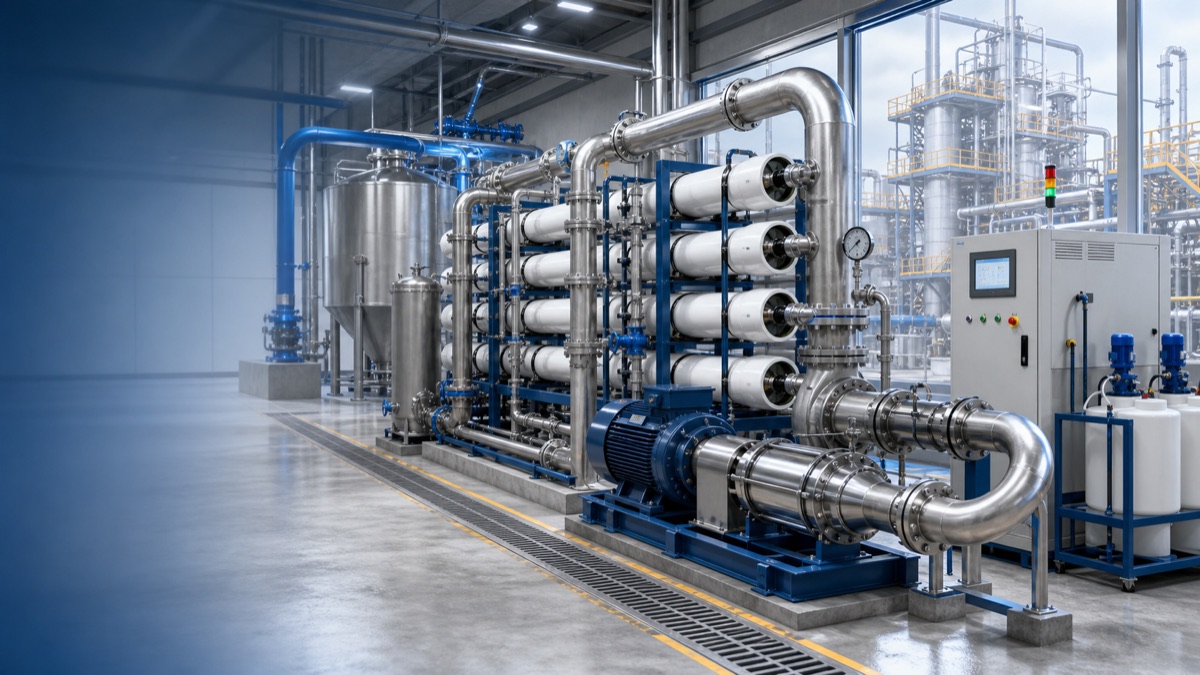
Ultra-High Pressure RO (UHPRO): concentrating ZLD brine within equipment limits
Industrial water reuse and Zero Liquid Discharge (ZLD) projects must manage concentrated brine as well as recover usable water. A reverse osmosis (RO) stage loses permeate-driving force as concentrate osmotic pressure () approaches the available hydraulic pressure (). Neither a TDS concentration nor a nominal pump pressure alone defines the limit: ionic composition, temperature, scaling, membrane rating and permeate pressure all matter.
For engineers comparing membrane concentration with evaporation, UHPRO can reduce the water sent to a thermal ZLD stage when real-brine trials demonstrate useful flux and stable operation. A documented commercial example is the DuPont XUS180804/XUS180802 element family, rated up to 120 bar under its specified conditions. This is a product limit, not a conventional pressure to exceed; higher-pressure proposals require equipment-specific evidence and compatible pressure ratings throughout the system. Savings must include pretreatment, pumping, cleaning and the residual-brine route.
Governing Principles of High-Pressure Membrane Separation
The simplified expression below describes net driving pressure () when represents the effective hydraulic pressure difference across the membrane. In a real array, allow for feed-channel pressure loss, permeate backpressure and concentration polarization:
Here, is the effective hydraulic pressure difference and is the osmotic pressure difference between the concentrate at the membrane surface and the permeate. For a fixed membrane and test condition, permeate flux () is often approximated as:
where is the membrane water-permeability coefficient at the stated temperature and membrane condition. The van ’t Hoff relation below is an ideal dilute-solution approximation, not a validated high-salinity-brine design model:
where is the van 't Hoff factor (number of ions/particles per mole of solute), is the molar concentration of the solute, is the ideal gas constant, and is the absolute temperature.
As industrial brines are concentrated, the solute concentration and generally increase. At the permitted , a smaller means lower flux. Concentrated mixed salts require an appropriate nonideal activity/osmotic model; more membrane area cannot overcome a nonpositive net driving pressure. Compare lower recovery, alternative staging and thermal treatment using the actual composition.
UHPRO raises the available within certified limits and can preserve at higher brine concentrations. It does not guarantee a total recovery rate, concentrate-volume reduction or energy saving. Establish these from feed-to-concentrate mass balances, sustainable flux, solubility limits and integrated pilot measurements. Increasing pressure alone neither prevents scaling nor completes ZLD.
Parameters to compare in a brine trial
| Parameter | Existing RO stage | Proposed UHPRO stage |
|---|---|---|
| Sustainable brine TDS | Measure concentrate composition and scaling limits | Demonstrate target composition at stable flux within ratings |
| Overall water recovery | Close the full-system water balance | Use the same inlet and outlet boundary, including cleaning losses |
| Specific energy consumption with ERS | Meter pumping and auxiliary energy per permeate volume | Include recovery-device losses, pretreatment and cleaning |
| Feed volume to thermal ZLD | Measure residual flow and salt load | Compare residual flow at the same incoming salt load |
| CIP interval and restored performance | Record normalized trends and cleaning recovery | Validate stable operation and compatible cleaning over time |
These are project comparison measurements, not claimed pilot results or universal operating limits. A useful trial reports feed chemistry, temperatures, pressure profiles, flux normalization and the complete energy boundary.
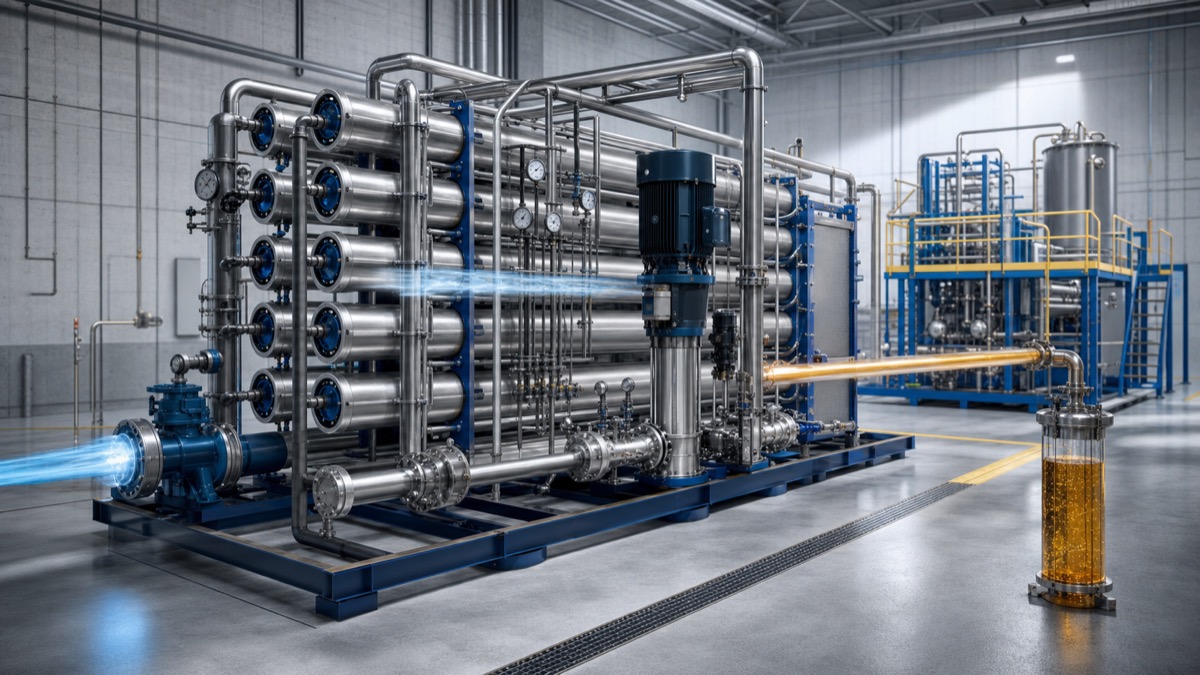
The illustration shows UHPRO as an industrial high-pressure membrane block rather than a generic RO cartridge: multiple pressure vessels, a heavy pumping section, energy-aware pipework, and a concentrated brine stream feeding the thermal ZLD boundary. That is the practical engineering point of this article: UHPRO is valuable only when the membrane block, energy recovery, antiscalant envelope, and downstream evaporator are sized around the same defensible brine chemistry.
Design and Operational Considerations for UHPRO
Implementing UHPRO systems requires meticulous engineering beyond simply selecting higher-pressure pumps and membrane elements. Key considerations include:
1. Membrane Materials and Element Design: Select an element expressly rated for the pressure, temperature and chemistry together. Verify membrane compaction, salt passage, pressure drop, axial loads and compatibility with the intended cleaning. A high-pressure pump does not make a conventional element suitable for UHPRO.
2. High-Pressure Pumping Systems: Select pump materials and seals for the real brine and operating range. Evaluate Energy Recovery Systems (ERS), including isobaric or turbine devices, using the available concentrate flow, pressure and efficiency; economic value is site-specific, rather than a universal requirement. Include motor, drive, recirculation and auxiliary losses.
3. Advanced Pre-treatment: Characterize suspended solids, colloids, silica, organics and sparingly soluble salts at the proposed concentration factor. Select physical filtration and chemical conditioning for the identified risks. UF or MF can remove particles but does not remove all dissolved scaling precursors; antiscalant dosing cannot make an oversaturated brine indefinitely stable.
4. Material Selection for Balance of Plant: Check pressure-temperature ratings and chemical compatibility for vessels, piping, valves, seals and instruments, including transients. Duplex alloys such as SAF 2205 and SAF 2507 are candidates, not automatic protection: chloride concentration, temperature, pH, oxidants, fabrication and crevice conditions affect corrosion.
5. Process Control and Automation: Monitor pressure, flow, temperature, conductivity and normalized flux/salt passage. Use validated pressure relief and interlocks, safe ramping and membrane-compatible Clean-In-Place (CIP) procedures. Trend data can guide inspection; automated sequences and predictive software do not establish integrity or replace safety controls.
Limits and honest boundaries
While UHPRO offers transformative potential, its performance is highly contingent on diligent system design and operation. Neglecting critical aspects can lead to rapid performance degradation and increased OpEx:
- Inadequate Pre-treatment: Solids, colloids and scaling precursors such as silica, sulfates and calcium phosphates can accumulate at elevated concentration factors. Establish sustainable recovery and cleaning criteria from real-water trials; cleaning reversibility cannot be assumed.
- Imprecise Chemical Dosing: Incorrect antiscalant dosage (either under- or over-dosing) or pH adjustment can either fail to inhibit scale formation or, conversely, lead to antiscalant fouling or membrane damage. The margin for error is significantly reduced at high ionic strengths and pressures.
- Lack of Redundancy or Robust Instrumentation: High-pressure operations inherently carry higher risks of mechanical failure. Insufficient redundancy in critical pumps or ERS, or poorly maintained pressure and flow sensors, can lead to system downtime, process instability, and potentially hazardous conditions.
- Material Compatibility Oversights: Components outside their pressure-temperature or chemical envelope risk deterioration, leakage and serious mechanical failure. Review all wetted components and transient conditions, not just the pump nameplate.
- Operator Training: UHPRO systems are not "set-and-forget." Operators must be highly trained in understanding the nuances of high-pressure operation, membrane chemistry, troubleshooting, and safety protocols.
FAQ
Q1: What are the practical upper limits for UHPRO pressure, and what are the main factors constraining it? A1: There is no single pressure limit for all UHPRO products. The cited DuPont commercial family permits up to 120 bar under specified conditions, and temperature or cleaning conditions can impose lower limits. Check the current element, vessel, pump, piping and seal ratings together, plus pressure drop, axial loading, relief settings and cyclic fatigue. Research pressures cannot be adopted as commercial operating permissions.
Q2: How does UHPRO specifically impact membrane lifespan compared to conventional RO systems? A2: Higher pressure and concentration can increase compaction, fouling, scaling and material stresses. Service life depends on feed, flux, cleaning compatibility and operating history. Validate normalized performance and post-cleaning recovery in the intended duty; a generic life in years cannot be promised from the technology name.
Q3: Is UHPRO always more energy-efficient than thermal ZLD (e.g., evaporators/crystallizers) for brine concentration? A3: No. Compare measured electrical and thermal energy on the same recovered-water and salt-load basis, including the thermal system’s heat source and heat recovery. UHPRO may reduce evaporation feed, but the concentrate still needs an authorized reuse or residue route. Membrane concentration alone does not produce dry solids or establish ZLD. Reference: DuPont UHPRO element family and operating pressure.
Related equipment & product lines
These categories typically support the approach above—open any line to compare brands and models.
- RO MembranesReverse osmosis membrane elements for municipal and industrial desalination.View category →
- Pumps & PumpingHigh-pressure and process pump solutions for water treatment skids and plants.View category →
- Pilot Units TestingPilot rigs and trial modules for process validation and feasibility studies.View category →
For a closer review, use the engineering inquiry form to share feed, capacity, target, and project stage. Submission does not constitute a completed design or performance commitment.