Solutions · New Technologies & Innovation
Targeted Fluoride Adsorption Media: validating engineered sorbents in complex water
Langmuir-style capacity thinking, competing anions, and bed life: when adsorption beats RO on carbon for decentralized fluoride compliance.
Use when
Competing species and pH can limit adsorption; compare actual breakthrough and total treatment costs with RO.
Process options
Selective nano-alumina / metal-oxide hybrids with engineered mass-transfer and regeneration strategy.
Assessment output
Measure real-water breakthrough, media release, regeneration and waste before estimating bed life or cost.
Inputs and conditions for an assessment
Collect feed variability, capacity, target quality, operating hours, discharge or reuse boundaries and installed equipment data. Compare examples on matched conditions and meter boundaries; assess a project using actual water data, equipment documentation and any necessary tests.
View the process illustration
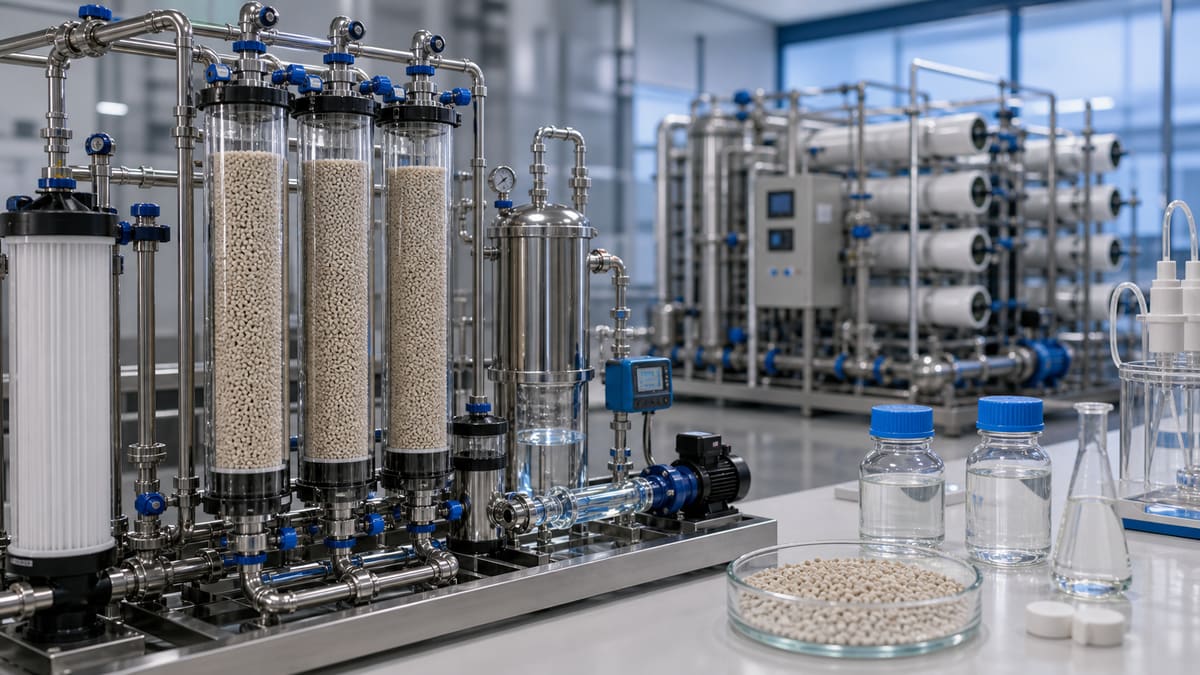
First-Principles Governing Fluoride Adsorption Mechanisms
The adsorption of fluoride onto solid media is fundamentally governed by surface chemistry, electrostatics, and mass transport phenomena. For many metal oxide-based adsorbents (e.g., activated alumina, cerium oxide, zirconium oxide), fluoride ions () exchange with surface hydroxyl groups or bind to Lewis acid sites. The efficiency of this process is influenced by the solution pH, temperature, and the presence of competing anions.
A common starting point for modeling adsorption equilibrium is the Langmuir isotherm, which describes monolayer adsorption on a homogeneous surface with a finite number of identical adsorption sites:
where:
- is the equilibrium adsorption capacity of the sorbent (e.g., mg F adsorbed per gram of media).
- is the maximum monolayer adsorption capacity (mg F / g media), representing the saturation limit.
- is the Langmuir constant (L / mg F), related to the affinity of the binding sites for the adsorbate.
- is the equilibrium concentration of fluoride in the solution (mg F / L).
This is an equilibrium fit under stated conditions, not a column bed-life calculation. Competition by phosphate, silica, bicarbonate and other species depends on medium and pH; sulfate and chloride cannot be assigned universal equal effects. and speciation and competition change with acidity, as do fitted and usable capacity. The EPA activated-alumina design manual uses influent pH 5.5–6.0 as a design example; this is not an optimal range for every metal oxide or nanomaterial. Validate the finished medium in the actual water.
Nanoscale surface modification may change accessible sites, selectivity and diffusion, but does not bypass solution chemistry or guarantee resistance to competing ions. Powder-batch must not be treated as the dynamic capacity of a bound/granulated drinking-water medium. Test breakthrough, pressure loss, particle release, leaching and repeated-cycle stability before assigning full-scale performance or potable-water suitability.
Measurements for comparing fluoride-removal media
| Parameter | Existing medium or reference treatment | Candidate engineered medium |
|---|---|---|
| Fluoride outlet (mg/L) | Measure through the full cycle against the project standard | Validate breakthrough at the same feed, pH and flow |
| Operating capacity | Calculate retained fluoride to the agreed breakthrough point | Use actual finished-bed data, not powder saturation capacity |
| Regeneration frequency | Record treated volumes and actual cycles | Include incomplete regeneration and capacity loss over cycling |
| Regenerant use | Meter compatible reagents, rinsing and neutralization | Include fluoride/metal release and final waste handling |
| Installation footprint | Record the same treated flow and outlet duty | Include lead/lag beds, storage, rinsing and waste equipment |
| Media service life | Record attrition and replacement criteria | Demonstrate durable capacity and safe leaching after cycling |
| Competing-ion tolerance | Characterize the actual ionic mixture | Test concentration changes at the agreed breakthrough criterion |
Engineered Selectivity and Performance Stability
Surface-engineered media are investigated to alter fluoride affinity and available binding sites. Conventional activated alumina also uses specific surface interactions; “nano-engineered” alone does not establish superior selectivity. Compare the actual commercial or research grade using representative water and a defined outlet specification.
Greater accessible area and shorter diffusion paths may improve batch uptake, but binders, particle size, pressure drop and contact time determine the finished bed’s kinetics. Smaller particles can create handling and particle-release problems. Demonstrate sustainable hydraulic loading and breakthrough before claiming a smaller reactor or lower capital cost.
A useful operating benefit is demonstrated stable fluoride control through a defined service cycle. Feed variability, regeneration and waste demand must be measured; neither minimal breakthrough nor fewer regeneration cycles follows automatically from a nanoscale material. Compare complete operating costs and residues with the reference route.
Design vessels and distributors for uniform flow, acceptable pressure loss and compatibility with feed and regeneration chemicals. Verify bed hydraulics and channeling; uniform distribution cannot guarantee complete utilization of every site. Materials must be assessed for the actual acidity, fluoride concentration and reagents.
Underdrains and distributors must retain the finished media and accommodate compatible backwashing or regeneration where applicable. Monitor inlet/outlet fluoride, pH, flow and pressure drop; conductivity is not a selective fluoride measurement. Verify restored capacity and effluent quality after rinsing. Sensor placement alone does not prove complete media restoration.
Limits and honest boundaries
Performance depends on the selected medium, actual water and controlled operation. Establish the required pretreatment and monitoring from trials; a laboratory nanomaterial result is not a potable-water deployment approval. Important limits include:
- pH Excursions: Operating outside the designed pH window can drastically reduce fluoride adsorption capacity and selectivity. Highly acidic or alkaline conditions can also lead to media degradation over time. Continuous pH monitoring and control are non-negotiable.
- Competing Ions: Characterize phosphate, silica, alkalinity, sulfate and other relevant species across expected feed variation. Their effects are medium-specific; no universal sulfate or phosphate threshold establishes acceptable capacity. Use real-water breakthrough tests before selecting pretreatment.
- Suspended Solids & Turbidity: Particulates can physically foul the media bed, leading to increased pressure drop, flow channeling, and reduced mass transfer efficiency. Pretreatment via filtration (e.g., microfiltration or ultrafiltration) is essential to protect the sorbent and maintain hydraulic performance.
- Organic Fouling: High concentrations of dissolved organic carbon (DOC) can irreversibly foul the media surface, blocking active sites and reducing capacity. While some media have higher tolerance, a significant organic load may necessitate upstream organic removal (e.g., activated carbon, oxidation).
- Heavy Metals: Certain heavy metals can co-precipitate or strongly adsorb onto the media, consuming capacity and potentially leading to hazardous waste generation during regeneration. Pre-screening for these contaminants and appropriate upstream removal are important.
- Instrumentation and Control: Accurate, reliable instrumentation for fluoride, pH, and flow is vital for optimizing regeneration cycles and ensuring consistent compliance. Without robust control loops, the advantages of advanced media can be undermined.
FAQ
Q3: What are the regeneration requirements for these media, and what are the waste considerations? A3: Regenerability depends on the particular chemistry and finished medium. Use the validated reagent sequence and compatibility limits, and measure capacity restoration, attrition and leaching over repeated cycles. Collect the fluoride-bearing regenerant and rinses; neutralizing pH alone does not remove dissolved fluoride or authorize discharge. Determine the applicable treatment/disposal route and characterize any precipitate or spent medium. Include waste volume, chemicals and water in the comparison. Reference: EPA activated-alumina fluoride-removal design manual.
Related equipment & product lines
These categories typically support the approach above—open any line to compare brands and models.
For a closer review, use the engineering inquiry form to share feed, capacity, target, and project stage. Submission does not constitute a completed design or performance commitment.