Solutions · New Technologies & Innovation
Selective Boron Removal: validating trace-boron polishing for semiconductor UPW
Speciation, pH swing, and selective media: engineering boron rejection beyond single-pass RO limits without hand-waving.
Use when
Neutral boric acid can pass RO more readily than charged borate; validate the site-specific boron specification.
Process options
Evaluate RO and boron-selective resin stages with compatible pH control, leachables and trace-analysis requirements.
Assessment output
Outlet B tied to documented influent matrices—not generic brochure curves.
Inputs and conditions for an assessment
Collect feed variability, capacity, target quality, operating hours, discharge or reuse boundaries and installed equipment data. Compare examples on matched conditions and meter boundaries; assess a project using actual water data, equipment documentation and any necessary tests.
View the process illustration
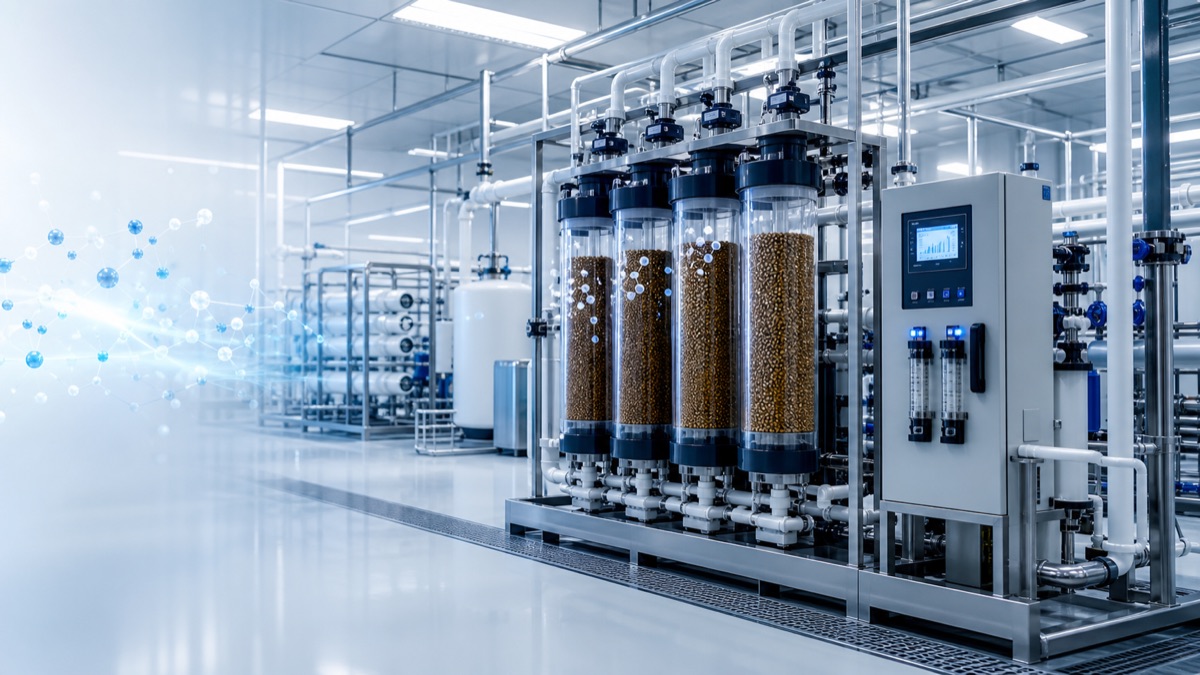
Selective Boron Removal: validating trace-boron polishing for semiconductor UPW
Semiconductor Ultra-Pure Water (UPW) treatment must control trace contaminants to the facility’s defined process specifications. Boron is difficult to verify using ordinary conductivity because much of it is weakly ionized. Do not infer a universal sub-ppb or ppt requirement, or device-yield effect, from a technology-node name. Establish the actual boron limit, sampling location, analytical quantification limit and validated treatment duty before specifying EPC polishing stages or modifying an existing UPW train.
At neutral or mildly acidic pH, boron is predominantly neutral boric acid (, also written ). Its weak ionization limits ordinary charge-based removal by conventional ion exchange (IX) or electrodeionization (EDI). Increasing pH favors borate () and may improve RO rejection, while boron-selective resins can use specific complexation rather than require bulk conversion to borate. These routes have different operating and purity constraints.
Governing Relations for Boron Speciation and Adsorption
Boron's chemical behavior in water is governed by its value and the solution's pH. At typical UPW operating temperatures (), the primary equilibrium is:
An equivalent hydroxide-binding expression is:
For dilute water at , is approximately . At pH 7, the ideal equilibrium gives about 0.57% borate, not less than 0.1%; at , the two species are equally abundant in this simplified system. Salinity, temperature and other boron complexes change the calculation. Raising pH can improve charge-based rejection, but is not a universal prerequisite for N-methylglucamine selective resin capture.
A Langmuir-type isotherm may fit measured equilibrium adsorption over a tested concentration range. It assumes a finite population of equivalent sites and a monolayer; it is not a dynamic column breakthrough model. For liquid concentration , the equilibrium amount (solute mass per adsorbent mass) is expressed as:
where represents the maximum adsorption capacity (at monolayer saturation, typically in mg/g or mmol/g), and is the Langmuir adsorption equilibrium constant (related to the energy of adsorption, typically in L/mg or L/mmol). This model assumes:
- Adsorption occurs on specific, identical sites.
- Each site can only accommodate one molecule (monolayer adsorption).
- Adsorption is reversible.
- Adsorbed molecules do not interact with each other.
Boron-selective resins with N-methylglucamine groups can complex boric acid/borate. pH affects resin-site and boron chemistry, but requiring all boron to be ionic misrepresents the selective mechanism. A fitted describes the tested equilibrium conditions; it cannot establish trace outlet leakage, regenerability or UPW suitability without dynamic trials.
Measurements for evaluating trace-boron polishing
For a project with a defined trace-boron specification, compare treatment routes using breakthrough, analytical validation and the same UPW duty. The table lists measurements to obtain, rather than claimed anonymous pilot performance.
| Parameter | Existing treatment train | Candidate selective-polishing train |
|---|---|---|
| Boron outlet and quantification limit | Measure below the site specification with validated sampling | Demonstrate leakage and breakthrough over the full service cycle |
| Specific energy (kWh/m³) | Meter the stated UPW process boundary | Include circulation, conditioning and regeneration auxiliaries |
| Regenerant use per produced water volume | Record actual chemical concentrations and volumes | Include acid/base, rinsing, neutralization and waste treatment |
| Installation footprint and integration | Document the current equipment and bypasses | Include lead/lag beds, sampling, storage and regeneration space |
| UPW recovery (%) | Close the complete water balance | Include rinsing, regeneration and rejected out-of-spec water |
| Resin service life | Record replacement criteria and actual operation | Validate capacity, leakage, attrition and leachables after cycling |
These are required project measurements. No universal outlet concentration, chemical consumption, recovery, equipment footprint or resin life follows from the term “boron-selective.”
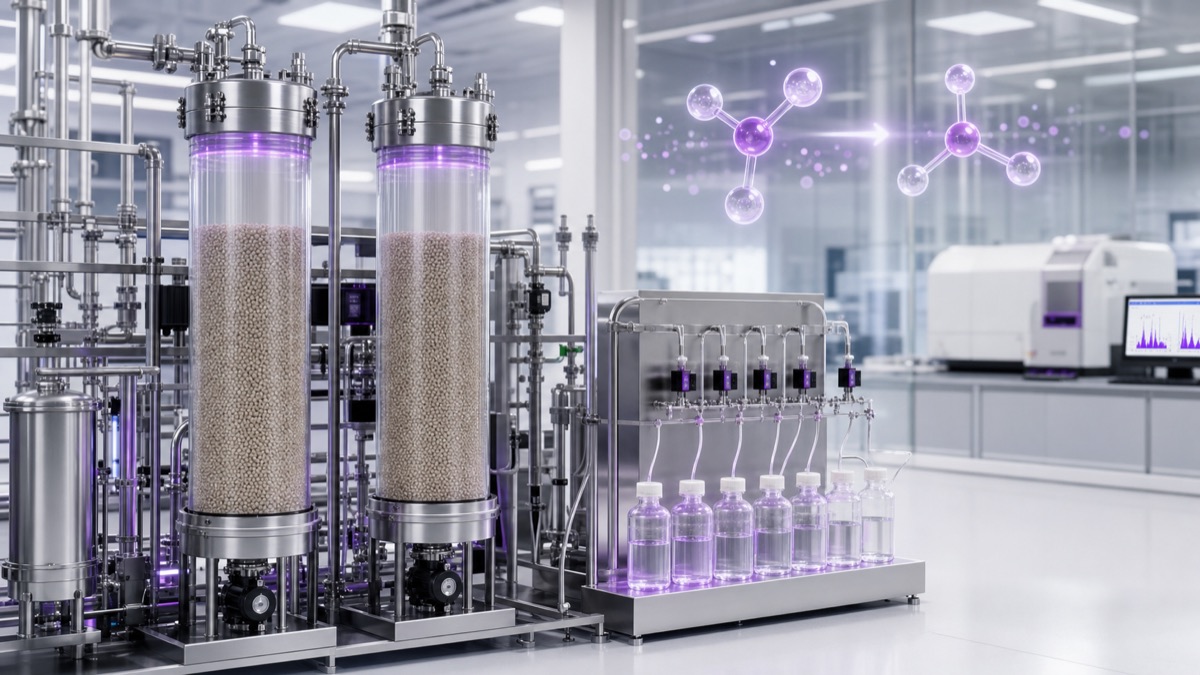
This image focuses on selective polishing columns, metered sampling, and trace-analysis context because boron removal is not just another conductivity problem. The purple trace-species motif hints at boric acid / borate speciation, while the resin beds and sample panel point to the real operating constraints: pH control, competing ions, resin breakthrough, and sub-ppb analytical validation.
Limits and honest boundaries
Selective removal remains sensitive to feed composition, temperature, resin chemistry and regeneration quality. Evaluate dissolved organics, silica, suspended solids, oxidants and competing interactions on the selected resin, rather than classify every common anion as an equal competitor. pH changes can affect RO scaling and downstream purity but are not always necessary for selective resin complexation. Qualify resin leachables and regeneration/rinse procedures for UPW; an industrial boron-removal grade is not automatically an UPW polishing grade. Use validated trace-boron analysis such as ICP-MS with appropriate blanks and sampling; conductivity or TOC alone cannot confirm boron removal.
FAQ
Q1: Why is boron considered a more challenging contaminant to remove to sub-ppb levels compared to other common ions in UPW? A1: At neutral pH, much of the boron is neutral boric acid (), so ordinary ionic-removal performance and conductivity do not establish its removal. RO pH strategies and specialized complexing resins may be useful, but must be assessed for the actual trace-boron requirement, leachables and water chemistry. A specific selective resin can capture neutral boric acid as well as borate; it should not be equated with a general anion exchanger.
Q2: What is the optimal pH range for selective boron removal using functionalized ion exchange resins, and what are the trade-offs? A2: There is no universal optimal pH range for all functionalized resins or UPW trains. Follow the selected grade’s service and regeneration conditions and validate dynamic leakage with the actual feed. For RO, higher pH may increase borate fraction and rejection but can raise carbonate scaling, chemical addition and downstream purity demands. Boron-selective N-methylglucamine resin does not universally require high-pH conversion before capture.
Q3: How are sub-ppb boron concentrations reliably measured and validated in a production UPW environment? A3: Validate an analytical method with a quantification limit below the facility’s specification, suitable sample preparation and demonstrated control of blanks, matrix effects, contamination and memory effects. ICP-MS is a common option; a specialized introduction system is not universally required. Use boron-compatible clean containers and reagents, field/procedural blanks, calibration and recovery checks. Validate any inline instrument against the qualified method. Reference: DuPont AmberSep IRA743 selective removal of boric acid and borate.
Related equipment & product lines
These categories typically support the approach above—open any line to compare brands and models.
- Ion Exchange ResinsCation/anion and mixed bed resin solutions for demineralization and polishing.View category →
- RO MembranesReverse osmosis membrane elements for municipal and industrial desalination.View category →
- Instrumentation & SensorsInstruments and sensors for online monitoring of flow, level, pressure, temperature, and water quality.View category →
For a closer review, use the engineering inquiry form to share feed, capacity, target, and project stage. Submission does not constitute a completed design or performance commitment.