Solutions · New Technologies & Innovation
Next-Gen Fouling-Resistant Membranes: biomimetic surface engineering and extended CIP intervals
Contact angle, bio-adhesion, and cake-layer physics: how engineered active layers stretch cleaning intervals without promising miracles.
Use when
Fouling increases pressure and cleaning demand; incompatible CIP can damage membrane performance.
Process options
Low-adhesion coatings, spacer/channel hydrodynamics, and cross-flow shear matched to foulant class.
Assessment output
Compare normalized performance and cleaning recovery on the actual feed before claiming longer CIP intervals.
Inputs and conditions for an assessment
Collect feed variability, capacity, target quality, operating hours, discharge or reuse boundaries and installed equipment data. Compare examples on matched conditions and meter boundaries; assess a project using actual water data, equipment documentation and any necessary tests.
View the process illustration
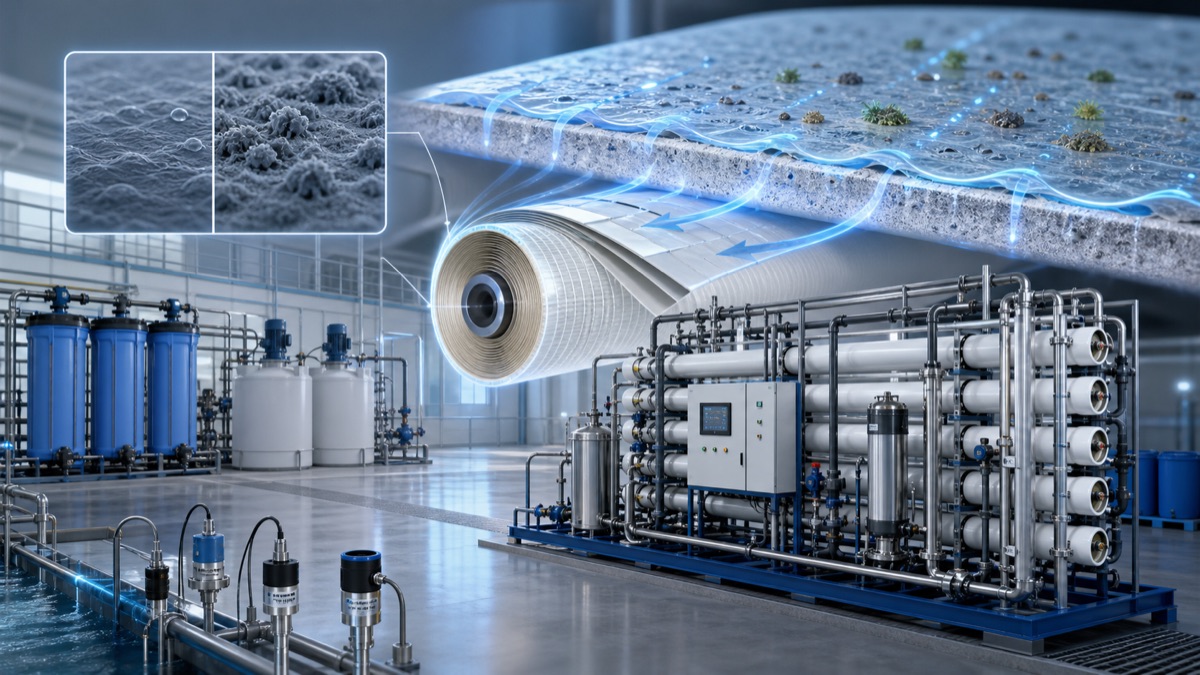
The Physics of Fouling Resistance
Membrane fouling accumulates particles, colloids, organics, microbes or precipitated salts on or within a membrane. It can lower flux at constant pressure or increase required Transmembrane Pressure (TMP) at constant flux. The resistance-in-series expression below is a simplified hydraulic description of permeate flux (); its use for RO must account consistently for surface osmotic pressure and membrane resistance.
where is the applied hydraulic pressure, is the reflection coefficient, is the osmotic pressure difference across the membrane, is the permeate viscosity, is the intrinsic membrane hydraulic resistance, and is the additional resistance due to fouling.
The added resistance () depends on the foulant and membrane structure. Cake resistance () and pore blocking () are useful descriptions for applicable porous layers, while the dense RO selective layer is not a simple open-pore sieve. Concentration polarization raises surface concentration above bulk and the local osmotic difference ; representing it as an apparent must not count the same effect again in the osmotic term. Surface modification may reduce attachment, but requires actual-feed verification.
Biomimetic design aims to reduce foulant adhesion by changing hydration, charge, roughness and surface chemistry. Adhesion work describes a particular interface under stated conditions, rather than a universal zero-fouling threshold. Contact angle or initial bacterial attachment alone does not predict prolonged system performance. Research coatings require durability, selectivity, chemical-cleaning and real-water tests before their benefits can be assigned to a commercial element.
Biomimetic Surface Engineering: Strategies and Mechanisms
Research into surface-engineered membranes extends beyond pore-size adjustment. The approaches below describe investigated mechanisms, rather than features shared by every commercial fouling-resistant RO/NF element:
-
Zwitterionic Polymer Grafting: Inspired by the non-fouling properties of cell membranes, zwitterionic polymers (e.g., poly(sulfobetaine methacrylate) or PSBMA) possess both positive and negative charges in their repeating units. When hydrated, these polymers form a robust hydration layer that sterically repels approaching foulants. This dense, ordered water layer effectively creates a physical and energetic barrier, reducing the thermodynamic favorability of foulant adsorption.
-
Polymer Brush Formation: Grafted chains such as polyethylene glycol (PEG) or selected polyacrylamides can create a hydrated steric layer. Response to pH or ionic strength depends on polymer chemistry and grafting conditions; PEG brushes are not inherently pH-responsive. Evaluate chain coverage, coating retention, added transport resistance and compatibility with operating and cleaning conditions.
-
Hydrogel Layer Deposition: Applying a thin, hydrophilic hydrogel layer to the membrane surface results in a highly hydrated, soft interface. This mimics the low-friction and anti-adhesive properties found in biological tissues. The high water content within the hydrogel layer provides a repulsive force against hydrophobic foulants and forms a low-energy barrier against protein and microbial adhesion.
These strategies aim to limit attachment or facilitate removal by hydration and appropriate steric or electrostatic interactions. Effects depend on foulant chemistry, salinity, shear and coating stability, and may trade off against permeability or selectivity. Improved initial adhesion tests do not establish longer CIP cycles in a biofilm-growing plant. In a published real-wastewater RO study, a zwitterionic coating did not assure better long-term operation: Ben-Gurion University research record.
Measurements for comparing membrane options
| Parameter | Existing membrane | Candidate membrane |
|---|---|---|
| CIP interval (days) | Record normalized cleaning triggers and feed changes | Apply the same triggers and operating conditions |
| CIP chemical consumption | Record concentration, volume, cycles and disposal | Include coating-compatible chemistry and actual waste volume |
| Specific energy (kWh/m³) | Meter the same system boundary and water-quality duty | Compare normalized duty and auxiliary losses |
| Water recovery (%) | Close the feed, permeate and reject balance | Include cleaning downtime and water losses |
| Sustainable flux (LMH) | Normalize for temperature, salinity and pressure | Track normalized decline, rejection and recovery after cleaning |
| Membrane service life | Use operating history and replacement criteria | Demonstrate durability rather than extrapolate short tests |
This table defines comparison measurements, not internal pilot results or guaranteed performance ranges. Published commercial fouling-resistant examples and research coatings must be evaluated separately.
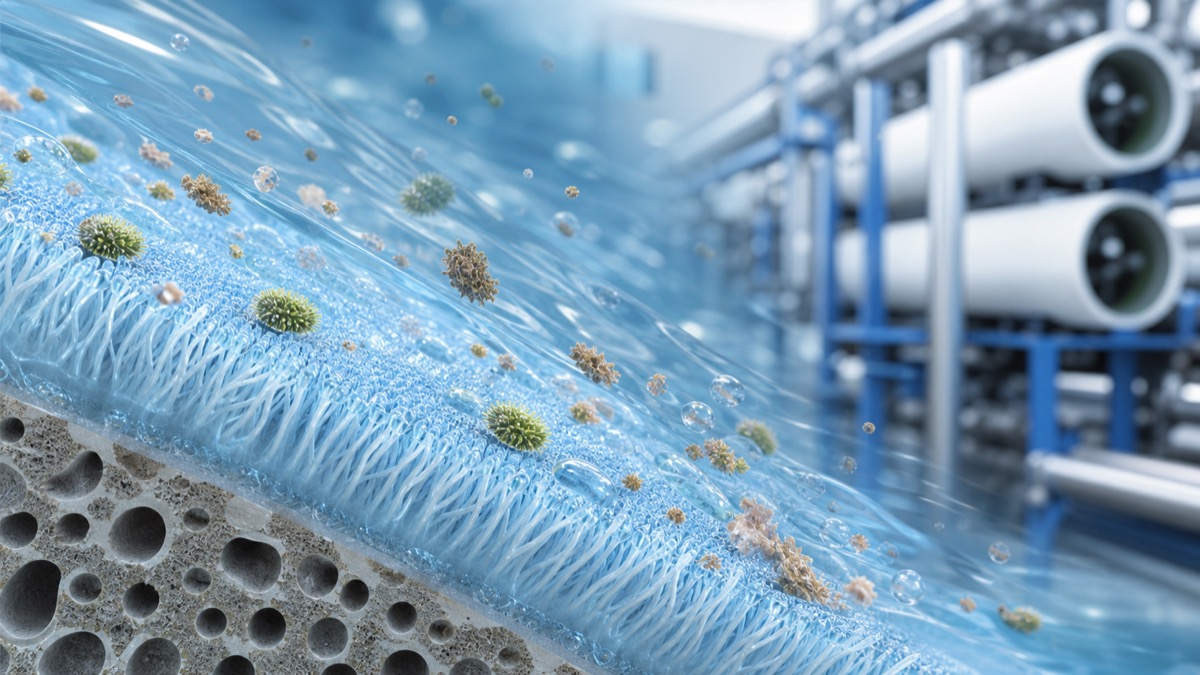
The illustration depicts a proposed hydrated surface and polymer brushes. It explains an investigated adhesion mechanism rather than proves that the shown coating is used in a commercial RO train. Confirm the selected product’s actual surface/module construction and test data before predicting performance.
Extended CIP Intervals and Operational Benefits
A useful membrane change slows normalized fouling or improves compatible cleaning recovery at the required water quality. Determine CIP intervals from performance triggers and operating evidence, not a fixed calendar extension. Potential benefits to assess include:
- Reduced OPEX: Measure cleaning chemicals, labor, energy and waste-disposal costs, including any coating-specific cleaning restrictions.
- Increased Uptime: Compare actual cleaning shutdowns and production availability under the same feed and duty.
- Lower Environmental Footprint: Evaluate total chemical use, cleaning wastewater and replacement materials across the stated boundary.
- Extended Membrane Lifespan: Track coating stability, rejection and irreversible damage; fewer cleanings alone does not prove longer service life.
- More Stable Performance: Compare normalized flux, salt passage and pressure-drop trends, rather than assume design values persist.
Where tests demonstrate weakly bound deposits, less aggressive or shorter compatible cleaning may be sufficient. Confirm restored flux and rejection; never dilute or postpone cleaning solely because a surface is described as biomimetic.
Limits and honest boundaries
While next-gen fouling-resistant membranes represent a significant advancement, it is critical to acknowledge their limitations and the absolute necessity of a holistic approach to water treatment. These membranes are fouling-resistant, not fouling-proof.
FAQ
Q2: What is the typical incremental cost for these advanced fouling-resistant membranes, and how does it affect the total cost of ownership (TCO)? A: Use current quotations and site-specific performance to calculate TCO, including elements, cleaning, energy, downtime, disposal and replacements. Generic price premiums, service lives and percentage savings are not supported here. Compare a representative trial and sensitivity scenarios with the existing system. Commercial fouling-resistant products do exist: DuPont FilmTec Fortilife portfolio; this does not establish that every product uses the research coatings described above.
Q3: How do these membranes perform with highly complex industrial wastewater streams compared to less challenging municipal or brackish water feeds? A: Complex industrial wastewater can contain interacting organics, colloids, scaling precursors and microbes. A coating that suppresses one adhesion mechanism may not control the whole mixture, and feed variability may remove an apparent advantage. Retain pretreatment and compare durable flux, rejection, pressure drop and cleaning recovery using representative industrial feed; stronger benefits than on municipal or brackish water cannot be presumed.
Related equipment & product lines
These categories typically support the approach above—open any line to compare brands and models.
- RO MembranesReverse osmosis membrane elements for municipal and industrial desalination.View category →
- ChemicalsAntiscalants, cleaners, and process chemicals for water treatment operations.View category →
- Replacement Parts / SparesGeneral replacement parts for treatment systems and subassemblies.View category →
For a closer review, use the engineering inquiry form to share feed, capacity, target, and project stage. Submission does not constitute a completed design or performance commitment.