Solutions · New Technologies & Innovation
Lithium Extraction from Brine: evaluating adsorption–membrane coupling
Selective sorbents, eluate polishing, and mass balance: what is pilot-credible versus headline hype in DLE narratives.
Use when
Battery demand makes brine lithium strategic; investors demand tonnes and kWh per kg Li, not adjectives.
Process options
Validate selective-media cycles, eluate purification and membrane concentration against the required lithium product.
Assessment output
Close lithium, impurity, reagent, water and energy balances across a representative integrated trial.
Inputs and conditions for an assessment
Collect feed variability, capacity, target quality, operating hours, discharge or reuse boundaries and installed equipment data. Compare examples on matched conditions and meter boundaries; assess a project using actual water data, equipment documentation and any necessary tests.
View the process illustration
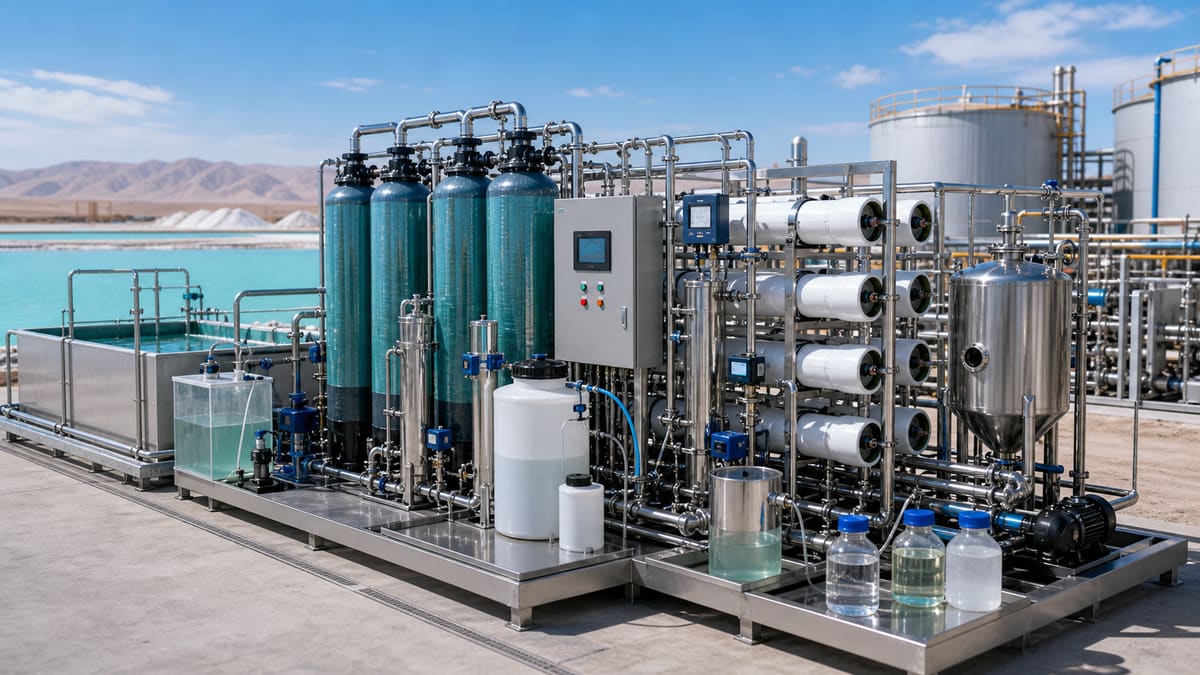
Lithium Extraction from Brine: evaluating adsorption–membrane coupling
Lithium occurs in some geological and process brines, but ordinary industrial wastewater, semiconductor wastewater or desalination concentrate cannot be presumed to contain an economically recoverable resource. For a 2026 engineering study, establish measured lithium concentration and flow, impurities, feed continuity and access, product specification and the authorized depleted-brine route. Adsorption–membrane coupling is one Direct Lithium Extraction (DLE) route to evaluate; useful extraction and water reuse must be demonstrated together rather than inferred from a technology label. Geothermal brine is a documented research and development context: U.S. Department of Energy lithium program.
Fundamental Principles of Coupled Separation
The efficacy of coupled adsorption–membrane systems for lithium extraction from concentrated brines hinges on two distinct yet synergistic principles: selective ion capture by adsorbents and efficient water/solute separation by membranes.
Adsorption Kinetics and Isotherms
Lithium-selective media may include manganese-oxide ion sieves (LMO), titanium-based materials and other chemistries. Their affinity for Li+ relative to Na+, K+, Mg2+ and Ca2+ varies with the actual brine and operating conditions; selectivity is not complete rejection of every competing cation. Measure loading, elution and repeated-cycle stability. Equilibrium capacity is sometimes fitted with the Langmuir isotherm, which assumes equivalent sites and monolayer adsorption:
where is the maximum adsorption capacity (mg/g), is the Langmuir constant related to the affinity of the binding sites for the adsorbate (L/mg), and is the equilibrium lithium concentration in the liquid phase (mg/L). For practical application, understanding the rate at which lithium loads onto the adsorbent is equally critical. This involves kinetic models that account for mass transfer limitations, critical for designing efficient contactors and predicting breakthrough curves. Parameters like intraparticle diffusion coefficients and film diffusion resistances dictate the contact time required to achieve a desired loading, directly impacting reactor sizing and regeneration frequency.
Membrane Osmotic Pressure and Fouling Management
Membrane processes, particularly Reverse Osmosis (RO) or Ultra-High Pressure Reverse Osmosis (UHPRO), are employed both upstream for pre-concentration (if raw brine is dilute) and downstream for concentrating the eluted lithium stream and purifying the wastewater for reuse or discharge. For concentrated brines, the osmotic pressure, , becomes a dominant factor in determining the energy requirements and achievable recovery. Van 't Hoff's law provides a basic approximation for dilute solutions: , where is the van 't Hoff factor, is the molar concentration of the solute, is the ideal gas constant, and is the absolute temperature. For highly concentrated brines, more complex models incorporating activity coefficients are needed, but the fundamental principle remains: higher directly translates to a greater transmembrane pressure requirement to overcome the natural osmotic gradient, thereby impacting the net driving pressure for permeate flux.
Characterize scaling potential at each proposed stage, not merely inlet hardness. Ca and Mg may form deposits such as CaSO or Mg(OH) when the relevant saturation and pH conditions are reached. Precipitation, softening or nanofiltration (NF) are options to evaluate; include lithium coprecipitation or membrane losses and waste generation. Set flux, recovery and cleaning boundaries from the actual ionic mixture and pilot results to establish specific energy consumption (SEC).
Integrated Adsorption-Membrane Process Flow
A typical coupled system involves several stages:
- Pretreatment: Analyze the brine and remove interfering solids or species using a compatible sequence. Evaluate filtration, precipitation or targeted ion exchange together with lithium losses, reagent use and downstream scaling; full Ca/Mg removal is not automatically required for every selective medium.
- Lithium Adsorption: Use a contactor suited to the selected material and flow. Measure lithium breakthrough, co-loading, hydraulic losses and the depleted-brine composition; preferential lithium uptake does not establish complete impurity exclusion.
- Washing & Elution: Follow the selected medium’s validated wash and regeneration chemistry, which may differ between ion-sieve and other sorbents. Track residual-brine carryover, acid or water demand, lithium loss, leached media and eluate volume. Elution does not automatically produce a concentrated or purified final product.
- Lithium Brine Concentration & Purification: Test NF separation of Li+ from multivalent impurities in the actual salt matrix, including rejection and lithium loss. RO or UHPRO may concentrate a suitable eluate within pressure and scaling limits; retaining salts concentrates impurities too, rather than inherently increasing lithium purity. Product conversion, crystallization and impurity polishing must separately meet the agreed product specification.
- Brine Management & Water Reuse: Account for depleted brine, wash water, regenerant, sludge and membrane concentrate. Reinjection, reuse or further treatment requires the site’s applicable technical and authorization conditions. A membrane stage or a DLE recovery figure does not prove environmental compliance or complete ZLD.
The illustration represents an adsorption contactor, not proof of the selected lithium medium or a completed industrial installation. Bed hydraulics, particle properties, wash displacement and regeneration determine channeling, breakthrough and eluate quality. Verify distribution and cycling with the actual medium; a generic ion-exchange column image cannot establish chemical consumption or concentrate strength.
Measurements for comparing lithium-recovery routes
| Parameter | Existing or reference route | Proposed adsorption–membrane route |
|---|---|---|
| Land and installation footprint | Document the same production capacity and scope | Include pretreatment, reagent storage, residue handling and utilities |
| Specific energy consumption (SEC) | Separate electricity, supplied heat and solar evaporation | Meter the integrated process per feed volume and lithium product mass |
| Lithium recovery | Close the complete lithium mass balance | Include pretreatment, wash, eluate, membrane and product-conversion losses |
| Lithium-product purity | Use the agreed product and impurity specification | Analyze the final product, not just eluate concentration |
| Time to production | Include approvals, construction, startup and specification acceptance | Include media qualification, integrated commissioning and reliable cycling |
| Water and environmental balance | Count freshwater, brine evaporation and waste streams separately | Include wash/regeneration water, residues and the final brine route |
These are measurements to obtain for a specific project, not generic DLE performance ranges. Resource composition and extraction method determine recovery, energy, water use and the final product; a bench capacity alone cannot establish commercial production.
Limits and honest boundaries
While adsorption-membrane coupling offers significant advantages, its successful implementation demands meticulous attention to several critical factors. Neglecting these can lead to compromised performance, increased operational costs, and even system failure:
- Feed Brine Variability: Fluctuations in feed brine concentration (especially for Li and competing ions), pH, temperature, and presence of trace organic contaminants can significantly impact adsorbent selectivity and membrane performance. Inadequate real-time monitoring and adaptive control strategies can lead to inefficient adsorption, premature adsorbent degradation, or membrane fouling.
- Pretreatment Efficacy: Residual solids, silica and scale-forming species may foul contactors or membranes under the selected conditions. Determine appropriate limits and cleaning (CIP, COP) from real-brine tests while measuring lithium losses and the costs of pretreatment itself.
- Adsorbent Stability and Selectivity: The long-term chemical and mechanical stability of the lithium-selective adsorbent in harsh brine environments is crucial. Leaching of adsorbent components or loss of selectivity due to irreversible poisoning by specific ions (e.g., iron, heavy metals) can reduce recovery and increase make-up costs. Rigorous testing with actual feed brine is non-negotiable.
- Membrane Selection and Operating Strategy: Choosing the correct membrane chemistry (e.g., polyamide, thin-film composite) and module configuration (spiral wound, plate-and-frame) for the specific brine characteristics and operating pressure is critical. Operating membranes beyond their design limits (e.g., excessive flux, recovery, or pressure) accelerates compaction, fouling, and structural damage, leading to higher SEC and increased replacement costs.
- Eluate Management and Purity: The purity and concentration of the lithium eluate from the adsorption stage directly impact the efficiency of subsequent membrane purification and crystallization. Incomplete washing or poor regeneration strategies can lead to a dilute or contaminated eluate, requiring more intensive and costly downstream processing.
- Waste Brine Management: While the system extracts lithium, it still generates a concentrated waste brine. The final disposition or further treatment (e.g., ZLD, salt recovery) of this stream must be fully integrated into the overall process design from the outset to avoid creating a secondary environmental challenge.
FAQ
Q1: How does the presence of high magnesium or calcium concentrations impact lithium recovery in these systems? A1: Mg and Ca may compete with Li on some media, contaminate the eluate or form deposits under the relevant saturation conditions. The importance depends on material selectivity, pH, counter-ions and stage recovery. Test selective media and options such as precipitation, ion exchange or NF while quantifying lithium losses and regenerant demand; universal complete removal before adsorption is not required by every chemistry.
Q2: What are the typical energy demands (kWh/m³) for this coupled adsorption-membrane process compared to traditional evaporation? A2: There is no supported universal SEC for this coupled process. Solar ponds primarily use environmental heat; their evaporation cannot be compared directly with purchased electricity. For thermal and membrane routes, measure supplied heat and electricity separately, include heat recovery, pretreatment, washing, regeneration and product finishing, and report the same feed-volume and lithium-product basis. Salinity and a batch adsorption result alone do not determine commercial energy demand.
Q3: Can this technology be applied to highly variable industrial wastewater streams, or is it better suited for consistent brine sources? A3: Stable and well-characterized brine makes qualification easier, but modular equipment does not guarantee adaptation to changing industrial wastewater. Define the operating envelope from measured lithium, impurities, pH and temperature over time. Buffering and control may help only within that validated range. Establish economic feed continuity and repeated integrated-cycle performance before committing to a product recovery or purity target.
Related equipment & product lines
These categories typically support the approach above—open any line to compare brands and models.
- Ion Exchange ResinsCation/anion and mixed bed resin solutions for demineralization and polishing.View category →
- RO MembranesReverse osmosis membrane elements for municipal and industrial desalination.View category →
- UF ModulesUltrafiltration modules for suspended solids and colloid removal.View category →
For a closer review, use the engineering inquiry form to share feed, capacity, target, and project stage. Submission does not constitute a completed design or performance commitment.