Solutions · New Technologies & Innovation
Heterogeneous Catalytic Ozone Oxidation: AOP upgrades for refractory TOC in industrial effluents
Surface-mediated ·OH pathways, ozone mass transfer, and catalyst life: when fixed-bed catalysis changes the opex curve versus ozone alone.
Use this guide within its scope
This page supports technical research and option comparison and is marked 2026. Illustrative values are not a quotation, completed process design, certification conclusion, or performance guarantee. Check current regulations, feed data, tests, and OEM records.
Problem
Ozone-only steps stall on recalcitrant organics; UV-AOP capex does not fit every brownfield.
Technology
Stable metal-oxide catalysts, ozone dissolution hardware, and monitored intermediate toxicity.
Results
Illustrative TOC vs SEC (kWh/kg removed) comparisons with pilot-scale caveats.
Engineering decision card
Use when
Ozone-only steps stall on recalcitrant organics; UV-AOP capex does not fit every brownfield.
Evaluate first
Stable metal-oxide catalysts, ozone dissolution hardware, and monitored intermediate toxicity.
Inputs still required
Feed source and variability, capacity, target quality, operating hours, discharge or reuse boundary, available space, and utilities.
Comparison output
Illustrative TOC vs SEC (kWh/kg removed) comparisons with pilot-scale caveats. The final decision still needs feed data, mass balance, and any necessary testing.
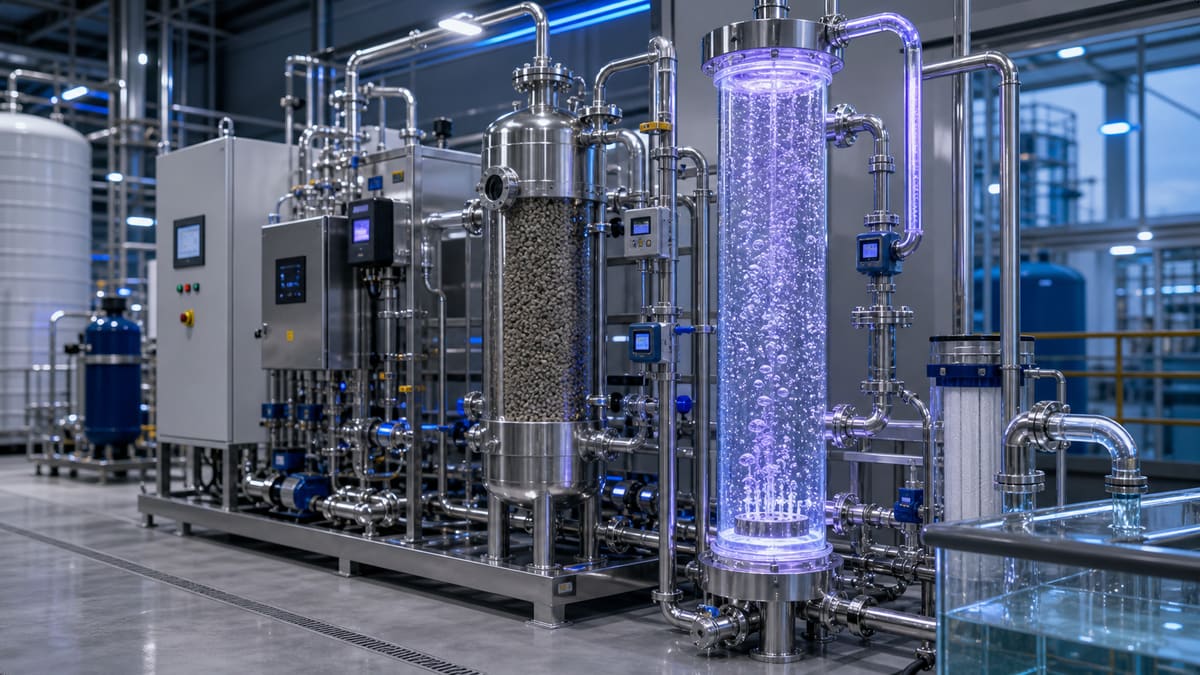
Heterogeneous Catalytic Ozone Oxidation: AOP upgrades for refractory TOC in industrial effluents
The escalating demand for ultra-pure water in advanced semiconductor manufacturing (2026 fabs) and stringent discharge limits for chemical majors are pushing the boundaries of conventional water treatment. Chief engineers and R&D leads are facing increasing challenges in sustainably removing refractory total organic carbon (TOC) that often bypasses even advanced biological or membrane-based processes. For EPC discipline engineers, integrating robust, efficient, and compact advanced oxidation processes (AOPs) capable of handling complex industrial effluents is becoming a critical differentiating factor in bids. Heterogeneous Catalytic Ozone Oxidation (HCOO) emerges as a pivotal technology, offering enhanced TOC degradation efficiency, reduced ozone consumption, and improved process economics, transcending the limitations of homogenous ozonation or UV/H2O2 systems. This technology is key for achieving ambitious reuse targets, ZLD (Zero Liquid Discharge) mandates, and ensuring compliance for challenging wastewater streams.
Principles of Enhanced Oxidative Degradation
Heterogeneous Catalytic Ozone Oxidation (HCOO) fundamentally leverages the synergistic interaction between ozone () and a solid catalyst surface to generate highly reactive hydroxyl radicals () more efficiently and selectively than ozone alone. While ozone is a potent oxidant, its direct reaction with many organic compounds is relatively slow and often non-selective. The rate-limiting step in gas-liquid ozone reactions is frequently the mass transfer of ozone from the gas phase into the aqueous phase. This transfer can be described by the following relation, which is critical for reactor design and efficiency:
Upon contact with a suitable catalyst (e.g., metal oxides like MnO, TiO, or supported noble metals), ozone undergoes accelerated decomposition, leading to the formation of radicals. These radicals exhibit an oxidation potential of relative to the standard hydrogen electrode (SHE), making them significantly more powerful and less selective than ozone (), capable of rapidly mineralizing a broad spectrum of recalcitrant organic molecules. The catalytic cycle often involves ozone adsorption onto active sites, electron transfer, and subsequent formation of surface-bound oxygen species and radicals, which then desorb or react with adsorbed organic compounds. The overall degradation of an organic pollutant (represented as TOC) can often be approximated by a pseudo-first-order decay kinetics in the presence of sufficient radicals: , where is the apparent rate constant influenced by catalyst activity, ozone dosage, and pollutant concentration.
Catalytic Mechanisms and Catalyst Selection
Key performance indicators for catalysts include:
- Activity: Rate of ozone decomposition and radical generation.
- Selectivity: Tendency to generate rather than unproductive .
- Stability: Resistance to leaching, fouling, and deactivation over extended operation.
- Regenerability: Ease of restoring activity through simple washing or mild thermal treatment.
- Cost-effectiveness: Balancing performance with material cost and lifecycle.
this approach's proprietary catalyst formulations are engineered for enhanced surface area, specific pore distribution, and robust mechanical integrity, ensuring long operational cycles and high mass transfer efficiency within the reactor.
Illustrative pilot / lab comparison
The following table highlights the typical performance advantages observed between conventional homogeneous ozonation and this approach's Heterogeneous Catalytic Ozone Oxidation systems based on pilot trials and advanced lab studies with complex industrial effluents.
| Parameter | Traditional process | engineering evaluation path innovative |
|---|---|---|
| TOC Removal Efficiency (Refractory compounds) | 40-60% | 75-95% |
| Ozone Consumption (g /g TOC removed) | 1.8-3.5 | 0.8-1.5 |
| Specific Energy Consumption (kWh/m³ for AOP stage) | 0.8-1.5 | 0.4-0.9 |
| Catalyst/System Lifespan (Operation hours before major intervention) | N/A (Homogeneous) | >20,000 |
| Reactor Footprint (Relative to throughput) | 1.0 (Baseline) | 0.7-0.9 |
| By-product formation (e.g., Bromate in Br-rich waters) | Moderate to High | Low to Moderate |
Numbers are illustrative and represent general trends observed in pilot-scale operations with varying wastewater matrices, and are not specific performance guarantees.
Limits and honest boundaries
While Heterogeneous Catalytic Ozone Oxidation offers significant advantages, its successful implementation relies on careful system design and operational discipline. Neglecting certain boundary conditions can lead to suboptimal performance or system failure:
- Pre-treatment: Insufficient removal of suspended solids or high concentrations of radical scavengers (e.g., carbonates, bicarbonates, certain organic species) in the feed can significantly reduce catalyst activity and ozone efficiency by consuming hydroxyl radicals unproductively or fouling the catalyst surface. A robust pre-filtration and pH adjustment stage is typically essential.
- Catalyst Fouling/Poisoning: Certain metal ions (e.g., iron, manganese) or specific organic compounds can adsorb onto or react with catalyst active sites, leading to reversible or irreversible deactivation. Regular monitoring and, if necessary, in-situ or ex-situ regeneration protocols are crucial for maintaining long-term catalyst performance and planned uptime.
- Instrumentation and Control: Accurate online monitoring of ozone dose, residual ozone, pH, and ORP (Oxidation-Reduction Potential) is vital for optimal process control. Inadequate instrumentation can lead to over-dosing (wasteful) or under-dosing (ineffective treatment).
- Off-gas Management: Despite high ozone utilization, trace ozone in the off-gas stream must be managed. Failure to incorporate an effective ozone destructor (e.g., thermal, catalytic) poses environmental and safety risks.
- BOD/COD Ratio: While excellent for recalcitrant TOC, HCOO is not a primary BOD/COD removal step for highly biodegradable wastes. It's often deployed after biological treatment or for specific non-biodegradable fractions. For certification or ppb-level targets, contextual measurement standards (e.g., detection limits, analytical method, matrix interference) must be established prior to claiming specific effluent quality.
Environmental and Economic Considerations
HCOO offers a compelling environmental profile. By significantly reducing ozone consumption per unit of TOC removed, it inherently lowers energy demand associated with ozone generation. Its efficiency in mineralizing complex organic pollutants reduces the overall chemical oxygen demand (COD) and biological oxygen demand (BOD) load, often enabling compliance with stricter discharge regulations without extensive secondary treatment. The robust nature of the catalysts, coupled with their long lifespan and regenerability, reduces waste generation compared to single-use adsorbent media or chemical-intensive processes. Economically, while the capital expenditure for HCOO may be higher than conventional ozonation due to the catalyst and specialized reactor design, the operational cost savings from reduced ozone dosage, minimized sludge generation, and lower specific energy consumption typically result in a favorable total cost of ownership (TCO) over the system's lifecycle, particularly for highly refractory wastewater streams.
FAQ
Q2: Can Heterogeneous Catalytic Ozone Oxidation effectively remove trace organic contaminants (e.g., Pharmaceuticals, EDCs) to ppb levels? A2: Yes, HCOO is highly effective at degrading a broad spectrum of trace organic contaminants due to the powerful and non-selective nature of hydroxyl radicals. For achieving very low ppb or sub-ppb levels, the system design considers factors like hydraulic retention time, ozone dosage, and catalyst loading. However, achieving specific ppb levels depends heavily on the initial concentration, matrix complexity, and the analytical detection limits of the target compounds, which must be agreed upon with contextually relevant measurement standards.
Q3: How does the capital cost and operational expenditure of HCOO compare to other AOPs like UV/H2O2 or Fenton processes? A3: The capital cost for HCOO can be marginally higher than basic UV/H2O2 due to the catalyst and specialized reactor. However, the operational expenditure (OpEx) is often significantly lower. HCOO typically requires less energy than UV/H2O2 (due to lower electrical input for ozone generation vs. UV lamps), and avoids the continuous chemical consumption, sludge generation, and pH adjustment associated with Fenton processes. This results in a superior total cost of ownership (TCO) for challenging applications over the system's lifetime, especially for high flow rates or high refractory TOC loads.
Related equipment & product lines
These categories typically support the approach above—open any line to compare brands and models.
- Ozone GeneratorOzone generation systems and peripherals for advanced oxidation processes.View category →
- ChemicalsAntiscalants, cleaners, and process chemicals for water treatment operations.View category →
- UV DisinfectionUV systems and modules for pathogen inactivation and final disinfection barriers.View category →
For a closer review, use the engineering inquiry form to share feed, capacity, target, and project stage. Submission does not constitute a completed design or performance commitment.