Solutions · Industry Solutions
Semiconductor UPW: define quality at the point of use
Compare RO, EDI, mixed beds, degassing and UV polishing against feed conditions, sampling locations and a fab-specific acceptance specification.
Use when
An acceptable online resistivity reading does not establish compliance for TOC, particles, microbes or process-critical ions.
Process options
Combine pretreatment, RO, degassing, EDI or mixed beds, UV and distribution according to feed variability and point-of-use requirements.
Assessment output
A project specification with sampling locations, temperature compensation, analytical methods and acceptance limits.
Inputs and conditions for an assessment
Collect feed variability, capacity, target quality, operating hours, discharge or reuse boundaries and installed equipment data. Compare examples on matched conditions and meter boundaries; assess a project using actual water data, equipment documentation and any necessary tests.
View the process illustration

Specify the measurement before the target
UPW resistivity is commonly described as approaching 18.2 MΩ·cm when referenced to 25°C. Record the project acceptance limit, measurement tolerance and temperature-compensation method rather than using an unexplained “>18.2” reading as a universal guarantee.
ASTM D5127-13(2018) provides guidance for electronics and semiconductor water. Its published scope places recommendations at the point of distribution (POD). Define point-of-use (POU) requirements separately and select the classification and analytes for the actual manufacturing process.
| Measurement | Define in the specification | Sampling locations |
|---|---|---|
| Resistivity/conductivity | Compensation method, acceptance limit, calibration and range | Polishing outlet, return loop, critical POU |
| TOC | Project limit, analytical method and detection limit | Production outlet, loop and critical POU |
| Particles | Size channels, sample volume and count limits | Worst-case loop location and POU |
| Microbes | Sampling procedure, culture/rapid method and sample volume | Tank, worst-case loop location and POU |
| Silica, boron and critical ions | Process-relevant analytes, methods and limits | RO/polishing profile and critical POU |
Resistivity reflects ionic conductivity. It does not replace checks for organics, particles, microbes or process-sensitive contaminants.
Select barriers for the measured load
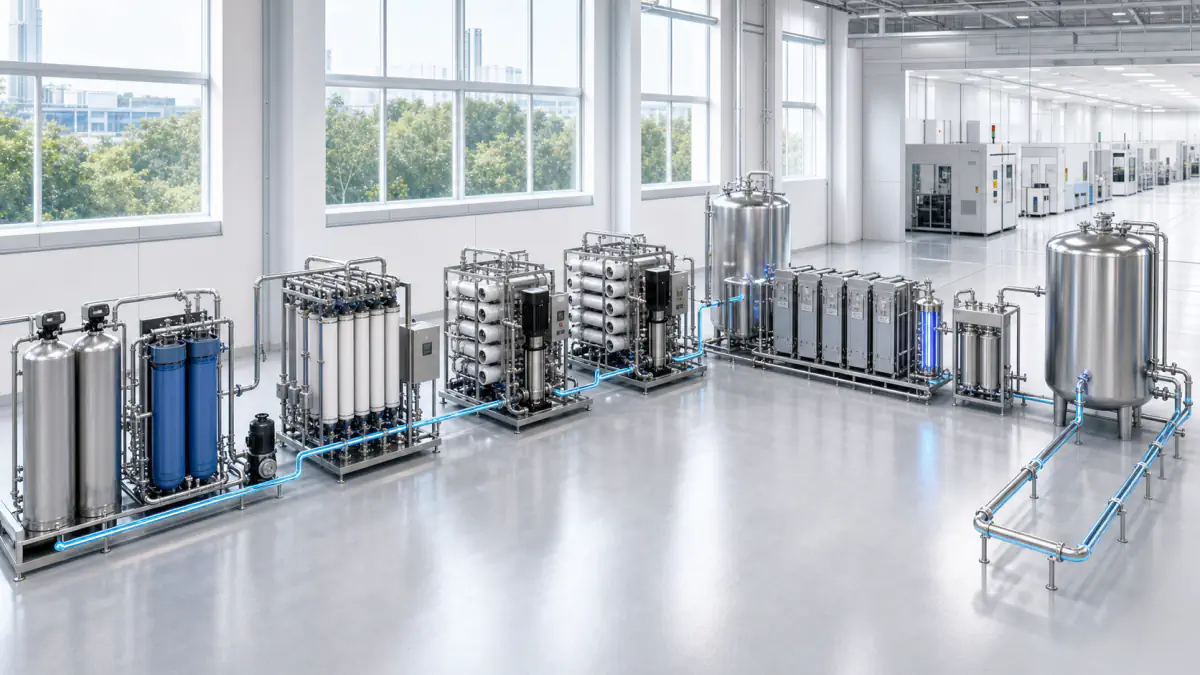
- Pretreatment: select clarification, filtration, UF, softening or chemical control for turbidity, colloids, hardness, organics and oxidants. Validate RO feed during seasonal peaks.
- RO and degassing: compare single- and double-pass RO; locate gas removal according to CO₂ and other gas loads before polishing.
- EDI or mixed beds: use the named module or resin requirements, flow range and quality target. Record temperature, pressure and electrical operating limits.
- UV and distribution: match TOC, microbial and particle objectives; check material release, dead legs, recirculation, sampling and sanitation effectiveness.
Data needed for an assessment
Collect feed and interstage analyses, production and return flows, temperature, online/laboratory comparisons, worst-season records, process specifications and installed equipment models. Separate startup acceptance from continued operation, and distinguish POD from POU results.
For an excursion, verify sampling location, compensation and analytical method before isolating the production train, tank or loop. A higher resistivity alone does not establish lower concentrations of every contaminant.
Original references
Related equipment & product lines
These categories typically support the approach above—open any line to compare brands and models.
- RO MembranesReverse osmosis membrane elements for municipal and industrial desalination.View category →
- Electrodeionization (EDI)EDI modules and systems for ultrapure water production.View category →
- Ion Exchange ResinsCation/anion and mixed bed resin solutions for demineralization and polishing.View category →
- UV DisinfectionUV systems and modules for pathogen inactivation and final disinfection barriers.View category →
For a closer review, use the engineering inquiry form to share feed, capacity, target, and project stage. Submission does not constitute a completed design or performance commitment.