Solutions · Industry Solutions
Pulp & paper: effluent COD reduction and white water closure
Fiber fines, lignin fragments, and COD in paper mill effluent: primary treatment, tertiary polishing, and membrane options for selective reuse.
Use this guide within its scope
This page supports technical research and option comparison and is marked 2026. Illustrative values are not a quotation, completed process design, certification conclusion, or performance guarantee. Check current regulations, feed data, tests, and OEM records.
Problem
Fiber fines and anionic trash blind screens and foul membranes; closing water loops concentrates problematic species.
Technology
Clarification, DAF, internal white water segregation, UF polish, and selective RO where high-quality streams justify capex.
Results
Lower freshwater intake, stable machine operations, and fewer sheet defects tied to chemistry drift.
Engineering decision card
Use when
Fiber fines and anionic trash blind screens and foul membranes; closing water loops concentrates problematic species.
Evaluate first
Clarification, DAF, internal white water segregation, UF polish, and selective RO where high-quality streams justify capex.
Inputs still required
Feed source and variability, capacity, target quality, operating hours, discharge or reuse boundary, available space, and utilities.
Comparison output
Lower freshwater intake, stable machine operations, and fewer sheet defects tied to chemistry drift. The final decision still needs feed data, mass balance, and any necessary testing.
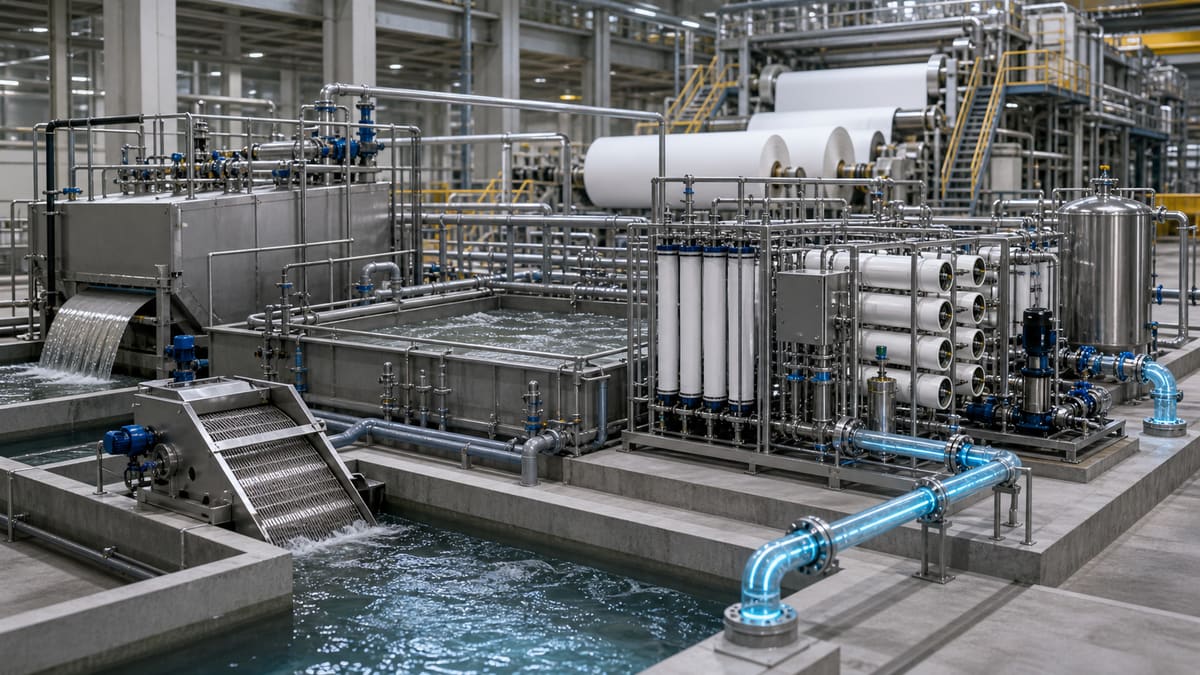
Pulp & paper: effluent COD reduction and white water closure
Pulp and paper manufacturing is one of the most water-intensive industries globally. Mills process enormous volumes of water, facing increasing pressure to reduce freshwater intake, minimize effluent discharge, and enhance internal water reuse. This drive is fueled by escalating regulatory stringency, water scarcity, and the economic imperative to recover valuable resources. The challenge intensifies with "white water" systems, which accumulate fiber fines, fillers, stickies, and dissolved organics, posing significant hurdles to effective closure and high-quality reuse. Meeting effluent discharge limits for chemical oxygen demand (COD), biochemical oxygen demand (BOD₅), total suspended solids (TSS), and color, while simultaneously improving internal water quality for process stability, requires a robust and adaptable water treatment strategy.
Industry Context & Regulatory Compliance Drivers
The pulp and paper sector operates under rigorous environmental regulations. Local and national environmental protection agencies (e.g., US EPA, European Environment Agency directives, or similar local authorities) set strict limits on the discharge of pollutants such as COD, BOD₅, TSS, and color into receiving waters. For instance, discharge permits often specify maximum allowable concentrations (e.g., 100 mg/L COD, 20 mg/L BOD₅, 30 mg/L TSS for direct discharge) that necessitate advanced tertiary treatment beyond conventional primary and secondary biological systems. Beyond external compliance, internal reuse targets are driven by the need to conserve resources, reduce operating costs associated with freshwater intake and wastewater treatment, and maintain product quality. Accumulation of dissolved solids, problematic ions (e.g., chlorides), and organics can impact paper machine chemistry, increasing corrosion rates, scaling, and the demand for process additives.
Water Quality Targets for Reuse & Discharge
Achieving mill closure requires a clear understanding of water quality targets for different reuse points:
- Machine Shower Water: Requires low TSS (<5 mg/L), low conductivity (<500 µS/cm), and minimal dissolved organics to prevent nozzle clogging, felt saturation, and sheet quality issues.
- Pulp Washing & Dilution: Tolerates higher conductivity but still requires low TSS and reduced COD to maintain pulp brightness and chemical efficiency.
- Boiler Feedwater (if applicable): Demands extremely high purity (low conductivity, low hardness, virtually no silica) to prevent scaling and corrosion, often requiring further polishing post-RO.
- External Discharge: Must comply with local regulatory limits for COD, BOD₅, TSS, color, and potentially specific toxic substances.
engineering evaluation path Integrated Process Train for Pulp & Paper
Our technical approach prioritizes internal segregation and polishing of specific streams to optimize treatment efficiency and cost-effectiveness.
Pretreatment: Foundation for Membrane Longevity
The highly variable and often challenging nature of pulp and paper effluents demands sophisticated pretreatment to protect downstream membrane systems from rapid fouling and scaling.
- Primary Treatment: Initial coarse screening and clarification (e.g., dissolved air flotation (DAF) or sedimentation) are crucial for removing gross suspended solids, fibers, and grease.
- Biological Treatment: Aerobic or anaerobic biological processes significantly reduce BOD₅ and COD.
- Advanced Solids Removal: Following biological treatment, multimedia filtration (MMF) is often employed to reduce residual TSS. For robust protection of downstream RO, especially when the SDI₁₅ (Silt Density Index at 15 minutes) of the treated effluent consistently exceeds 5, ultrafiltration (UF) is essential. UF effectively removes suspended solids, colloids, and macromolecules, virtually eliminating the risk of particulate fouling on RO membranes.
Reverse Osmosis (RO): Dissolved Solids & Color Removal
After effective UF pretreatment, Reverse Osmosis (RO) is employed to achieve significant reductions in dissolved solids, color, and residual COD, enabling high-quality water reuse or compliant discharge. RO membranes operate via cross-flow filtration, where a portion of the feed water passes through the membrane as permeate, and the concentrated impurities are flushed away as concentrate.
- High Salt Rejection: Our RO systems achieve typical salt rejection rates of 98-99.5%, depending on membrane type and feed water quality.
- Efficient COD & Color Removal: RO effectively removes dissolved organic matter, including lignins and color compounds, critical for closing water loops and meeting stringent discharge color limits.
- Scaling Control: Given the potential for high concentrations of calcium, magnesium, silica, and other scaling salts in the RO concentrate at high recovery rates, this approach systems incorporate advanced antiscalant dosing. We meticulously calculate the LSI (Langelier Saturation Index) and other scaling indices (e.g., Modified Fouling Index) to optimize antiscalant chemistry and dosage, preventing crystal formation on the membrane surface.
Post-Treatment (Optional): Targeted Polishing
While RO often provides sufficient water quality for most pulp and paper reuse applications, highly specialized needs, such as ultra-pure boiler feed or specific chemical make-up water, might require further polishing. This could include ion exchange for complete deionization or UV disinfection for enhanced microbiological control.
Operations, Monitoring, and CIP Philosophy
Effective operation of membrane systems hinges on continuous monitoring and a proactive CIP (Clean-in-Place) strategy.
- Performance Monitoring: this approach systems include comprehensive instrumentation to monitor key parameters such as transmembrane pressure (TMP), individual pressure vessel ΔP (pressure drop), permeate flow rate, feed/permeate conductivity, and temperature.
- Normalized Permeate Flow: We continuously calculate and trend normalized permeate flow to detect membrane fouling early, allowing for timely intervention before irreversible damage occurs.
- CIP Triggers: Our digital control systems use trend-based triggers for initiating CIP cycles. For example, a 10-15% drop in normalized permeate flow or a 10-15% increase in transmembrane pressure (or ΔP across a stage) typically signals the need for a CIP. This proactive approach minimizes downtime and extends membrane lifespan.
- CIP Regimen: CIP typically involves sequential chemical washes (e.g., alkaline wash with detergents/chelants for organic/biofouling, acidic wash for inorganic scaling) tailored to the specific foulants identified in the effluent.
Risks and Common Engineering Mistakes
Several factors can undermine the success of membrane projects in pulp and paper mills:
- Underestimating Fouling Potential: Effluents often contain high levels of anionic trash, colloids, and biological precursors that can rapidly foul membranes if not adequately addressed by robust pretreatment.
- Insufficient Pretreatment: Skipping or under-designing MMF/UF stages before RO is a critical mistake, leading to premature membrane degradation, frequent CIPs, and higher operating costs.
- Ignoring Scaling Indices: Neglecting thorough LSI and other scaling potential calculations, especially for calcium sulfate, silica, and barium sulfate, often results in severe scaling at high RO recovery rates.
- Biofouling Management: Inadequate control of microbiological growth in closed loops can lead to biofouling of membranes, septicity, and odor issues.
- Poor Chemical Compatibility: Selecting membrane materials or cleaning chemicals incompatible with the effluent chemistry or paper machine additives can lead to membrane damage.
2026 Forward-Looking Solutions
this approach is at the forefront of driving innovation and sustainability in industrial water treatment.
Related equipment & product lines
These categories typically support the approach above—open any line to compare brands and models.
- Filtration MediaGranular and specialty media for depth filtration and polishing stages.View category →
- UF ModulesUltrafiltration modules for suspended solids and colloid removal.View category →
- RO MembranesReverse osmosis membrane elements for municipal and industrial desalination.View category →
- ChemicalsAntiscalants, cleaners, and process chemicals for water treatment operations.View category →
For a closer review, use the engineering inquiry form to share feed, capacity, target, and project stage. Submission does not constitute a completed design or performance commitment.