Solutions · Industry Solutions
PCB & precision electroplating wastewater: metals recovery and reuse
Heavy metals, chelates, and high TDS from PCB and plating shops: pretreatment, selective recovery, membrane concentration, and discharge compliance.
Use when
Mixed rinses and drag-out create variable metal loads and chelated chemistry—standard hydroxide precipitation fails or produces unstable sludge.
Process options
Segregated streams, targeted IX or adsorption for high-value metals, membrane concentration for reuse or volume reduction, and polishing for permit limits.
Assessment output
Lower fresh water and chemical use, metal recovery where economics support it, and effluent that survives spot sampling.
Inputs and conditions for an assessment
Collect feed variability, capacity, target quality, operating hours, discharge or reuse boundaries and installed equipment data. Compare examples on matched conditions and meter boundaries; assess a project using actual water data, equipment documentation and any necessary tests.
View the process illustration
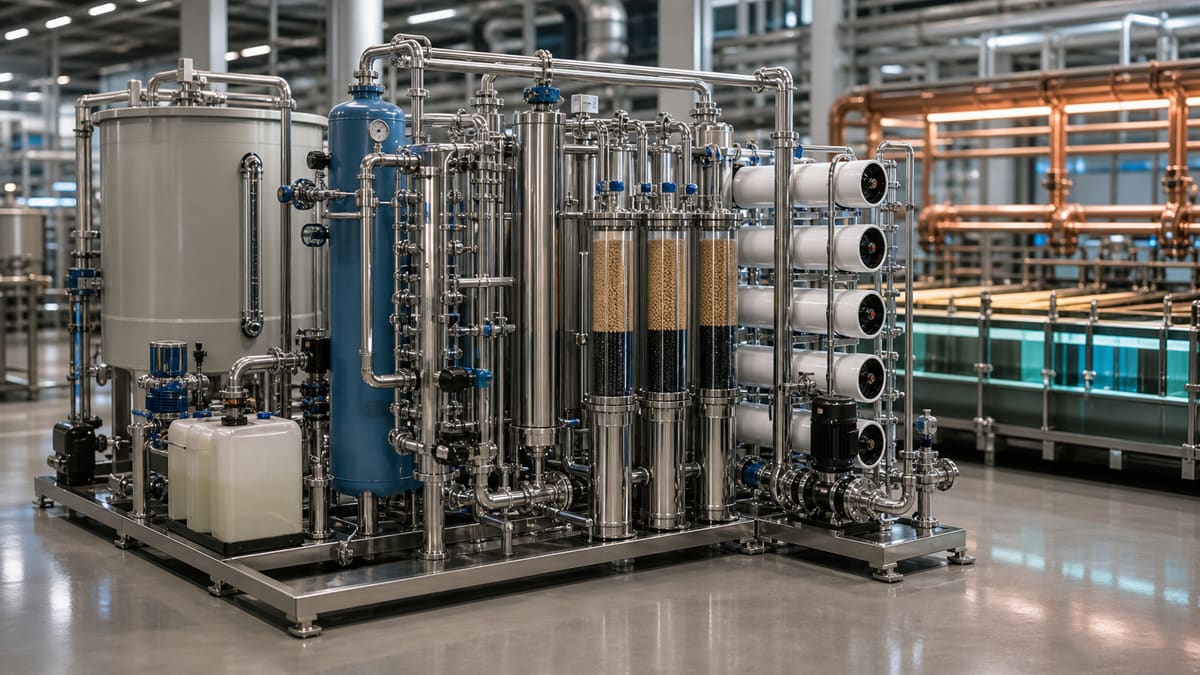
Industry Context & Regulatory/Compliance Drivers
PCB and electroplating treatment often uses precipitation, which can be hindered by complexed metals. Characterize and legally classify each sludge/residual rather than treating every stream as identical hazardous waste. Segregating compatible streams can preserve recovery options and reduce treatment interference; keep cyanide-bearing and chromium-bearing streams under their specific controlled treatment requirements.
Regulatory frameworks, such as local environmental discharge codes (e.g., for municipal wastewater systems or direct discharge limits), are becoming increasingly stringent regarding heavy metal concentrations, total dissolved solids (TDS), and organic pollutants. Beyond compliance, corporate Environmental, Social, and Governance (ESG) initiatives are driving companies to pursue higher levels of resource recovery, water reuse, and achieve a positive metal mass balance, moving beyond mere end-of-pipe compliance. The economic incentives are also clear: recovering high-value metals reduces raw material costs, while water reuse minimizes fresh water intake and wastewater discharge fees.
Water Quality Targets for Recovery and Reuse
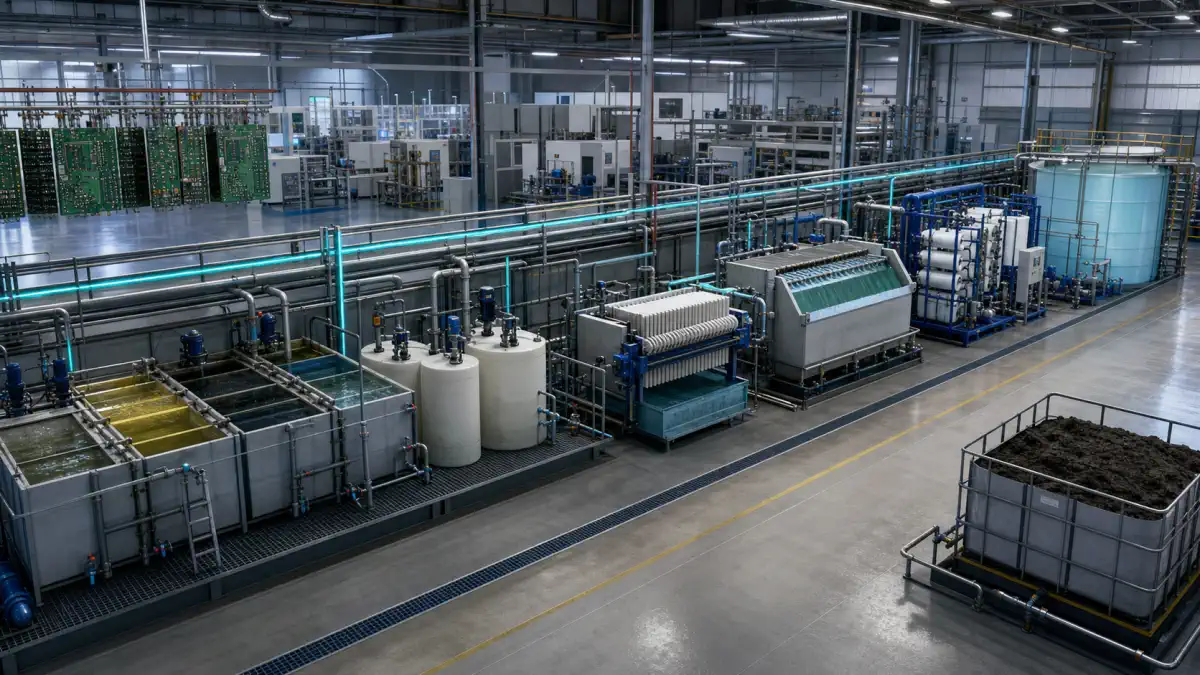
Recovered-metal quality depends on its approved end use, such as bath reuse, purified salts or electrowinning. The rinse-water numbers below are project examples, not universal limits; establish process specifications, sampling locations and analytical methods.
- Initial Rinses: May tolerate higher conductivity (e.g., 500-1000 µS/cm) if metals are specifically recovered.
- Intermediate Rinses: Often target conductivity below 100 µS/cm, with stringent limits on suspended solids and specific metal ions.
- Final Rinses/Make-up Water: Example targets below 5 µS/cm or 1-18 MΩ·cm, with TOC and particles specified separately. Laboratory Type II/Type I terminology must not be equated automatically with the electronics-water guide ASTM D5127-13 Type E-1.2; confirm the actual standard, edition and end-use criteria.
1. Stream Segregation and Primary Treatment
The cornerstone of effective recovery is stream segregation at the source. Separating concentrated drag-out solutions, different rinse cascades, and floor spills prevents cross-contamination and allows for targeted treatment.
- Drag-out Solutions: Often rich in specific metals, these can be directly recovered or concentrated for electrowinning.
- Spent Baths: Dedicated treatment for specific bath chemistries.
- Rinse Waters: Further segregated based on metal type or contaminant profile.
Initial primary treatment may involve pH adjustment, flocculation, and sedimentation/clarification for bulk metal removal where appropriate, particularly for non-chelated metals.
2. Advanced Pretreatment for Membrane Protection
Characterize suspended solids, oils, organics and dissolved contaminants before selecting membrane pretreatment. SDI₁₅ above 5 can indicate unsuitable feed for selected RO elements, but does not alone mandate a universal physical process; verify the manufacturer limits and a representative treatment route.
-
Multi-Media Filtration (MMF): For larger suspended solids removal, acting as a guard filter.
-
Ultrafiltration (UF): Evaluate the actual membrane for suspended solids, colloids, emulsions and suitable macromolecules. SDI below 3 is a project target rather than a guaranteed UF outcome; validate net production, integrity and fouling behavior. Crossflow can assist control but does not eliminate fouling.
-
Granular Activated Carbon (GAC): Test adsorption of actual organics, surfactants and ligands such as EDTA, citrate or brighteners. Removal varies with speciation, pH, carbon and competition; GAC does not universally remove every chelating agent or establish membrane/resin protection.
-
Chemical Dosing: Antiscalants are critically important here, dosed proportionally to prevent scale formation on RO membranes, particularly when concentrating hardness ions like calcium and magnesium, or sparingly soluble salts like barium sulfate. Biocides may also be dosed intermittently to control biofouling.
3. Metals Recovery and Concentration
-
Ion Exchange (IX): Select resin for actual metal species, ligands and competing ions. Evaluate any pretreatment, including UV-peroxide, for ligand transformation, byproducts and residual compatibility. Analyze the loaded resin and regenerant; concentration alone does not prove bath reuse or electrowinning suitability.
-
Reverse Osmosis (RO) / Nanofiltration (NF): These membrane processes are central to volume reduction and water purification for reuse.
- Nanofiltration (NF): Can selectively reject multivalent ions (like heavy metals) while allowing some monovalent salts to pass, useful for pre-concentration or specific separations.
- Reverse Osmosis (RO): >98% rejection, 10-25 bar (1.0-2.5 MPa) and 75-85% single-pass recovery are illustrative conditions, not universal plating-wastewater performance. Measure target-metal passage, organics, pressure, osmotic limits and mass balance. LSI (Langelier Saturation Index) applies to carbonate; assess sulfate, silica and other salts separately and validate actual antiscalant compatibility.
The concentrated RO stream (concentrate) can be further processed for metal recovery (e.g., electrowinning) or volume reduction, or sent for responsible disposal.
- Electrowinning: Assess the actual metal concentration, ligands, conductivity, impurities and electrode reactions before recovery from IX regenerant or RO concentrate. Mixed or dilute streams may require other processing; metal concentration alone does not guarantee selective recovery or less waste.
4. Post-Treatment and Polishing for Reuse
-
Continuous Electrodeionization (EDI): Polish suitable feed within actual hardness, silica, organic and conductivity-equivalent limits. The electric field transfers ions into the concentrate compartment while water splitting regenerates resin; electrode compartments have distinct reactions and manufacturer-specific flows/gas handling. Up to 18 MΩ·cm is a conditional ionic-quality example, not full process acceptance. Routine acid/caustic resin regeneration is avoided, but cleaning and residual streams remain.
-
Ultraviolet (UV) Disinfection: Validate dose, transmission and microbial reduction for the actual loop. UV does not provide a persistent residual or guarantee prevention of biofouling throughout downstream equipment.
Operations, Monitoring, and CIP Philosophy
Clean-in-Place (CIP) criteria and chemistry depend on the membrane and identified deposit. A 10-15% fall in normalized permeate flow is an example review trigger; check actual manufacturer flow, salt-passage and ΔP criteria. Select approved acid/alkaline sequences and verify post-cleaning performance rather than assuming every scheduled CIP restores rejection or life.
Risks and Common Engineering Mistakes
- Inadequate Pretreatment: The most common mistake, leading to rapid and often irreversible fouling of RO membranes, reduced flux, increased transmembrane pressure, and ultimately premature membrane replacement.
- Ignoring Chelates: Metal complexes can hinder precipitation or selected IX routes. Verify ligand/speciation treatment and membrane compatibility; chelation alone does not prove chemical degradation of an RO membrane.
- Overestimating Metal Recovery: Without proper stream segregation and a detailed metal mass balance study, projected metal recovery can be significantly overstated.
- Mixing Incompatible Waste Streams: Combining streams with different chemistries (e.g., acid and alkaline, or different metal contaminants) can create intractable treatment challenges and reduce recovery potential.
- Poor Antiscalant Strategy: Select and dose from actual concentrated-water chemistry at the proposed recovery rates. LSI concerns carbonate, not every scale; evaluate other salts and possible interactions with metal coagulants separately.
- Neglecting Biofouling: Failure to control microbial growth, especially in warm or nutrient-rich streams, can lead to severe biofouling of membranes and other equipment.
References
Related equipment & product lines
These categories typically support the approach above—open any line to compare brands and models.
- Ion Exchange ResinsCation/anion and mixed bed resin solutions for demineralization and polishing.View category →
- RO MembranesReverse osmosis membrane elements for municipal and industrial desalination.View category →
- ChemicalsAntiscalants, cleaners, and process chemicals for water treatment operations.View category →
- Filtration MediaGranular and specialty media for depth filtration and polishing stages.View category →
For a closer review, use the engineering inquiry form to share feed, capacity, target, and project stage. Submission does not constitute a completed design or performance commitment.