Solutions · Industry Solutions
High-pressure boiler feed water: UF + RO + EDI demineralization
Power and process boilers: silica limits, conductivity, and iron control with membrane demineralization, degassing strategy, and chemical coordination.
Use when
High-pressure drums demand extremely low dissolved solids and silica; poor makeup design drives carryover, tube failures, and unplanned outages.
Process options
UF pretreatment, two-pass RO where needed, EDI or mixed-bed polishing, and coordinated internal boiler chemistry with consistent makeup quality.
Assessment output
Assess steam purity, chemical-cleaning intervals and blowdown conductivity against actual duty.
Inputs and conditions for an assessment
Collect feed variability, capacity, target quality, operating hours, discharge or reuse boundaries and installed equipment data. Compare examples on matched conditions and meter boundaries; assess a project using actual water data, equipment documentation and any necessary tests.
View the process illustration
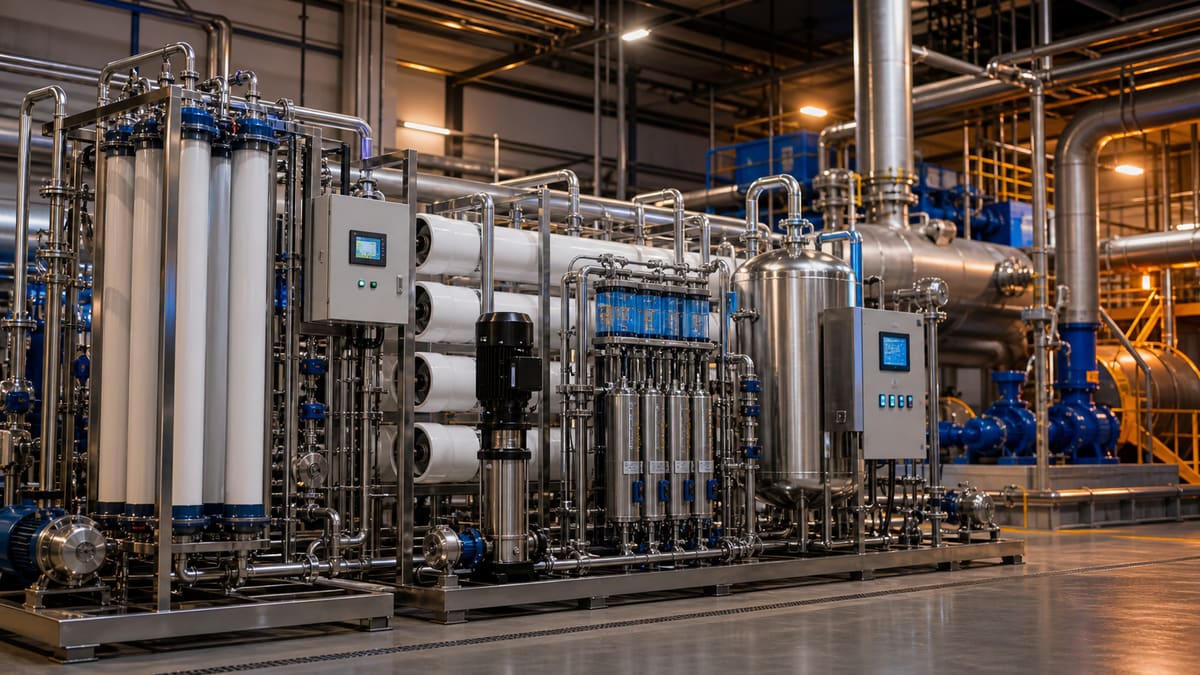
High-Pressure Boiler Feed Water: UF + RO + EDI Demineralization
High-pressure boilers, integral to utility and large industrial steam plants, demand makeup water of exceptional purity. The presence of even trace contaminants—especially hardness, silica, and dissolved solids (TDS)—can lead to severe operational issues such as tube scaling, corrosion, carryover, and costly turbine damage. These phenomena not only reduce plant efficiency but also pose significant safety risks and necessitate expensive unscheduled maintenance. Traditional demineralization methods often struggle with variable raw water quality, particularly seasonal changes in turbidity and dissolved solids, pushing the limits of system recovery and silica rejection.
Industry Challenges & Regulatory Drivers
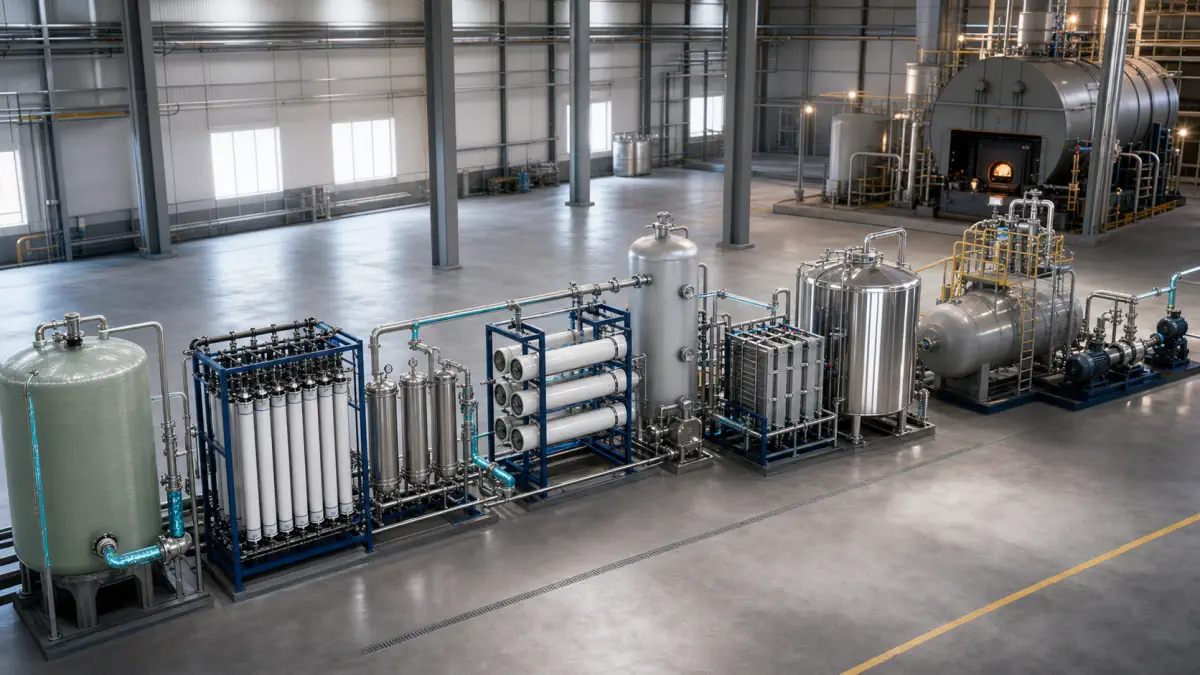
High-pressure boilers, including units above 10 MPa (100 bar), require plant-specific water/steam chemistry limits. IAPWS TGD2-09(2024), Instrumentation for monitoring and control of cycle chemistry, addresses sample points and monitoring; it is not the cited TP-03 universal makeup specification. Conductivity below 0.1 µS/cm and silica below 10 µg/L (ppb) are project examples: confirm temperature, analysis, plant metallurgy, pressure and the applicable chemistry guidance. Local discharge rules also affect concentrate management.
1. Advanced Pretreatment for Membrane Protection
For raw water with suspended solids, turbidity or biofouling risk (e.g., surface water), select pretreatment from analysis and membrane limits. A Silt Density Index (SDI₁₅) above 5 is a warning for selected RO feed specifications, not a universal mandate for one physical treatment.
- Multimedia Filtration (MMF): Effectively removes larger suspended solids, reducing particulate load.
- Ultrafiltration (UF): Evaluate the membrane, net yield, integrity and fouling on representative water. SDI₁₅ below 3 is an illustrative feed target, not a guaranteed UF result or a guarantee of longer RO life and fewer Clean-In-Place (CIP) cycles.
3. Degasification for Optimized Post-RO Treatment
Post-RO, dissolved carbon dioxide (CO₂) can depress the permeate pH, increase conductivity, and exert a significant load on downstream ion exchange or EDI systems.
- Forced Draft Degasifier (FDD): Often employed after RO to remove dissolved CO₂, improving the efficiency of subsequent polishing steps and reducing the overall operating cost.
4. Continuous Electrodeionization (EDI) for Ultrapure Water
For project targets such as <0.1 µS/cm, <2 ppb Na and <10 ppb SiO₂, assess Continuous Electrodeionization (EDI) against actual feed limits and product requirements; it is one polishing option, not a mandatory final stage for every high-pressure boiler.
- Continuous Regeneration: EDI uses a DC electric field, ion-selective membranes and water splitting to regenerate resin continuously. It avoids routine acid/caustic resin regeneration; pretreatment chemicals and cleaning may still be required.
- Multi-Compartment Design: Ions move from dilute product-water compartments into concentrate compartments. Electrode compartments have separate reactions and manufacturer-specific water/gas requirements. Assess the concentrate and electrode streams separately before reuse or discharge; recycling to the RO inlet changes the water and contaminant balance.
Operations, Monitoring, and CIP Philosophy
Sustained high-purity water production depends on rigorous monitoring and a proactive maintenance strategy.
Risks and Common Engineering Mistakes
- Underestimating Raw Water Variability: Failing to account for seasonal or episodic changes in raw water quality (turbidity, TDS, organics) can lead to rapid fouling, reduced rejection, and system upsets. Comprehensive raw water analysis and flexible pretreatment design are crucial.
- Aggressive Recovery Rates: Select RO recovery rates from concentrated-water chemistry and operating conditions. LSI assesses carbonate, while silica and other salts require separate saturation evaluation. Excessive recovery can cause scaling, lower rejection and more CIP; actual risk depends on the water and design.
- Ignoring Dissolved Gases: Overlooking CO₂ post-RO can overload downstream polishing, increasing operational costs and potentially failing to meet strict conductivity targets.
- Inadequate Pretreatment: Insufficient particulate removal (high SDI) before spiral-wound RO membranes is a primary cause of fouling, leading to higher transmembrane pressure and shortened membrane lifespan.
Digital Operations & Maintenance (O&M)
Specify actual monitoring, data retention, alarms, control permissions and maintenance responsibilities. Trend analysis supports investigation; it does not by itself prove a root cause or predict every outage.
Modular RO Systems: Scalable Solutions
Compare pilot and production configurations using feed variability, product quality, recovery, availability, controls and maintainability.
- pilot-scale RO: Ideal for pilot studies, laboratory applications, or small-flow prototyping, pilot-scale RO systems provide precise control and data acquisition for R&D and process optimization before full-scale deployment.
- industrial RO: For production-scale high-pressure boiler makeup, assess staging versus two-pass treatment, construction, redundancy and the actual SCADA interface. Continuous high-volume operation and operator effort require commissioning and operating evidence rather than a generic portfolio guarantee.
References
Related equipment & product lines
These categories typically support the approach above—open any line to compare brands and models.
- RO MembranesReverse osmosis membrane elements for municipal and industrial desalination.View category →
- Electrodeionization (EDI)EDI modules and systems for ultrapure water production.View category →
- UF ModulesUltrafiltration modules for suspended solids and colloid removal.View category →
- ChemicalsAntiscalants, cleaners, and process chemicals for water treatment operations.View category →
For a closer review, use the engineering inquiry form to share feed, capacity, target, and project stage. Submission does not constitute a completed design or performance commitment.