Solutions · Industry Solutions
Dairy & juice: membrane concentration and quality retention
UF/NF/RO in dairy and juice: flux control, cleaning protocols, sensory retention, and energy comparison to thermal evaporation.
Use this guide within its scope
This page supports technical research and option comparison and is marked 2026. Illustrative values are not a quotation, completed process design, certification conclusion, or performance guarantee. Check current regulations, feed data, tests, and OEM records.
Problem
Protein and pectin fouling drives flux loss; plants need predictable CIP and hygiene without cooking sensitive nutrients.
Technology
Ceramic or robust spiral UF, staged NF/RO for concentration, hygienic CIP chemistry, and temperature discipline.
Results
Stable solids profiles, lower thermal energy versus evaporators where membranes fit, and longer runs between deep cleans.
Engineering decision card
Use when
Protein and pectin fouling drives flux loss; plants need predictable CIP and hygiene without cooking sensitive nutrients.
Evaluate first
Ceramic or robust spiral UF, staged NF/RO for concentration, hygienic CIP chemistry, and temperature discipline.
Inputs still required
Feed source and variability, capacity, target quality, operating hours, discharge or reuse boundary, available space, and utilities.
Comparison output
Stable solids profiles, lower thermal energy versus evaporators where membranes fit, and longer runs between deep cleans. The final decision still needs feed data, mass balance, and any necessary testing.
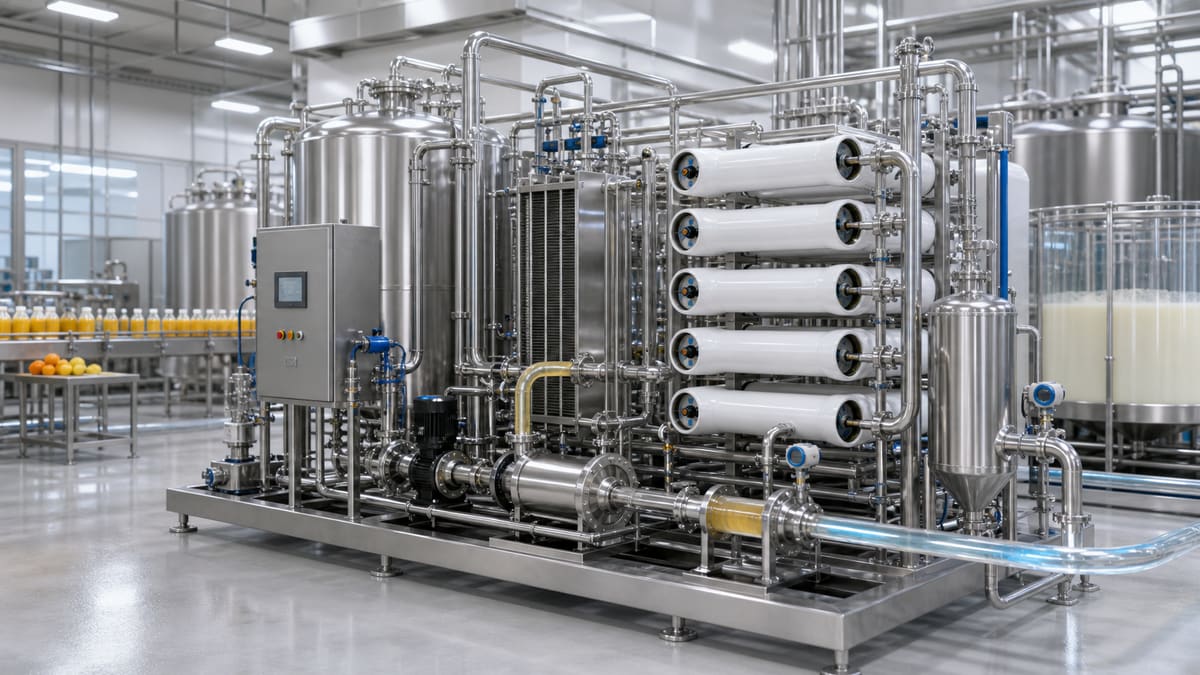
Dairy & juice: membrane concentration and quality retention
The dairy and juice industries are under increasing pressure to optimize processing, enhance product quality, and improve sustainability. Membrane technologies offer a compelling alternative or complement to traditional thermal processes for concentration, fractionation, and clarification. By leveraging membrane separation, processors can reduce energy consumption, preserve heat-sensitive nutrients and flavors, and significantly cut transportation costs.
Industry Context & Regulatory/Compliance Drivers
Dairy and juice producers face unique challenges related to product viscosity, high organic loads (proteins, fats, sugars, pectins, starches), and stringent hygiene requirements. The primary drivers for adopting membrane technology include:
- Concentration: Increasing Brix (for juices), total solids (for dairy products like milk protein concentrate or yogurt), or other desired components to reduce volume for transport, storage, or further processing (e.g., before evaporation or drying).
- Fractionation: Separating specific components like proteins from lactose in dairy, or clarifying juice by removing suspended solids and macromolecules.
- Quality Preservation: Minimizing thermal exposure helps retain natural flavors, colors, vitamins, and other heat-labile compounds, leading to a superior final product.
- Operational Efficiency: Reducing energy expenditure compared to thermal evaporators and potentially enabling continuous processing.
- Regulatory Compliance: Meeting strict food safety and hygiene standards, such as those outlined by FDA 21 CFR Part 117 (Current Good Manufacturing Practice, Hazard Analysis, and Risk-Based Preventive Controls for Human Food) in the U.S. or EU Regulation (EC) No 852/2004 on the hygiene of foodstuffs. This necessitates sanitizable equipment designs and robust cleaning validation protocols.
Water Quality Targets
Water quality targets vary depending on the application:
- Product Concentrate: The primary goal is to achieve specific Brix levels, protein concentrations, or other dissolved solids targets, while maintaining sensory attributes and microbial stability. For instance, concentrating apple juice from 12 Brix to 42 Brix, or milk from 13% total solids to 25%.
- Permeate (from product concentration): This water-rich stream can have varying levels of sugars, salts, and organic compounds. Depending on its quality, it may be discharged (requiring compliance with local wastewater codes) or potentially reused within the facility for non-product contact applications like cooling tower makeup or preliminary equipment rinses, following appropriate treatment.
- CIP Water: Water used for Cleaning-In-Place (CIP) and sanitation must meet potable water standards, typically aligned with WHO Guidelines for Drinking-water Quality or local municipal regulations. For effective CIP, water hardness should be managed, often requiring softening, to prevent scaling and optimize chemical efficacy.
1. Pre-treatment & Clarification (for product feed)
The product stream often requires initial treatment to remove gross solids before membrane filtration. This may involve:
- Centrifugation or decanting for heavy solids removal.
- Coarse filtration to protect downstream membranes.
2. Ultrafiltration (UF)
UF is a cornerstone for many dairy and juice applications, acting as a clarification step or initial concentration.
- Applications: Protein standardization (e.g., milk protein concentrates), clarification of fruit juices (removing pulp, pectins, and suspended solids), pre-concentration prior to NF/RO.
- Membrane Selection:
- Spiral-wound elements: Cost-effective for clarified feeds with lower solids and viscosity.
- Tubular membranes: More robust, tolerant of higher suspended solids and more viscous fluids, easier to clean mechanically if needed.
- Ceramic membranes: Offer extreme chemical and thermal resistance, ideal for very aggressive CIP cycles and highly fouling or abrasive feeds, but with higher capital cost.
- Operation: UF systems operate in cross-flow mode to sweep away retained particles from the membrane surface, mitigating concentration polarization and biofouling, and maintaining stable flux (typically 30–80 L/(m²·h) for juice clarification or dairy protein concentration).
Related equipment & product lines
These categories typically support the approach above—open any line to compare brands and models.
- UF ModulesUltrafiltration modules for suspended solids and colloid removal.View category →
- RO MembranesReverse osmosis membrane elements for municipal and industrial desalination.View category →
- ChemicalsAntiscalants, cleaners, and process chemicals for water treatment operations.View category →
- Pumps & PumpingHigh-pressure and process pump solutions for water treatment skids and plants.View category →
For a closer review, use the engineering inquiry form to share feed, capacity, target, and project stage. Submission does not constitute a completed design or performance commitment.