Solutions · Industry Solutions
Coastal plants: seawater desalination (SWRO) packages
Intake, pretreatment, SWRO staging, energy recovery, and post-treatment for reliable plant water from seawater.
Use when
Biofouling, intake debris, and seasonal algal events challenge availability; energy intensity must stay defensible.
Process options
Robust intake screens, DAF/media/UF as needed, SWRO with ERD, and honest boron/post-treatment planning.
Assessment output
Stable permeate quantity and quality with documented kWh/m³ and recovery assumptions.
Inputs and conditions for an assessment
Collect feed variability, capacity, target quality, operating hours, discharge or reuse boundaries and installed equipment data. Compare examples on matched conditions and meter boundaries; assess a project using actual water data, equipment documentation and any necessary tests.
View the process illustration
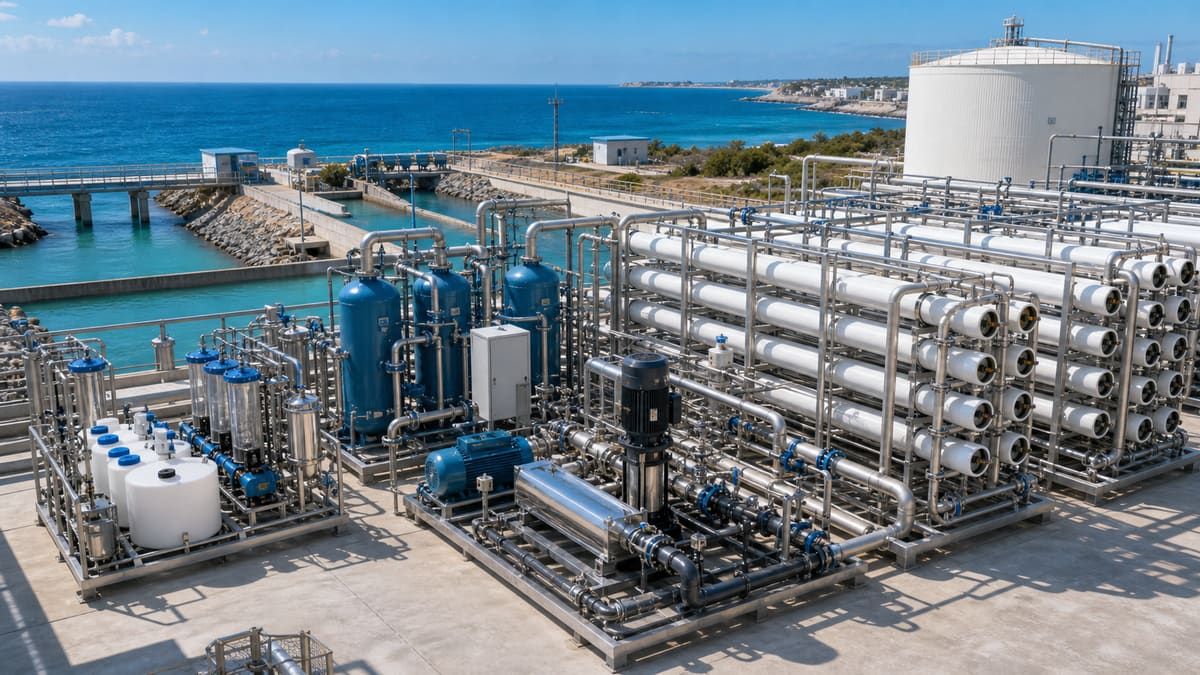
Industry Context & Regulatory/Compliance Drivers
Operating a coastal desalination plant involves navigating unique challenges, from variable raw water quality to complex regulatory frameworks.
- Raw Water Variability: Seawater composition fluctuates significantly, influenced by tides, currents, seasonal algal blooms, and proximity to river mouths or shipping lanes. This variability introduces risks of high suspended solids, organic loading (algal organic matter (AOM)), and potential for biofouling and scaling within the membrane system. Oil sheen from maritime activities also presents a pretreatment challenge.
- Energy Intensity: SWRO is inherently more energy-intensive than brackish water RO due to higher osmotic pressures. Minimizing specific energy consumption (kWh/m³ permeate) is a primary operational and ESG objective.
- Boron Removal: Establish the actual local or process boron criterion. <0.5 mg/L is a possible project target, not the WHO Guidelines for Drinking-water Quality, 4th Edition value; the cited WHO boron fact sheet gives 2.4 mg/L. Local law and sensitive process requirements can differ.
- Discharge Regulations: The concentrate stream, containing elevated salinity and any residual treatment chemicals, must be discharged in compliance with strict local environmental discharge regulations. This often requires careful dispersion modeling and adherence to limits on temperature, salinity, and chemical residuals.
Water Quality Targets
- Potable Water: <500 µS/cm conductivity and <0.5 mg/L boron are illustrative project targets, not complete or universal drinking-water requirements. Verify microbial, chemical and stability criteria under the applicable rules.
- Process Water: Conductivity and specific ion limits tailored to the industrial process (e.g., cooling water, wash water).
- Boiler Feedwater: <0.2 µS/cm conductivity and <20 µg/L silica are illustrative makeup targets, not universal feedwater limits. Specify actual boiler/cycle chemistry, temperature and analysis; assess EDI or mixed-bed polishing where required.
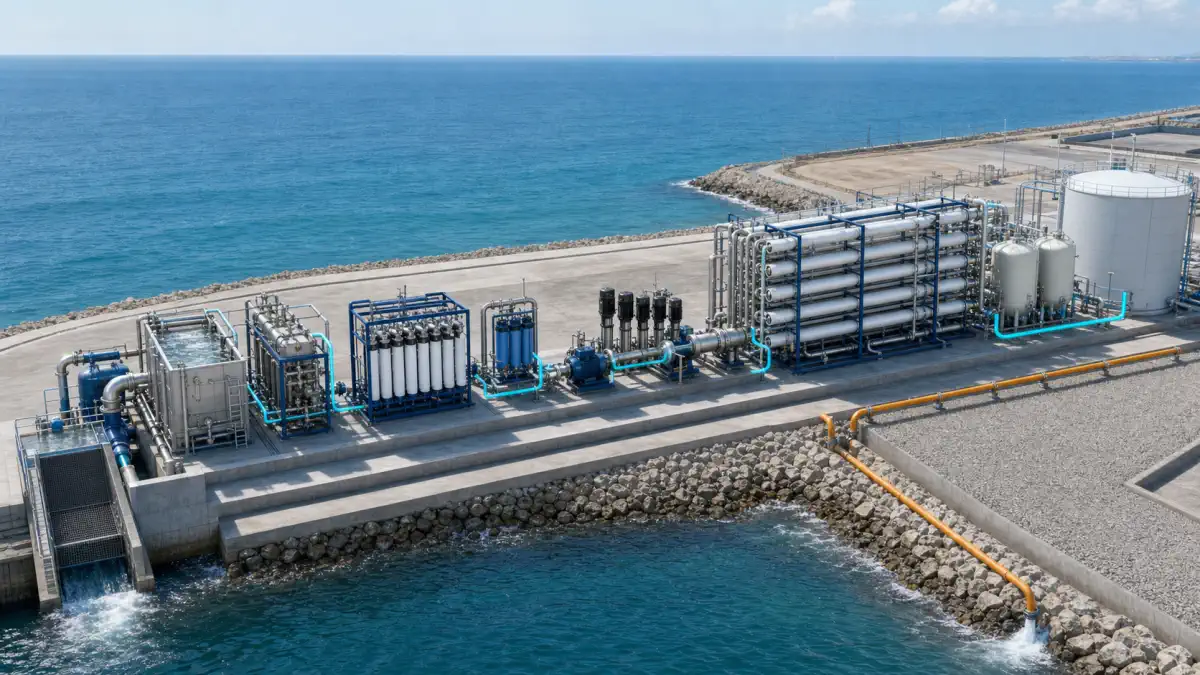
Process Train Description
-
Seawater Intake & Pre-screening:
- Open Intakes: Designed with appropriate intake velocity and coarse screens to prevent macro-fouling and protect marine life.
- Beach Wells: Offer natural filtration, significantly reducing suspended solids and AOM, often resulting in lower SDI values. However, they can have limited yield and potential for greater TDS variability due to groundwater influence.
- Initial screening with bar screens and rotating band screens removes larger debris.
-
Pretreatment (Fouling Control): This is the cornerstone of reliable SWRO operation, directly impacting membrane lifespan and overall system efficiency.
- Coagulation/Flocculation: Chemical dosing (e.g., ferric chloride) enhances the aggregation of colloidal particles and organic matter.
-
Dissolved Air Flotation (DAF): Effective for removing algae, oils, and suspended solids, especially critical during algal blooms.
- Multimedia Filtration (MMF): Evaluate actual particles, organics and membrane feed limits. SDI₁₅ (15-minute Silt Density Index) above 5 after clarification flags a feed-quality concern, but does not mandate Ultrafiltration (UF) or prove one barrier prevents biofouling and particulate fouling.
-
Cartridge Filtration: A final guard filter may use 5 µm or 10 µm ratings only where accepted by the actual design. Distinguish nominal from absolute retention and specify bypass/integrity controls; filtration is not universal removal of every fine particle.
- High-Pressure Pumping:
High-pressure pumps elevate the pretreated seawater to the operating pressure of the RO membranes, typically 55-80 bar (5.5-8.0 MPa), depending on salinity and desired recovery rate.
-
Seawater Reverse Osmosis (SWRO):
- Membrane Technology: State-of-the-art polyamide thin-film composite membranes, designed for high salt rejection (typically >99.5%) and durability.
- System Design: Select pressure, array, number of stages and any second pass from actual feed and product requirements. Optimize recovery rate, concentration polarization and scaling limits; SWRO is not invariably a multiple-stage configuration.
- Antiscalant Dosing: Select compatible salt control for the actual brine. LSI (Langelier Saturation Index) concerns carbonate and is not suitable for every high-salinity calculation; evaluate the applicable high-ionic-strength carbonate method, such as Stiff-Davis, and sulfate/silica separately. Choose recovery rate from element pressure, mass balance and saturation limits, not a proprietary universal dosing claim.
- Energy Recovery Devices (ERDs): Essential for cost-effective SWRO, ERDs recover significant energy from the high-pressure concentrate stream, reducing the overall specific energy consumption of the plant.
-
Post-Treatment:
- Boron Removal: If the target boron level is exceptionally low, a second pass RO system, often operating at lower pressure and higher pH (to convert boric acid to borate ion, which is better rejected), or specialized ion exchange resins, may be employed.
- Remineralization: For potable water applications, the highly purified permeate may require remineralization (e.g., limestone contactor, chemical dosing) to improve taste, reduce corrosivity, and meet specific health guidelines.
- Disinfection: UV disinfection or chlorination is typically applied to ensure bacteriological quality for potable or sensitive process water uses.
- Advanced Polishing (e.g., EDI): For defined high-purity duties, Continuous Electrodeionization (EDI) can polish compatible feed without routine acid/caustic resin regeneration. Ion transfer goes to the concentrate compartment; electrode compartments have separate reactions and water/gas handling. Pretreatment chemicals, cleaning and residual streams remain, so it is not a universally chemical-free train.
Operations, Monitoring, and CIP Philosophy
Define actual monitoring, response and maintenance responsibilities, with documented baseline and acceptance criteria.
- Continuous Monitoring: Key performance indicators (KPIs) such as raw water quality, membrane feed pressure, transmembrane pressure (TMP), permeate flow rate (m³/h), permeate conductivity (µS/cm), and temperature are continuously monitored.
- Performance Normalization: Track normalized permeate flow using temperature, pressure, salinity and recovery corrections. Changes in normalized permeate flow or ΔP can indicate fouling but are not unique proof; investigate instruments, operation, damage and feed changes.
- CIP (Clean-in-Place): Use actual manufacturer flow, salt-passage and pressure criteria for operator-approved CIP. Prepare a site-specific algal-event plan for tested coagulant settings, UF backwash and contingency operation; a plan does not guarantee response time or prevent every outage.
Risks and Common Engineering Mistakes
- Inadequate Pretreatment: The most common and costly mistake. Insufficient removal of suspended solids, organics, and colloidal matter leads to rapid biofouling and scaling of RO membranes, requiring frequent CIPs, increased chemical consumption, and premature membrane replacement.
- Poor Hydraulic Design: Improper array configuration or flow distribution can lead to localized concentration polarization, increasing scaling potential and reducing permeate quality.
- Ignoring LSI and Scaling Potential: LSI has carbonate and ionic-strength limits; assess actual high-salinity carbonate chemistry and other salt saturations separately at proposed recovery rates.
- Lack of Proactive Monitoring: Reactive maintenance, rather than trend-based monitoring and preventative CIP, invariably leads to higher operational costs and downtime.
- Underestimating Energy Costs: Failing to incorporate efficient high-pressure pumps and energy recovery devices (ERDs) significantly impacts the total cost of ownership.
Frequently Asked Questions
-
Q: Beach wells vs. open intake? A: Beach wells can provide natural filtration, but actual SDI, algal organic matter (AOM), yield and TDS depend on local hydrogeology and contaminants. Open-intake availability, screening, marine impact and treatment also require site assessment. Compare measured source quality, permitted yield, CAPEX and OPEX rather than assuming one intake is always simpler or more consistent.
-
Q: Can SWRO permeate feed high-pressure boilers? A: Evaluate SWRO permeate against actual boiler makeup requirements for TDS, hardness, silica, sodium, organics and conductivity. Additional EDI or mixed-bed polishing may be needed, plus appropriate deaeration and internal chemistry. Control corrosivity using the specified cycle treatment; potable-water remineralization is not a generic high-pressure boiler step.
References
Related equipment & product lines
These categories typically support the approach above—open any line to compare brands and models.
- RO MembranesReverse osmosis membrane elements for municipal and industrial desalination.View category →
- Pumps & PumpingHigh-pressure and process pump solutions for water treatment skids and plants.View category →
- ChemicalsAntiscalants, cleaners, and process chemicals for water treatment operations.View category →
- Instrumentation & SensorsInstruments and sensors for online monitoring of flow, level, pressure, temperature, and water quality.View category →
For a closer review, use the engineering inquiry form to share feed, capacity, target, and project stage. Submission does not constitute a completed design or performance commitment.