Solutions · Digital & Smart O&M
Virtual Commissioning Services: cloud-first IO checks before the skid hits the slab
Simulate loops, assess alarms, and rehearse operator HMI flows remotely, with test coverage and remaining physical commissioning checks documented before mechanical completion.
Use when
Late control-interface discoveries create site rework; physical wiring still needs site verification.
Process options
Digital FAT extensions: signal simulation, alarm review, and verified remote-access controls.
Assessment output
Document simulated scenarios, remaining site checks, and operator rehearsal before startup.
Inputs and conditions for an assessment
Collect feed variability, capacity, target quality, operating hours, discharge or reuse boundaries and installed equipment data. Compare examples on matched conditions and meter boundaries; assess a project using actual water data, equipment documentation and any necessary tests.
View the process illustration
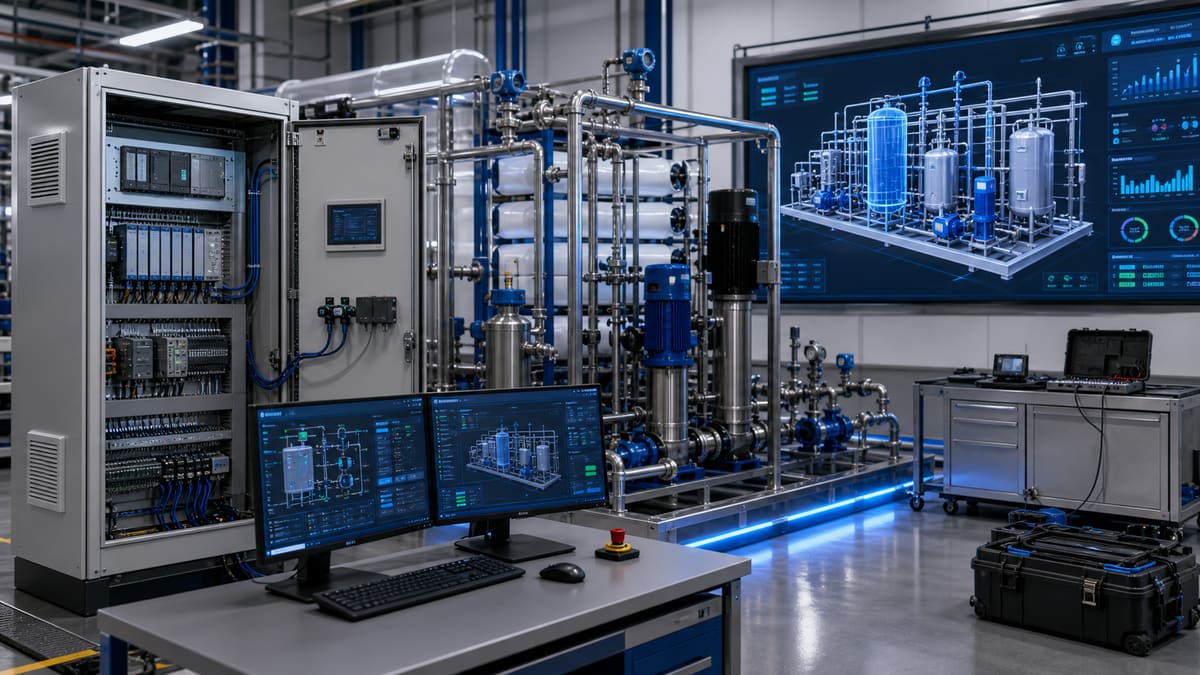
Virtual Commissioning Services: Cloud-First IO Checks Before the Skid Hits the Slab
Virtual commissioning can test defined control behavior before equipment installation. Specify the simulation platform, process model, control-code version, test scenarios, and acceptance records. Local or cloud environments can support the work; neither cloud hosting nor simulation guarantees seamless installation, absence of delay, or correct physical operation from startup.
Engineering Certainty Through Digital Replication
Virtual commissioning tests Programmable Logic Controllers (PLCs), Human-Machine Interfaces (HMIs), Supervisory Control and Data Acquisition (SCADA), or Distributed Control Systems (DCS) against defined simulated signals and process behavior. Software-in-the-loop, hardware-in-the-loop, or mixed arrangements may be used. Verify Input/Output (I/O) mappings, sequences, alarms, HMI response, and model limitations against a documented test plan. Simulation can expose logic and interface errors, but does not prove installed field wiring, actual sensor calibration, mechanical operation, or safety-function acceptance. Factory Acceptance Tests (FAT) are factory acceptance activities; Site Acceptance Tests (SAT) still verify the installed site system. Measure resolved defects and remaining checks rather than assigning a universal schedule reduction.
Site discovery and planned virtual checks
Consider commissioning a new reverse osmosis (RO) skid for industrial water purification:
| Issues to manage | Virtual checks to evaluate |
|---|---|
| Late I/O Errors: Physical wiring or PLC errors discovered during field checks or SAT can cause rework; FAT and site checks have distinct scopes. | Pre-validation: Test simulated I/O and PLC logic before shipment, recording coverage and defects. Retain physical loop and installation checks; no fixed defect-removal or time-saving percentage is established. |
| Delayed System Integration: Missing interface definitions or hardware can delay integration of separately delivered panels and skids. | Parallel Engineering & Integration: SCADA/DCS interfaces and HMI behavior can be developed with models during fabrication. Check versions, supported protocols, and remaining hardware tests, and measure actual schedule impact. |
| Unplanned Costs & Schedule Overruns: Late software changes, hardware incompatibilities, or missing parts can generate change orders and delays. | Interface and Version Review: Check simulated conflicts, software versions, and Bill of Material (BOM) records against actual hardware evidence. Simulation alone does not prove supplied components or prevent a defined cost overrun. |
| Limited Training & Documentation: Rushed training and late documents can leave operators unprepared for startup. | Operational Rehearsal: Use verified scenarios to rehearse HMI and sequences, tracking operator readiness and document revisions. Actual startup and safety checks remain necessary. |
Securing Your Operational Data: Trust in the Cloud
- Verify actual authentication, authorization, and time-limited remote access.
- Review independent audit or penetration-test evidence and remediation within the agreed scope.
- Check applicable data-handling obligations, hosting location, and contractual responsibilities.
- Verify least-privilege roles, access logs, and revocation for project stakeholders.
FAQ
-
Q: How does Virtual Commissioning save money if we still need an on-site team? A: A tested simulation may move some logic and interface troubleshooting earlier. Compare model-development cost, licenses, engineering hours, travel, resolved defects, and remaining on-site work against the actual baseline. Installed wiring, instrument calibration, safety checks, and physical acceptance remain; net savings need project evidence.
-
Q: How long does it typically take to set up a virtual commissioning environment for a new plant? A: Time depends on available drawings, control-code maturity, model fidelity, interfaces, and test coverage. Weeks for a skid or months for a larger plant are planning examples, not delivery commitments. Confirm the work breakdown and measure effects on the critical path; a model does not guarantee a percentage reduction in total project time.
References
Related equipment & product lines
These categories typically support the approach above—open any line to compare brands and models.
- Instrumentation & SensorsInstruments and sensors for online monitoring of flow, level, pressure, temperature, and water quality.View category →
- InvertersVariable-frequency drives and inverter systems for variable-speed motor control.View category →
- Pilot Units TestingPilot rigs and trial modules for process validation and feasibility studies.View category →
For a closer review, use the engineering inquiry form to share feed, capacity, target, and project stage. Submission does not constitute a completed design or performance commitment.