Solutions · Application Scenarios
Ultrapure water polishing: EDI and nuclear-grade resin finishing
Continuous EDI after RO with defined concentrate and electrode waste handling. Stable high-resistivity product with documented minor waste streams.
Use when
Polishing is where contract resistivity and TOC either pass—or fail in audits.
Process options
Continuous EDI after RO with defined concentrate and electrode waste handling.
Assessment output
Stable high-resistivity product with documented minor waste streams.
Inputs and conditions for an assessment
Collect feed variability, capacity, target quality, operating hours, discharge or reuse boundaries and installed equipment data. Compare examples on matched conditions and meter boundaries; assess a project using actual water data, equipment documentation and any necessary tests.
View the process illustration
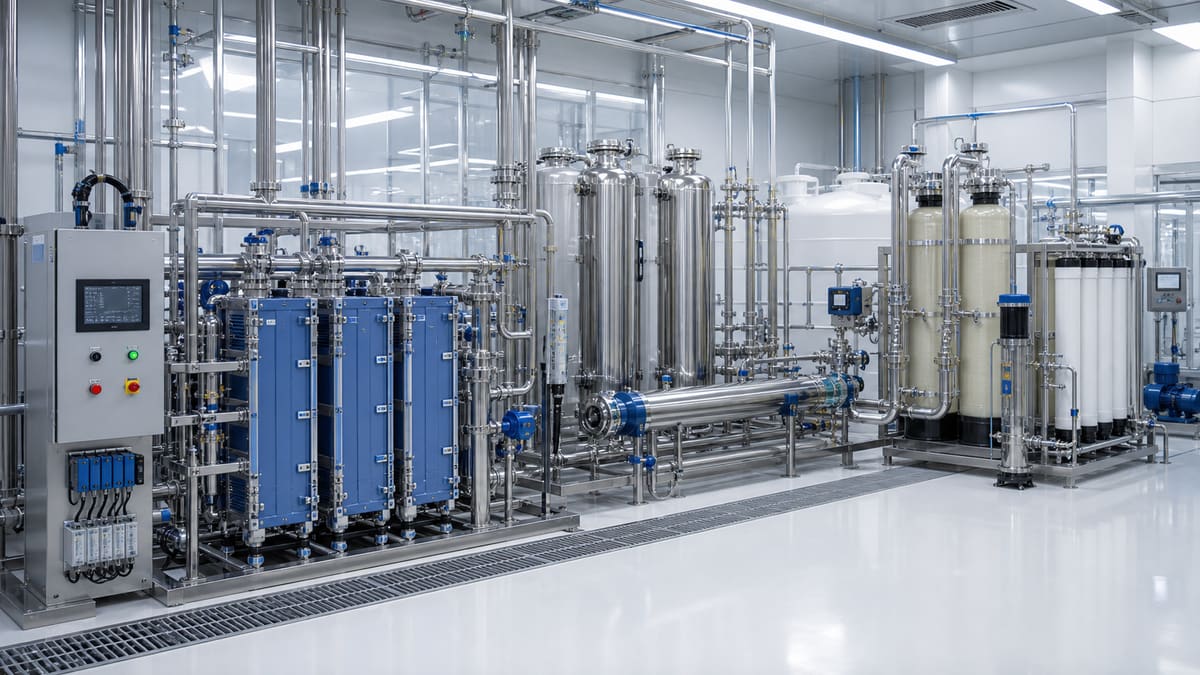
Process context & when this scenario is the right entry point
Ultrapure water (UPW) production controls ions, particles, organics, and microorganisms. Semiconductor, pharmaceutical, boiler, and laboratory duties have distinct specifications; they do not all require the same UPW grade. This scenario examines Electrodeionization (EDI) and final ion exchange (IX), comparing qualified ultrapure-water and nuclear-grade resins for the actual application. Multi-megohm-cm resistivity and Total Organic Carbon (TOC) must be measured separately.
Evaluate this sequence after suitable RO and, where needed, degasification. A feed conductivity of 1-50 µS/cm is a planning example, not a universal EDI allowance; measured conductivity alone omits weakly ionized CO₂/silica load. EDI avoids routine acid/alkali resin regeneration but still needs specified cleaning, sanitization, and residual management. Nuclear-grade resin is not automatically semiconductor-UPW grade or a particle filter. A target such as 18.2 MΩ·cm at 25°C, sub-ppb TOC, or low particle count needs separate resin qualification, full-train validation, and a defined measurement method.
Feed characteristics & key risks
The feed to the EDI system is typically high-purity permeate from a well-maintained RO system, often after a decarbonation/degasification step. Key feed characteristics include:
- Conductivity/TDS: 1-50 µS/cm is an illustrative measured-conductivity range. Apply the selected module conductivity-equivalent/total-exchangeable-anion requirement, including CO₂ and silica, rather than assuming every value in the range is acceptable.
- Hardness: <0.1 ppm as CaCO₃ is a conservative project example. The allowable value depends on module, recovery, chemistry, and temperature; exceeding the actual feed limit can scale the module.
- Silica: <0.5 ppm is an illustrative input, not a universal allowance or protection guarantee. Consider dissolved/colloidal silica, metals, recovery, pH, and module specifications.
- Total Organic Carbon (TOC): <100 ppb is an illustrative RO-permeate target. EDI can remove some ionized organics, but neutral organics may pass or foul the module. Check actual module limits and final application targets.
- Particulates/Colloids: SDI₁₅ <1.0 or <0.5 can be project screening examples, not a universal EDI feed specification. Use the prescribed timed test plus appropriate particle, turbidity, and filtration checks.
Key risks in EDI operation relate primarily to scaling and fouling:
- Scaling: Even trace levels of hardness (Ca, Mg) and silica can precipitate within the EDI concentrate compartments or on the anion/cation exchange membranes, especially under the influence of the electric field and pH shifts. This reduces ion removal efficiency and increases differential pressure.
- Fouling: Residual TOC, particularly humic acids or other complex organic molecules, can foul the ion exchange resins within the EDI modules, leading to reduced performance and increased electrical resistance. Colloidal silica or fine particulates, if not adequately removed by upstream filtration, can also contribute to fouling.
- Gas and CO₂ Load: Dissolved CO₂ can be converted to removable ionic forms in EDI but increases electrical demand and may lower quality. Electrode reactions can produce gas, requiring specified purge/venting. Oxygen removal, where required by the application, is a separately designed duty.
Concentrate / reject routing
A fundamental principle of water treatment is mass balance. For EDI, there are two primary streams requiring disposition:
-
EDI Concentrate Stream: A 5-10% fraction of feed is an example, not a universal split. Account for the actual module arrangement, recovery, concentrate circulation, and electrode streams; the concentrate contains removed ionic species.
- Routing Option 1 (Recycle): Return to RO feed only after checking the complete ionic/CO₂ balance, hydraulic capacity, and a controlled bleed. Recycle can improve total recovery but may accumulate impurities and raise the upstream load; it is not automatic maximum recovery.
- Routing Option 2: Discharge only to a compatible, authorized outlet with measured flow/composition and applicable limits. Low volume or abundant raw water does not by itself establish permission.
- Routing Option 3 (Advanced): Further processing through a dedicated secondary RO or a small ion exchange unit if ZLD (Zero Liquid Discharge) or stricter environmental regulations apply.
-
Electrode Compartment Purge/Bleed: <1% of feed is an illustrative planning value, not a universal electrode-flow requirement. Follow the module circuit arrangement, minimum flows, electrical safeguards, and venting design for electrode gases.
- Routing Option 1: Combine with concentrate only where the actual manufacturer design permits, after required gas handling and composition checks.
- Routing Option 2: Discharge only after required gas handling and confirmation of an authorized compatible outlet; small volume is not permission.
For final qualified polishing resin, choose replaceable or regenerable beds from the actual service specification. Some cartridges have no continuous concentrate, but initial rinse, sanitization, and replacement/regeneration residuals still need management. Classify spent resin by its actual contaminants and source; nuclear-grade supply does not itself mean the resin is radioactive, while nuclear service can require specialized handling.
Reference process train options
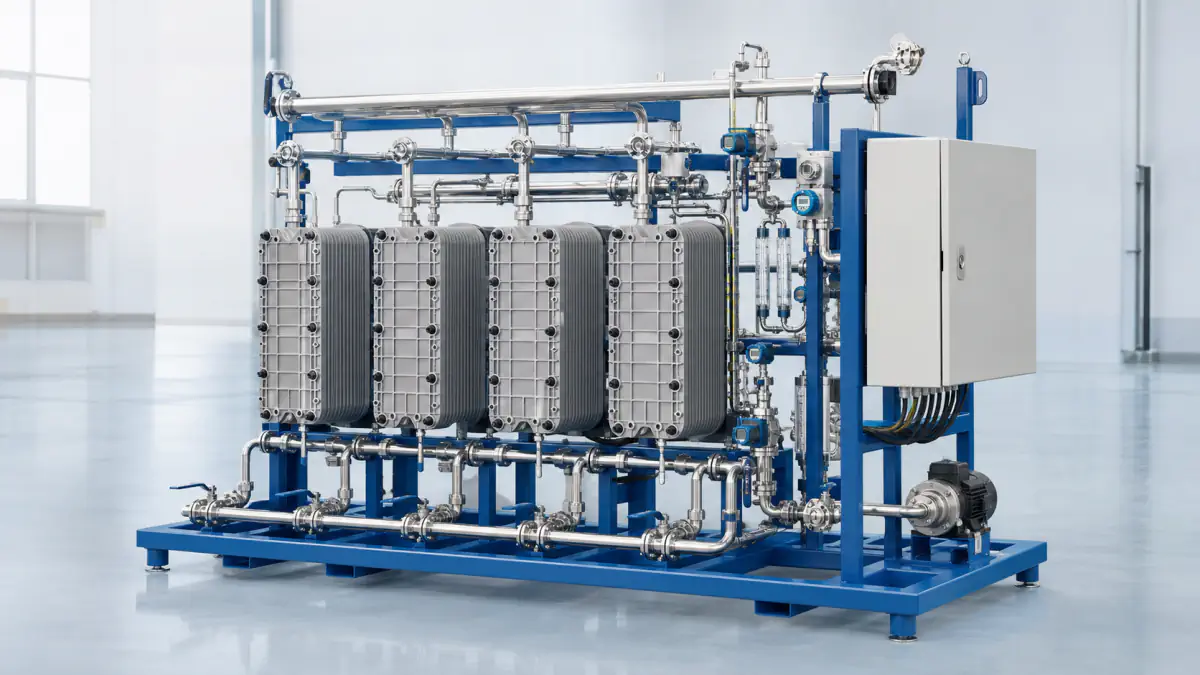
A robust UPW system featuring EDI and nuclear-grade resin finishing typically follows this sequence:
- Raw Water Pretreatment: Use appropriate particulate filtration and validated oxidant removal. Activated carbon may adsorb selected organics and remove compatible oxidants, but does not guarantee removal of all TOC; control microbial growth and fines.
- Primary Reverse Osmosis (RO): Select single-pass or two-pass treatment from actual feed and product needs. >98% salt rejection is an illustrative target requiring element-specific conditions; passes are not membrane stages.
- Degasification: A forced-draft tower may strip CO₂ but does not provide general O₂ removal and can exchange oxygen with air. A membrane/vacuum/sweep-gas system can be designed for specific CO₂/O₂ duties. Verify gas removal, hygienic design, and the effect on EDI load.
- Secondary RO (Optional): In some ultra-high purity applications, a second pass RO system further reduces the ionic load and prepares the water for EDI.
- EDI (Electrodeionization): DC current moves ions from the dilute product stream to concentrate through resin and selective membranes, with water splitting regenerating resin sites in service. Internal circulation, concentrate feed, and electrode plumbing differ by module; specify the actual arrangement rather than assuming every module has a recirculation loop.
- UV Disinfection: 254 nm is a common wavelength, but target-organism inactivation requires delivered-dose and water-quality validation. UV does not guarantee sterility, stop all downstream biofilm, or leave a persistent residual.
- Qualified Mixed Bed Ion Exchange (MBIX): Select resin purity, ionic form, leachables, rinsing, capacity, and application qualification. Nuclear-grade and semiconductor-UPW grades have different specifications and cannot be assumed interchangeable. A guard bed can reduce ionic slip but is not an absolute contaminant or particle-removal guarantee.
- Ultraviolet Oxidation (UV-Oxidation): 185 nm systems may reduce susceptible organics under validated conditions. A sub-ppb TOC target needs demonstrated measurement capability and full-train performance; not every neutral organic is completely mineralized. Place suitable degassing/ion polishing after oxidation as needed to remove resulting CO₂ and ionic by-products.
- Point-of-Use Filtration: Final sub-micron or ultrafiltration membrane filters just before the point of use to remove any particulates generated downstream or from the distribution loop.
Operating parameters
Precise control and monitoring of operating parameters are crucial for consistent UPW quality and system longevity.
- SDI₁₅: <1 or <0.5 is an illustrative particulate-screening target, not a universal EDI criterion. Apply the timed test and actual module feed requirements; SDI alone does not describe all colloids, biological, organic, or scaling risks.
- LSI (Langelier Saturation Index): LSI describes carbonate saturation, not silica or every local EDI scale. Hardness <0.1 ppm and silica <0.5 ppm are preliminary examples. Check actual module/recovery limits, CO₂, local pH changes, concentrate composition, and separately defined silica behavior.
- Flow / Loading: Operate at the module-specific dilute, concentrate, and electrode flow ranges with the specified electrical loading. RO membrane-area flux is not a universal EDI rating; use the actual hydraulic geometry and manufacturer flow/current criteria.
- DP (Differential Pressure / Stage Pressure Drop): Measure module ΔP at comparable temperature and flow. 0.5-1.5 bar clean ΔP and >2-3 bar above baseline are historical planning examples, not universal normal/cleaning values or permitted limits. Follow module maximum pressure/ΔP and diagnose hydraulic, fouling, or scaling causes before cleaning.
- Resistivity: Feed values of 1 MΩ·cm to 20 kΩ·cm and product targets >15 MΩ·cm after EDI or >18 MΩ·cm after polishing are illustrative, not grade guarantees. Specify temperature/reference compensation and actual feed, flow, current, and measurement conditions; resistivity alone is not complete UPW acceptance.
- TOC: <100 ppb feed and <5 ppb or <1 ppb final targets are application examples, not automatic results of EDI/UV. Validate module compatibility, blank/quantification limits, resin leachables, and distribution contamination.
Digital twin & instrumentation
- Flow Meters: Meter EDI feed, dilute product, concentrate, and electrode purge with instruments qualified for actual low-conductivity water, flow, and pipe conditions. Electromagnetic meters require sufficient conductivity; verify the selected meter rather than assuming every type works on UPW.
- Pressure Transmitters: Inlet and outlet pressures for each EDI module, as well as differential pressure transmitters across each module and the final polishing beds.
- Conductivity/Resistivity Probes: High-precision sensors at key points: RO permeate (EDI feed), EDI permeate, EDI concentrate, electrode purge lines, and post-MBIX. Temperature compensation is essential.
- Temperature Sensors: On all major process streams to provide context for conductivity readings and to monitor system stability.
- TOC Analyzers: Online TOC analyzers are indispensable on the EDI feed and final UPW permeate to monitor organic contamination.
- Silica Analyzers (Optional): For critical applications, online silica analyzers on RO permeate and EDI permeate can provide early warning of silica scaling potential.
Pilot-Scale vs Industrial RO
Use pilot-scale RO to test representative feed conditioning and membrane behavior before selecting a qualified EDI/resin subsystem. Confirm the actual equipment, instrumentation, hydraulic/current settings, sanitization, and scale-up protocol for laboratory, temporary, or point-of-use duties; a compact RO line does not inherently include EDI or establish UPW qualification.
Common engineering mistakes & pilot KPIs
Common Engineering Mistakes:
- Inadequate Pretreatment: Failing to achieve stringent RO permeate quality (e.g., elevated hardness, silica, or TOC) directly compromises EDI performance, leading to premature scaling, fouling, and reduced life.
- Neglecting Degasification: High CO₂ in the EDI feed significantly increases the current demand, reducing efficiency and potentially lowering permeate resistivity due to carbonic acid.
- Over-fluxing/Under-currenting EDI: Operating EDI modules outside their specified design parameters can lead to incomplete deionization, poor water quality, or accelerated scaling.
- Ignoring Concentrate Management: Assuming the EDI concentrate is a benign waste stream without considering its volume, quality, and environmental impact (or potential for reuse) is a critical oversight.
- Lack of Redundancy: Compare acceptable interruption, buffer storage, spare-module strategy, and redundant trains for the actual critical duty rather than assuming every single-train installation is unacceptable.
- Poor Instrumentation & Monitoring: Insufficient sensor coverage or inadequate data interpretation makes it impossible to proactively manage system performance, leading to reactive troubleshooting.
Pilot KPIs (Key Performance Indicators):
- Product Water Resistivity: >17 MΩ·cm post-EDI and >18 MΩ·cm post-MBIX are illustrative targets. Specify reference temperature, method, and actual contract limits.
- Ionic Removal Efficiency: Measure target Na, Cl, Ca, Mg, and SiO₂ separately. >99.5% for EDI is an illustrative target, not uniform rejection of every species or feed.
- TOC Reduction: Measure reduction from EDI feed to final product with specified blanks and quantification limits. Sub-ppb is a project target requiring validation, not proof from high resistivity.
- EDI Module ΔP Stability: Minimal increase in pressure drop over extended periods, indicating effective fouling/scaling control.
- Current Efficiency: Ratio of theoretical current required for ion removal to actual current consumed, reflecting energy efficiency.
- System Recovery: Overall water recovery percentage for the entire UPW train, including concentrate recycling strategies.
- Membrane/Resin Life: Projected operating hours/volume before cleaning or replacement is required, assessed from performance trends.
FAQ
Q1: Why choose EDI over conventional mixed-bed ion exchange for UPW production? A1: EDI provides continuous ionic removal without routine acid/alkali resin regeneration, reducing those regeneration-related chemical and waste duties. It still requires specified cleaning/sanitization, electrical operation, feed conditioning, and concentrate/electrode residual management; compare the complete system rather than assuming no chemicals or waste.
Q2: What are the most critical feed parameters for stable EDI operation? A2: Apply the actual module feed specifications and recovery. Hardness <0.1 ppm as CaCO₃, silica <0.5 ppm, and measured conductivity 1-50 µS/cm are planning examples, not universal allowances. Include CO₂/silica in the appropriate equivalent load and check oxidants, metals, organics, particulates, temperature, and current/flow settings.
Q3: How is dissolved CO₂ handled if it passes through the RO system into the EDI feed? A3: While EDI can remove dissolved CO₂ (which forms carbonic acid in water), it is energy-intensive. Therefore, a degasifier (e.g., forced-draft or membrane degasifier) is typically installed between the primary RO and EDI to reduce CO₂ concentration, improving EDI efficiency and final permeate resistivity.
Q4: What defines "nuclear-grade resin" and why is it used for UPW polishing? A4: Nuclear-grade resin is manufactured/qualified to specified nuclear-service purity and ionic-form requirements. This label alone does not establish semiconductor-UPW suitability, sub-ppb TOC, or complete particle removal. Compare actual nuclear-grade and ultrapure-water resin specifications, leachables/rinse performance, capacity, and the complete final-use qualification before selecting the finishing bed.
References
Related equipment & product lines
These categories typically support the approach above—open any line to compare brands and models.
- Electrodeionization (EDI)EDI modules and systems for ultrapure water production.View category →
- RO MembranesReverse osmosis membrane elements for municipal and industrial desalination.View category →
- UV DisinfectionUV systems and modules for pathogen inactivation and final disinfection barriers.View category →
For a closer review, use the engineering inquiry form to share feed, capacity, target, and project stage. Submission does not constitute a completed design or performance commitment.