Solutions · Application Scenarios
RO pretreatment optimization: MMF, UF, and chemistry acting as one system
Integrated SDI, TOC, and metal control before RO, with measured pressure-drop, normalized production, cleaning recovery, and replacement needs.
Use when
RO fails early when pretreatment is bought as unrelated skids.
Process options
Unified SDI/TOC/metal control strategy ahead of the membrane block.
Assessment output
Track ΔP, normalized production, cleaning recovery, and replacement needs.
Inputs and conditions for an assessment
Collect feed variability, capacity, target quality, operating hours, discharge or reuse boundaries and installed equipment data. Compare examples on matched conditions and meter boundaries; assess a project using actual water data, equipment documentation and any necessary tests.
View the process illustration
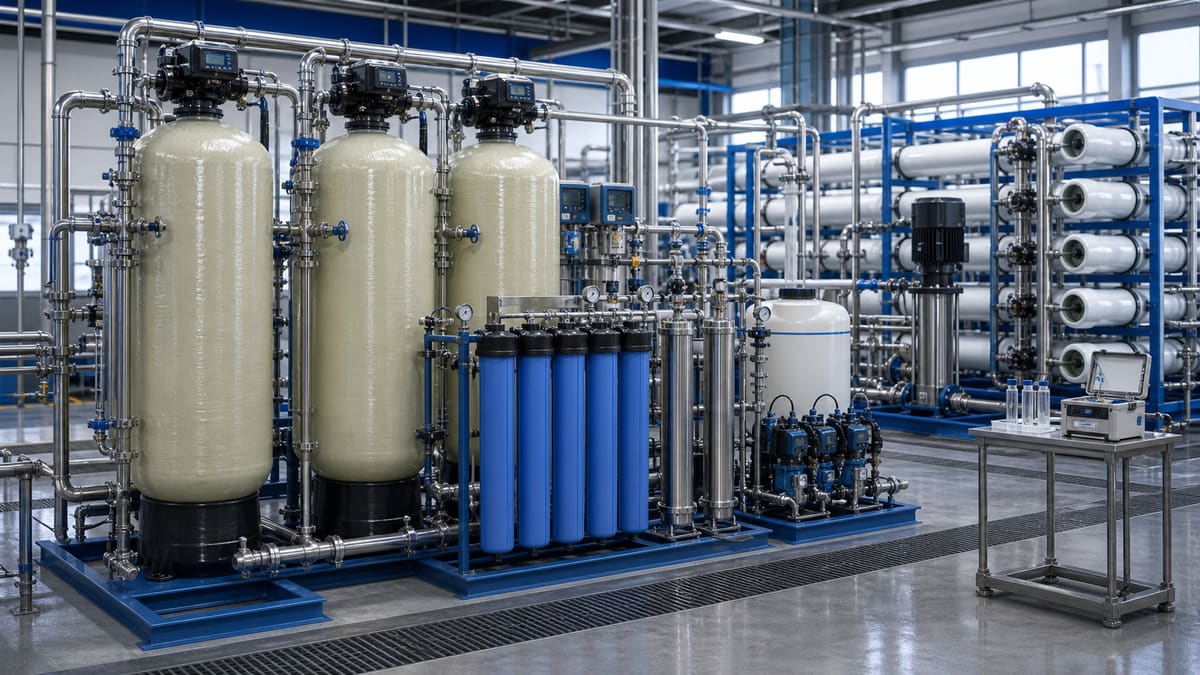
1. Process context & when this scenario is the right entry point
Reverse Osmosis (RO) pretreatment is not merely a preliminary step; it is the cornerstone of a reliable, efficient, and cost-effective membrane filtration system. This scenario focuses on optimizing the synergistic operation of mechanical filtration (Multi-Media Filters, MMF; Ultrafiltration, UF) and chemical conditioning. It is the right entry point when:
- An existing RO system frequently experiences premature fouling, high differential pressures, or shortened membrane lifespan.
- Feedwater quality is variable or challenging (e.g., surface water, municipal wastewater effluent, highly turbid industrial streams).
- The goal is to achieve higher RO recovery rates, reduce cleaning-in-place (CIP) frequency, or minimize operational expenditure (OPEX) related to membrane replacement and cleaning chemicals.
- Strict permeate quality requirements necessitate robust and consistent RO performance.
- Considering a new RO installation where predictable long-term performance is paramount.
Effective pretreatment is an integrated system designed to protect downstream RO membranes from fouling and scaling, thereby maximizing their operational efficiency and extending their service life.
2. Feed characteristics & key risks
Understanding the raw water feed is paramount. Key parameters include Total Suspended Solids (TSS), turbidity, Silt Density Index (SDI), Total Organic Carbon (TOC), Chemical Oxygen Demand (COD), hardness (calcium, magnesium), alkalinity, silica, iron, and manganese.
The primary risks for RO membranes originating from inadequate pretreatment are:
- Colloidal and Particulate Fouling: Suspended solids, colloids, and finely dispersed particles (often measured by SDI₁₅) can accumulate on the membrane surface, increasing feed channel differential pressure and reducing permeate flux.
- Organic Fouling: Natural Organic Matter (NOM) and synthetic organics (TOC/COD) can adsorb onto membranes, leading to flux decline and increased cleaning frequency.
- Scaling: Precipitation of sparingly soluble salts such as calcium carbonate (monitored by Langelier Saturation Index, LSI, or Stiff & Davis Index), calcium sulfate, silica, and barium/strontium sulfate can occur if saturation limits are exceeded at the membrane surface.
- Biological Fouling: Microorganisms can form biofilms on membranes, leading to flux decline and potential membrane damage.
- Oxidative Damage: Residual oxidants (e.g., chlorine) can irreversibly damage polyamide RO membranes.
These risks translate directly into increased OPEX (chemical consumption, energy for higher pressures, membrane replacement) and reduced system availability.
3. Concentrate / reject routing
A fundamental principle in water treatment is mass balance; matter does not simply disappear. In the context of pretreatment, the reject streams primarily originate from the backwash and flush cycles of the filtration units and the purge of spent chemical solutions.
- Multi-Media Filters (MMF) Backwash: A 24–72 hours interval is a planning example, not a fixed rule; trigger backwash from validated pressure drop, filtrate quality, loading, and the filter procedure. Backwash carries solids, organics, and possible coagulant residuals. Route it to authorized treatment or discharge within local TSS/chemical limits, with hydraulic and solids capacity checked.
- Ultrafiltration (UF) Backwash/Flush: UF systems perform periodic backwashes and Chemical Enhanced Backwashes (CEB) to remove accumulated foulants. These streams are rich in suspended solids, colloids, and concentrated organics, often carrying the chemicals used in CEB (e.g., caustic, acid, hypochlorite). Like MMF backwash, they are typically directed to the wastewater treatment plant or a dedicated handling system.
- Cartridge Filter Disposal: Spent cartridge filters, which capture remaining fine particulates, are disposed of as solid waste, requiring proper classification and handling based on absorbed contaminants.
It is crucial to note that the RO system, which this pretreatment system protects, will generate its own concentrate stream. The effectiveness of pretreatment directly impacts the volume and quality of this RO concentrate, potentially enabling higher RO recovery and thus reducing the overall concentrate volume to be managed downstream (e.g., by further concentration, evaporation, crystallizer feed, haul-off, or deep well injection). The pretreatment reject streams, however, must be explicitly managed to avoid simply shifting the pollution burden.
4. Reference process train options
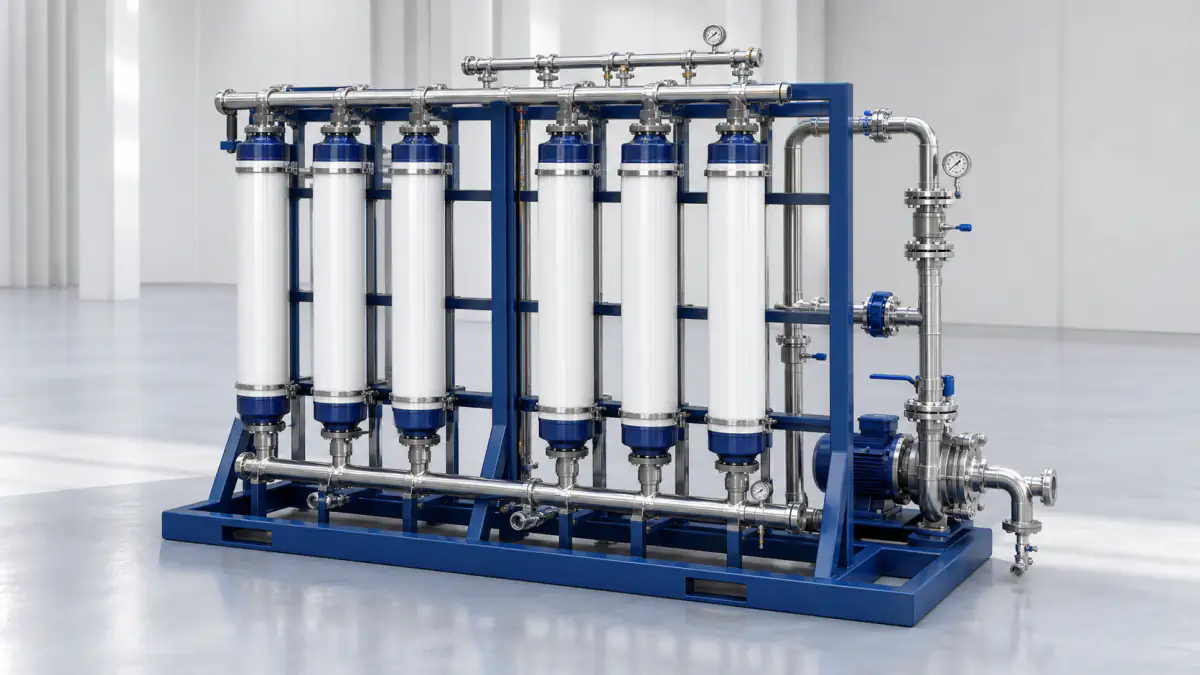
The selection of a pretreatment train is highly dependent on the raw water quality and target RO permeate specifications.
- Basic Pretreatment (Low SDI Feed): Granular media filtration, with suitable media and oxidation/regeneration for iron or manganese where needed, may precede cartridge filtration and conditioning. A 5-10 micron nominal cartridge rating is not equivalent to a 5 micron absolute guard filter; use the selected RO requirement and verified retention rating.
- Robust Pretreatment (Moderate to High SDI/TOC Feed): Consider UF/MF, optionally after coagulation/flocculation, then suitable guard filtration and conditioning. A UF pore size of 0.01-0.1 micron is an illustrative product range; verify actual rating and integrity. SDI₁₅ below 3 is a potential project target, not a guarantee; UF does not necessarily remove dissolved TOC or all microorganisms.
- Advanced Pretreatment (Very Challenging Feeds): May include clarification/dissolved air flotation (DAF) for high TSS feeds, followed by MMF or UF, then cartridge filtration and chemical conditioning. Adsorption (e.g., GAC) may be added for specific organic removal.
Chemical conditioning involves:
- Coagulation/Flocculation: For aggregating suspended solids and colloids prior to filtration.
- Dechlorination: Sodium bisulfite or activated carbon may remove residual chlorine under designed conditions. Identify each oxidant, required reaction/contact time, and analytical endpoint; the same procedure does not automatically remove all oxidants. ORP alone is not an oxidant-concentration measurement.
- Antiscalant Dosing: To inhibit the precipitation of scaling salts, crucial for achieving high RO recovery.
- pH Adjustment: Optimize coagulation and carbonate control while evaluating the separate pH-dependent chemistry of silica and other scale species. Do not assume one pH adjustment prevents every scale or silica polymerization.
- Biocides: For controlling biological growth in feed lines and on membranes.
5. Operating parameters
Precise control and monitoring of key operating parameters ensure optimal pretreatment and RO performance.
- SDI₁₅ (Silt Density Index): Apply the selected membrane requirements and timed test method. RO targets below 3.0 or 2.0, NF <5.0, and UF filtrate values 0.5 to 1.5 are illustrative project/test values, not universal RO/NF criteria or UF guarantees. Low SDI₁₅ does not exclude dissolved-organic fouling, biofouling, or scale.
- LSI (Langelier Saturation Index) / Scaling Posture: LSI addresses CaCO₃; evaluate silica and sulfates separately at actual concentrate conditions. A concentrate LSI +1.0 and silica 100-120 ppm as SiO₂ are illustrative inputs, not generic allowed limits. ppm is concentration, not saturation percentage. Silica solubility/deposition depends on temperature, pH, metals, and concentration polarization; verify the chosen antiscalant and recovery rather than relying on a fixed number.
- Flux (L/(m²·h) / LMH): UF 40 to 100 LMH, brackish-water RO 10-25 LMH, and seawater/high-TDS RO 5-15 LMH are preliminary comparison ranges, not universal allowable fluxes. Select actual loading from element requirements, temperature, water quality, backwash/cleaning behavior, and pilot results. Lower flux may reduce fouling load but does not itself guarantee lower total energy or longer life.
- DP (Differential Pressure): Monitoring differential pressure across filtration stages is critical for determining cleaning cycles and media/cartridge replacement.
- MMF: ΔP 0.5-0.7 bar is an illustrative backwash trigger; use the filter procedure, actual flow, media condition, and filtrate quality.
- UF Modules: Evaluate TMP at normalized flow and temperature. A 20-30% rise is an illustrative investigation trigger, not a universal backwash/CEB criterion; respect the module pressure limits and actual cleaning procedure.
- Cartridge Filters: ΔP 0.7-1.5 bar is an illustrative replacement range, subject to cartridge and housing limits. Use validated pressure/quality criteria and specified hygiene/service intervals; trends can support maintenance but do not guarantee prevention of every upset.
6. Digital twin & instrumentation
Instrumentation & Sensors:
- Online Analyzers: Configure continuous measurements where applicable and timed tests where required:
- Turbidity: Raw water and post-filtration (MMF/UF permeate).
- SDI: Timed periodic or automated tests after pretreatment, before RO; report the test interval and method.
- pH & ORP: Raw water, post-coagulation, post-dechlorination.
- Conductivity/TDS: Raw water and RO feed; conversion of conductivity to TDS requires a suitable calibration and does not identify individual ions.
- Flow Meters: Accurate measurement of raw water intake, backwash rates, permeate flows, and chemical dosing rates.
- Pressure Transducers: High-resolution measurement of feed pressure, permeate pressure, concentrate pressure, and crucially, differential pressures across all filtration stages (MMF, UF, cartridge filters).
- Temperature Sensors: Monitoring water temperature, which impacts viscosity, membrane performance, and scaling kinetics.
Where specified, connect measurements to the project data platform with calibration, timestamp, missing-data, and access controls.
Models / Digital Twin Use Cases:
- Mass Balance Reconciliation: Account for MMF/UF product, backwash, flush, drains, and chemical additions. Flag discrepancies and measurement uncertainty; a model cannot confirm balance or distinguish drift without sufficient independent measurements.
- Fouling & Scaling Risk Assessment: Compare SDI, turbidity, and ΔP trends, with reliable water analyses and temperature. LSI and separately defined saturation calculations can support concentrate-risk assessment; validate any forecast against actual records, rather than assuming complete real-time chemistry or unique foulant identification.
- Maintenance Planning: Evaluate MMF/UF backwash, cartridge replacement, and UF CIP triggers using the equipment procedure and tested trends. Verify any prediction with independent records and operator review; do not guarantee optimal timing or prevention of irreversible fouling.
- Chemical Dosing Assessment: Compare coagulant, antiscalant, and biocide doses against measured feed and outlet response. Confirm compatibility, safe operating ranges, and approval controls before changing doses; lower consumption with preserved performance must be demonstrated.
- Energy Consumption Analysis: Monitoring pump pressures and flow rates allows for real-time calculation and optimization of specific energy consumption, identifying opportunities for efficiency improvements.
- Operator Decision Support: Evaluate actionable alarms and recommendations under actual project scope. Maintain safeguards and operator approval; fewer interventions, shutdowns, or damaged membranes are objectives to measure, not guaranteed functions.
7. Pilot-Scale vs Industrial RO
Pilot-scale and industrial pretreatment duties require different representative-flow, hydraulic, control, and availability checks; select equipment against the actual project scope rather than assuming a particular existing product portfolio.
pilot-scale RO: A skid-mounted or mobile pilot may characterize variable feedwater, compare MMF and UF, test coagulant/antiscalant doses, and measure achievable SDI₁₅ and downstream RO response. Check representative loading, deployment requirements, utilities, and test duration. Use measured whole-system cost and performance to evaluate investment before scaling up; compact size does not by itself prove ROI.
8. Common engineering mistakes & pilot KPIs
Common Engineering Mistakes:
- Undersizing Pretreatment: Failing to account for peak loads or worst-case feed quality variations.
- Ignoring Seasonal Variations: Designing for average conditions, leading to performance issues during seasonal turbidity spikes, temperature changes, or organic load fluctuations.
- Inadequate Chemical Dosing Control: Fixed-rate dosing irrespective of feed quality, leading to over-dosing (waste) or under-dosing (fouling).
- Poor Monitoring & Data Interpretation: Relying solely on manual grab samples or neglecting online data trends, missing early indicators of fouling/scaling.
- Neglecting Concentrate Disposal: Not having a comprehensive and cost-effective plan for managing MMF/UF backwash and ultimately RO concentrate, leading to permitting or operational bottlenecks.
- Insufficient Pilot Testing: Skipping pilot studies for complex waters, leading to costly redesigns or operational headaches at full scale.
Key Performance Indicators (KPIs) for Pilot Studies:
- SDI₁₅ Reduction: Percentage reduction from raw water to RO feed, and consistency of final SDI₁₅.
- UF/MMF Permeate Turbidity: <0.1 NTU for UF and <1.0 NTU for MMF are illustrative trial targets. Verify actual performance, instrument range, and selected RO feed requirements rather than treating them as universal filter guarantees.
- Specific Flux Decline Rate: For UF, rate of flux decline between cleans, and recovery of specific flux after backwash/CEB.
- Cleaning Frequency & Chemical Consumption: Optimized backwash/CEB frequency and associated chemical usage per cubic meter of treated water.
- Chemical Dosage Optimization: Minimum effective dosages for coagulant and antiscalant to meet performance targets.
- Projected RO Recovery: The maximum sustainable RO recovery achievable with the optimized pretreatment.
- Overall Water Recovery: The percentage of raw water converted to RO feed after pretreatment's own internal water losses (backwash).
9. FAQ
Q: How often should I check SDI? A: Define a sampling plan from the feed variability, manufacturer requirements, and consequences of excursions. Automated SDI₁₅ instruments still perform timed tests. Daily sampling is one planning example; additional tests may be needed during storms, seasonal changes, or pretreatment upsets. Use continuous turbidity/pressure trends alongside, not as substitutes for SDI.
Q: Can I skip UF and just use MMF for RO pretreatment? A: Compare actual outlet quality and operating costs for the feed range. Raw-water turbidity <5 NTU and SDI₁₅ <3 are illustrative screening values, not sufficient acceptance criteria. MMF may be adequate with appropriate chemistry and guard filtration; UF can improve particle control but needs product-specific testing and does not solve all dissolved-organic or scale risks.
Q: What is the single biggest driver for RO membrane fouling? A: While scaling is critical, inadequate removal of colloidal and particulate matter (high SDI₁₅) or problematic organic compounds (high TOC) from the feed water often represents the biggest challenge leading to RO membrane fouling. These foulants create a cake layer that increases differential pressure, reduces flux, and exacerbates scaling by concentrating ions at the membrane surface.
Q: How does pH adjustment fit into pretreatment? A: pH affects coagulation, carbonate saturation, silica chemistry, and other precipitates. Lowering pH can reduce carbonate saturation but does not generally increase silica solubility; elevated pH can increase silica solubility in an appropriate range while creating other precipitation risks. Select the complete chemistry and membrane-compatible range, with upstream solids separation where precipitation occurs.
References
Related equipment & product lines
These categories typically support the approach above—open any line to compare brands and models.
For a closer review, use the engineering inquiry form to share feed, capacity, target, and project stage. Submission does not constitute a completed design or performance commitment.