Solutions · Application Scenarios
Fluoride and arsenic removal: drinking-water and industrial discharge barriers
Speciation-aware treatment with media/IX/RO and explicit residual streams. Verify effluent quality and document spent-media, regenerant and concentrate handling.
Use when
Fluoride and arsenic need validated, species-specific removal beyond generic filtration.
Process options
Speciation-aware treatment with media/IX/RO and explicit waste residual streams.
Assessment output
Verify effluent targets and manage spent media, regenerant and concentrates.
Inputs and conditions for an assessment
Collect feed variability, capacity, target quality, operating hours, discharge or reuse boundaries and installed equipment data. Compare examples on matched conditions and meter boundaries; assess a project using actual water data, equipment documentation and any necessary tests.
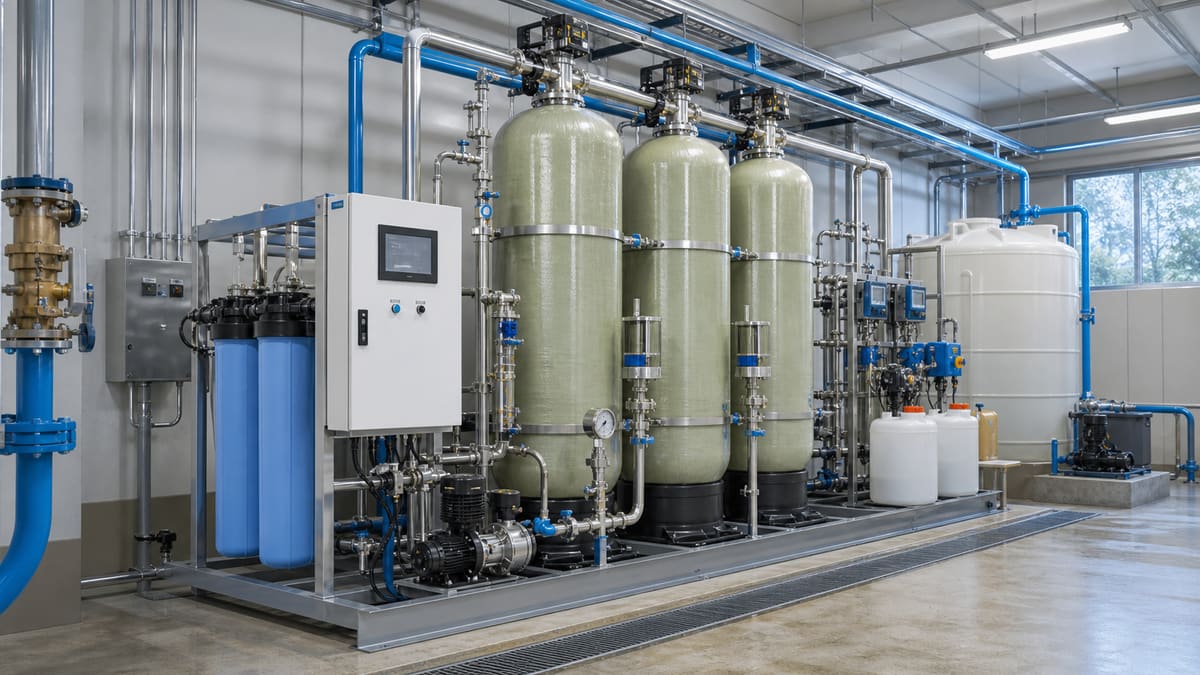
View the process illustration
1. Process context & when this scenario is the right entry point
Fluoride (F⁻) and arsenic (As) require concentration- and exposure-specific health and treatment assessment. Excess fluoride can cause dental or skeletal fluorosis; inorganic arsenic is carcinogenic with important long-term risks. Compare actual local drinking-water or discharge requirements. Examples are the WHO provisional As guideline 10 µg/L, US EPA public-water-system As MCL 10 µg/L and fluoride MCL 4 mg/L; these are not worldwide industrial discharge limits.
Typical applications include municipal drinking water treatment where natural geological formations release these contaminants, and industrial sectors such as mining, semiconductor manufacturing, glass production, and power generation, where F⁻ and As can be process byproducts or leached from raw materials. Targeted removal strategies are necessary because these contaminants are often present alongside other dissolved solids and can interact complexly with treatment chemicals and media.
2. Feed characteristics & key risks
The efficacy of F⁻ and As removal processes is highly dependent on feed water characteristics. Fluoride typically exists as the F⁻ ion, but its removal efficiency can be affected by pH and other competing anions. Arsenic speciation is crucial: arsenate (As(V)) is anionic (H₂AsO₄⁻, HAsO₄²⁻) and generally easier to remove by adsorption or ion exchange, while arsenite (As(III)) is uncharged (H₃AsO₃) at neutral pH, making its removal more challenging without prior oxidation. Common co-contaminants include iron, manganese, hardness (calcium, magnesium), sulfates, chlorides, and total organic carbon (TOC), which can interfere with treatment.
Key risks for downstream membrane processes include:
- Fouling: Particulate fouling (silt, colloids) and organic fouling (TOC) can lead to reduced flux and increased cleaning frequency. Biofouling is also a concern.
- Scaling: Calculate CaF₂, CaCO₃, silica and metal-hydroxide precipitation separately using actual concentrate chemistry. Langelier Saturation Index (LSI) addresses carbonate and cannot assess CaF₂ saturation. Appropriate pretreatment and species-specific control must be validated.
- Osmotic Pressure Limits: High total dissolved solids (TDS) feeds result in high osmotic pressure, requiring higher operating pressures for reverse osmosis (RO) and increasing energy consumption and potentially limiting recovery.
Regulatory drivers often mandate stringent discharge limits, pushing for high removal efficiencies and creating significant challenges for concentrate management.
3. Concentrate / reject routing
A core principle of water treatment is mass balance; contaminants are not destroyed but transferred to another phase or concentrated. For fluoride and arsenic removal, accountability for the concentrate or spent media is paramount.
- Adsorption Systems (e.g., Activated Alumina, Iron-based media): Spent media and any regeneration/rinse solution require characterization and permitted disposal or treatment. Arsenic content alone does not establish hazardous-waste classification; applicable leaching tests and local rules determine acceptance.
- Co-precipitation (e.g., with lime, ferric chloride): Fluoride may precipitate as a calcium salt while arsenic can be adsorbed/coprecipitated with iron or other solids. Dewater sludge and test the cake, filtrate and other residues under applicable classification and acceptance requirements; hazardous-landfill routing is not automatic.
- Ion Exchange (IX): Regeneration of IX resins with brine produces a highly concentrated regenerate waste stream rich in F⁻, As, and other ions exchanged from the feed water. This regenerant brine requires further treatment, such as chemical precipitation (e.g., lime for F⁻, ferric for As), evaporation to minimize volume, or in some cases, deep well injection if permitted and geologically suitable.
- Reverse Osmosis (RO) / Nanofiltration (NF): These membrane processes generate a concentrated reject stream (brine) that contains the rejected F⁻, As, and other dissolved salts. The disposition of this brine is critical:
- Further Concentration: The concentrate can be fed to additional RO stages in a high-recovery system to maximize permeate yield and minimize concentrate volume.
- Evaporation/Crystallization: For Zero Liquid Discharge (ZLD) applications, the concentrate can be sent to evaporators and crystallizers to recover salts and produce a solid waste for disposal.
- Chemical Precipitation: Validate calcium-based fluoride removal or arsenic adsorption/coprecipitation chemistry for the concentrate. Resulting sludge and liquid require testing, dewatering and classification-specific permitted treatment.
- Deep Well Injection: Where permitted and geologically viable, the concentrate can be injected into deep geological formations.
- Haul-off: For smaller volumes, concentrate can be hauled off-site for disposal at permitted facilities.
In all cases, the concentrate or solid waste stream is carefully characterized for F⁻, As, and other regulated constituents to ensure compliant and safe disposal, adhering strictly to mass balance principles.
4. Reference process train options
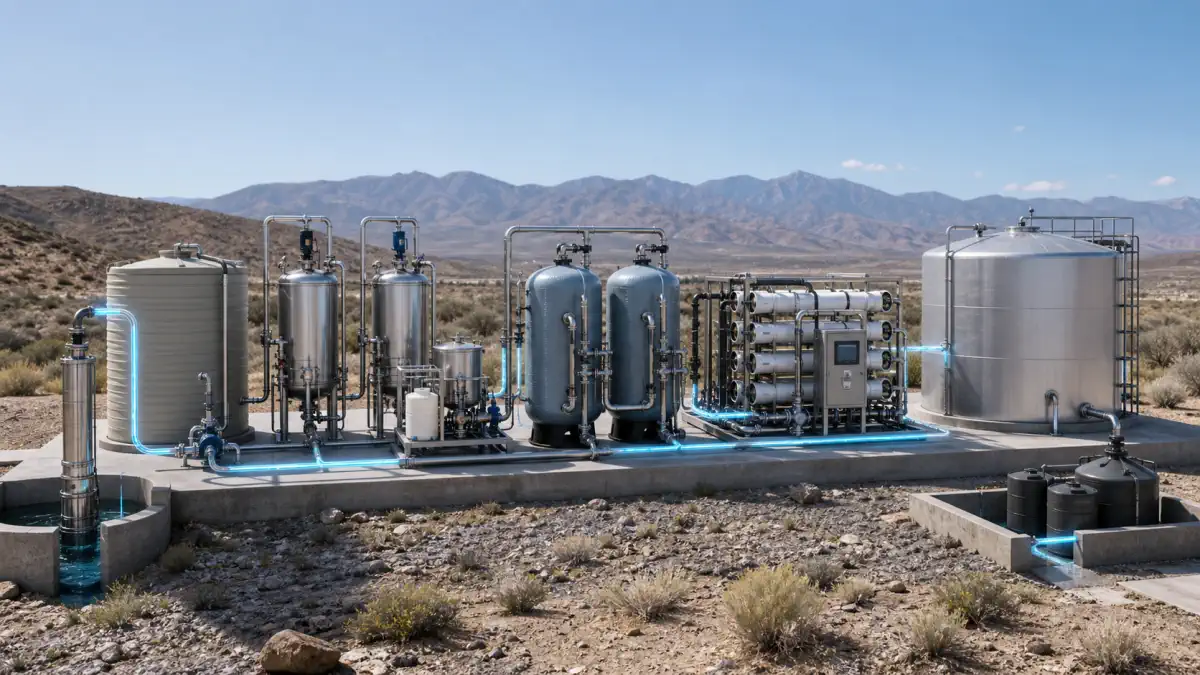
Effective F⁻ and As removal often requires a multi-stage process train, tailored to the specific feed water and regulatory requirements.
Pre-treatment: Essential for protecting downstream membrane and adsorption processes.
- Oxidation: Determine As(III)/As(V) and validate an appropriate oxidant, dose, contact time and residual/byproduct control. Chlorine or permanganate may convert As(III) to As(V); hydrogen peroxide alone is not a universal rapid-conversion method. Oxidation changes speciation but does not itself remove arsenic.
- pH Adjustment: Select pH for actual media, coagulation and membrane conditions. Activated-alumina fluoride adsorption often favors a lower pH, while 6-7 is only an example for iron coagulation, not a universal optimum.
- Coagulation/Flocculation & Clarification: Addition of coagulants (e.g., ferric chloride, alum) to precipitate suspended solids and some dissolved contaminants, followed by sedimentation or dissolved air flotation (DAF).
- Filtration: Multimedia filters, ultrafiltration (UF), or microfiltration (MF) are used to reduce turbidity and suspended solids. This is crucial for achieving an SDI₁₅ target typically less than 3, ideally <2, for downstream RO/NF.
Primary F/As Removal:
- Adsorption:
- Activated Alumina (AA): Highly effective for fluoride removal, especially at lower pH. Can also remove As(V).
- Iron-based Adsorbents: Granular ferric hydroxide (GFH) or iron oxide media can remove arsenic under validated conditions. Some media adsorb As(III) directly; oxidized As(V) behavior and competing ions must be assessed separately. These systems are typically operated in pressure vessels (e.g., FRP tanks).
- Co-precipitation:
- Lime Softening: Primarily for hardness removal, but can co-precipitate fluoride as CaF₂ and arsenic if iron is also present.
- Enhanced Coagulation: Using ferric chloride or alum with careful pH control to achieve high removal of As(V) and other contaminants.
- Ion Exchange (IX): Strong base anion (SBA) resins can remove As(V), subject to competing ions and breakthrough. Conventional anion resins generally have limited fluoride selectivity, so validate a fluoride-specific resin or compare adsorption/precipitation/membranes rather than assuming SBA removes both contaminants efficiently.
Polishing / Membrane Separation:
- Nanofiltration (NF): Can offer good rejection of F⁻ and As(V) while operating at lower pressures than RO, if the target removal allows. Retains some hardness.
- Reverse Osmosis (RO): Rejection such as 95-99+% is illustrative, not a guarantee for every F⁻/As species, membrane or water. Validate absolute permeate concentrations at actual pH, temperature and recovery, with appropriate pretreatment.
- Electrodeionization (EDI): While not a primary F/As removal technology, EDI can be used post-RO to polish the permeate for ultra-pure water applications, handling any residual ions if required.
The specific combination of technologies depends on raw water quality, desired treated water quality, and economic considerations.
5. Operating parameters
Precise control and monitoring of operating parameters are vital for efficient and sustainable F/As removal:
- SDI₁₅ (Silt Density Index): Below 3, preferably below 2, are example targets subject to the membrane and actual feed. The timed test measures particulate/colloidal potential, not all organic or biological fouling; investigate high values rather than assuming a guaranteed rate of performance loss.
- LSI (Langelier Saturation Index) / Scaling Posture: For membrane systems, the LSI must be carefully managed to prevent calcium carbonate scaling, typically by maintaining a negative LSI or through effective antiscalant dosing. For fluoride, monitoring the saturation index for CaF₂ is equally important. High F⁻ concentrations combined with high Ca²⁺ can lead to CaF₂ scaling, which is difficult to remove. Pre-treatment with lime softening can remove bulk Ca²⁺ before RO to mitigate this.
- Flux (LMH): 10-25 LMH in L/(m²·h) is an illustrative RO/NF design range, dependent on actual water, membrane, temperature and recovery. Lower flux may reduce fouling risk but does not guarantee membrane life. Normalize performance for changing operating conditions.
- DP (Differential Pressure): Distinguish vessel and stage ΔP. >10-15 psi or 0.7-1 bar above baseline is an example, not a universal trigger or equipment limit. Normalize for flow and conditions; increases or sudden decreases may have hydraulic, mechanical or fouling causes and do not alone prove membrane/seal failure. Investigate alongside product-water quality and applicable limits.
6. Digital twin & instrumentation
Key instrumentation includes:
- Flow meters: Monitoring feed, permeate, and concentrate flows for mass balance and recovery calculations.
- Pressure transducers: Measuring inlet, outlet, and inter-stage pressures across membrane trains, adsorption columns, and filters to track ΔP.
- Conductivity probes: Monitoring feed, permeate, and concentrate conductivity for salt rejection performance and system recovery.
- Temperature sensors: Essential for flux normalization and chemical dosing adjustments.
- pH and ORP (Oxidation-Reduction Potential) sensors: Support pH control and oxidation trending. ORP does not selectively measure arsenic oxidation state, disinfectant concentration or completed removal; verify chemical speciation and residuals.
- Turbidity sensors: Monitoring pre-treatment effectiveness (e.g., post-filtration).
- Online F⁻ and As analyzers: Providing real-time insights into removal efficiency (though often laboratory analysis provides the definitive compliance data).
A proposed digital twin should specify actual data connections, installed functions and independent validation. Assess each function rather than assuming a deployed model:
- Mass balance reconciliation: Reconcile measured F⁻, As and TDS streams with analytical and flow uncertainties; deviations can prompt checks of sampling, sensors or process conditions.
- Fouling and scaling risk forecasting: Compare timed SDI, carbonate-specific LSI, species-specific saturation, normalized flux and ΔP trends. Test predictions against independent events before using approved maintenance recommendations.
- Performance optimization: Evaluate proposed parameters, chemicals and cleaning against validated limits, water quality, energy and waste handling. Recommendations do not guarantee a global optimum or savings.
- Operator decision support: Provide documented evidence, uncertainty and suggested checks for operator approval; alerts alone do not establish continued legal compliance.
7. Pilot-Scale vs Industrial RO
For fluoride and arsenic removal applications, the choice between pilot-scale RO and industrial RO depends primarily on scale, complexity, and desired integration level.
Pilot-scale RO can test representative water and actual media/membrane compatibility. Less than 100 m³/day is an illustrative duty, not a pilot definition or drinking-water approval. Verify pressure, materials, mobility, logistics and all water-quality requirements before temporary or emergency supply.
Industrial RO may serve larger continuous duties, including above 100 m³/day where appropriate. Confirm actual design, automation, SCADA, redundancy and concentrate/thermal interfaces in the project scope; scale alone does not establish high recovery, drinking-water approval, ZLD or long-term reliability.
8. Common engineering mistakes & pilot KPIs
Several recurring pitfalls can compromise the effectiveness and cost-efficiency of F/As removal systems:
- Underestimating As(III) Oxidation Needs: Failing to characterize arsenic species or validate required oxidation can undermine removal. Some adsorbents can remove As(III) directly, so assess the actual method rather than assuming identical oxidation needs for all media.
- Inadequate Pre-treatment for Membranes: Skipping or undersizing pre-treatment steps (e.g., filtration, pH adjustment, antiscalant dosing) leads to rapid membrane fouling and scaling, increasing operational costs and reducing membrane life.
- Neglecting Concentrate Management: Focusing solely on permeate quality without a robust, compliant, and cost-effective plan for concentrate/sludge disposition leads to operational bottlenecks and potential regulatory non-compliance.
- Ignoring Synergistic Contaminant Effects: The presence of other ions (e.g., sulfate competing with As(V) on IX resins, high TOC causing fouling) can significantly impact removal efficiency and membrane performance.
- Lack of Pilot Testing: Directly scaling up without pilot data specific to the actual feed water characteristics is a high-risk strategy, often leading to underperforming or over-designed systems.
Key Performance Indicators (KPIs) for pilot studies and full-scale operations:
- F⁻/As Removal Efficiency: Percentage reduction from feed to permeate (primary KPI).
- Media Exhaustion Rate: For adsorption/IX, measured as bed volumes (BV) to breakthrough, dictating regeneration/replacement frequency.
- Normalized Permeate Flux: For membranes, stability over time, indicating fouling rates.
- Cleaning Frequency & Efficacy: Number of chemical cleanings per time period, and restoration of flux after cleaning.
- Chemical Consumption: Quantifying coagulants, oxidants, antiscalants, and pH adjusters per unit volume of treated water.
- Concentrate Volume & Characteristics: Volume of concentrate/sludge generated per volume of permeate, and its composition for disposal planning.
9. FAQ
Q1: Why is arsenite (As(III)) harder to remove than arsenate (As(V))? At neutral pH, As(III) is mainly neutral H₃AsO₃, making conventional anion exchange less suitable. As(V) commonly occurs as H₂AsO₄⁻ and HAsO₄²⁻ and may be easier to remove with selected resins or metal-oxide media. Some adsorbents also remove As(III); assess speciation, competition and required oxidation for the selected treatment.
Q2: Can RO completely remove all fluoride and arsenic to non-detect levels? Figures such as 95-99%+ are illustrative rejection results for selected ions and conditions. Achieving a target or a non-detect result depends on inlet concentration, membrane, pH, temperature, recovery and the analytical reporting limit. Multiple permeate passes or additional treatment may be needed; do not treat 100% rejection as a design guarantee or non-detect as proof of zero contaminant.
Q3: What's the main challenge associated with concentrate from fluoride and arsenic removal? The challenge is a complete, permitted residual route. Measure F⁻, As, other constituents and applicable leaching or corrosivity characteristics; concentration alone does not automatically classify a liquid or solid as hazardous. Evaluate suitable precipitation, thermal treatment, permitted injection or licensed off-site treatment. Liquid concentrate is not directly landfill-acceptable merely because a hazardous-waste landfill exists.
Engineering references
Related equipment & product lines
These categories typically support the approach above—open any line to compare brands and models.
- Filtration MediaGranular and specialty media for depth filtration and polishing stages.View category →
- Ion Exchange ResinsCation/anion and mixed bed resin solutions for demineralization and polishing.View category →
- RO MembranesReverse osmosis membrane elements for municipal and industrial desalination.View category →
For a closer review, use the engineering inquiry form to share feed, capacity, target, and project stage. Submission does not constitute a completed design or performance commitment.