Solutions · Application Scenarios
Brine concentration: shrinking volume before disposal or thermal end-points
Concentrate brine using verified water chemistry, species-specific scaling assessment and a complete balance for downstream thermal treatment or disposal.
Use when
Disposal and thermal costs scale with volume—every m³ of avoided permeate loss matters.
Process options
Concentration staging with carbonate/silica assessment and measured brine chemistry.
Assessment output
Measure downstream volume, energy, condensate quality and residual-solids handling.
Inputs and conditions for an assessment
Collect feed variability, capacity, target quality, operating hours, discharge or reuse boundaries and installed equipment data. Compare examples on matched conditions and meter boundaries; assess a project using actual water data, equipment documentation and any necessary tests.
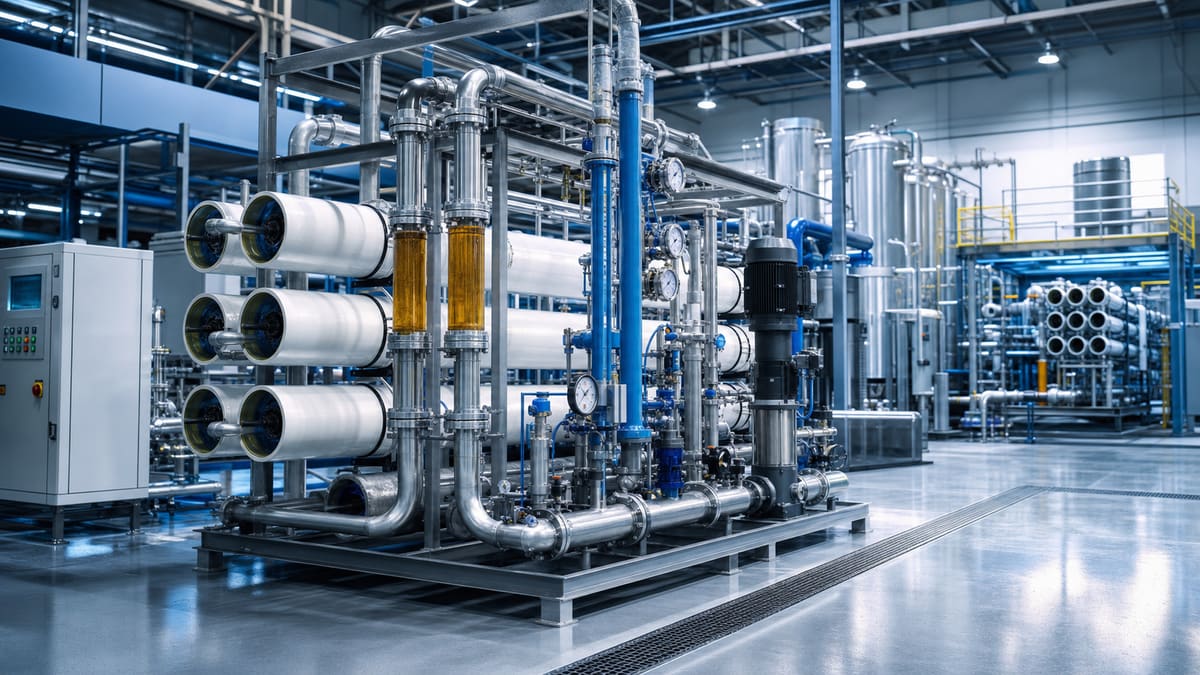
View the process illustration
Process Context & When This Scenario Is the Right Entry Point
Brine concentration reduces the volume of high total dissolved solids (TDS) wastewater, including upstream reverse osmosis (RO) or nanofiltration (NF) concentrates. It is relevant when direct discharge is prohibited, volume-based disposal is expensive or Zero Liquid Discharge (ZLD) is required. Recovering reusable water may reduce the feed volume for evaporation, crystallization, injection or off-site treatment, but compare the added membrane energy, pretreatment, residues and total lifecycle cost. Applications include power generation, oil & gas, mining, chemical processing and manufacturing; lower OPEX or environmental impact is not automatic.
Feed Characteristics & Key Risks
Feed chemistry and salinity vary by project. 50,000 mg/L and 100,000 mg/L or more illustrate challenging brines, not universal membrane-feed capabilities. Characterize calcium, magnesium, barium, strontium, silica, sulfate, carbonate/bicarbonate, sodium, chloride and actual organic contaminants.
The primary risks for membrane-based brine concentration are:
- Scaling: Assess gypsum (CaSO₄·2H₂O), silica (SiO₂), BaSO₄, SrSO₄ and CaCO₃ separately using actual activities and temperature. Langelier Saturation Index (LSI) is carbonate-specific, need not always be positive and may be unsuitable at high ionic strength without an appropriate alternative or activity model.
- Fouling: Despite upstream treatment, residual colloidal matter, organics, and biological growth can still lead to membrane surface fouling, especially at high pressures and low fluxes.
- Osmotic Pressure: Actual feed and permeate chemistry determine net osmotic pressure. Some duties may require 1000 psi or more, but this is not a universal requirement or an allowable pressure for any membrane, pump or vessel. Verify temperature-dependent ratings and net driving pressure.
- Regulatory Drivers: Compliance with ZLD mandates or stringent discharge limits for specific contaminants often necessitates maximum water recovery, pushing membrane systems to their operational limits.
Concentrate / Reject Routing
A complete balance accounts for feed constituents in permeate, concentrate, pretreatment solids, cleaning wastes and other outlets. The final membrane concentrate requires a permitted disposition; dissolved constituents are not all perfectly excluded from permeate. Reuse as process water, boiler makeup or non-potable water requires application-specific quality checks and any necessary polishing.
The concentrate stream from the final membrane stage is not discarded directly. Its routing options include:
- Further Thermal Treatment: Mechanical vapor recompression (MVR), multi-effect evaporators (MEE) or crystallizers can recover condensate and separate salts. Compare total energy and cost with the verified smaller feed volume; condensate may need treatment for volatile compounds or entrainment, and mother liquor and wet cake still require management.
- Evaporation Ponds: If climatically suitable, geologically sound, and permitted by regulations, large evaporation ponds can be used for final brine disposal, though this is less common for new industrial facilities due to environmental concerns and land footprint.
- Deep Well Injection (DWI): In regions with appropriate geology and regulatory approval, the concentrated brine can be injected into deep, non-potable aquifers. Pre-filtration is often required to prevent well plugging.
- Haul-off to Licensed Disposal Facilities: Confirm waste classification, facility acceptance, transport permissions and actual pricing. It may suit small volumes or constrained sites but is not universally the most expensive route.
- Salt Recovery: In niche cases where valuable salts (e.g., lithium, sodium chloride) are present, the brine can be further processed for salt harvesting and purification.
The objective is to reduce volume sent to permitted endpoints while meeting reuse quality and operational constraints. Compare the complete capital and operating costs rather than assuming concentration alone makes downstream handling economical.
Reference Process Train Options
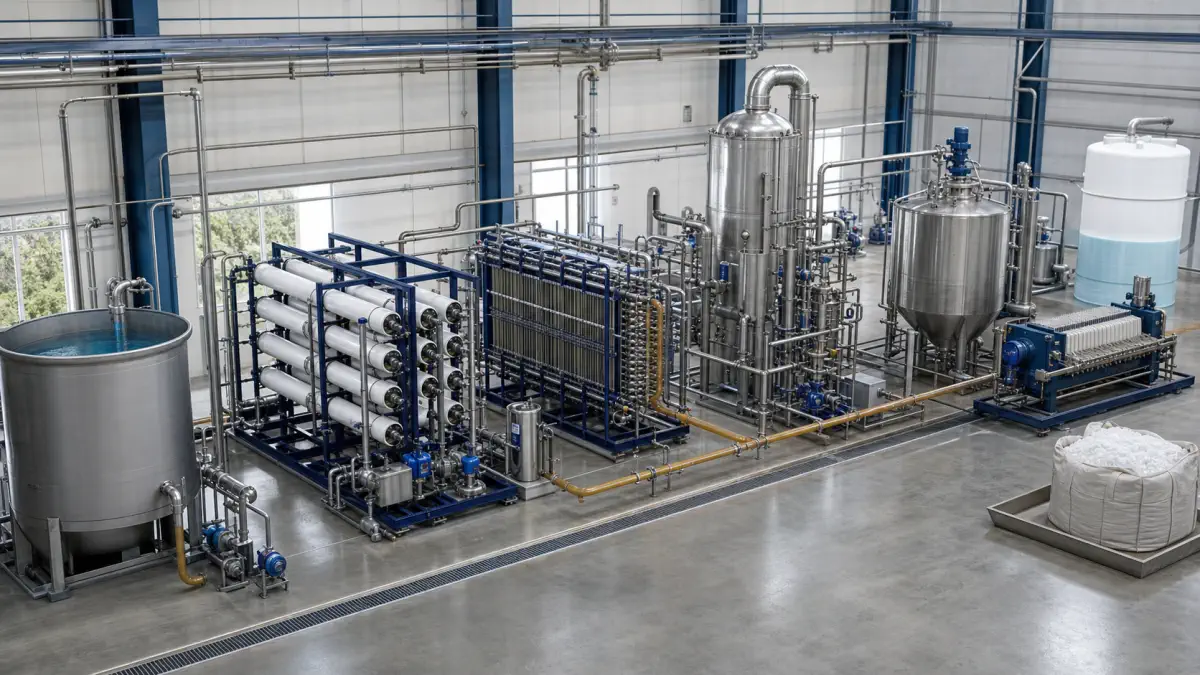
Effective brine concentration often involves a multi-pronged approach:
- Pretreatment: Robust pretreatment is non-negotiable. This typically includes chemical clarification, multi-media filtration, and often ultrafiltration (UF) or microfiltration (MF) to achieve stringent SDI targets. Chemical conditioning with coagulants, flocculants, pH adjustment (e.g., acid dosing to prevent carbonate scaling, caustic dosing for silica/metal hydroxide control), and multi-component antiscalant dosing are critical.
- Membrane Staging:
- Initial RO/NF: Select the first membrane step for actual feed and separation targets. NF often rejects multivalent ions preferentially, but monovalent salts in its permeate can still create substantial osmotic pressure for downstream RO. Include both NF outlets and pretreatment in the overall recovery balance.
- High-Pressure RO (HPRO): 800-1200 psi is an illustrative duty range, not a generic equipment rating. Select actual membrane, pump, pressure-vessel and connection ratings for pressure, temperature, chemistry and net driving pressure.
- Ultra-High Pressure RO (UHPRO): Do not assume 1800 psi or higher is allowable. Selected commercial DuPont elements specify up to 120 bar / 1740 psi, with temperature-dependent derating; other equipment requires its own ratings. Some high-salt-passage concentration membranes reach high retentate salinity by sacrificing salt rejection, so permeate may require further treatment.
- Staged Membrane Arrays: Multiple stages of HPRO/UHPRO in series (e.g., three or four stages) with interstage pH adjustment and antiscalant redosing are common to maximize overall water recovery.
- Interstage Treatment: Between membrane stages, adjustments to pH and additional antiscalant dosing are often necessary to manage saturation indices as the brine becomes progressively concentrated. Degasification may also be required if CO₂ is generated from acid dosing.
- Integration with Thermal Systems: Match final membrane concentrate chemistry and flow to the evaporator or crystallizer design, including buffer storage, pretreatment and residual management. Integration must be compared on full energy, reliability and cost; it does not ensure a universally optimal ZLD solution.
Operating Parameters
Precision in monitoring and control of operating parameters is paramount for sustainable brine concentration:
- SDI₁₅ (Silt Density Index): Values below 4, <3 or <2 are example targets to validate for the membrane and feed. This timed test measures particulate/colloidal fouling potential, not all organic or biological risks; a deviation alone does not prove irreversible damage.
- LSI (Langelier Saturation Index) / Scaling Posture: Carbonate saturation and antiscalant operation must be validated for actual ionic strength and chemistry. Calculate CaSO₄, BaSO₄ and SiO₂ separately. Positive carbonate or other saturation indices are not generally safe operating targets merely because an antiscalant is used.
- Flux (LMH): 8 to 15 L/(m²·h) is an illustrative HPRO/UHPRO design range subject to actual feed, membrane, temperature and recovery. Lower flux uses more area and may reduce fouling risk; longer membrane life is not guaranteed.
- DP (Differential Pressure): Distinguish vessel and stage ΔP and normalize comparisons for operating conditions. 10-15 psi above baseline or 60-80 psi overall stage drop are examples, not generic cleaning triggers or allowable vessel limits. Fouling, flow changes or mechanical issues can raise ΔP; follow actual manufacturer limits and approved cleaning criteria.
Digital Twin & Instrumentation
Instrumentation supports safe control and performance tracking. Digital-twin functions, where proposed, need verified data connections, calibration, independent validation and an approved operator-response procedure; they are not a prerequisite or an automatic installed capability.
Instrumentation: Specify and verify the sensor scope for the actual system:
- Flow Meters: Monitoring feed, permeate, concentrate, and CIP flows.
- Pressure Transducers: High-accuracy sensors at feed inlet, interstage points, permeate outlets, concentrate outlets, and crucially, individual membrane vessel inlet/outlet to track ΔP.
- Conductivity Sensors: Measure feed, permeate and concentrate conductivity with temperature compensation. Salt rejection and mass concentration require a validated composition-dependent relationship or direct chemical analysis.
- Temperature Sensors: Monitoring feed and CIP solution temperatures.
- pH Sensors: Essential for feed pretreatment, interstage chemistry adjustments, and CIP.
- Online Analyzers: Use appropriate methods for turbidity and specific ions such as silica or iron. Automated SDI remains a periodic timed test; ORP is not a selective oxidant-concentration measurement.
- Dosing Pump Feedback: Verification of antiscalant and acid/caustic dosing rates.
Pilot-Scale vs Industrial RO
For brine concentration, pilot-scale RO must be rated for the actual pressure and chemistry; ~50 GPM permeate is an illustrative test duty, not a pilot definition. Representative testing can assess selectivity, antiscalant, recovery and cleaning, while mobile deployment depends on the actual equipment. Industrial RO may serve larger duties, including hundreds to thousands of GPM where required, but verify pretreatment, chemical dosing, pressure ratings, SCADA connections and safety interlocks. High recovery, energy efficiency and lifetime require evidence from the actual design and operating conditions.
Common Engineering Mistakes & Pilot KPIs
Common Engineering Mistakes:
- Inadequate Feed Characterization: Underestimating variability in feed TDS, temperature, pH, or specific foulants (e.g., high organics, metals).
- Insufficient Pre-treatment Design: Failure to achieve and consistently maintain the required SDI₁₅, leading to rapid colloidal fouling and scaling.
- Overly Aggressive Recovery Targets: Pushing membrane recovery too high without proper chemical management, resulting in rapid scaling and irreversible membrane damage.
- Ignoring Interstage Chemistry: Neglecting to re-dose antiscalants or adjust pH between high-recovery stages where concentration factors dramatically increase.
- Suboptimal Antiscalant Selection: Using a general-purpose antiscalant for complex brine chemistries instead of one tailored to specific scaling species and pH ranges.
- Insufficient Concentrate Handling: Lack of properly designed concentrate tankage, transfer pumps, or integration with downstream thermal systems, leading to operational bottlenecks.
- Lack of Spares: Underestimating the need for critical spares for high-pressure pumps, energy recovery devices, and membrane elements, leading to extended downtime.
Key Pilot KPIs:
- Sustainable Permeate Recovery: Achievable percentage of water recovery without excessive fouling or scaling.
- Normalized Permeate Flux: Consistent permeate flow per unit of membrane area, indicating membrane health.
- Salt Rejection: Measure salt passage and all required reuse constituents; rejection alone does not establish product-water compliance.
- Specific Antiscalant Dosage: Optimized chemical consumption per volume of feed.
- Membrane Cleaning Frequency & Effectiveness: How often CIP is required and how well it restores performance.
- Energy Consumption (kWh/m³ concentrated): Direct operating cost.
- ΔP Trends: Rate of pressure drop increase across elements/stages.
- Pilot Membrane Autopsy Results: Post-mortem analysis of membrane foulants and condition.
FAQ
Q: What's the practical limit for brine concentration with membranes? A: Limits depend on actual osmotic pressure, temperature-dependent membrane/equipment ratings, salt passage, concentration polarization and precipitation. 120,000-150,000 mg/L TDS is an illustrative historical concentration range, not a universal ceiling or guarantee. Selected commercial high-salt-passage elements specify different salinity capabilities under defined conditions; verify product water and full process recovery separately.
Q: How do you handle silica scaling at high recoveries? A: Silica scaling is challenging because its solubility is pH-dependent. Strategies include operating at an optimal pH (often slightly alkaline where silica is more soluble but metal hydroxides might precipitate, requiring careful balance), using specialized antiscalants designed for silica, and in some cases, incorporating silica removal pre-treatment (e.g., warm lime softening or adsorption processes) before the membrane stages.
Q: Is NF always beneficial before HPRO? A: Not necessarily. NF may reduce some multivalent-ion loads in its permeate, while Na⁺ and Cl⁻ still contribute substantially to downstream HPRO osmotic pressure. Rejected Ca²⁺, Mg²⁺ and SO₄²⁻ remain in NF concentrate and need their own route. Compare both outlet balances, pressure, recovery and total energy rather than assuming an osmotic-pressure or cost benefit.
Q: What is the typical energy consumption for HPRO/UHPRO? A: 8-15 kWh/m³ of permeate is an illustrative estimate, not a guaranteed consumption range. Meter pumps, auxiliaries and any additional permeate treatment at actual salinity, recovery and temperature. Energy recovery devices (ERDs) may recover pressure energy when suitable, but selection, compatibility and measured net savings are project-specific.
Engineering references
Related equipment & product lines
These categories typically support the approach above—open any line to compare brands and models.
For a closer review, use the engineering inquiry form to share feed, capacity, target, and project stage. Submission does not constitute a completed design or performance commitment.