Solutions · Application Scenarios
Boron and silica control: boiler and UPW polishing pain points
Staged barriers with chemistry control and measured passage trends. Verify boron/silica concentrations and manage concentrate and regenerant streams.
Use when
Boron and silica requirements can limit recovery and determine the polishing train.
Process options
Staged barriers with chemistry control and measured passage trends.
Assessment output
Verify boron/silica concentrations, membrane passage and all concentrate/regenerant routes.
Inputs and conditions for an assessment
Collect feed variability, capacity, target quality, operating hours, discharge or reuse boundaries and installed equipment data. Compare examples on matched conditions and meter boundaries; assess a project using actual water data, equipment documentation and any necessary tests.
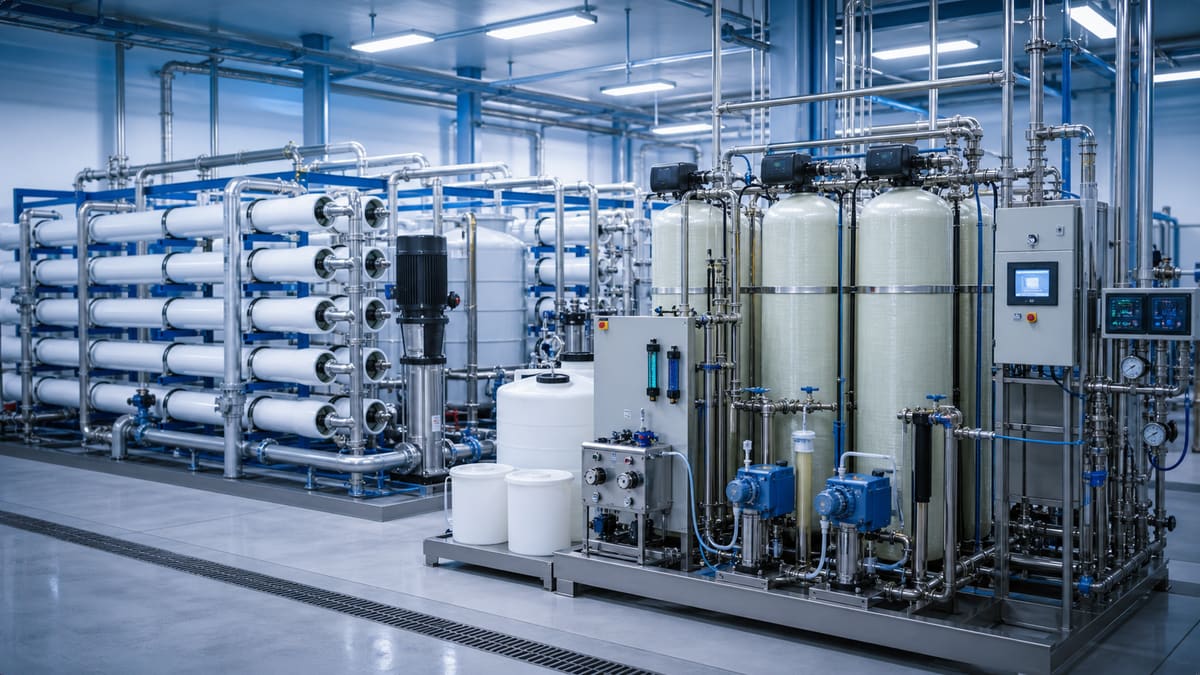
View the process illustration
1. Process context & when this scenario is the right entry point
Boron and silica are critical contaminants in industrial water treatment, particularly for boiler feedwater and ultrapure water (UPW) production. Their presence, even at trace levels, can lead to significant operational issues and product quality degradation.
For boiler feedwater, silica can form deposits and enter steam through both mechanical carryover and volatility-dependent partitioning, affecting turbine deposits and heat transfer. Required limits depend on boiler pressure, cycle chemistry and steam duty. Boron requirements should be based on the specific cycle and contaminants rather than a generic assertion of boron-induced boiler corrosion.
In ultrapure water (UPW) systems, semiconductor processes may require ppb or ppt boron/silica limits defined by the fabrication process and validated analytical methods. Pharmaceutical and power-generation water have their own specifications; they do not share a universal boron/silica target. Weakly ionized boric acid can escape detection by bulk conductivity/resistivity, so resistivity alone does not prove absence.
This scenario is relevant to sources with elevated boron or silica and a defined reuse specification. >10 MW is an example boiler duty, not a threshold determining treatment. Semiconductor, pharmaceutical and power-cycle requirements must each be established, particularly where existing RO does not meet measured constituent limits.
2. Feed characteristics & key risks
The efficacy of boron and silica removal is highly dependent on their speciation, feed water chemistry, and concentration.
Boron: At neutral pH, boron commonly occurs as boric acid H₃BO₃, also written B(OH)₃. At 25°C, a representative pKa is 9.24; increasing pH favors B(OH)₄⁻, not a generic H₂BO₃⁻/HBO₃²⁻ pair. Values such as <50% neutral-pH rejection, pH 9.5-10.5 and 95-99% rejection are illustrative, not universal membrane limits or outcomes. Verify membrane, temperature, salinity and scaling compatibility. Concentrate reuse for irrigation requires crop-, soil- and water-specific boron assessment.
Silica: Dissolved silica often includes H₄SiO₄, while total silica can also include colloidal/polymeric forms. Solubility and precipitation depend on pH, temperature, metals and other constituents. Deposits may be difficult to clean, but are not inevitably irreversible. Langelier Saturation Index (LSI) does not assess silica. 80-90% of an appropriate amorphous-silica solubility estimate is an illustrative design margin, not a guarantee; validate speciation, analytical basis and antiscalant conditions.
Key Risks:
- Silica Scaling: Silica or metal-silicate deposits can reduce flux and increase differential pressure (ΔP). Determine chemistry and approved cleaning compatibility; successful removal is not guaranteed, and replacement may be needed.
- Boron Breakthrough: Actual product-water boron can exceed the relevant reuse or UPW process limit despite acceptable bulk conductivity; verify specific concentration and analytical reporting limits.
- Osmotic Pressure: High total dissolved solids (TDS) in the feed water can lead to high osmotic pressure, requiring higher operating pressures for RO, increasing energy consumption and potentially reducing membrane life.
- Regulatory Drivers: Strict discharge limits for boron in some jurisdictions due to its impact on agriculture.
3. Concentrate / reject routing
A complete balance accounts for boron and silica in RO permeate, concentrate, pretreatment solids, IX regenerant, rinse and cleaning wastes. Neither complete retention nor a single residual route is assumed. Disposition must be defined for every outlet:
-
RO Concentrate:
- Discharge to Sewer/Surface Water: Check the specific permit, receiving system and constituent loads. Additional treatment may be required; dilution does not remove contaminants and is not automatically an authorized compliance route.
- Further Concentration for ZLD: Mechanical vapor recompression (MVR), evaporation or crystallization require species-specific scale control, possibly including magnesium-assisted silica removal. Verify boron partitioning, condensate contamination, mother liquor, wet solids and the actual zero liquid discharge (ZLD) boundary rather than assuming all boron remains soluble or all water is recovered.
- Evaporation Ponds: For sites with available land and appropriate climate, this can be a low-energy option. However, silica polymerization and boron accumulation in the pond sludge/water must be managed.
- Deep Well Injection: A viable option in specific geological formations, subject to stringent permitting and seismic activity assessment.
- Recycle/Reuse: In some cases, RO concentrate may be suitable for less critical applications such as cooling tower makeup (with careful monitoring of silica and boron buildup), dust suppression, or landscape irrigation, provided boron levels are not phytotoxic.
-
Ion Exchange (IX) Regenerant Waste: Spent regenerant from selective boron or silica removal IX resins will contain high concentrations of these contaminants along with regeneration chemicals (e.g., caustic for silica, acid/caustic for boron). This stream typically requires neutralization and may need further treatment (e.g., precipitation, MVR) before discharge or specific disposal protocols.
4. Reference process train options
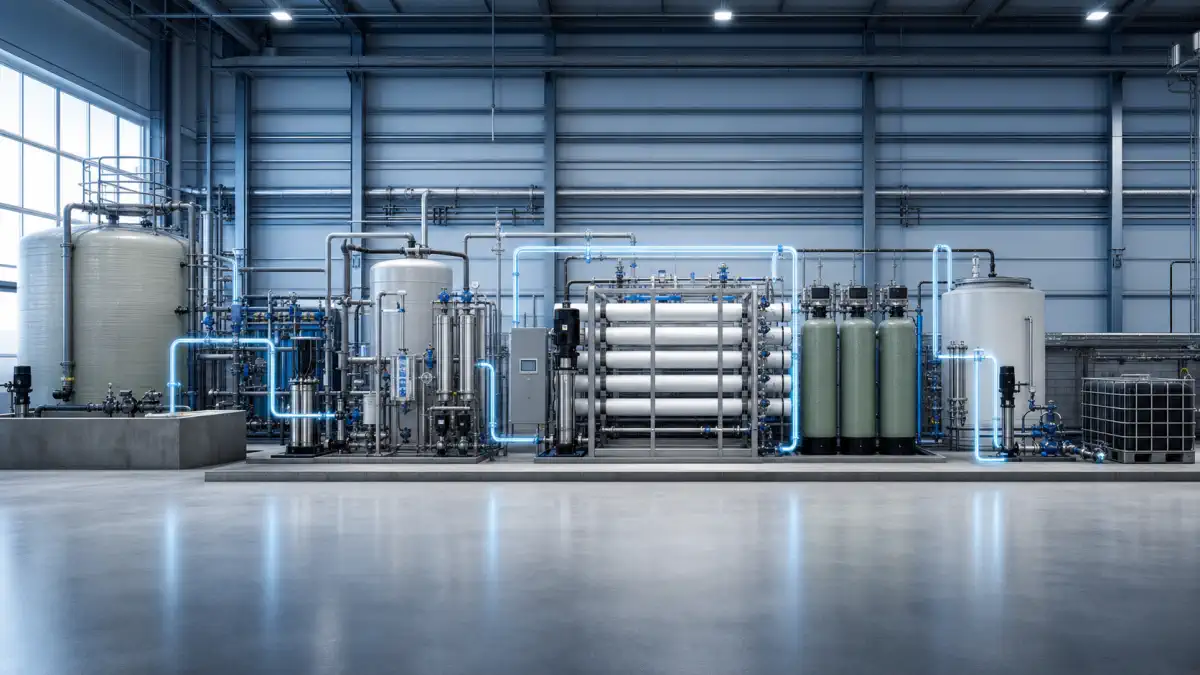
Effective boron and silica removal often requires a multi-barrier approach:
-
Pretreatment:
- Particulate Removal: Multimedia filters (MMF) followed by ultrafiltration (UF) or microfiltration (MF) are essential to reduce Silt Density Index (SDI) and prevent particulate fouling of RO membranes.
- Silica Management: Evaluate actual dissolved/colloidal silica and metal-silicate risk. Acid lowers carbonate scaling tendency but does not generally increase silica solubility. A suitable high-pH route, specific antiscalant or precipitation may be considered within membrane and competing-scale limits; precipitation creates sludge.
- Initial pH Adjustment: For feedwaters with highly variable pH or to optimize conditions for downstream RO.
-
Primary Reverse Osmosis (RO):
- Removes bulk TDS according to actual membrane performance. Neutral-pH boron 20-50% and silica 95-99% rejection are illustrative, not universal or necessarily equal to TDS rejection. Measure constituent passage, total/reactive silica and recovery under representative conditions.
-
Inter-pass pH Adjustment:
- A selected second-pass RO route may raise first-pass permeate pH with NaOH, for example 9.5-10.5, to favor borate. Confirm membrane pH limits and carbonate/metal precipitation. CO₂ degassing and alkaline dosing require a defined sequence; increasing pH converts CO₂ to less readily stripped bicarbonate/carbonate rather than making degassing automatically effective.
-
Second-Pass Reverse Osmosis (RO):
- Elevated-pH second-pass RO can improve boron rejection, but >95-99% is an illustrative result, not a guarantee. Verify target boron, conductivity, silica and concentrate routing at actual temperature, pressure and recovery, as described in Section 3.
-
Selective Ion Exchange (IX):
- Boron-Selective Resins: N-methylglucamine functional groups can capture boric acid as well as borate without universally requiring high pH. <50 ppb is an example polishing target, not guaranteed capacity or effluent. Validate competition, leakage, regeneration and analytical blanks; an industrial resin designation does not itself qualify the product for UPW use.
- Silica-Selective Resins: Strong base anion (SBA) resins can remove silica, particularly in polished water applications (e.g., after RO). They are regenerated with concentrated caustic, producing a high-pH, high-silica waste stream.
-
Electrodeionization (EDI) / Continuous Electrodeionization (CEDI):
- Compatible RO permeate may receive additional EDI/CEDI polishing, subject to module-specific feed limits and verified boron/silica performance. EDI avoids routine acid/caustic resin regeneration, but pretreatment, cleaning chemicals and electrode-rinse management may still be required; it does not alone establish UPW compliance.
-
Thermal Treatment (Evaporation/Crystallization):
- As a ZLD component, for highly concentrated RO rejects or IX regenerants. These systems can achieve very high water recovery, but require robust designs to handle severe scaling (especially from silica) and the highly corrosive nature of concentrated brines.
5. Operating parameters
Precise control and monitoring of key operating parameters are paramount for successful boron and silica removal:
- SDI₁₅ (Silt Density Index): Below 3.0 or <1.0 are example targets to validate for the selected RO duty and timed test. SDI assesses particulate/colloidal potential and does not establish control of dissolved boron/silica or all fouling mechanisms.
- LSI / Scaling Posture (Silica Saturation): Use LSI only for applicable carbonate conditions. A silica margin of 80-90% is illustrative and must be based on actual silica form, temperature, metal chemistry and antiscalant validation. Recovery and concentration polarization affect local risk; no single margin assures freedom from silica or metal-silicate deposition.
- Flux (LMH): 10 to 25 LMH is an illustrative industrial RO design range, not a guarantee of acceptable scaling or cleaning intervals. Select flux for actual membrane, water, temperature and recovery, then track normalized performance.
- DP (Differential Pressure): Element, vessel and stage ΔP are different quantities. A normalized >10-15% increase may prompt manufacturer-specific investigation or CIP. Flow changes, obstruction and mechanical conditions can also affect ΔP; a rapid rise does not uniquely prove silica or biological fouling. Respect actual equipment limits.
6. Digital twin & instrumentation
Instrumentation & Sensors:
- Flow Meters: Electromagnetic or ultrasonic flow meters on feed, permeate, concentrate, chemical dosing lines, and IX regenerant lines.
- Pressure Transducers: At critical points including RO array inlet, inter-stage, and outlet, UF permeate, IX bed inlet/outlet.
- Conductivity Meters: On raw water, UF permeate, RO feed, RO permeate (primary and second-pass), RO concentrate, and EDI permeate.
- pH Sensors: On raw water, chemical dosing points (e.g., acid/caustic), RO feed, inter-pass RO, and IX regenerant waste.
- ORP Sensors: Track oxidation conditions where relevant. ORP does not selectively measure disinfectant concentration, boron or silica, and cannot replace membrane-specific oxidant checks.
- Temperature Sensors: On raw water, RO feed, and within RO/IX trains.
- SDI Analyzers: Automated instruments perform periodic timed RO-feed tests; they do not provide instantaneous continuous SDI or establish dissolved-contaminant removal.
- Silica Analyzers: Colorimetric methods commonly measure reactive silica; total/colloidal silica may need additional sample preparation and analysis. Verify reporting limits and chemistry before deriving saturation.
- Boron Analyzers: Select a method and reporting limit appropriate to actual feed and product specifications. Online spectrophotometry is not automatically adequate for trace UPW targets; validate blanks, recovery and suitable laboratory analysis where needed.
7. Pilot-Scale vs Industrial RO
Pilot-scale RO can test representative water, pH strategies, membrane selectivity, silica control and IX leakage/regeneration. Confirm actual equipment and compatible test conditions rather than assuming a ready-made supply capability. Industrial RO may integrate defined membrane passes, IX or EDI, pH control and concentrate treatment for production. Verify pressure/material limits, SCADA scope, analytical performance and any ZLD interface; continuous reliability and UPW quality require separate acceptance evidence.
8. Common engineering mistakes & pilot KPIs
Common Engineering Mistakes:
- Underestimating Silica Risk: Failing to adequately characterize feed silica (total vs. reactive, colloidal) and design for its polymerization kinetics, leading to rapid, irreversible membrane scaling.
- Incorrect pH Strategy for Boron: Assuming a fixed RO rejection or applying elevated pH without membrane and scaling checks can fail. Selective N-methylglucamine resin does not universally need high-pH feed; choose the pH strategy for the actual route.
- Inadequate Pretreatment: High SDI leads to general membrane fouling, masking the specific challenges of boron/silica removal and increasing cleaning frequency.
- Ignoring Concentrate Disposition: Designing a highly effective treatment train for product water without a viable, permitted, and cost-effective plan for the concentrated waste stream. This is a common pitfall in ZLD planning.
- Poor Chemical Selection: Using generic antiscalants that are ineffective against silica polymerization or failing to select appropriate IX resins for selective removal.
Pilot KPIs (Key Performance Indicators):
- Boron/Silica Rejection Rates: Measured across each RO pass and IX bed at varying pH and recovery rates.
- Membrane Flux Stability: Monitoring flux decay over time without cleaning, indicating fouling propensity.
- ΔP Stability: Tracking pressure drops across RO stages and IX beds to determine cleaning frequencies or regeneration cycles.
- Antiscalant Efficacy: Evaluating different antiscalant types and dosages for their ability to maintain silica solubility and prevent polymerization.
- IX Resin Capacity and Regeneration Efficiency: For selective IX, determining the resin's operational capacity, regenerant consumption, and target breakthrough.
- Operational Cost per Unit Volume: Assessing energy consumption, chemical usage, and waste disposal costs.
9. FAQ
-
Q: Why is boron so difficult to remove by RO at neutral pH? A: Neutral boric acid H₃BO₃ may partition and diffuse through the dense RO selective layer more readily than many charged ions; RO is not a conventional sieve with open membrane pores. Raising pH favors B(OH)₄⁻ and may improve rejection, subject to membrane and actual water conditions.
-
Q: How can I effectively prevent silica scaling on my RO membranes? A: Characterize dissolved, reactive and colloidal silica and competing metals. A target such as 80-90% of calculated solubility is only a starting design margin. Validate recovery, concentration polarization, specific antiscalant, pretreatment and actual approved cleaning limits with representative water.
-
Q: Can a single RO pass remove both boron and silica to UPW levels? A: Establish the application-specific boron/silica target and analytical method first. A single pass may or may not meet it; verify measured constituent passage instead of assuming a universal UPW level. Additional permeate passes, selective IX or compatible EDI may be required, with separate product-purity and residual checks.
-
Q: What are the main challenges when dealing with boron/silica in ZLD systems? A: Concentration can increase silica or metal-silicate deposition and alter boron partitioning among liquids and solids. Evaluate actual chemistry, thermal surfaces, condensate, mother liquor, wet residues and permits. Neither rapid silica deposition nor boron-caused corrosivity is inevitable for every ZLD stream.
Engineering references
Related equipment & product lines
These categories typically support the approach above—open any line to compare brands and models.
- RO MembranesReverse osmosis membrane elements for municipal and industrial desalination.View category →
- Ion Exchange ResinsCation/anion and mixed bed resin solutions for demineralization and polishing.View category →
- Electrodeionization (EDI)EDI modules and systems for ultrapure water production.View category →
For a closer review, use the engineering inquiry form to share feed, capacity, target, and project stage. Submission does not constitute a completed design or performance commitment.