Solutions · Application Scenarios
Acid and alkali recovery: diffusion dialysis and bipolar membrane loops
Electromembrane and diffusion-based recovery with measured reagent quality and explicit impurity purge streams. Assess actual chemical reuse, energy and the disposal balance.
Use when
Spent acid/alkali becomes an opex and discharge liability.
Process options
Electromembrane and diffusion-based recovery with explicit bleed and impurity purge streams.
Assessment output
Verify recovered reagent quality, net chemical use and the purge/disposal balance.
Inputs and conditions for an assessment
Collect feed variability, capacity, target quality, operating hours, discharge or reuse boundaries and installed equipment data. Compare examples on matched conditions and meter boundaries; assess a project using actual water data, equipment documentation and any necessary tests.
View the process illustration
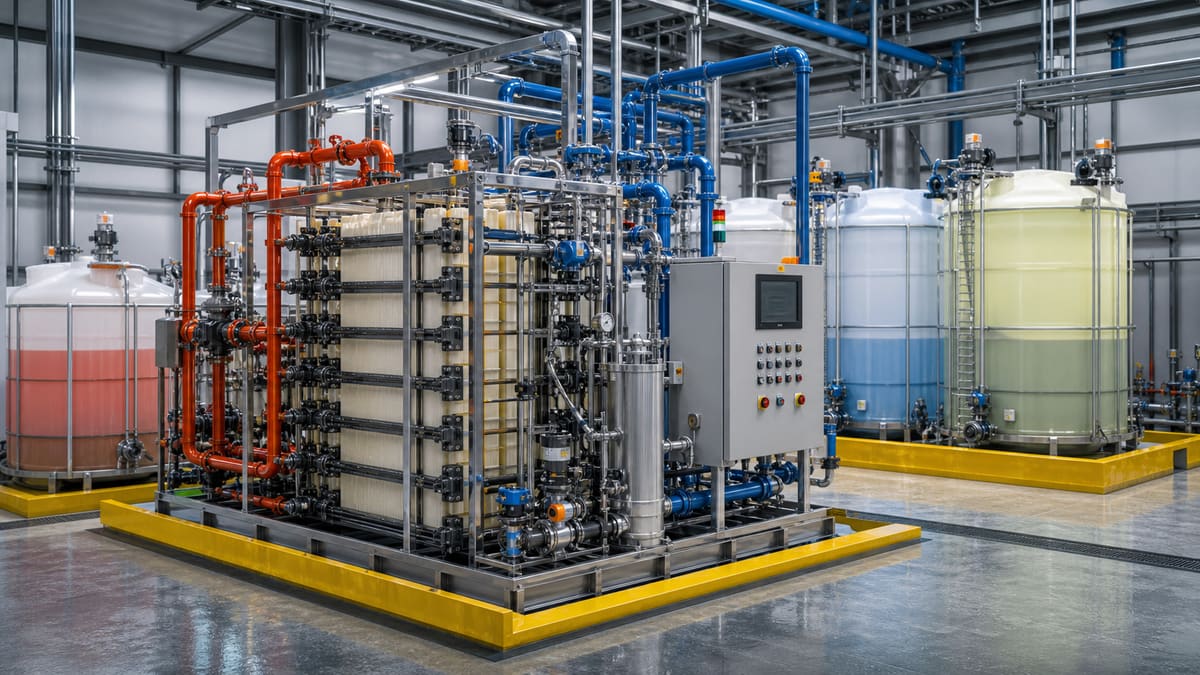
Process context & when this scenario is the right entry point
Industrial processes across numerous sectors—including metal finishing, electroplating, semiconductor manufacturing, chemical production, and textile dyeing—generate significant volumes of acidic and alkaline waste streams. These streams often contain valuable dissolved salts, heavy metals, or organic contaminants, making direct discharge environmentally problematic and economically undesirable due to the loss of expensive reagents and high disposal costs.
This scenario evaluates Diffusion Dialysis (DD) and Bipolar Membrane Electrodialysis (BPMED) for acid or alkali recovery. DD transfers selected species down chemical-potential gradients; it does not automatically reconcentrate the recovered reagent. BPMED converts suitable salts into acid and base streams, with purity and achievable concentration depending on the membrane stack and feed. Consider these methods when:
- Minimizing chemical reagent consumption is a strategic goal.
- Regulatory drivers mandate reduced hazardous waste generation and resource recovery.
- Conventional neutralization leads to high sludge volumes and ongoing disposal costs.
- High-purity acid or base streams are required for reuse.
- Achieving Zero Liquid Discharge (ZLD) or near-ZLD targets for process effluents.
Suitable membranes can separate strong acids such as HCl and H₂SO₄ from some metal-bearing solutions, or convert selected salts into acids and bases. Validate reagent purity, concentration, leakage, pumping/electrical energy and residual treatment before claiming a closed loop or environmental benefit.
Feed characteristics & key risks
Feed streams for acid and alkali recovery are highly diverse and present significant challenges. Typical characteristics include:
- Extreme pH: Often pH < 1 or pH > 13.
- High ionic strength: High concentrations of target acids/bases, metal salts, and other dissolved solids (TDS).
- Contaminants: Heavy metals (Cr, Ni, Cu, Zn, Fe), organic acids/bases, suspended solids, oils, and complexing agents.
- Temperature: Often elevated, impacting membrane stability and transport rates.
Key risks to be managed for successful operation include:
- Membrane degradation: Exposure to extreme pH, high temperatures, and aggressive chemical species can compromise membrane integrity and lifespan.
- Fouling: Particulates, colloids, and certain organic compounds can foul membrane surfaces, leading to reduced flux and increased differential pressure.
- Scaling: Precipitation of metal hydroxides (especially in pH transition zones within bipolar membranes), calcium sulfate, or silica can occur, particularly when concentrating reject streams or under specific operating conditions. The Langelier Saturation Index (LSI) is not directly applicable in highly acidic/alkaline feeds, but the solubility limits of specific metal salts and precipitates at various pH conditions must be rigorously assessed.
- Osmotic limits: While DD and BPMED are not pressure-driven like RO, downstream concentration steps (e.g., RO for salt reject) will be limited by osmotic pressure.
- Co-ion permeation: DD may transfer unwanted ions or metal complexes into recovered reagent; membrane charge does not guarantee complete metal exclusion. In BPMED, proton/hydroxide leakage and unwanted-ion transport can reduce current efficiency and product purity.
Concentrate / reject routing
A complete balance distinguishes feed, recovered reagent, depleted solution, impurity-rich residue, cleaning waste and electrode circuits. DD diffusate and BPMED acid/base compartments are not simply conventional RO permeate; impurities can enter multiple outlets.
In Diffusion Dialysis (DD), selected acid or base species diffuse into a receiving stream using an appropriate acid- or alkali-compatible membrane. Many metal salts may remain in the original stream, but leakage and complex transport must be measured. The DD reject or retentate, such as metal-rich spent pickling liquor, still requires treatment. Options include:
- Metal precipitation: Validate pH, speciation and ligands before hydroxide precipitation, clarification and sludge dewatering. Further RO recovery or discharge of supernatant requires appropriate feed compatibility and permit or reuse checks.
- Evaporation/Crystallization: Recover condensate and separate salts where justified. Check volatile compounds, droplet carryover, mother liquor and wet solids; neither pure distillate nor saleable salts are automatic.
- Specific ion exchange: For selective removal of certain problematic ions before discharge or further processing.
In Bipolar Membrane Electrodialysis (BPMED), suitable salt ions and water dissociation at bipolar junctions form acid and base in configured compartments. The diluate still contains residual salts and impurities and is not necessarily the sole or primary waste stream. Product bleed, washing and electrode circuits also matter. Options depend on the complete recovery and ZLD balance:
- Conventional RO/NF: Evaluate residual-water chemistry, pressure and selectivity before further recovery. NF does not necessarily concentrate monovalent salts like RO. Reuse or discharge of permeate needs quality and permit checks, and any concentrate needs an appropriate thermal or other disposal route.
- Recycle to upstream processes: If the diluate's purity and concentration are suitable, it might be recycled to the initial process where the salt was formed, reducing makeup water demand.
- Discharge: If the diluate meets discharge limits, it can be sent to a wastewater treatment plant.
Any periodic electrode rinse solutions and cleaning wastes must be collected and classified for treatment or disposal. Whole-stack electrode reactions may generate gases and require appropriate separation and ventilation even though bipolar-junction water dissociation differs from electrode electrolysis. Account for all outlets in the mass and energy balance.
Reference process train options
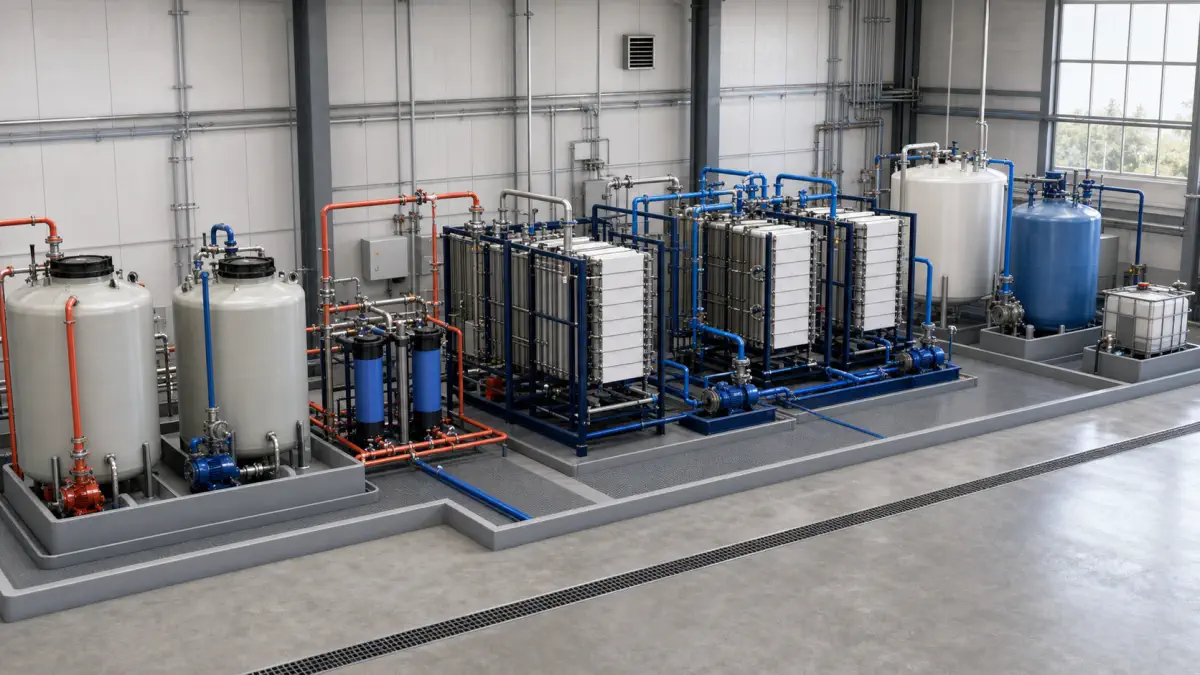
The selection and configuration of the process train depend heavily on the specific feed chemistry, desired product purity, and recovery targets.
Operating parameters
Effective operation and maintenance of DD and BPMED systems require diligent monitoring of key parameters:
- SDI₁₅: SDI₁₅ < 5, preferably <3, is an illustrative screening target, not a universal DD/BPMED specification; the timed test may not suit aggressive feed chemistry. Check stack-specific particle and filtration requirements. MF/UF may be appropriate but is not mandatory for every feed or chemically compatible by default.
- Scaling Indices: As noted, LSI is less relevant. Instead, comprehensive solubility modeling based on feed chemistry (e.g., concentrations of Ca, Mg, Ba, Sr, Si, heavy metals, sulfates, carbonates) at various pH and temperature conditions is used. Preventative measures include pH control, chemical inhibitors, or feed softening. For BPMED, managing the pH in the dilute and concentrate channels is critical to avoid metal hydroxide precipitation, which manifests as increased electrical resistance and ΔP.
- Flux / Recovery Rate:
- DD: Acid mass flux, for example 100-300 g/m²·h for HCl, is distinct from percentage recovery. This illustrative range depends on membrane, solution composition, receiving flow, temperature and gradients; validate both recovery and product concentration.
- BPMED: Current density such as 50-150 mA/cm² and current efficiency of 70-90% are illustrative, not guaranteed operating windows. Specify current limits and compare energy (kWh/kg product) at the required acid/base concentration and purity.
- Differential Pressure (ΔP): Monitor each stack inlet/outlet pressure drop and pressure differences between compartments. 0.5-1.0 bar is an example, not a universal BPMED allowable drop or cleaning trigger. Rising ΔP can reflect flow changes, obstruction, fouling or scaling; follow actual mechanical limits, baseline normalization and approved cleaning procedures.
Digital twin & instrumentation
Instrumentation & Sensors:
- Flow meters: Electromagnetic or ultrasonic flow meters on all feed, product, and reject lines to track volumes and mass balance.
- Pressure transducers: At the inlet and outlet of each membrane stack, as well as inter-stage, to monitor ΔP and identify fouling or flow distribution issues.
- Conductivity sensors: Conductivity supports process trending but cannot establish acid/base concentration or metal purity alone. Use calibrated composition-dependent relationships and appropriate titration or chemical analysis.
- pH probes: In feed, product, and reject streams to verify process chemistry and control pH adjustments.
- Temperature sensors: Throughout the system, especially before membrane stacks, to ensure optimal operating conditions and membrane protection.
- Voltage and Amperage transducers: For BPMED systems, to monitor power consumption and control current density.
- Level sensors: In all tanks (feed, product, cleaning solutions) for inventory management and automated operation.
Pilot-scale versus industrial recovery systems
Choose pilot or industrial DD/BPMED equipment for the actual membrane chemistry, stack configuration, electrical and hydraulic limits, reagent purity and residual routing. A generic RO system is not a substitute for an acid-recovery or bipolar-membrane stack. Representative pilot testing can establish leakage, concentration, energy and cleaning before scale-up. For continuous production, verify pretreatment, redundancy, materials, SCADA and Distributed Control Systems (DCS) interfaces and safety interlocks in the actual project scope; automation, ZLD and long-term reliability are not automatic features.
FAQ
Q1: What are the primary advantages of Diffusion Dialysis (DD) compared to other acid recovery methods like evaporation? A1: DD uses diffusion rather than bulk evaporation and may require less phase-change heat. It still uses pumps and may need reagent concentration, polishing and residue treatment. Compare actual recovery, reagent concentration, metal leakage, footprint and whole-process cost rather than assuming high recovery or universally lower CAPEX/OPEX.
Q2: When is Bipolar Membrane Electrodialysis (BPMED) the preferred technology over Diffusion Dialysis? A2: BPMED can convert a suitable salt, for example NaCl, into HCl and NaOH using electrical energy. Select it when feed compatibility, product specifications and the full waste balance support that conversion. Insufficient DD selectivity does not itself guarantee BPMED purity. Reagent-free pH adjustment at the bipolar junction does not mean the whole process needs no pretreatment or cleaning chemicals.
Q3: Can these technologies handle highly mixed waste streams containing both acids, bases, and various salts? A3: While DD and BPMED are powerful, highly mixed streams increase complexity. Effective pre-separation (e.g., selective precipitation, ion exchange, or initial rough concentration) is often required before applying these membrane technologies to ensure optimal performance and membrane lifespan.
Q4: What is the typical lifespan for DD and BPMED membranes? A4: Lifetime depends on actual feed, pH, temperature, oxidants, electrical/hydraulic stress and cleaning. Planning assumptions such as 3-5 years for DD or 2-4 years for BPMED are not generic measured lifetimes or guarantees. Obtain membrane-specific evidence and track performance and replacement criteria for the actual duty.
Engineering references
Related equipment & product lines
These categories typically support the approach above—open any line to compare brands and models.
For a closer review, use the engineering inquiry form to share feed, capacity, target, and project stage. Submission does not constitute a completed design or performance commitment.