Solutions · Sustainability & ESG
Zero Liquid Discharge (ZLD) Roadmaps: modular integration for full water reuse
Pretreatment, membrane staging, and thermal block sequencing—how to phase capex without painting yourself into a chemistry corner.
Use this guide within its scope
This page supports technical research and option comparison and is marked 2026. Illustrative values are not a quotation, completed process design, certification conclusion, or performance guarantee. Check current regulations, feed data, tests, and OEM records.
Problem
ZLD fails when organics, silica, or scaling chemistry are underestimated.
Technology
Phased modules with agreed boundary conditions between membrane and thermal vendors.
Results
Predictable concentrate and solids pathways for permits and ESG reporting.
Engineering decision card
Use when
ZLD fails when organics, silica, or scaling chemistry are underestimated.
Evaluate first
Phased modules with agreed boundary conditions between membrane and thermal vendors.
Inputs still required
Feed source and variability, capacity, target quality, operating hours, discharge or reuse boundary, available space, and utilities.
Comparison output
Predictable concentrate and solids pathways for permits and ESG reporting. The final decision still needs feed data, mass balance, and any necessary testing.
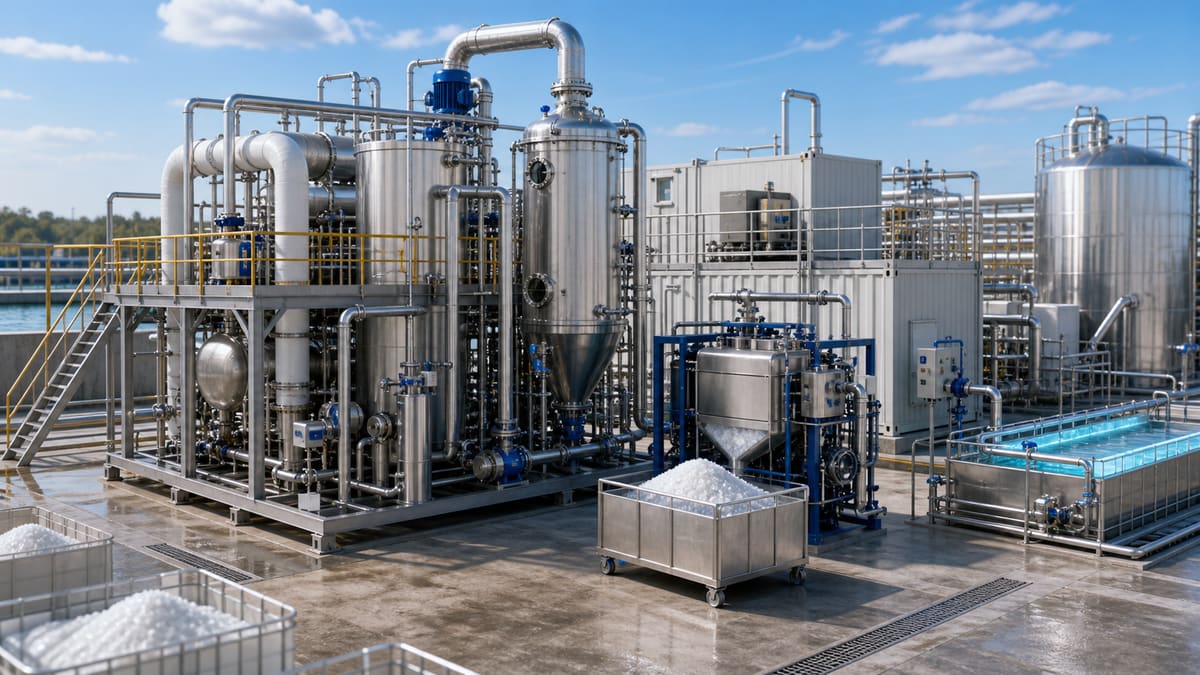
Zero Liquid Discharge (ZLD) Roadmaps: Modular Integration for Full Water Reuse
As industries globally navigate the accelerating currents of climate change and water scarcity, the imperative for sustainable water management intensifies. For businesses operating within or supplying to the UK and EU, stringent environmental regulations, escalating water costs, and growing ESG (Environmental, Social, and Governance) expectations from buyers and investors are transforming water stewardship from a compliance issue into a strategic differentiator. Zero Liquid Discharge (ZLD) is emerging as a critical solution, enabling industries to eliminate wastewater discharge entirely, reduce freshwater intake, and mitigate significant water-related risks. While ZLD systems are often perceived as complex and energy-intensive, a modular integration approach offers a pragmatic roadmap to achieving full water reuse, optimising both operational efficiency and carbon footprint.
The connection between water and carbon is undeniable. Pumping, treating, heating, and cooling water are energy-intensive processes. By reducing freshwater abstraction and eliminating wastewater discharge, ZLD directly lowers the embodied energy and associated carbon emissions of a facility's water cycle. Moreover, for industries seeking to demonstrate robust water stewardship—a key component of carbon disclosures and ESG reporting—ZLD provides quantifiable metrics of water circularity and risk mitigation, essential for satisfying demanding export markets.
The Modular Advantage in ZLD
- Phased Implementation: Start with critical sections, prove value, and expand.
- Optimised Performance: Custom configurations for specific wastewater profiles, maximising recovery and minimising energy.
- Reduced Footprint: Compact units designed for integration into existing plant layouts.
- Faster Deployment: Pre-assembled modules reduce on-site construction time and risk.
- Future-Proofing: Adaptability to changes in water quality regulations, production volumes, or technological advancements.
This modularity is not just about physical components; it's a strategic framework for achieving full water reuse with greater control, predictability, and a clearer path to return on investment.
Worked energy / carbon sketch
To illustrate the potential for energy optimisation through a modular ZLD approach, consider an industrial facility tasked with achieving ZLD for a challenging process wastewater stream.
Assumptions (Illustrative):
- Flow rate (Q): 500 m³/day (approximately 21 m³/h, assuming 24/7 operation)
- Operating hours (H): 8,000 hours/year
- Energy consumption of a traditional, less optimised ZLD (E_trad): 20 kWh/m³ of treated wastewater
- Energy consumption of this approach's modular ZLD (E_mod): 12 kWh/m³ of treated wastewater (due to superior pre-concentration and heat recovery)
- Energy saving (ΔkWh/m³): 8 kWh/m³
- Grid emission factor: 0.25 kg CO₂e/kWh (representing a typical moderate-emission European grid mix in 2026)
Calculation:
- Annual Volumetric Flow (Q_annual): Q_annual = 21 m³/h * 8,000 h/year = 168,000 m³/year
- Annual Energy Saving (ΔE_annual): ΔE_annual = Q_annual * ΔkWh/m³ = 168,000 m³/year * 8 kWh/m³ = 1,344,000 kWh/year
- Annual Carbon Saving (ΔCO₂e_annual): ΔCO₂e_annual = ΔE_annual * Grid Emission Factor = 1,344,000 kWh/year * 0.25 kg CO₂e/kWh = 336,000 kg CO₂e/year ΔCO₂e_annual = 336 tonnes CO₂e/year
This back-of-envelope calculation illustrates how a modular, optimised ZLD system can deliver substantial annual energy and carbon emission reductions compared to conventional, less integrated ZLD approaches for the same wastewater volume. These are illustrative figures; actual savings will vary based on wastewater characteristics, specific technology choices, and local energy grids.
Traditional vs engineering evaluation path
| Topic | Monolithic ZLD | Modular roadmap (engineering evaluation path) |
|---|---|---|
| Capex / time | Big-bang EPC; long FAT/SAT loops. | Phased skids; capacity follows cash and permit milestones. |
| Chemistry risk | One vendor owns the whole story—or nobody does. | Explicit interfaces between pretreat, membrane, and thermal blocks. |
| Operability | Hard to tune when feed shifts. | Add UF/RO/evap capacity without redesigning the entire fence line. |
FAQ
Q: Is ZLD always more energy-intensive than traditional wastewater treatment? A: While ZLD systems typically have a higher energy demand per cubic meter than conventional discharge-based treatment, a modular approach allows for significant optimisation. By selecting the right combination of membranes, evaporators, and crystallisers, and integrating heat recovery, the overall energy intensity can be substantially reduced compared to a monolithic ZLD system. The net environmental benefit, considering reduced freshwater abstraction and eliminated discharge impacts, often far outweighs the increased operational energy.
Q: How does modularity help with specific or complex wastewater streams? A: Modularity allows for a "train" of tailored technologies. For example, a complex stream might start with advanced oxidation (AOP) for recalcitrant organics, followed by ultrafiltration, then a specific type of reverse osmosis for salt removal, and finally a specialised MVR evaporator for the brine. This customisation ensures optimal performance and recovery for specific contaminants without over-engineering the entire system.
Q: What regulatory advantages does ZLD offer, especially for UK/EU operations? A: ZLD proactively addresses increasing regulatory pressure around wastewater discharge limits, pollutant loads, and water abstraction. By eliminating discharge, facilities can sidestep complex permitting processes, avoid potential fines, and future-proof operations against tightening environmental standards. For businesses supplying into the UK/EU, demonstrating ZLD directly contributes to meeting supply-chain sustainability criteria and carbon reduction targets.
Carbon savings calculator (illustrative)
Estimate annual electricity savings and avoided CO₂e when specific energy improves (e.g. after ERD, VFD tuning, or train optimization). Replace defaults with your meter data and your grid emission factor from your utility or ESG methodology.
ΔkWh/year ≈ Q(m³/h) × hours/year × (kWh/m³before − kWh/m³after) · tCO₂e ≈ ΔkWh × factor / 1000
Δ specific energy: 1.00 kWh/m³
Estimated electricity savings: 800,000 kWh/year
Indicative avoided emissions: 336 tCO₂e/year
Related equipment & product lines
These categories typically support the approach above—open any line to compare brands and models.
- RO MembranesReverse osmosis membrane elements for municipal and industrial desalination.View category →
- Pumps & PumpingHigh-pressure and process pump solutions for water treatment skids and plants.View category →
- ChemicalsAntiscalants, cleaners, and process chemicals for water treatment operations.View category →
For a closer review, use the engineering inquiry form to share feed, capacity, target, and project stage. Submission does not constitute a completed design or performance commitment.