Solutions · Sustainability & ESG
Rainwater Harvesting & Treatment: sponge-factory distributed supply
Catchment hygiene, first-flush diversion, and treatment to match end use—reducing storm peaks and municipal dependence.
Use this guide within its scope
This page supports technical research and option comparison and is marked 2026. Illustrative values are not a quotation, completed process design, certification conclusion, or performance guarantee. Check current regulations, feed data, tests, and OEM records.
Problem
Hardscape sends peaks to the sewer while plants buy potable for non-potable uses.
Technology
Storage, screening, UF/UV where needed, and cross-connection controls.
Results
Lower municipal draw and storm discharge fees where tariffs reward it.
Engineering decision card
Use when
Hardscape sends peaks to the sewer while plants buy potable for non-potable uses.
Evaluate first
Storage, screening, UF/UV where needed, and cross-connection controls.
Inputs still required
Feed source and variability, capacity, target quality, operating hours, discharge or reuse boundary, available space, and utilities.
Comparison output
Lower municipal draw and storm discharge fees where tariffs reward it. The final decision still needs feed data, mass balance, and any necessary testing.
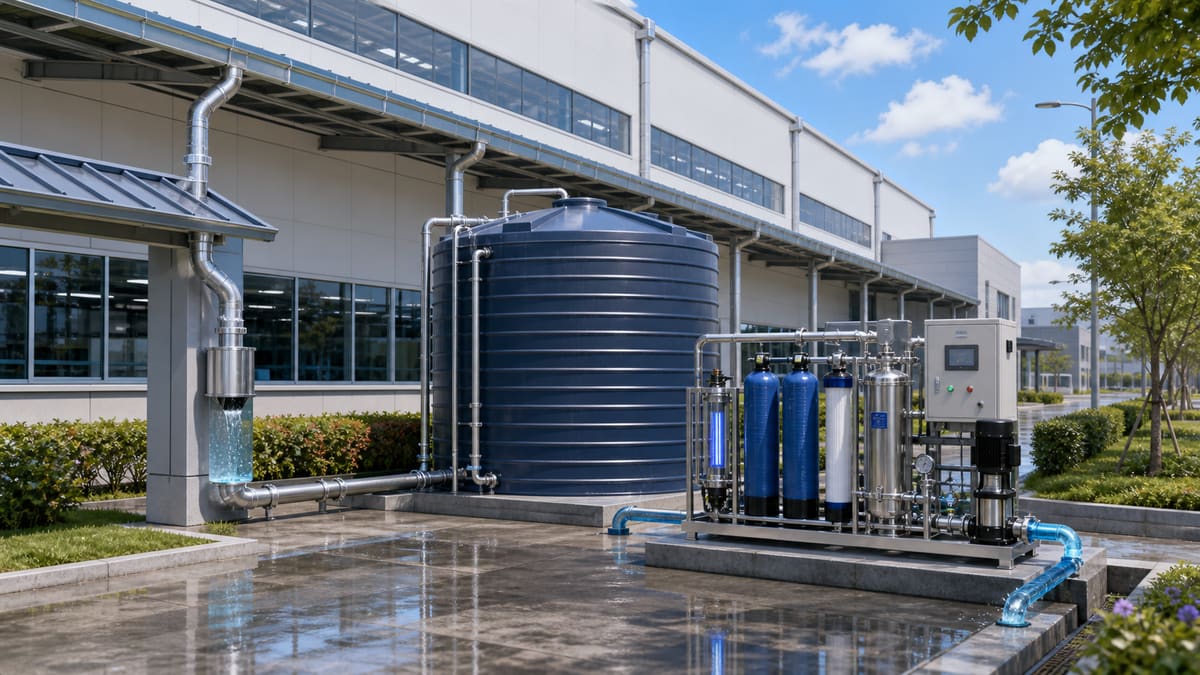
Rainwater Harvesting & Treatment: sponge-factory distributed supply
In an era defined by intensifying climate change impacts, increasing regulatory scrutiny, and acute resource scarcity, industrial operations face unprecedented pressure to manage their environmental footprint. For industries supplying into stringent markets like the UK and EU, demonstrating robust water stewardship is no longer optional—it's a critical ESG gate. Every cubic meter of water sourced, treated, and discharged has an associated carbon footprint, impacting Scope 1, 2, and increasingly, Scope 3 emissions. Addressing water risk proactively, rather than reactively, is paramount for operational continuity and market access.
Rainwater harvesting and intelligent treatment systems offer a compelling solution, transforming industrial sites into "sponge factories." This distributed approach to water resource management enhances resilience by reducing reliance on stressed municipal or groundwater supplies, mitigates flood risk, and provides a sustainable, often lower-carbon, alternative water source directly at the point of use. By integrating advanced treatment technologies, this captured water can be purified to meet specific industrial process requirements, from cooling towers to non-potable utility water, reducing both operational costs and environmental impact.
Enhancing Operational Resilience and Reducing Risk
The global water crisis manifests as both scarcity and extreme weather events. Industries dependent on external water sources face supply disruptions, increasing costs, and reputational damage. A distributed rainwater harvesting system acts as a buffer, ensuring a stable, independent water supply even during periods of drought or infrastructure strain. Furthermore, by managing stormwater runoff on-site, companies can reduce pressure on municipal drainage systems, mitigate local flood risks, and often avoid or reduce storm drain discharge fees. This dual benefit of enhanced water supply and flood mitigation directly contributes to a company's overall operational resilience and reduces its exposure to physical climate risks.
Worked energy / carbon sketch
Consider an industrial facility in the UK currently purchasing 50,000 m³/year of municipal water, which is supplied from a distant reservoir requiring significant pumping and centralized treatment. Implementing a rainwater harvesting and treatment system to supply 80% of this demand (40,000 m³/year) involves on-site collection, primary filtration, and UV disinfection.
Assumptions:
- Energy for municipal water supply (pumping, treatment, distribution) = 0.8 kWh/m³ (illustrative, varies widely by region).
- Energy for on-site rainwater treatment (pumping, filtration, UV) = 0.2 kWh/m³ (illustrative).
- UK grid emission factor (2026, projected) = 0.15 kg CO₂e/kWh (illustrative, steadily decreasing).
Calculation:
-
Energy saved from avoiding municipal water: 40,000 m³/year × 0.8 kWh/m³ = 32,000 kWh/year
-
Energy consumed by on-site rainwater treatment: 40,000 m³/year × 0.2 kWh/m³ = 8,000 kWh/year
-
Net annual energy savings: 32,000 kWh/year - 8,000 kWh/year = 24,000 kWh/year
-
Annual carbon emissions reduction: 24,000 kWh/year × 0.15 kg CO₂e/kWh = 3,600 kg CO₂e/year This equates to 3.6 tonnes CO₂e/year in emissions reduction.
This illustrative calculation demonstrates the potential for significant energy and carbon footprint reductions by decentralising water supply and treatment, even with the energy demands of on-site processing. Additional benefits include reduced water bills and enhanced water security.
Traditional vs engineering evaluation path
| Topic | Utility-only raw water | Rainwater harvest + fit-for-purpose treat (engineering evaluation path) |
|---|---|---|
| Risk | Tariff, rationing, and basin stress passed through. | On-site buffer; storm peak shaved at the fence line. |
| Energy | Long conveyance + central plant stack. | Shorter loops; UV/UF sized to actual end use. |
| Disclosure | Opacity without sub-metering. | Volume, kWh/m³, and end-use tags for questionnaires. |
Carbon savings calculator (illustrative)
Estimate annual electricity savings and avoided CO₂e when specific energy improves (e.g. after ERD, VFD tuning, or train optimization). Replace defaults with your meter data and your grid emission factor from your utility or ESG methodology.
ΔkWh/year ≈ Q(m³/h) × hours/year × (kWh/m³before − kWh/m³after) · tCO₂e ≈ ΔkWh × factor / 1000
Δ specific energy: 1.00 kWh/m³
Estimated electricity savings: 800,000 kWh/year
Indicative avoided emissions: 336 tCO₂e/year
Related equipment & product lines
These categories typically support the approach above—open any line to compare brands and models.
- Sediment FiltersPre-filtration cartridges and housings for suspended solids removal.View category →
- UF ModulesUltrafiltration modules for suspended solids and colloid removal.View category →
- UV DisinfectionUV systems and modules for pathogen inactivation and final disinfection barriers.View category →
For a closer review, use the engineering inquiry form to share feed, capacity, target, and project stage. Submission does not constitute a completed design or performance commitment.