Solutions · New Technologies & Innovation
Next-Gen Fouling-Resistant Membranes: biomimetic surface engineering and extended CIP intervals
Contact angle, bio-adhesion, and cake-layer physics: how engineered active layers stretch cleaning intervals without promising miracles.
Use this guide within its scope
This page supports technical research and option comparison and is marked 2026. Illustrative values are not a quotation, completed process design, certification conclusion, or performance guarantee. Check current regulations, feed data, tests, and OEM records.
Problem
Aggressive CIP schedules erode rejection, waste chemicals, and inflate Scope 3 hauling narratives.
Technology
Low-adhesion coatings, spacer/channel hydrodynamics, and cross-flow shear matched to foulant class.
Results
Illustrative pilot tables show longer clean intervals when biology and organics are bounded.
Engineering decision card
Use when
Aggressive CIP schedules erode rejection, waste chemicals, and inflate Scope 3 hauling narratives.
Evaluate first
Low-adhesion coatings, spacer/channel hydrodynamics, and cross-flow shear matched to foulant class.
Inputs still required
Feed source and variability, capacity, target quality, operating hours, discharge or reuse boundary, available space, and utilities.
Comparison output
Illustrative pilot tables show longer clean intervals when biology and organics are bounded. The final decision still needs feed data, mass balance, and any necessary testing.
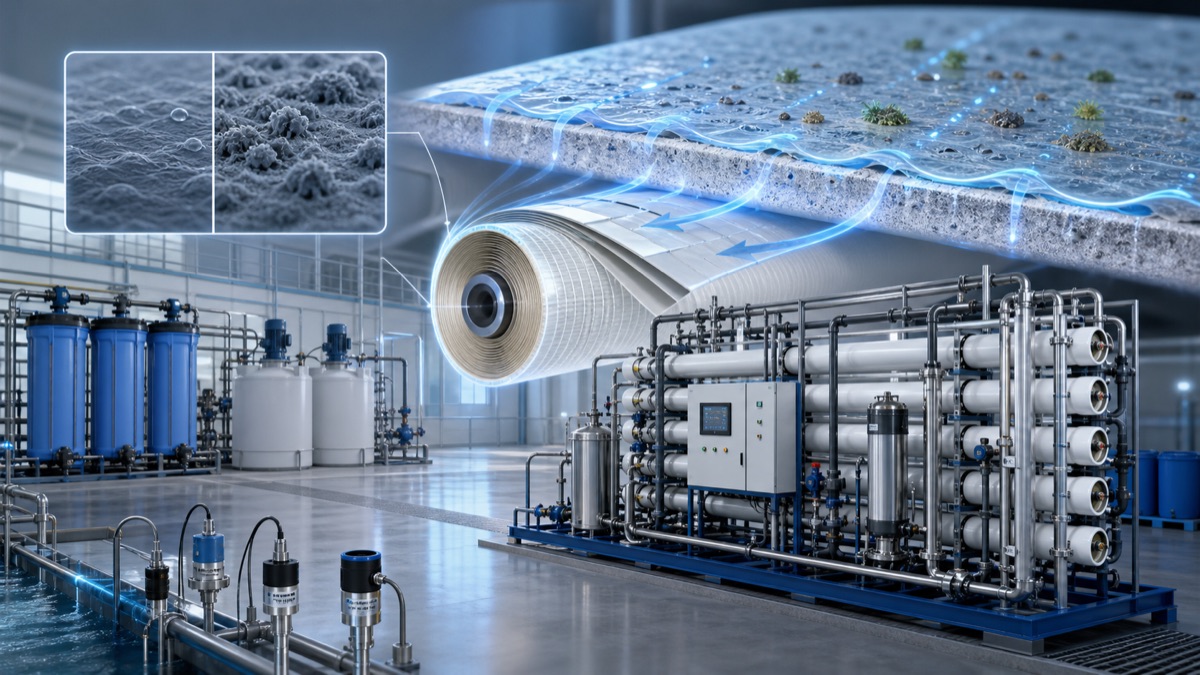
The Physics of Fouling Resistance
Membrane fouling is a complex phenomenon driven by a multitude of physicochemical interactions between the membrane surface and constituents in the feedwater. These interactions lead to the accumulation of foulants (particulates, colloids, organic macromolecules, microorganisms, sparingly soluble salts) on or within the membrane, resulting in flux decline and increased Transmembrane Pressure (TMP). The fundamental relationship governing permeate flux () through a membrane is often expressed as:
where is the applied hydraulic pressure, is the reflection coefficient, is the osmotic pressure difference across the membrane, is the permeate viscosity, is the intrinsic membrane hydraulic resistance, and is the additional resistance due to fouling.
Fouling resistance () is the primary target for improvement. It can be decomposed into several components, including concentration polarization (), cake layer formation (), and pore blocking (). Biomimetic surface engineering directly addresses and by altering the membrane-foulant interface. For example, the build-up of a foulant cake layer significantly increases flow resistance, leading to a reduction in effective driving pressure across the clean membrane, or requiring an increase in to maintain flux. This effect is often exacerbated by increasing concentration polarization, where the concentration of solutes at the membrane surface, , becomes significantly higher than in the bulk, , thereby increasing the localized osmotic pressure and reducing the net driving pressure for water flux.
The core principle of biomimetic membrane design is to mimic natural surfaces that exhibit exceptional fouling resistance. This involves tailoring surface properties such as hydrophilicity, surface charge, roughness, and dynamic behavior to minimize the adhesion strength of foulants. A key metric for assessing surface-foulant interaction is the adhesion work , which for an ideally non-fouling surface approaches zero, minimizing the energy required for foulant detachment. Current research often focuses on creating surfaces with neutral charge, high hydrophilicity, and low surface energy heterogeneity to reduce both electrostatic attraction and hydrophobic interactions with foulants.
Biomimetic Surface Engineering: Strategies and Mechanisms
this approach's innovative fouling-resistant membranes leverage advanced surface modification techniques, moving beyond simple pore size optimization. These techniques generally fall into categories such as:
-
Zwitterionic Polymer Grafting: Inspired by the non-fouling properties of cell membranes, zwitterionic polymers (e.g., poly(sulfobetaine methacrylate) or PSBMA) possess both positive and negative charges in their repeating units. When hydrated, these polymers form a robust hydration layer that sterically repels approaching foulants. This dense, ordered water layer effectively creates a physical and energetic barrier, reducing the thermodynamic favorability of foulant adsorption.
-
Polymer Brush Formation: Grafting polymer chains (e.g., polyethylene glycol (PEG) or polyacrylamides) onto the membrane surface creates a "brush-like" structure. These brushes can extend and collapse dynamically in response to environmental changes (pH, ionic strength) but primarily function by creating a steric hindrance layer. The high chain density and flexibility prevent foulants from making direct contact with the underlying membrane, thereby minimizing adhesion.
-
Hydrogel Layer Deposition: Applying a thin, hydrophilic hydrogel layer to the membrane surface results in a highly hydrated, soft interface. This mimics the low-friction and anti-adhesive properties found in biological tissues. The high water content within the hydrogel layer provides a repulsive force against hydrophobic foulants and forms a low-energy barrier against protein and microbial adhesion.
These biomimetic strategies collectively aim to make the membrane surface thermodynamically unfavorable for foulant deposition. By increasing the surface hydrophilicity and creating a repulsive barrier (either steric or electrostatic), the adhesive forces between foulants and the membrane are significantly reduced. This not only minimizes initial foulant attachment but also facilitates the removal of any weakly bound foulants during routine cross-flow operation or mild physical cleaning, thereby extending the time between demanding chemical cleaning cycles.
Illustrative pilot / lab comparison
| Parameter | Traditional process | engineering evaluation path innovative |
|---|---|---|
| Average CIP Interval (days) | 30-60 | 90-180 |
| CIP Chemical Volume (L/m³/yr) | 0.5-1.0 (acid/base) | 0.1-0.3 (acid/base) |
| Specific Energy Consumption (kWh/m³) | 0.75-1.2 (RO) | 0.7-1.1 (RO) |
| Water Recovery (%) | 80-85% | 85-90% |
| Average Stable Flux (LMH) | 12-18 | 15-22 |
| Membrane Element Lifespan (years) | 3-5 | 5-7 |
The numbers presented in this table are illustrative composites derived from internal this approach pilot studies and aggregated literature, and are not specific to any single proprietary feed or system.
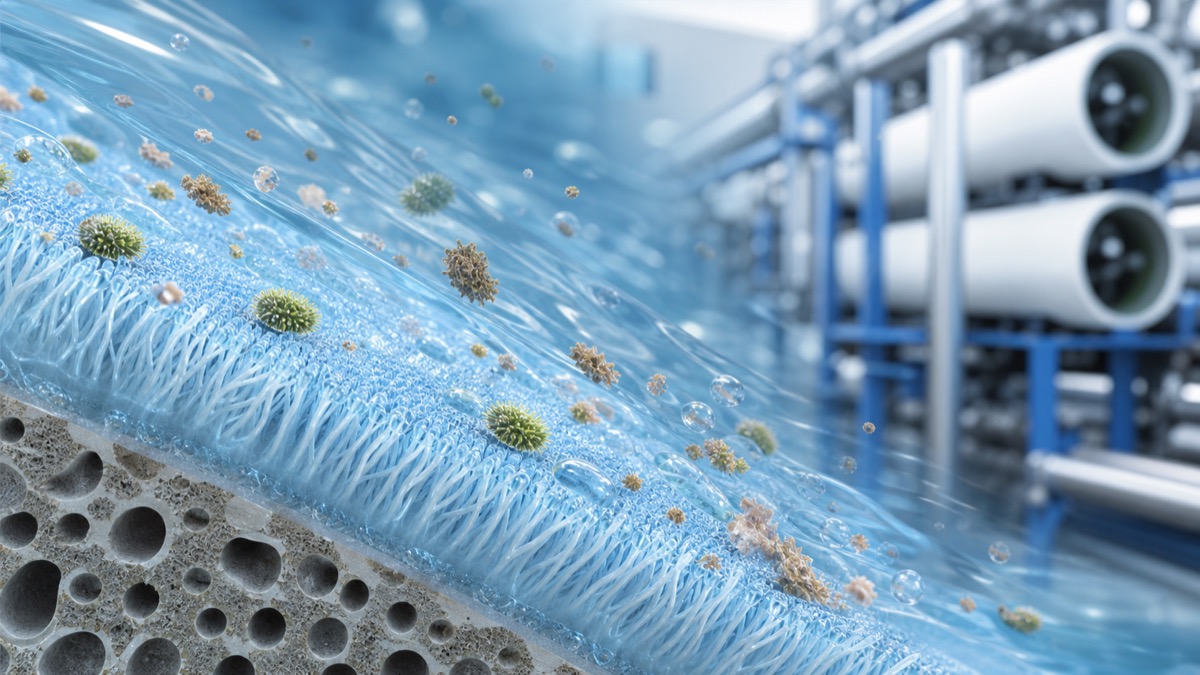
The visual shifts from plant hardware to the membrane surface because the article's main claim lives at the interface: hydrated polymer brushes and low-adhesion chemistry reduce foulant attachment before a resistant cake layer can mature. The blurred RO train in the background keeps the scale honest, while the foreground surface shows why the same cross-flow shear can become more effective when adhesion work is lowered.
Extended CIP Intervals and Operational Benefits
The most direct and impactful benefit of these next-gen membranes is the substantial extension of CIP intervals. Instead of monthly or bi-monthly cleaning, systems can potentially operate for 3-6 months without chemical intervention. This translates into:
- Reduced OPEX: Significant savings in chemical consumption (acids, bases, biocides, antiscalants) and associated disposal costs for CIP waste.
- Increased Uptime: Fewer shutdowns for cleaning mean higher plant availability and production throughput, crucial for high-value manufacturing like semiconductor fabs.
- Lower Environmental Footprint: Decreased chemical usage aligns with corporate sustainability goals and reduces the burden on wastewater treatment facilities.
- Extended Membrane Lifespan: Less frequent exposure to harsh cleaning chemicals minimizes membrane degradation, contributing to longer element life and lower replacement CAPEX.
- More Stable Performance: By resisting fouling from the outset, these membranes maintain closer-to-design flux and rejection over longer periods, leading to more predictable system operation and reduced energy spikes associated with managing severe fouling.
Furthermore, when CIP is eventually required, the biomimetically engineered surfaces facilitate easier removal of accumulated foulants. The reduced adhesion means that less aggressive chemistries or shorter cleaning cycles may be effective, further safeguarding membrane integrity.
Limits and honest boundaries
While next-gen fouling-resistant membranes represent a significant advancement, it is critical to acknowledge their limitations and the absolute necessity of a holistic approach to water treatment. These membranes are fouling-resistant, not fouling-proof.
FAQ
Q2: What is the typical incremental cost for these advanced fouling-resistant membranes, and how does it affect the total cost of ownership (TCO)? A: The initial capital expenditure (CAPEX) for biomimetically engineered membranes is generally 15-30% higher than for conventional elements, reflecting the advanced manufacturing and material science involved. However, this increment is typically offset by substantial reductions in operational expenditure (OPEX) due to extended CIP intervals (lower chemical and energy consumption, reduced labor), increased uptime, and longer membrane lifespan. Over a 5-7 year operational window, clients typically observe a TCO reduction of 10-25%, depending on feed water quality and operational intensity.
Q3: How do these membranes perform with highly complex industrial wastewater streams compared to less challenging municipal or brackish water feeds? A: The performance gains from biomimetic fouling resistance are often more pronounced and economically impactful in highly challenging industrial wastewater applications. Such streams contain a diverse and often aggressive cocktail of foulants—high organic loads, mixed colloidal suspensions, complex inorganic precipitates, and persistent microbial populations. While pretreatment remains crucial, the ability of these surfaces to significantly reduce adhesion and accumulation of multiple foulant types simultaneously provides a disproportionate benefit in maintaining stable flux and minimizing operational intervention compared to conventional membranes under similar conditions.
Related equipment & product lines
These categories typically support the approach above—open any line to compare brands and models.
- RO MembranesReverse osmosis membrane elements for municipal and industrial desalination.View category →
- ChemicalsAntiscalants, cleaners, and process chemicals for water treatment operations.View category →
- Replacement Parts / SparesGeneral replacement parts for treatment systems and subassemblies.View category →
For a closer review, use the engineering inquiry form to share feed, capacity, target, and project stage. Submission does not constitute a completed design or performance commitment.