Solutions · Industry Solutions
Textile dyeing & finishing: color, salt, and reuse
High COD, color, and salt from dyeing: coagulation, oxidation, MBR/UF pretreatment, and RO for high-quality reuse with antiscalant discipline.
Use this guide within its scope
This page supports technical research and option comparison and is marked 2026. Illustrative values are not a quotation, completed process design, certification conclusion, or performance guarantee. Check current regulations, feed data, tests, and OEM records.
Problem
Salt and dye hydrolysates foul membranes; reuse targets collide with variable batch discharges.
Technology
Primary color removal, biological steps where BOD allows, UF/MBR polish, and staged RO with chemistry tuned to sulfate/silica.
Results
Predictable permeate for wash steps, lower freshwater withdrawal, and compliance on discharge streams.
Engineering decision card
Use when
Salt and dye hydrolysates foul membranes; reuse targets collide with variable batch discharges.
Evaluate first
Primary color removal, biological steps where BOD allows, UF/MBR polish, and staged RO with chemistry tuned to sulfate/silica.
Inputs still required
Feed source and variability, capacity, target quality, operating hours, discharge or reuse boundary, available space, and utilities.
Comparison output
Predictable permeate for wash steps, lower freshwater withdrawal, and compliance on discharge streams. The final decision still needs feed data, mass balance, and any necessary testing.
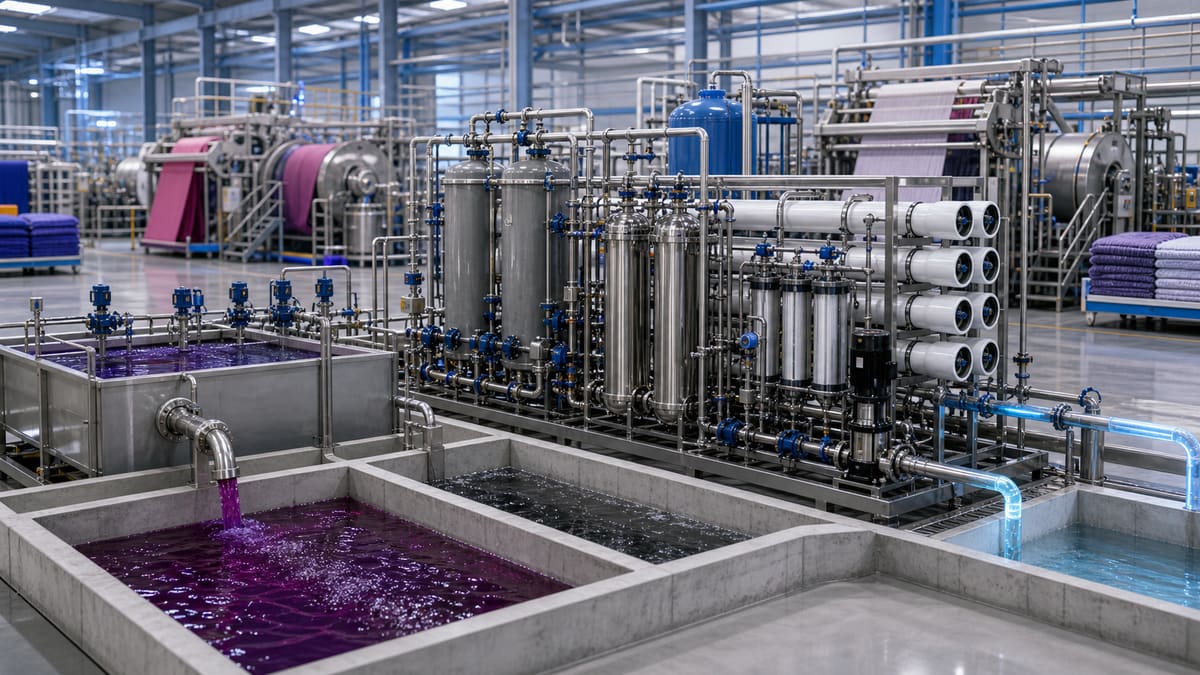
Textile Dyeing & Finishing Wastewater Treatment: A Sustainable Approach to Color, Salt, and Reuse
The textile dyeing and finishing industry is a critical global sector, yet it is highly water-intensive and generates complex wastewater streams. These effluents are characterized by significant concentrations of chemical oxygen demand (COD), color (chromaticity), high salinity (primarily chlorides and sulfates from reactive dyes and fixing agents), surfactants, and often heavy metals. The inherent batch variability in dyeing processes, driven by different fabric types, dye recipes, and production schedules, presents substantial challenges for consistent wastewater treatment and especially for water reuse initiatives.
Water Quality Targets for Reuse
- Dye Bath Makeup: Conductivity typically < 50 µS/cm, color < 10 ADMI units, TSS < 1 mg/L, and low COD (< 20 mg/L) to prevent interference with dye uptake and color consistency.
- Washing & Rinsing: Conductivity < 20-30 µS/cm, color < 5 ADMI units, and zero suspended solids are often required to prevent staining or redeposition.
- General Utilities (Cooling Towers, Boiler Feed): Conductivity requirements vary, but typically < 100 µS/cm for cooling and much lower, with hardness < 1 mg/L and silica < 0.1 mg/L, for high-pressure boilers (e.g., in accordance with ASME/IAPWS guidelines).
- RO Feedwater Quality: A critical target is a Silt Density Index (SDI₁₅) < 3 and TSS < 1 mg/L to protect downstream reverse osmosis membranes.
engineering evaluation path Integrated Process Train for Textile Wastewater Reuse
-
Primary & Secondary Treatment:
- Equalization: Critical for buffering the highly variable flow rates, pH, and pollutant loads from batch processes.
- Physicochemical Treatment: Coagulation, flocculation, and sedimentation/dissolved air flotation (DAF) are employed for bulk removal of TSS, color, heavy metals, and a significant portion of COD.
- Biological Treatment: Aerobic or anaerobic biological processes are implemented where biodegradable organic loads (BOD) are high and amenable to biological degradation, provided toxicity levels permit stable biomass.
- Advanced Oxidation Processes (AOPs): For particularly recalcitrant organic compounds and persistent color, AOPs like ozone, Fenton, or photo-Fenton can be integrated to further reduce COD and improve biodegradability.
-
Advanced Fine Filtration (Pre-RO): For challenging textile effluents, particularly those with high TSS, colloidal matter, or fluctuating organic loads, multimedia filtration (MMF) alone is often inadequate to meet the stringent SDI₁₅ requirements for RO. this approach mandates advanced fine filtration using either ultrafiltration (UF) or a membrane bioreactor (MBR) system prior to reverse osmosis. UF/MBR effectively removes suspended solids, colloids, and microorganisms, ensuring a robust and consistent SDI₁₅ < 3, preventing irreversible fouling of RO membranes.
Operations, Monitoring, and CIP Philosophy
Sustained high performance of membrane systems relies on vigilant monitoring and proactive maintenance. this approach's operational philosophy emphasizes digital oversight and intelligent cleaning strategies.
Risks and Common Engineering Mistakes
Several pitfalls can derail textile wastewater reuse projects:
Digital Operations & Maintenance (O&M)
this approach leverages advanced digital tools for smart, predictive O&M. Our systems offer real-time remote monitoring of critical parameters such as flow rates, pressures (including stage ΔP), conductivity, temperature, and chemical dosing. Predictive maintenance algorithms analyze trends in normalized permeate flow and transmembrane pressure to anticipate fouling and scaling events, allowing for proactive intervention. This data-driven approach optimizes CIP timing, extends asset lifespan, and ensures continuous, efficient operation, moving beyond reactive maintenance to a truly predictive paradigm.
Related equipment & product lines
These categories typically support the approach above—open any line to compare brands and models.
- ChemicalsAntiscalants, cleaners, and process chemicals for water treatment operations.View category →
- RO MembranesReverse osmosis membrane elements for municipal and industrial desalination.View category →
- UF ModulesUltrafiltration modules for suspended solids and colloid removal.View category →
- Ozone GeneratorOzone generation systems and peripherals for advanced oxidation processes.View category →
For a closer review, use the engineering inquiry form to share feed, capacity, target, and project stage. Submission does not constitute a completed design or performance commitment.