Solutions · Industry Solutions
Fine chemical plants: corrosion-safe, stable process water
Aggressive reagent environments: materials selection, RO/EDI stability, chemical injection, and instrumentation for batch and multi-product sites.
Use this guide within its scope
This page supports technical research and option comparison and is marked 2026. Illustrative values are not a quotation, completed process design, certification conclusion, or performance guarantee. Check current regulations, feed data, tests, and OEM records.
Problem
Multi-product batches change water demand and quality tiers; incompatible materials and organics spikes cause unplanned shutdowns.
Technology
Segmented loops, RO/EDI or polishers sized per tier, compatible alloys and gaskets, and dosing skids with redundancy.
Results
Fewer batch scrubs from water excursions and faster changeovers between campaigns.
Engineering decision card
Use when
Multi-product batches change water demand and quality tiers; incompatible materials and organics spikes cause unplanned shutdowns.
Evaluate first
Segmented loops, RO/EDI or polishers sized per tier, compatible alloys and gaskets, and dosing skids with redundancy.
Inputs still required
Feed source and variability, capacity, target quality, operating hours, discharge or reuse boundary, available space, and utilities.
Comparison output
Fewer batch scrubs from water excursions and faster changeovers between campaigns. The final decision still needs feed data, mass balance, and any necessary testing.
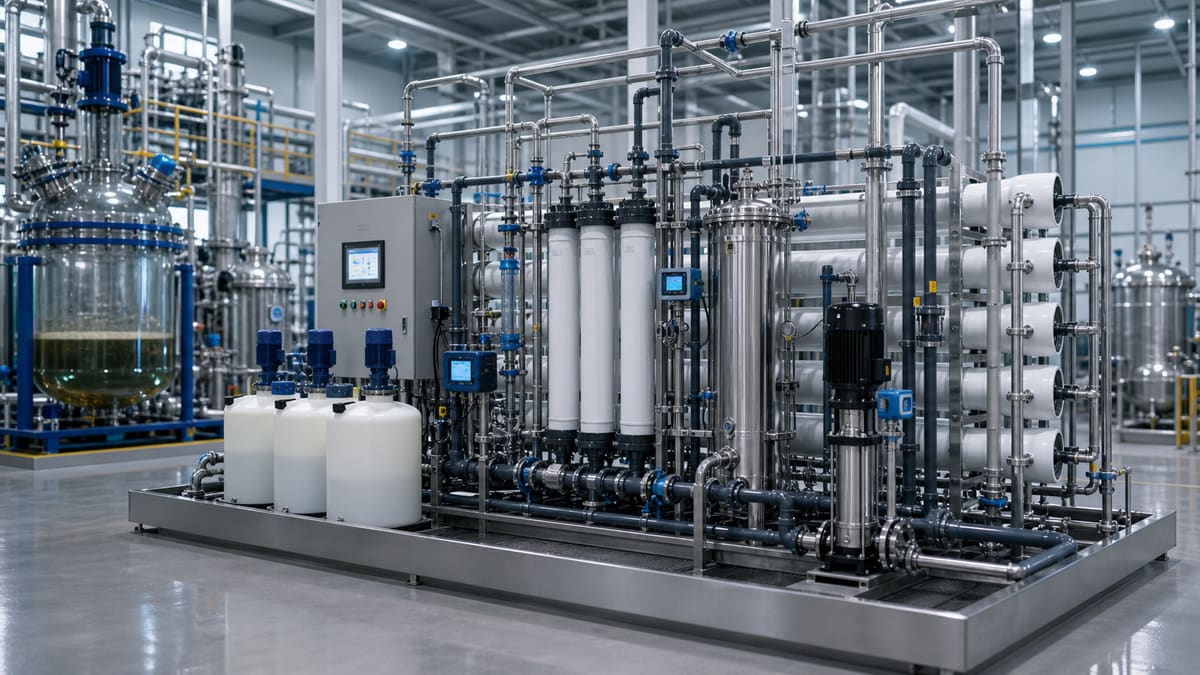
Industry context & regulatory/compliance drivers
Fine chemical facilities face a unique set of challenges. Production often involves aggressive chemistries, which can lead to corrosive atmospheres impacting instrument housings and seals. The nature of batch processing means water demands fluctuate significantly, requiring systems capable of rapid ramp-up and turndown. Furthermore, accidental organic spills or volatile vent condensates can unpredictably stress water treatment pretreatment systems if not adequately designed for such events.
Water quality targets
Water quality targets in fine chemical plants are highly segmented based on application. Examples include:
- Cooling Water Makeup: Often requires removal of hardness and suspended solids to prevent scaling and biofouling, with conductivity typically <500 µS/cm.
- Rinse Water: Varies widely; some non-critical rinses might tolerate conductivity <100 µS/cm, while critical intermediate product rinses might demand <1 µS/cm or even resistivity >1 MΩ·cm.
- Reactor Feed/Synthesis Water: This is often the most critical, requiring very low conductivity (<0.1 µS/cm, or >10 MΩ·cm resistivity), extremely low TOC (<50 ppb), and absence of specific ions that could interfere with reactions.
- Boiler Feedwater: Typically requires demineralized water with conductivity <5 µS/cm, low hardness, silica, and dissolved oxygen to protect boiler integrity.
this approach adopts a modular approach to achieve these varied targets, ensuring each use point receives the precise water quality it needs, without over-treating where unnecessary.
Process train description
-
Activated Carbon Filtration: Essential for removing chlorine, chloramines, and a significant portion of dissolved organics, which can damage RO membranes or interfere with processes.
- Chemical Dosing:
- Antiscalant: Precisely dosed upstream of the RO to mitigate scaling potential (e.g., calcium carbonate, silica) on the membrane surface, especially at higher recovery rates. this approach systems incorporate redundant chemical dosing pumps with interlocks for critical additions.
- Chemical Dosing:
-
pH Adjustment: To optimize RO performance and prevent scaling.
-
Multi-stage RO systems are often employed to maximize recovery rate while managing LSI / scaling risk in the concentrate stream. The permeate from the first pass RO typically achieves conductivity in the range of 5-20 µS/cm.
- Post-Treatment / Polishing: For applications requiring higher purity.
- Second Pass RO: For even lower conductivity (e.g., <1 µS/cm) and reduced dissolved solids.
- Ultraviolet (UV) Sterilization: Placed at strategic points (e.g., post-RO, before storage, before use point) to reduce microbial load.
-
Continuous Electrodeionization (EDI): For generating ultrapure water from RO permeate. EDI continuously deionizes water using ion-exchange resins, DC electric fields, and ion-selective membranes. Ions migrate through the resin to concentrate compartments under the influence of the electric field, where they are continuously flushed away in a concentrate stream. Water splitting at the electrode compartments provides the H+ and OH- ions necessary for continuous resin regeneration, eliminating the need for hazardous chemical regeneration. EDI typically achieves permeate resistivity >10 MΩ·cm.
-
Mixed-Bed Ion Exchange (MBDI): Used for achieving the highest resistivity (>18 MΩ·cm) and lowest TOC levels, often as a final polish after EDI or for critical points. This step typically uses external chemical regeneration.
Related equipment & product lines
These categories typically support the approach above—open any line to compare brands and models.
- RO MembranesReverse osmosis membrane elements for municipal and industrial desalination.View category →
- Electrodeionization (EDI)EDI modules and systems for ultrapure water production.View category →
- Control ValvesProcess control and softening valves for automated treatment trains.View category →
- ChemicalsAntiscalants, cleaners, and process chemicals for water treatment operations.View category →
For a closer review, use the engineering inquiry form to share feed, capacity, target, and project stage. Submission does not constitute a completed design or performance commitment.