Solutions · Industry Solutions
Display & photovoltaic panel cleaning water: high flow, low particle burden
High-volume rinse and cleaning water for displays and PV: particle control, hardness, and RO/UF design for throughput and membrane protection.
Use this guide within its scope
This page supports technical research and option comparison and is marked 2026. Illustrative values are not a quotation, completed process design, certification conclusion, or performance guarantee. Check current regulations, feed data, tests, and OEM records.
Problem
High-flow rinses demand huge water volumes; particles and hardness drive spotting, coating defects, and rapid RO fouling if pretreatment is undersized.
Technology
Multimedia or UF pretreatment, single-pass RO for demineralization, and loop sanitation discipline—with flux and recovery chosen for water cost, not hero recovery.
Results
Stable rinse quality at design throughput, fewer unplanned RO cleans, and predictable makeup water chemistry across shifts.
Engineering decision card
Use when
High-flow rinses demand huge water volumes; particles and hardness drive spotting, coating defects, and rapid RO fouling if pretreatment is undersized.
Evaluate first
Multimedia or UF pretreatment, single-pass RO for demineralization, and loop sanitation discipline—with flux and recovery chosen for water cost, not hero recovery.
Inputs still required
Feed source and variability, capacity, target quality, operating hours, discharge or reuse boundary, available space, and utilities.
Comparison output
Stable rinse quality at design throughput, fewer unplanned RO cleans, and predictable makeup water chemistry across shifts. The final decision still needs feed data, mass balance, and any necessary testing.
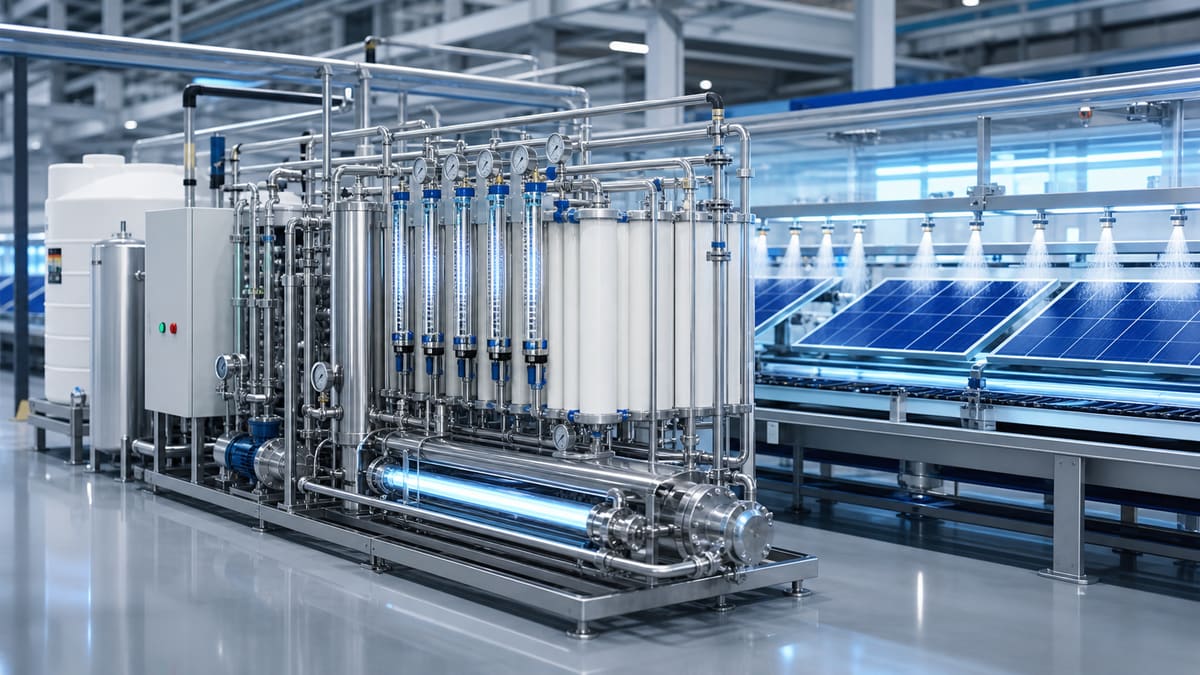
Display & Photovoltaic Panel Cleaning Water: High Flow, Low Particle Burden
In the highly competitive manufacturing of flat-panel displays and photovoltaic (PV) modules, water quality is not merely a utility requirement; it is a critical process input directly impacting product yield and reliability. These industries rely on continuous, high-flow rinses to meticulously remove contaminants from delicate surfaces. The water employed must possess extremely low suspended solids, precisely controlled hardness, and often ultra-low conductivity to prevent staining, spotting, and electrical reliability issues, particularly in thin-film deposition and etching steps. For some critical process steps, water quality approaches ultrapure water (UPW) specifications, drawing guidance from standards such as ASTM D5127-13 for electronic grade water (e.g., Type E-1.2 or higher resistivity grades).
The economic ramifications of suboptimal water treatment are substantial. Beyond the direct cost of makeup water, manufacturers face losses from increased blowdown rates, premature membrane replacement, and costly rework or scrap. A common challenge arises when system designs prioritize theoretical recovery rate without adequately addressing feed water quality variability, such as seasonal spikes in SDI (Silt Density Index) or organic load. Such oversights can lead to excessive concentration polarization on membrane surfaces, forcing frequent, unscheduled CIP (Clean-in-Place) cycles, which undermine the economic justification for aggressive water conservation strategies.
Industry Context & Regulatory Drivers
The global demand for high-performance displays and efficient solar cells continues to escalate, driving innovation in manufacturing processes that require ever-more stringent control over contamination. Water is used in numerous stages, from wafer slicing and substrate cleaning to chemical mechanical polishing (CMP) and final rinsing. Each step presents unique water quality demands.
Water Quality Targets
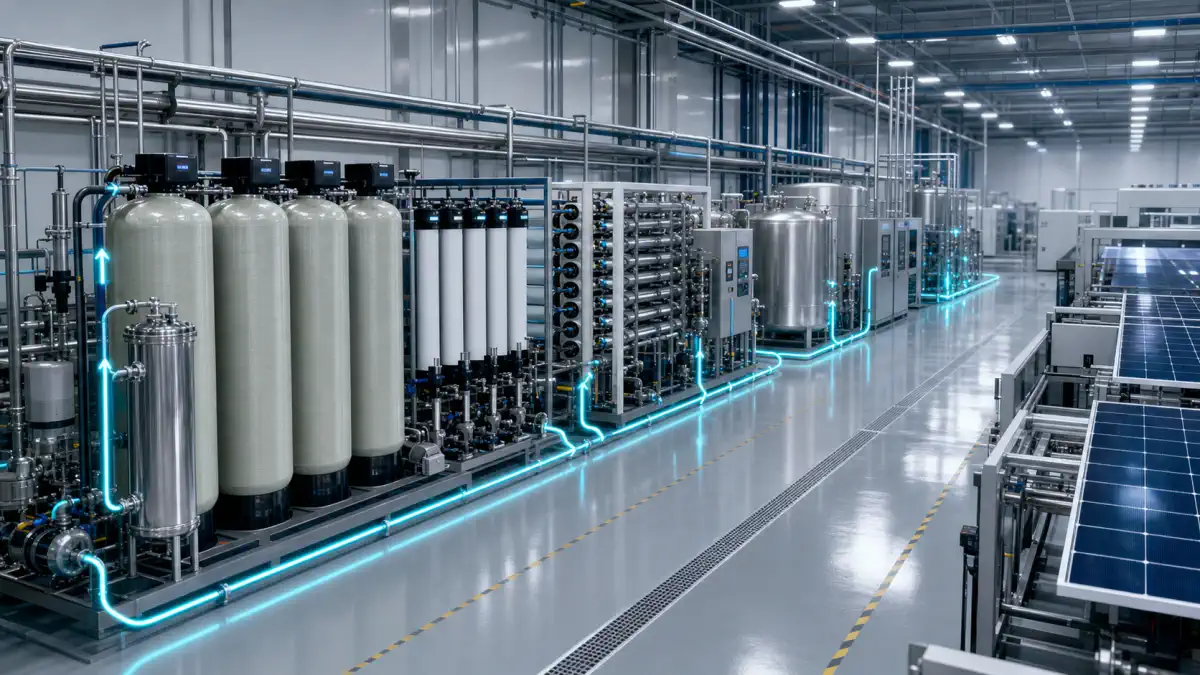
Achieving high yields in display and PV manufacturing necessitates highly purified water. Typical targets include:
- Conductivity/Resistivity: For general rinsing, conductivity often needs to be below 1 µS/cm. For critical thin-film processes, resistivity can exceed 10 MΩ·cm, sometimes approaching 18.2 MΩ·cm (ultrapure water standards).
- Particles: Extremely low particle counts, often specified by particle size and quantity (e.g., <100 particles/mL @ >0.2 µm).
- Total Organic Carbon (TOC): Typically <50 ppb for general use, and <5 ppb for critical applications.
- Hardness: Effectively zero (<0.01 mg/L as CaCO₃) to prevent spotting and scaling.
- Silica: <20 ppb for RO feed, and <5 ppb in permeate for high-purity applications, to prevent scaling and film defects.
- Dissolved Gases: Often degassed (e.g., <20 ppb O₂) for certain sensitive processes.
- Microbial Count: <10 Colony Forming Units (CFU)/100mL for bulk, and non-detectable for critical points of use.
1. Pretreatment – Safeguarding Downstream Processes
The initial stages are crucial for protecting sensitive membrane technologies and ensuring consistent feed water quality.
3. Electrodeionization (EDI) – Continuous Polishing
For applications requiring very high resistivity water, Continuous Electrodeionization (EDI) is the preferred polishing technology after RO. EDI combines ion exchange resin, ion-selective membranes, and a DC electric field to continuously remove residual ions without the need for periodic chemical regeneration.
- Mechanism: Ions migrate through the ion exchange resins and then through ion-selective membranes towards electrodes under the influence of an electric field. The concentrate compartment continuously flushes away removed ions, while the electrode compartments contain electrodes that facilitate the ion transport and consume a small amount of water. This continuous process eliminates the downtime and chemical handling associated with conventional mixed-bed ion exchangers.
- Benefits: EDI delivers stable, high-purity water (typically >10 MΩ·cm) and reduces operational costs and environmental impact by avoiding chemical regenerants.
4. Post-Treatment & Distribution – Maintaining Purity
The final stages ensure the water maintains its purity until the point of use.
Operations, Monitoring, and CIP Philosophy
this approach's philosophy centers on proactive maintenance and intelligent process control to maximize uptime and minimize operational costs.
Risks and Common Engineering Mistakes
Several factors can jeopardize the efficiency and reliability of display and PV water treatment systems:
- Underestimating Raw Water Variability: Failing to account for seasonal or episodic changes in raw water quality (e.g., turbidity, organics, temperature) can lead to rapid fouling of pretreatment and RO membranes, resulting in frequent CIPs or premature membrane replacement.
- Aggressive Recovery Rates without LSI Management: Maximizing recovery rate without proper LSI calculation and antiscalant dosing will inevitably lead to scaling on RO membranes, reducing flux and increasing operating pressure.
- Inadequate Pretreatment: Skipping or undersizing UF or MMF when the SDI of the raw water is consistently high directly exposes RO membranes to particulate fouling, drastically shortening their lifespan.
- Poor Distribution System Design: A highly purified water source can be recontaminated by an improperly designed or maintained distribution loop. Stagnant zones, inappropriate materials, or insufficient flushing can lead to microbial growth or particle shedding.
- Neglecting TOC Control: For thin-film applications, high TOC can lead to defects. Without UV oxidation or specific TOC removal resins, even high-resistivity water may not be suitable.
Related equipment & product lines
These categories typically support the approach above—open any line to compare brands and models.
- UF ModulesUltrafiltration modules for suspended solids and colloid removal.View category →
- RO MembranesReverse osmosis membrane elements for municipal and industrial desalination.View category →
- Sediment FiltersPre-filtration cartridges and housings for suspended solids removal.View category →
- Pumps & PumpingHigh-pressure and process pump solutions for water treatment skids and plants.View category →
For a closer review, use the engineering inquiry form to share feed, capacity, target, and project stage. Submission does not constitute a completed design or performance commitment.