Solutions · Industry Solutions
Coastal plants: seawater desalination (SWRO) packages
Intake, pretreatment, SWRO staging, energy recovery, and post-treatment for reliable plant water from seawater.
Use this guide within its scope
This page supports technical research and option comparison and is marked 2026. Illustrative values are not a quotation, completed process design, certification conclusion, or performance guarantee. Check current regulations, feed data, tests, and OEM records.
Problem
Biofouling, intake debris, and seasonal algal events challenge availability; energy intensity must stay defensible.
Technology
Robust intake screens, DAF/media/UF as needed, SWRO with ERD, and honest boron/post-treatment planning.
Results
Stable permeate quantity and quality with documented kWh/m³ and recovery assumptions.
Engineering decision card
Use when
Biofouling, intake debris, and seasonal algal events challenge availability; energy intensity must stay defensible.
Evaluate first
Robust intake screens, DAF/media/UF as needed, SWRO with ERD, and honest boron/post-treatment planning.
Inputs still required
Feed source and variability, capacity, target quality, operating hours, discharge or reuse boundary, available space, and utilities.
Comparison output
Stable permeate quantity and quality with documented kWh/m³ and recovery assumptions. The final decision still needs feed data, mass balance, and any necessary testing.
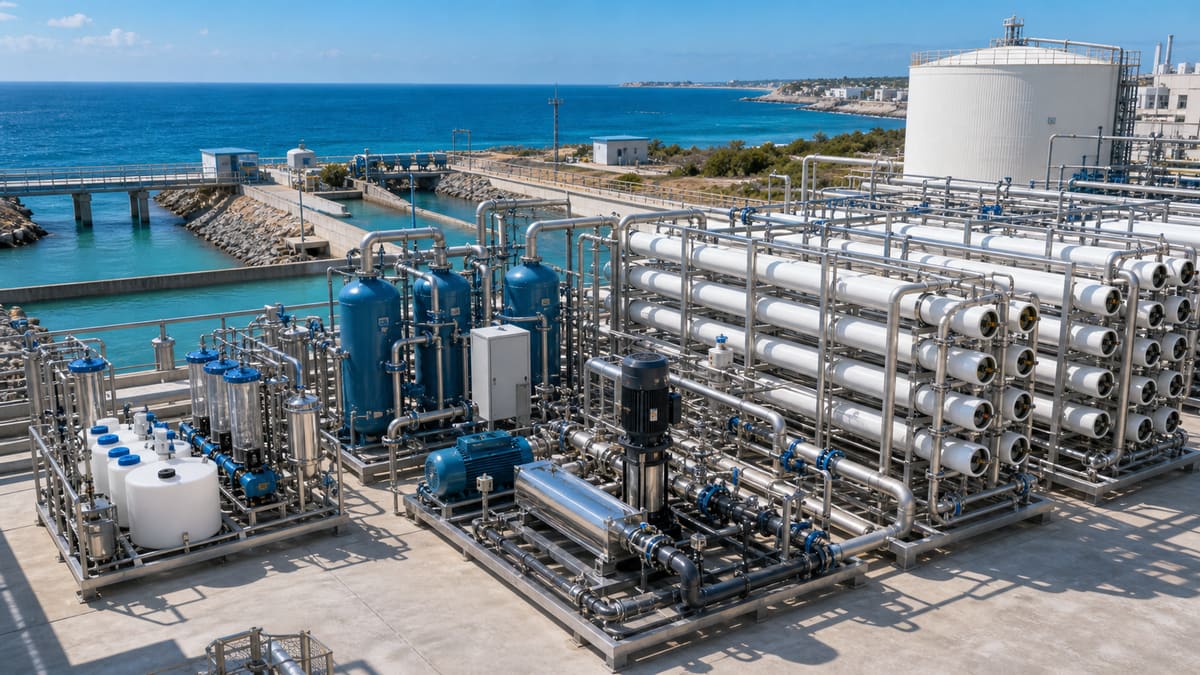
Industry Context & Regulatory/Compliance Drivers
Operating a coastal desalination plant involves navigating unique challenges, from variable raw water quality to complex regulatory frameworks.
- Raw Water Variability: Seawater composition fluctuates significantly, influenced by tides, currents, seasonal algal blooms, and proximity to river mouths or shipping lanes. This variability introduces risks of high suspended solids, organic loading (algal organic matter (AOM)), and potential for biofouling and scaling within the membrane system. Oil sheen from maritime activities also presents a pretreatment challenge.
- Energy Intensity: SWRO is inherently more energy-intensive than brackish water RO due to higher osmotic pressures. Minimizing specific energy consumption (kWh/m³ permeate) is a primary operational and ESG objective.
- Boron Removal: Seawater naturally contains boron, which must be reduced to very low levels for potable water (e.g., < 0.5 mg/L as per WHO Guidelines for Drinking-water Quality, 4th Edition) or specific industrial processes.
- Discharge Regulations: The concentrate stream, containing elevated salinity and any residual treatment chemicals, must be discharged in compliance with strict local environmental discharge regulations. This often requires careful dispersion modeling and adherence to limits on temperature, salinity, and chemical residuals.
Water Quality Targets
- Potable Water: < 500 µS/cm conductivity, < 0.5 mg/L Boron, free from pathogens and chemical contaminants.
- Process Water: Conductivity and specific ion limits tailored to the industrial process (e.g., cooling water, wash water).
- Boiler Feedwater: Typically requires very low conductivity (< 0.2 µS/cm), silica (< 20 µg/L), and hardness. This often necessitates additional post-treatment like EDI or mixed-bed ion exchange.
Process Train Description
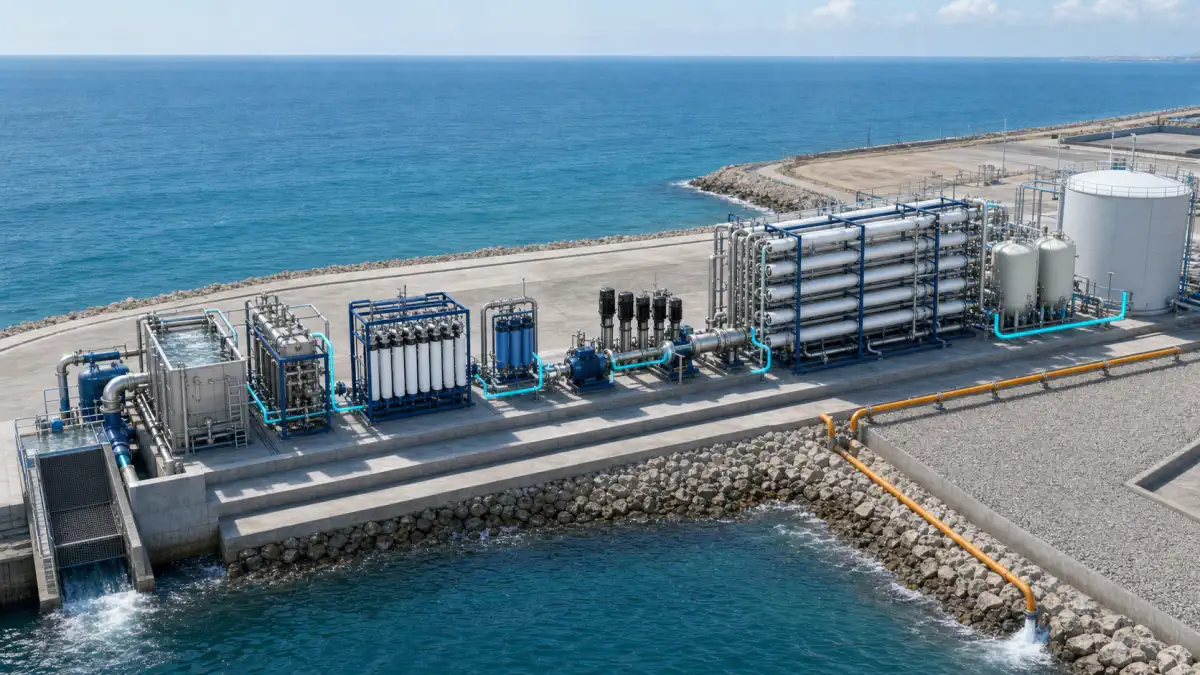
-
Seawater Intake & Pre-screening:
- Open Intakes: Designed with appropriate intake velocity and coarse screens to prevent macro-fouling and protect marine life.
- Beach Wells: Offer natural filtration, significantly reducing suspended solids and AOM, often resulting in lower SDI values. However, they can have limited yield and potential for greater TDS variability due to groundwater influence.
- Initial screening with bar screens and rotating band screens removes larger debris.
-
Pretreatment (Fouling Control): This is the cornerstone of reliable SWRO operation, directly impacting membrane lifespan and overall system efficiency.
- Coagulation/Flocculation: Chemical dosing (e.g., ferric chloride) enhances the aggregation of colloidal particles and organic matter.
-
Dissolved Air Flotation (DAF): Effective for removing algae, oils, and suspended solids, especially critical during algal blooms.
- Multimedia Filtration (MMF): A robust physical barrier. If the raw seawater SDI₁₅ (Silt Density Index over 15 minutes) is consistently above 5 after primary clarification, then Ultrafiltration (UF) or another advanced physical separation step is mandatory before spiral-wound RO membranes to prevent rapid biofouling and particulate fouling.
-
Cartridge Filtration: A final security filter (typically 5 µm or 10 µm) protects the high-pressure pumps and RO membranes from any remaining fine particulates.
- High-Pressure Pumping:
High-pressure pumps elevate the pretreated seawater to the operating pressure of the RO membranes, typically 55-80 bar (5.5-8.0 MPa), depending on salinity and desired recovery rate.
-
Seawater Reverse Osmosis (SWRO):
- Membrane Technology: State-of-the-art polyamide thin-film composite membranes, designed for high salt rejection (typically >99.5%) and durability.
- System Design: SWRO systems are typically designed with multiple stages and carefully optimized array configurations to maximize recovery rate while managing concentration polarization and minimizing scaling risk.
- Antiscalant Dosing: A proprietary antiscalant is continuously dosed upstream of the RO membranes to prevent precipitation of sparingly soluble salts (e.g., calcium carbonate, calcium sulfate, silica) on the membrane surface. Careful monitoring of the LSI (Langelier Saturation Index) and other scaling indices in the concentrate stream guides antiscalant selection and dosing. The recovery rate is carefully selected to balance permeate production with scaling risk, not simply for brochure maxima.
- Energy Recovery Devices (ERDs): Essential for cost-effective SWRO, ERDs recover significant energy from the high-pressure concentrate stream, reducing the overall specific energy consumption of the plant.
-
Post-Treatment:
- Boron Removal: If the target boron level is exceptionally low, a second pass RO system, often operating at lower pressure and higher pH (to convert boric acid to borate ion, which is better rejected), or specialized ion exchange resins, may be employed.
- Remineralization: For potable water applications, the highly purified permeate may require remineralization (e.g., limestone contactor, chemical dosing) to improve taste, reduce corrosivity, and meet specific health guidelines.
- Disinfection: UV disinfection or chlorination is typically applied to ensure bacteriological quality for potable or sensitive process water uses.
- Advanced Polishing (e.g., EDI): For critical applications like boiler feed or ultrapure water, Continuous Electrodeionization (EDI) provides a chemical-free polishing step. EDI continuously regenerates ion-exchange resins within a DC electric field, moving ions across ion-selective membranes into a concentrate compartment and electrode compartments, eliminating the need for hazardous chemical regeneration.
Operations, Monitoring, and CIP Philosophy
this approach's operational philosophy centers on proactive, data-driven maintenance to maximize uptime and membrane lifespan.
- Continuous Monitoring: Key performance indicators (KPIs) such as raw water quality, membrane feed pressure, transmembrane pressure (TMP), permeate flow rate (m³/h), permeate conductivity (µS/cm), and temperature are continuously monitored.
- Performance Normalization: We track normalized permeate flow to account for variations in temperature and pressure, providing a true indication of membrane performance degradation (fouling). Significant deviations in normalized permeate flow or an increase in ΔP (pressure drop across stages) are critical indicators of membrane fouling.
- CIP (Clean-in-Place): A proactive CIP strategy is vital. While routine CIP may be scheduled, this approach promotes trend-based triggers for CIP initiation, based on deviations in normalized permeate flow or significant increases in TMP. A well-defined "algal event playbook," including optimized coagulant dose curves and UF backwash strategies, ensures rapid response to challenging raw water conditions.
Risks and Common Engineering Mistakes
- Inadequate Pretreatment: The most common and costly mistake. Insufficient removal of suspended solids, organics, and colloidal matter leads to rapid biofouling and scaling of RO membranes, requiring frequent CIPs, increased chemical consumption, and premature membrane replacement.
- Poor Hydraulic Design: Improper array configuration or flow distribution can lead to localized concentration polarization, increasing scaling potential and reducing permeate quality.
- Ignoring LSI and Scaling Potential: Not rigorously calculating and managing LSI and other scaling indices, particularly at high recovery rates, results in mineral precipitation on membrane surfaces.
- Lack of Proactive Monitoring: Reactive maintenance, rather than trend-based monitoring and preventative CIP, invariably leads to higher operational costs and downtime.
- Underestimating Energy Costs: Failing to incorporate efficient high-pressure pumps and energy recovery devices (ERDs) significantly impacts the total cost of ownership.
Frequently Asked Questions
-
Q: Beach wells vs. open intake? A: Beach wells offer natural pre-filtration, significantly reducing SDI and algal organic matter (AOM), often leading to less complex pretreatment and lower chemical usage. However, they are site-specific, can have limited yield, and might exhibit TDS variability due to groundwater influence. Open intakes require more robust and often chemical-intensive pretreatment but offer higher, more consistent flow rates. this approach performs detailed site-specific modeling of both CAPEX and OPEX to determine the optimal intake strategy.
-
Q: Can SWRO permeate feed high-pressure boilers? A: Yes, very effectively. SWRO permeate, with its extremely low TDS and hardness, is an ideal feedstock for advanced boiler systems. For high-pressure boilers, it typically requires further polishing, such as EDI or mixed-bed ion exchange, to achieve ultra-low conductivity and silica levels. It's crucial to coordinate with boiler internal treatment programs and consider potential corrosivity control (e.g., pH adjustment, remineralization) for the pure permeate.
Related equipment & product lines
These categories typically support the approach above—open any line to compare brands and models.
- RO MembranesReverse osmosis membrane elements for municipal and industrial desalination.View category →
- Pumps & PumpingHigh-pressure and process pump solutions for water treatment skids and plants.View category →
- ChemicalsAntiscalants, cleaners, and process chemicals for water treatment operations.View category →
- Instrumentation & SensorsOnline measurement and control: flow, level, pressure, and water-quality sensors indexed from the Lenntech instrumentation hub.View category →
For a closer review, use the engineering inquiry form to share feed, capacity, target, and project stage. Submission does not constitute a completed design or performance commitment.