Solutions · Digital & Smart O&M
Virtual Commissioning Services: cloud-first IO checks before the skid hits the slab
Simulate loops, validate alarms, and rehearse operator HMI flows remotely—compressing the critical path before mechanical completion.
Use this guide within its scope
This page supports technical research and option comparison and is marked 2026. Illustrative values are not a quotation, completed process design, certification conclusion, or performance guarantee. Check current regulations, feed data, tests, and OEM records.
Problem
Site days burn on wiring surprises that could have been flushed in a staged environment.
Technology
Digital FAT extensions: signal injection, alarm rationalization, and security-hardened remote access patterns.
Results
Shorter punch lists on arrival and calmer first fills with operators who have already 'flown' the plant once.
Engineering decision card
Use when
Site days burn on wiring surprises that could have been flushed in a staged environment.
Evaluate first
Digital FAT extensions: signal injection, alarm rationalization, and security-hardened remote access patterns.
Inputs still required
Feed source and variability, capacity, target quality, operating hours, discharge or reuse boundary, available space, and utilities.
Comparison output
Shorter punch lists on arrival and calmer first fills with operators who have already 'flown' the plant once. The final decision still needs feed data, mass balance, and any necessary testing.
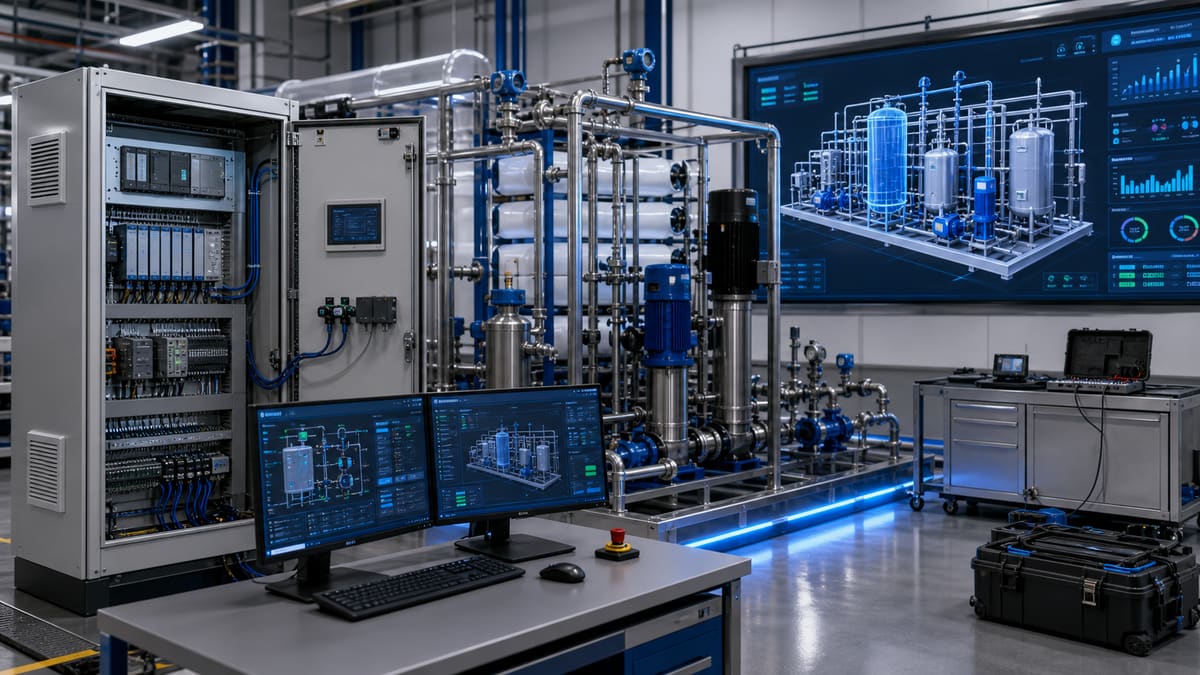
Virtual Commissioning Services: Cloud-First IO Checks Before the Skid Hits the Slab
Achieving operational certainty and supply-chain efficiency starts long before equipment arrives on site. Our Virtual Commissioning Services ensure your critical electrical and control systems are rigorously tested and validated in a cloud environment, eliminating costly surprises and delays in the final stages of project delivery. This proactive approach de-risks your project delivery, ensuring that when physical components are installed, they integrate seamlessly and operate as intended from day one.
Engineering Certainty Through Digital Replication
Virtual Commissioning is the process of testing and validating your industrial control systems—Programmable Logic Controllers (PLCs), Human-Machine Interfaces (HMIs), Supervisory Control and Data Acquisition (SCADA) systems, and Distributed Control Systems (DCS)—in a simulated, cloud-based environment. Before any physical equipment leaves the factory floor, a precise digital twin of your plant’s electrical and control infrastructure is created. This digital replica allows our engineers, in collaboration with your team, to perform exhaustive Input/Output (I/O) checks, validate control logic, simulate process dynamics, and test HMI responsiveness. By running hundreds or even thousands of test scenarios against the digital twin, we proactively identify and rectify software bugs, wiring mismatches, and operational sequence flaws that would traditionally only surface during costly on-site Factory Acceptance Tests (FAT) or Site Acceptance Tests (SAT). This proactive approach transforms commissioning from a reactive troubleshooting exercise into a streamlined, predictable validation process, significantly compressing timelines and enhancing overall project quality.
Traditional vs engineering evaluation path
Consider commissioning a new reverse osmosis (RO) skid for industrial water purification:
| Traditional way | engineering evaluation path way |
|---|---|
| On-site Discovery of I/O Errors: Physical wiring issues or PLC programming bugs found during on-site FAT/SAT, causing rework and delays. | Cloud-based Pre-validation: Virtual I/O checks and PLC logic simulation performed remotely, identifying and resolving 80%+ of control issues before equipment shipment. Cuts on-site electrical commissioning by 30-50%. |
| Delayed System Integration: Each control panel and skid arrives separately; integration only begins once all components are physically present, adding weeks to the schedule. | Parallel Engineering & Integration: SCADA/DCS integration and HMI development proceed concurrently with skid fabrication, using virtual models. Shortens overall project schedule by weeks. |
| Unplanned Costs & Schedule Overruns: Unexpected equipment-specific software updates, hardware incompatibilities, or missing parts identified on site lead to expensive change orders and extended timelines, often 15-20% over budget. | Predictive Issue Resolution: Comprehensive virtual environment identifies interface conflicts, validates software versions, and confirms Bill of Material (BOM) accuracy. Avoids typical 15-20% cost overruns due to late-stage discovery. |
| Limited Training & Documentation: Operator training often rushed during late-stage commissioning; documentation may be finalized after startup, leading to initial operational inefficiencies and higher support costs. | Enhanced Training & Operational Readiness: Operators trained on the virtual system months in advance, familiarizing them with HMI and control sequences. Detailed, verified documentation available at mechanical completion, leading to faster, safer startup and sustained performance. |
Securing Your Operational Data: Trust in the Cloud
- Robust authentication and authorization protocols.
- Regular security audits and penetration testing.
- Compliance with industry-specific data handling standards.
- Granular access controls for all project stakeholders.
FAQ
-
Q: How does Virtual Commissioning save money if we still need an on-site team? A: While an on-site team is always needed for final physical hookups and fine-tuning, Virtual Commissioning drastically reduces the time they spend troubleshooting logic errors or wiring faults. This translates to fewer expensive engineering hours, reduced travel costs, and a shorter overall commissioning timeline, directly impacting your project's bottom line.
-
Q: How long does it typically take to set up a virtual commissioning environment for a new plant? A: The setup time varies depending on plant complexity and available engineering data. For a standard water treatment skid, it can be weeks. For a larger, multi-unit plant, it might take a few months to develop the full digital twin. However, this investment up-front significantly de-risks the much longer physical commissioning phase, often shortening the overall project by 10-20%.
Related equipment & product lines
These categories typically support the approach above—open any line to compare brands and models.
- Instrumentation & SensorsOnline measurement and control: flow, level, pressure, and water-quality sensors indexed from the Lenntech instrumentation hub.View category →
- InvertersVariable-frequency drives and inverter systems for variable-speed motor control.View category →
- Pilot Units TestingPilot rigs and trial modules for process validation and feasibility studies.View category →
For a closer review, use the engineering inquiry form to share feed, capacity, target, and project stage. Submission does not constitute a completed design or performance commitment.