Solutions · Digital & Smart O&M
Digital Twin for Water Plants: 3D models to live operations and lifecycle decisions
Link P&ID and 3D asset context to live SCADA streams—simulate what-if loads, training, and retrofit planning without gambling on the real plant.
Use this guide within its scope
This page supports technical research and option comparison and is marked 2026. Illustrative values are not a quotation, completed process design, certification conclusion, or performance guarantee. Check current regulations, feed data, tests, and OEM records.
Problem
Operators and remote experts lack a shared visual ground truth when diagnosing upsets across distributed sites.
Technology
engineering evaluation-backed digital twin layers: geometry + tag mapping + instrument validation from the field.
Results
Faster root-cause work, safer change management, and clearer capex stories for owners and insurers.
Engineering decision card
Use when
Operators and remote experts lack a shared visual ground truth when diagnosing upsets across distributed sites.
Evaluate first
engineering evaluation-backed digital twin layers: geometry + tag mapping + instrument validation from the field.
Inputs still required
Feed source and variability, capacity, target quality, operating hours, discharge or reuse boundary, available space, and utilities.
Comparison output
Faster root-cause work, safer change management, and clearer capex stories for owners and insurers. The final decision still needs feed data, mass balance, and any necessary testing.
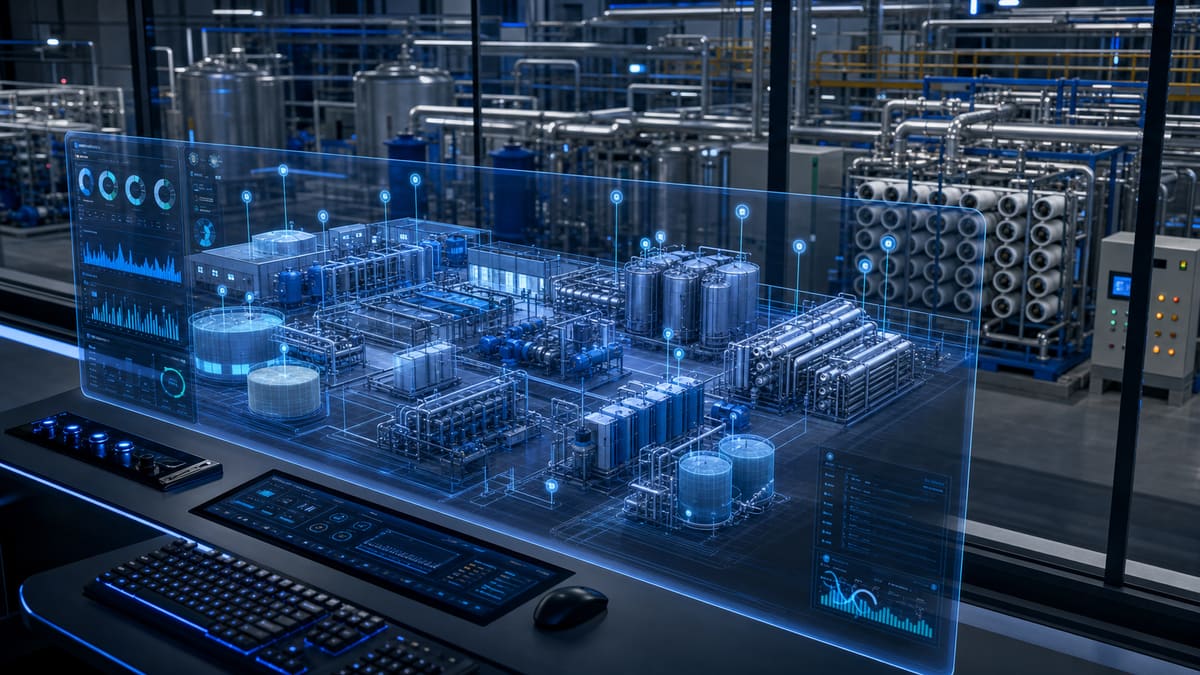
Digital Twin for Water Plants: 3D models to live operations and lifecycle decisions
Achieving operational certainty and supply-chain efficiency in water treatment plants demands more than just historical data. It requires a dynamic, intelligent framework that connects every asset, every process, and every decision to real-time conditions. This is where a digital twin transforms your plant from a collection of assets into a precisely managed, continuously optimized ecosystem.
A digital twin for a water plant is not merely a static 3D model; it's a living, breathing virtual replica of your physical facility. It integrates design specifications, operational data, and maintenance histories into a single, cohesive platform. This powerful tool provides a comprehensive view of your plant's performance, predicting future states, simulating operational changes, and enabling proactive, informed decision-making throughout the entire asset lifecycle. From initial design validation to ongoing performance optimization and proactive maintenance, a digital twin empowers plant owners and operators to navigate complexity with unprecedented clarity and control.
Beyond Static Schematics: Bridging Design and Reality
Traditionally, the detailed engineering models created during plant design often become static archives once construction is complete. A digital twin changes this paradigm entirely. It links these foundational 3D models and P&IDs directly to live sensor data, SCADA systems, and enterprise resource planning (ERP) systems. This integration means that the virtual plant mirrors the physical one in real-time, displaying actual pressures, flows, chemical dosages, and equipment statuses overlaid onto accurate representations of your assets. This real-time feedback loop allows for immediate identification of anomalies, performance deviations, and potential bottlenecks, translating complex data into actionable insights for operators.
Traditional vs engineering evaluation path
Consider the critical task of managing membrane performance and spare parts inventory in an Ultrafiltration (UF) plant.
| Traditional way | engineering evaluation path way |
|---|---|
| Membrane Maintenance: Fixed schedule cleaning (e.g., every 3 months) or manual triggering based on operator observation of declining flux. | Membrane Maintenance: Predictive cleaning cycles optimized by real-time fouling models, transmembrane pressure (TMP) trends, and feed water quality. Automated alerts trigger chemical cleans exactly when needed, extending membrane life by 15-20% and reducing chemical usage. |
| Spare Part Inventory (e.g., UF modules): Safety stock based on historical averages and lead times; often leads to either overstocking (high capital lockup) or understocking (risk of 2-week downtime for critical spares). | Spare Part Inventory: Dynamic inventory optimization linked to predictive maintenance, supplier lead times, and planned turnarounds. Inventory levels are adjusted based on real-time asset health and supply chain visibility, ensuring parts arrive 2-3 days before scheduled maintenance, reducing capital tied up in stock by 10-15%. |
| Troubleshooting: Reactive response to failures (e.g., pump cavitation). Manual data correlation across disparate systems (SCADA, logbooks, maintenance records). | Troubleshooting: Proactive fault detection and diagnosis through AI-driven anomaly detection. The digital twin pinpoints root causes by analyzing deviations in pressure, vibration, and motor current, reducing troubleshooting time by 50% and preventing cascading failures. |
| Training & Simulation: Classroom-based training or on-the-job learning. Limited ability to simulate high-risk scenarios or major operational changes without impacting production. | Training & Simulation: Immersive virtual training environments and operational simulators. Operators can practice complex procedures, emergency responses, and "what-if" scenarios in a risk-free digital environment, improving preparedness and reducing human error during actual operations. |
Data Security & Trust
- AES-256 encryption for data at rest.
- TLS 1.2+ protocols for data in transit.
- Role-based access control (RBAC) for granular data permissions.
- Regular third-party security audits and penetration testing.
The Foundation of Truth: Instrumentation & Sensors
The intelligence of any digital twin is directly proportional to the quality and reliability of its underlying data. This field truth originates from your online instruments, which continuously measure critical process parameters such as flow rates, pressures, conductivity, Oxidation-Reduction Potential (ORP), pH, turbidity, and tank levels. These sensors are the eyes and ears of your digital plant, providing the real-time inputs that allow the twin to accurately reflect the physical world. Without precise and consistent data from these robust instruments, predictive models are guesses, and optimization strategies are theoretical.
Related equipment & product lines
These categories typically support the approach above—open any line to compare brands and models.
- Instrumentation & SensorsOnline measurement and control: flow, level, pressure, and water-quality sensors indexed from the Lenntech instrumentation hub.View category →
- InvertersVariable-frequency drives and inverter systems for variable-speed motor control.View category →
- Pilot Units TestingPilot rigs and trial modules for process validation and feasibility studies.View category →
For a closer review, use the engineering inquiry form to share feed, capacity, target, and project stage. Submission does not constitute a completed design or performance commitment.