Solutions · Industry Solutions
Pharmaceutical grade water: GMP and pharmacopeia alignment
PW, WFI, and pure steam considerations: pretreatment, RO, EDI, distillation, sanitization, and documentation for validation-friendly systems.
Use this guide within its scope
This page supports technical research and option comparison and is marked 2026. Illustrative values are not a quotation, completed process design, certification conclusion, or performance guarantee. Check current regulations, feed data, tests, and OEM records.
Problem
Validation and change control make water systems expensive to fix after the fact; excursions hit batch release and audit observations.
Technology
URS-driven generation (RO/EDI vs distillation), loop sanitization strategy, instruments calibrated to pharmacopeia expectations, and clear sampling plans.
Results
Consistent compendial quality, defendable data packages, and reduced reactive CAPA on the water system.
Engineering decision card
Use when
Validation and change control make water systems expensive to fix after the fact; excursions hit batch release and audit observations.
Evaluate first
URS-driven generation (RO/EDI vs distillation), loop sanitization strategy, instruments calibrated to pharmacopeia expectations, and clear sampling plans.
Inputs still required
Feed source and variability, capacity, target quality, operating hours, discharge or reuse boundary, available space, and utilities.
Comparison output
Consistent compendial quality, defendable data packages, and reduced reactive CAPA on the water system. The final decision still needs feed data, mass balance, and any necessary testing.
Water Quality Targets & Regulatory Compliance
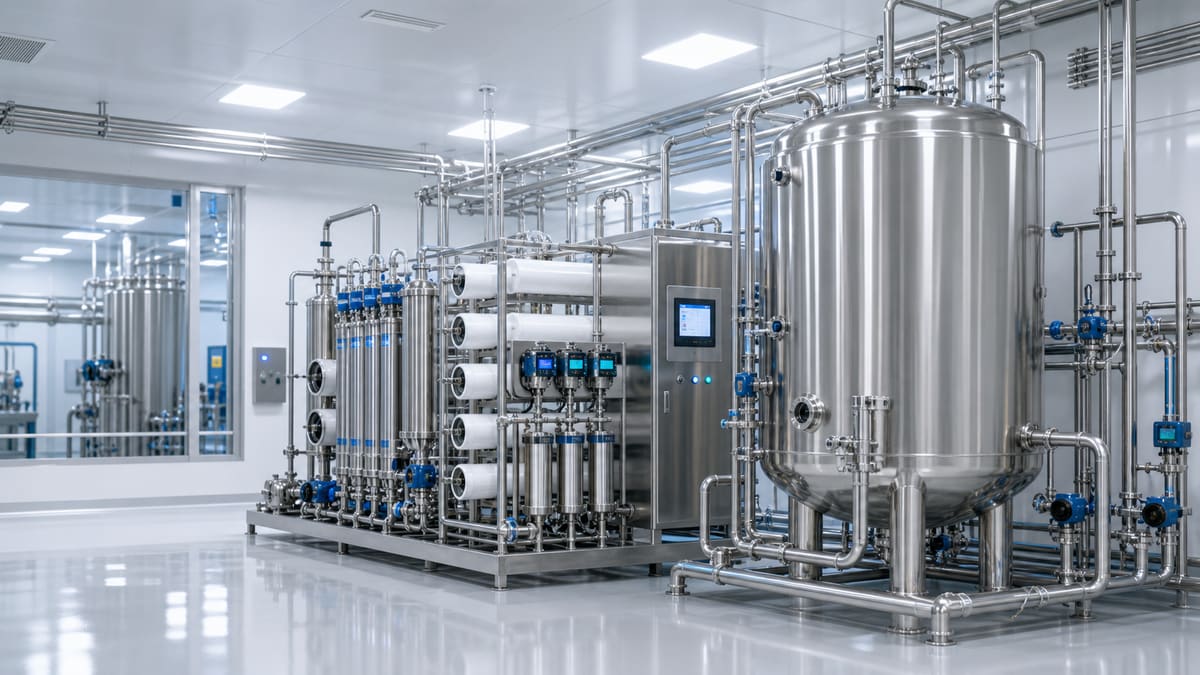
- Purified Water (PW): Often produced by a combination of membrane-based and deionization technologies. Key parameters include conductivity (e.g., not more than 1.3 µS/cm at 25 °C, as per USP <645>), TOC (e.g., not more than 500 µg/L, as per USP <643>), and microbial limits (e.g., not more than 100 CFU/mL, as per USP <1231>).
- Water for Injection (WFI): Historically produced by distillation, some pharmacopoeias now permit membrane-based processes (e.g., EU Ph. Eur. Monograph 0169 for WFI). WFI has tighter limits for bacterial endotoxins (e.g., < 0.25 EU/mL, as per USP <85>), in addition to meeting PW specifications for conductivity and TOC.
1. Pretreatment – Safeguarding Membrane Integrity
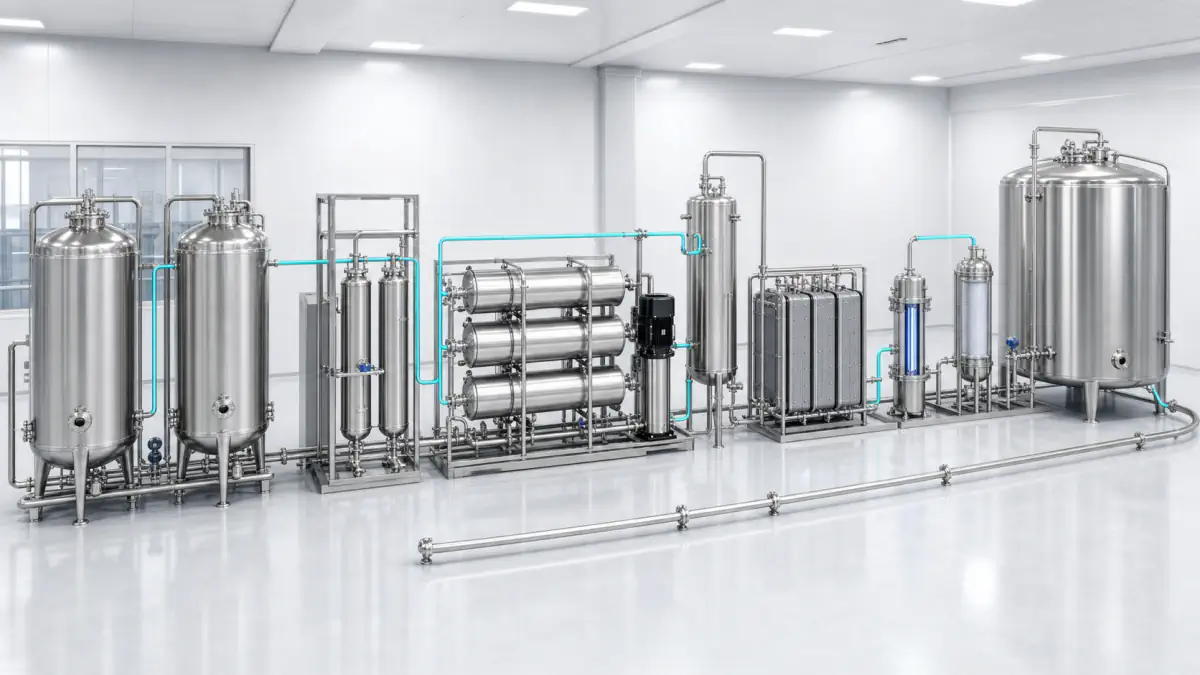
Raw water sources, whether municipal or borewell, vary significantly in quality. High levels of suspended solids, organic matter, and colloids can lead to rapid biofouling and scaling of downstream reverse osmosis (RO) membranes.
- Multimedia Filtration (MMF): Removes larger suspended solids and turbidity.
- Ultrafiltration (UF): For challenging surface water sources or where the Silt Density Index (SDI₁₅) of the raw water consistently exceeds 5, UF is mandatory to protect the RO membranes. UF systems remove suspended solids, colloids, and microorganisms down to typically 0.01-0.05 µm, significantly reducing the SDI and protecting against transmembrane pressure increases.
- Chemical Dosing: Antiscalants are typically dosed upstream of the RO to prevent scaling by sparingly soluble salts (e.g., calcium carbonate, silica) at high recovery rates. pH adjustment may also be employed for optimal RO performance and scale control, particularly for LSI management.
- Activated Carbon Filtration: Removes chlorine, chloramines, and certain organic compounds that can damage RO membranes.
3. Continuous Electrodeionization (EDI) – Post-RO Polishing
EDI technology continuously removes residual ions from the RO permeate without the need for periodic chemical regeneration of ion exchange resins, crucial for pharmaceutical environments.
- Continuous Regeneration: Within the EDI stack, ion-exchange resins are continuously regenerated by a direct current (DC) electric field, driving ions through ion-selective membranes into dedicated concentrate and electrode compartments. This eliminates hazardous chemical handling and waste associated with conventional mixed-bed ion exchange.
- High Purity Output: EDI consistently produces high-purity water (e.g., > 10 MΩ·cm resistivity, corresponding to < 0.1 µS/cm conductivity), suitable for PW and pre-WFI applications.
Operations, Monitoring, and CIP Philosophy
Robust operational strategies and continuous monitoring are paramount for maintaining validated water quality.
Risks and Common Engineering Mistakes
Ignoring proper design principles in pharmaceutical water systems can lead to significant compliance risks and operational headaches.
2026 Forward-Looking Context
this approach is committed to driving sustainability and digital transformation in pharmaceutical water systems.
Related equipment & product lines
These categories typically support the approach above—open any line to compare brands and models.
- RO MembranesReverse osmosis membrane elements for municipal and industrial desalination.View category →
- Electrodeionization (EDI)EDI modules and systems for ultrapure water production.View category →
- UV DisinfectionUV systems and modules for pathogen inactivation and final disinfection barriers.View category →
- Ozone GeneratorOzone generation systems and peripherals for advanced oxidation processes.View category →
For a closer review, use the engineering inquiry form to share feed, capacity, target, and project stage. Submission does not constitute a completed design or performance commitment.