Solutions · Sustainability & ESG
Phosphorus Recovery (Struvite): turning municipal nutrients into slow-release fertilizer
Controlled precipitation, reactor design, and fertilizer pathways—cutting chemical P load and struvite scaling elsewhere in the plant.
Use this guide within its scope
This page supports technical research and option comparison and is marked 2026. Illustrative values are not a quotation, completed process design, certification conclusion, or performance guarantee. Check current regulations, feed data, tests, and OEM records.
Problem
Phosphorus in effluent is both a pollutant and a lost resource; struvite fouls pipes if uncontrolled.
Technology
Engineered supersaturation, seeding, and dewatering with quality specs for reuse markets.
Results
Lower chemical costs downstream and a sellable product stream where markets exist.
Engineering decision card
Use when
Phosphorus in effluent is both a pollutant and a lost resource; struvite fouls pipes if uncontrolled.
Evaluate first
Engineered supersaturation, seeding, and dewatering with quality specs for reuse markets.
Inputs still required
Feed source and variability, capacity, target quality, operating hours, discharge or reuse boundary, available space, and utilities.
Comparison output
Lower chemical costs downstream and a sellable product stream where markets exist. The final decision still needs feed data, mass balance, and any necessary testing.
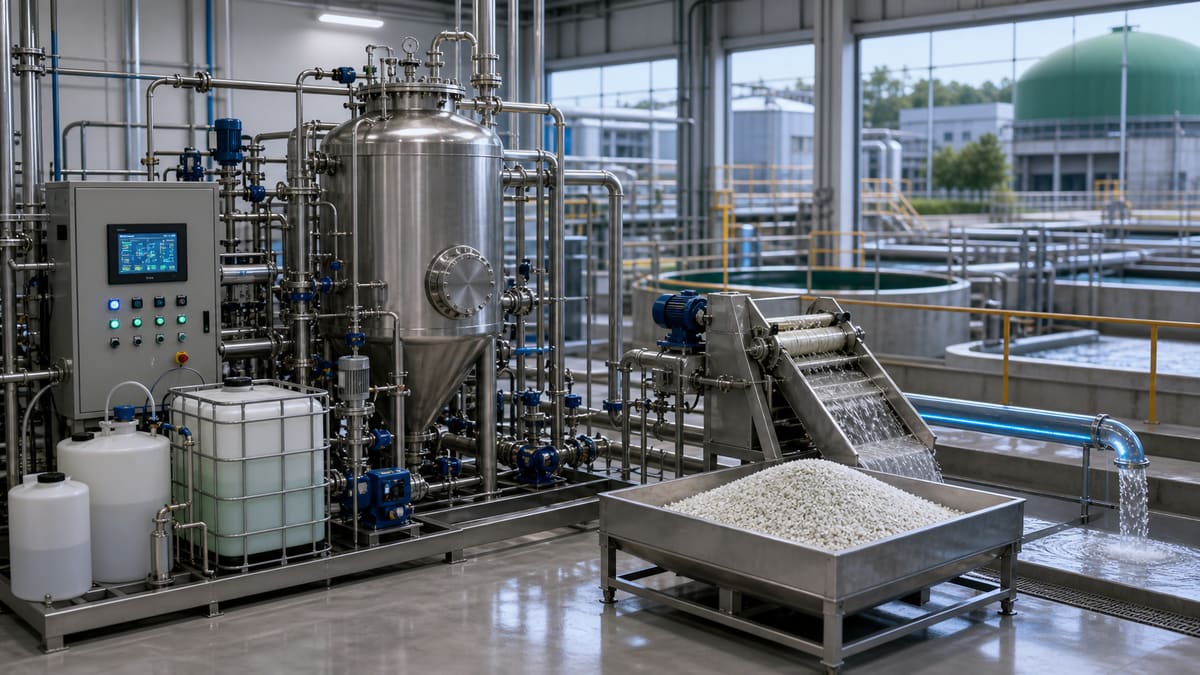
Phosphorus Recovery (Struvite): turning municipal nutrients into slow-release fertilizer
Phosphorus is an essential nutrient, critical for global food security, yet it is a finite, non-renewable resource facing geopolitical supply chain risks. Simultaneously, phosphorus discharged into waterways from municipal wastewater treatment plants (WWTPs) contributes to eutrophication, a significant water quality issue that disrupts aquatic ecosystems and can increase water treatment costs for downstream users. This dual challenge – resource scarcity and environmental pollution – positions phosphorus recovery as a strategic imperative for industries and municipalities alike.
The transition towards a circular economy in the UK and EU is accelerating, driven by ambitious net-zero targets, tightening environmental regulations, and robust ESG (Environmental, Social, and Governance) reporting frameworks. Industrial buyers and EPCs operating within these supply chains are increasingly scrutinised on their resource efficiency, waste valorisation, and carbon footprints. Recovering phosphorus, particularly through struvite precipitation, offers a potent solution to address these pressures. By converting a waste product into a valuable, slow-release fertiliser, organisations can simultaneously mitigate water risk, reduce operational carbon emissions, enhance resource security, and unlock new revenue streams, aligning directly with the evolving ESG expectations of export markets.
The Mechanism of Struvite Precipitation
Struvite (magnesium ammonium phosphate, MgNH₄PO₄·6H₂O) is a naturally occurring crystal that can be selectively precipitated from nutrient-rich wastewater streams. The process involves optimising pH and introducing magnesium ions (e.g., from magnesium chloride or magnesium hydroxide) into phosphorus-rich effluents. This carefully controlled reaction encourages the formation of high-purity struvite crystals, which can then be dewatered and sold as a valuable, slow-release fertiliser product. This not only removes phosphorus from the wastewater, helping meet discharge limits, but also simultaneously reduces ammonia, contributing to overall effluent quality.
Worked energy / carbon sketch
Recovering phosphorus as struvite directly mitigates the need for new, energy-intensive virgin phosphate fertiliser production, thereby reducing embedded carbon. Let's consider an illustrative municipal wastewater treatment plant (WWTP) with a moderate phosphorus recovery potential.
Assumptions (Illustrative):
- A WWTP recovers 250 kg of elemental phosphorus (P) per day as struvite.
- This recovered P is equivalent to approximately 573 kg of P₂O₅ per day (1 kg P ≈ 2.29 kg P₂O₅).
- The production and processing of conventional virgin phosphate fertilisers have an average carbon intensity of 2.5 kg CO₂e per kg of P₂O₅ (considering mining, beneficiation, and acidulation processes).
- The system operates 350 days per year.
Calculation:
- Annual P₂O₅ recovery: 573 kg P₂O₅/day × 350 days/year = 200,550 kg P₂O₅/year
- Avoided CO₂e emissions: 200,550 kg P₂O₅/year × 2.5 kg CO₂e/kg P₂O₅ = 501,375 kg CO₂e/year
- Annual carbon savings (tonnes CO₂e): 501,375 kg CO₂e/year ÷ 1000 kg/tonne = 501.4 tonnes CO₂e/year
This back-of-envelope calculation illustrates that by recovering 250 kg of phosphorus daily, a facility could avoid over 500 tonnes of CO₂e emissions annually from the conventional fertiliser supply chain. This substantial carbon footprint reduction, coupled with the resource circularity, represents a compelling case for struvite recovery as a green transition technology.
Traditional vs engineering evaluation path
| Topic | Chemical P removal + sludge disposal | Struvite recovery (engineering evaluation path) |
|---|---|---|
| Outcome | P shifted to sludge; landfill/incineration; limited circularity. | Slow-release product stream; nutrient stays in economy. |
| OPEX | Metal salts, hauling wet cake, rising disposal fees. | Mg/reactor OPEX often offset by product and cleaner hydraulics. |
| ESG | Compliance-first narrative. | Quantified P recovery (t/y) for circular-economy disclosures. |
Integrating Phosphorus Recovery into Water Stewardship and ESG Disclosure
Implementing struvite recovery technology is a tangible step towards holistic water stewardship. By meticulously monitoring and documenting the mass balance of phosphorus entering and exiting your facility, alongside the energy and chemical inputs for recovery, organisations can generate robust, auditable data. This granular data is invaluable for ESG questionnaires and reporting frameworks like CDP (Climate Change, Water Security, Forests) and the Alliance for Water Stewardship (AWS) Standard.
Such data-driven insights allow for clear articulation of how your operations are:
- Reducing water quality impacts: Quantifying phosphorus removal and its effect on local ecosystems.
- Enhancing resource circularity: Documenting tonnes of phosphorus recovered and diverted from waste streams, demonstrating progress towards a circular economy.
- Mitigating climate risk: Reporting the avoided Scope 3 emissions associated with replacing virgin phosphate fertiliser, as well as reduced energy for sludge handling.
- Improving operational resilience: Highlighting reduced reliance on external, potentially volatile phosphorus markets.
This rigorous approach ensures that sustainability claims are backed by verifiable metrics, lending credibility and fostering trust with stakeholders—from investors to regulators and supply chain partners.
Carbon savings calculator (illustrative)
Estimate annual electricity savings and avoided CO₂e when specific energy improves (e.g. after ERD, VFD tuning, or train optimization). Replace defaults with your meter data and your grid emission factor from your utility or ESG methodology.
ΔkWh/year ≈ Q(m³/h) × hours/year × (kWh/m³before − kWh/m³after) · tCO₂e ≈ ΔkWh × factor / 1000
Δ specific energy: 1.00 kWh/m³
Estimated electricity savings: 800,000 kWh/year
Indicative avoided emissions: 336 tCO₂e/year
Related equipment & product lines
These categories typically support the approach above—open any line to compare brands and models.
- ChemicalsAntiscalants, cleaners, and process chemicals for water treatment operations.View category →
- Statiflo Static MixersStatic mixing components for inline chemical dosing and blending.View category →
- Pumps & PumpingHigh-pressure and process pump solutions for water treatment skids and plants.View category →
For a closer review, use the engineering inquiry form to share feed, capacity, target, and project stage. Submission does not constitute a completed design or performance commitment.