Solutions · Industry Solutions
Industrial park ZLD: brine reduction and resource recovery
Centralized or multi-tenant ZLD: stream segregation, membrane concentration ladders, thermal blocks, and salt recovery narratives.
Use this guide within its scope
This page supports technical research and option comparison and is marked 2026. Illustrative values are not a quotation, completed process design, certification conclusion, or performance guarantee. Check current regulations, feed data, tests, and OEM records.
Problem
Mixed tenant effluents create organic and metals surprises; ZLD fails when segregation and chemistry narratives are weak.
Technology
Hub segregation, robust pretreatment, staged RO/NF/UHPRO where justified, thermal/evaporation partnership, and salt recovery options.
Results
Defensible mass balances, smaller thermal footprint, and clearer opex allocation across tenants.
Engineering decision card
Use when
Mixed tenant effluents create organic and metals surprises; ZLD fails when segregation and chemistry narratives are weak.
Evaluate first
Hub segregation, robust pretreatment, staged RO/NF/UHPRO where justified, thermal/evaporation partnership, and salt recovery options.
Inputs still required
Feed source and variability, capacity, target quality, operating hours, discharge or reuse boundary, available space, and utilities.
Comparison output
Defensible mass balances, smaller thermal footprint, and clearer opex allocation across tenants. The final decision still needs feed data, mass balance, and any necessary testing.
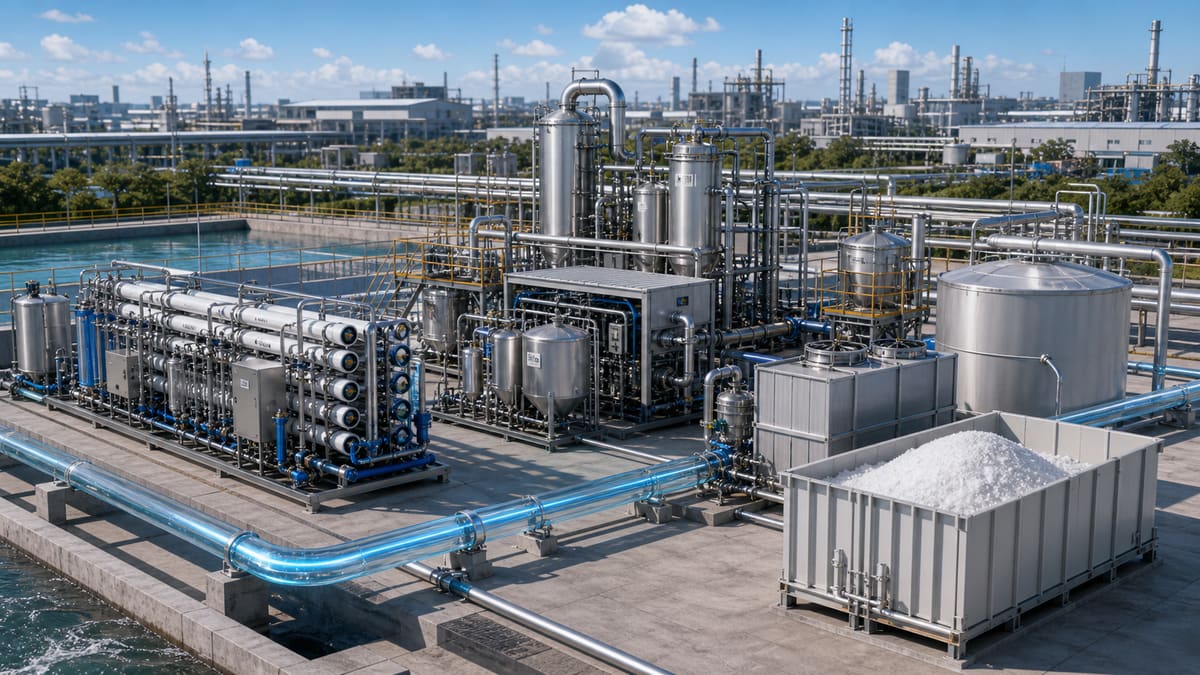
Industrial park ZLD: brine reduction and resource recovery
Industrial parks globally face increasing pressure to adopt sustainable water management practices, driven by tightening environmental regulations, escalating water scarcity, and the imperative for circular economy models. These facilities, housing diverse manufacturing tenants, present a unique challenge: the aggregation of highly variable wastewater effluents. These streams often possess differing characteristics, including high Chemical Oxygen Demand (COD), elevated concentrations of metals, and wide-ranging salinity (Total Dissolved Solids, TDS) signatures.
Traditional wastewater treatment approaches often fall short, leading to significant discharge volumes and lost resources. Zero Liquid Discharge (ZLD) mandates, particularly in water-stressed regions or environmentally sensitive areas, push industrial parks toward centralized, advanced brine management and resource recovery. Failure to implement a robust and adaptable ZLD strategy can result in non-compliance, heavy fines, and operational instability. Common pitfalls include the commingling of incompatible waste streams in a single sump, mis-sizing membrane systems based on average rather than peak or worst-case water quality, and designing thermal evaporation/crystallization blocks for a chemistry that is never consistently achieved.
Water Quality Targets & Compliance
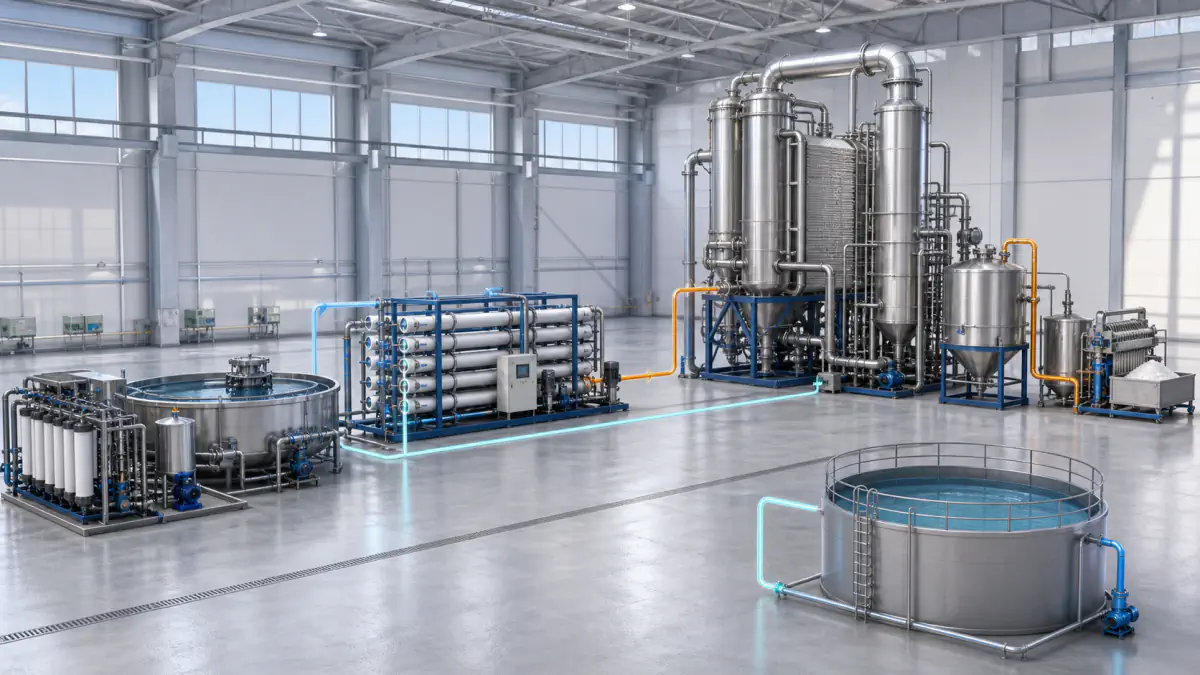
The primary objective of ZLD is to eliminate liquid discharge. However, embedded within this goal are critical water quality targets for both internal reuse and the composition of the final concentrated solid or manageable brine fraction. Incoming raw water from various tenants can exhibit significant fluctuations in:
- Total Suspended Solids (TSS) and Colloids: Impacting membrane fouling.
- Chemical Oxygen Demand (COD) and Biological Oxygen Demand (BOD): Indicating organic loading.
- Heavy Metals: Requiring specific removal strategies.
- Salinity (TDS) and Specific Ions: Driving osmotic pressure and scaling potential.
- pH: Influencing solubility and membrane compatibility.
For internal reuse, water quality targets are dictated by the application. For instance, cooling tower makeup might require permeate with TDS below 500 mg/L and low hardness, while high-pressure boiler feed demands exceptional purity, typically with conductivity below 0.2 µS/cm or resistivity above 5 MΩ·cm, and undetectable silica. The ultimate concentrate destined for off-site disposal or resource recovery must meet specific criteria for hazardous waste classification or purity for sale (e.g., industrial-grade salts).
this approach's solutions are engineered to consistently meet these diverse quality benchmarks, ensuring maximum resource utilization and minimal environmental impact.
1. Source Segregation and Pre-treatment
Effective ZLD begins at the source. this approach champions a segregation policy where high organics, high metals, and high TDS streams are separated at the tenant's curb where feasible. This prevents cross-contamination, optimizes the treatability of each stream, and reduces the overall treatment burden.
Pre-treatment is meticulously designed per effluent line, based on comprehensive treatability studies:
- Primary Treatment: For bulk solids and gross organic removal, processes like dissolved air flotation (DAF), flocculation, and sedimentation are employed.
- Advanced Physical Filtration: To protect downstream membrane systems, robust filtration is paramount. For raw waters with an SDI₁₅ consistently above 5, multimedia filtration (MMF) and/or ultrafiltration (UF) are explicitly required. UF effectively removes suspended solids, colloids, and macromolecules, significantly reducing the SDI and preventing irreversible fouling of reverse osmosis (RO) membranes.
- Chemical Conditioning: pH adjustment, oxidation, and the precise dosing of antiscalants are critical to prevent scaling, especially at higher recovery rates.
- Specialized Treatments:
- Granular Activated Carbon (GAC): For adsorption of refractory organics, color, and certain trace contaminants.
- Ion Exchange (IX): For selective removal of specific heavy metals or other ionic species that could foul membranes or exceed discharge limits.
- Advanced Oxidation Processes (AOP): Such as UV/H₂O₂ or ozone, for the degradation of recalcitrant organic compounds that are not amenable to biological treatment.
2. Membrane Concentration Ladder
- Stage 1: Primary Reverse Osmosis (RO) or Nanofiltration (NF):
- Purpose: This stage is designed for bulk TDS reduction and initial concentration. NF membranes selectively remove multivalent ions and larger organics while allowing monovalent ions to pass, useful for specific applications like hardness removal or color reduction. BWRO (Brackish Water RO) membranes offer high salt rejection (typically 98-99.5%) for general desalination.
- Operation: Membranes operate in a cross-flow configuration, continuously separating permeate (treated water) from concentrate (brine). Close monitoring of transmembrane pressure and normalized permeate flow is crucial to detect fouling early.
3. Post-RO Polishing and High-Purity Water Production
For applications requiring ultra-high purity, such as boiler feed or specialized process rinse water, further polishing is applied to the RO permeate:
- Continuous Electrodeionization (CEDI/EDI): EDI systems continuously remove residual ions from RO permeate without the need for chemical regeneration. A DC electric field drives ions across ion-selective membranes, continuously regenerating the ion-exchange resin beads packed within the compartments. Concentrate streams are continuously flushed from the system, and a small electrode stream is generated. This produces ultra-pure water, often achieving resistivity greater than 10 MΩ·cm.
- Ultraviolet (UV) Disinfection: For biological control, especially in reuse applications.
4. Concentrate Management and Resource Recovery
The final highly concentrated brine from the Brine RO stage is managed through a thermal partnership with evaporators and crystallizers.
- Evaporation/Crystallization: These units recover the remaining water as distillate, leaving behind solid salts. The design and operation of these systems are critically dependent on the agreed brine compositions from the upstream membrane stages.
- Salt Recovery: Where markets exist and salt purity allows, these solid salts can be recovered as valuable byproducts (e.g., sodium chloride, sodium sulfate) for industrial use, aligning with resource recovery goals.
engineering evaluation path engineering tip
Write a single internal brine table signed by membrane and thermal vendors—if they disagree, you are still in study phase, not construction. This ensures all parties are aligned on the composition and volume of the final concentrate, preventing costly redesigns and operational issues downstream.
Related equipment & product lines
These categories typically support the approach above—open any line to compare brands and models.
- RO MembranesReverse osmosis membrane elements for municipal and industrial desalination.View category →
- Pumps & PumpingHigh-pressure and process pump solutions for water treatment skids and plants.View category →
- Pilot Units TestingPilot rigs and trial modules for process validation and feasibility studies.View category →
- ChemicalsAntiscalants, cleaners, and process chemicals for water treatment operations.View category →
For a closer review, use the engineering inquiry form to share feed, capacity, target, and project stage. Submission does not constitute a completed design or performance commitment.