Solutions · Industry Solutions
Beverage & bottled water: taste, chlorine removal, and micro barriers
Ingredient and bottle water plants: GAC, RO tuning, UV barriers, and sensory-stable operations with microbiological redundancy.
Use this guide within its scope
This page supports technical research and option comparison and is marked 2026. Illustrative values are not a quotation, completed process design, certification conclusion, or performance guarantee. Check current regulations, feed data, tests, and OEM records.
Problem
Sensory drift from GAC exhaustion and seasonal organics collides with micro compliance—plants optimize one and lose the other.
Technology
Layered barriers, chloramine/chlorine strategy, RO where minerals must be controlled, and UV with validated dose monitoring.
Results
Stable taste panels, audit-friendly monitoring, and fewer emergency dumps.
Engineering decision card
Use when
Sensory drift from GAC exhaustion and seasonal organics collides with micro compliance—plants optimize one and lose the other.
Evaluate first
Layered barriers, chloramine/chlorine strategy, RO where minerals must be controlled, and UV with validated dose monitoring.
Inputs still required
Feed source and variability, capacity, target quality, operating hours, discharge or reuse boundary, available space, and utilities.
Comparison output
Stable taste panels, audit-friendly monitoring, and fewer emergency dumps. The final decision still needs feed data, mass balance, and any necessary testing.
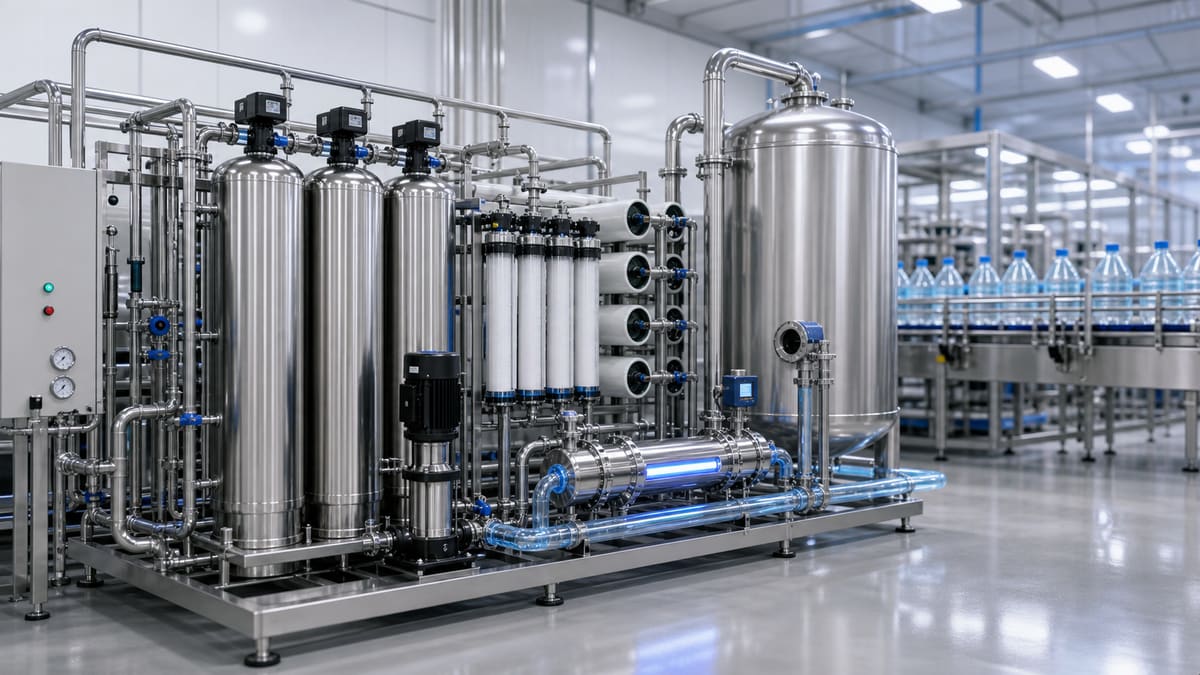
Industry Context & Regulatory/Compliance Drivers
Beverage and bottled water facilities operate under intense scrutiny. Key challenges include maintaining microbiological control, achieving specific TDS (Total Dissolved Solids) profiles for desired taste and mouthfeel, and consistently removing unwanted contaminants. The removal of disinfectants like chlorine and chloramine is paramount, as even trace levels can cause off-flavors and react with organic matter. Furthermore, the use of disinfection technologies like ozone introduces the potential for bromate formation, a regulated contaminant, requiring careful management.
Water Quality Targets
Water quality targets vary significantly depending on the final product.
- Purified Bottled Water: Often requires significant demineralization, with conductivity typically aiming for less than 5 µS/cm. Total Organic Carbon (TOC) is usually targeted below 50 µg/L. The focus is on a "clean," neutral taste.
- Spring/Mineral Water: While still treated for safety, the goal is to retain the inherent mineral profile that defines its unique character. Treatment focuses on microbiological safety and removal of undesirable substances without altering the natural TDS.
- Process Water for Beverages (e.g., carbonated soft drinks, juices): Quality can range from municipal supply (post-carbon filtration) to highly purified water depending on ingredients and final product specifications. Critical parameters include low alkalinity, hardness, and specific ion limits to prevent interactions with product formulations, impact on flavor stability, or scaling in process equipment. Microbiological limits are always stringent, often requiring plate counts of less than 1 CFU/mL.
1. Pretreatment – Safeguarding Downstream Processes
The quality and consistency of raw water, often from municipal or well sources, can fluctuate. Effective pretreatment is crucial to protect downstream membrane systems from fouling and extend their lifespan.
2. Primary Purification – Reverse Osmosis (RO)
Reverse Osmosis is the core technology for reducing TDS, removing specific ions (e.g., nitrate), and acting as a physical barrier to microbiological contaminants. this approach's RO systems are engineered for optimal performance.
- Cross-Flow Filtration: RO membranes operate in a cross-flow configuration, where the feed water flows tangentially across the membrane surface. This minimizes concentration polarization and continuously flushes away rejected salts.
- High Rejection & Recovery: Our systems typically achieve salt rejection rates of 98-99% on common ions, producing high-quality permeate. System recovery rates are engineered based on feed water quality, often ranging from 75% to 85%, optimized to minimize concentrate waste while managing scaling risk. For higher salinity feeds, multi-stage RO designs are employed.
- Flux Management: Operating flux (e.g., 10-20 L/(m²·h)) is carefully selected to balance membrane lifespan, cleaning frequency, and capital expenditure.
3. Post-Treatment – Polishing and Disinfection
Following RO, further polishing and disinfection steps ensure the water meets final product specifications and remains microbiologically pure until bottling.
- Degasification (Optional): If CO₂ removal is critical for pH stability or downstream processes, forced draft degasifiers can be incorporated.
- UV Disinfection: A non-chemical disinfection method, UV-C (254 nm) effectively inactivates bacteria, viruses, and protozoa. UV reactors are typically placed post-RO, and often again post-storage, just before bottling to provide a final microbiological barrier. Sizing is based on minimum UV transmittance (UVT) and target dose (e.g., 40 mJ/cm² for disinfection).
- EDI (Electrodeionization) (Optional for Ultra-Pure Process Water): For specific applications within a beverage facility requiring extremely high purity water (e.g., ingredient preparation, specialized cleaning cycles) beyond standard bottled water, EDI can be used. Unlike traditional ion exchange, EDI continuously regenerates its resin beds using a DC electric field and ion-selective membranes. This eliminates the need for chemical regenerants. Feed water passes through resin-filled compartments, where ions migrate across membranes towards electrodes. The concentrated ions are continuously flushed away in the concentrate stream, while a separate electrode stream carries off reactions from the electrode compartments.
- Sanitary Storage & Distribution: Stainless steel storage tanks with sterile air vents and hygienic distribution loops are critical. Recirculation loops help maintain water quality and prevent biofilm growth.
- Final Filtration: A critical barrier, typically 0.2 µm absolute filters, positioned just before the bottling line to ensure complete removal of any remaining particulates or microorganisms.
Operations, Monitoring, and CIP Philosophy
this approach's operational philosophy prioritizes proactive maintenance and digital oversight.
- Continuous Monitoring: Real-time monitoring of critical parameters including feed and permeate conductivity, pH, ORP, chlorine residual, turbidity, UVT, and pressure differentials (ΔP) across filters and RO stages. This data is essential for maintaining optimal performance.
- CIP (Clean-in-Place): A robust CIP program is fundamental. Regular chemical cleaning cycles (e.g., alkaline for organic foulants, acidic for scale) for RO membranes are scheduled based on trends in normalized permeate flow, transmembrane pressure (TMP) increase, or salt passage. Sanitary design facilitates efficient and effective cleaning of all product-contact surfaces.
- Preventive Maintenance: Scheduled replacement of UV lamps, GAC media, and cartridge filters ensures consistent water quality and system reliability.
Risks and Common Engineering Mistakes
- Inadequate Pretreatment: The most common cause of premature RO membrane fouling (e.g., colloidal fouling, scaling, biofouling), leading to increased cleaning frequency, reduced membrane life, and higher operating costs.
- Ignoring Concentration Polarization: Not accounting for this phenomenon during design can lead to localized supersaturation at the membrane surface, causing scaling even if bulk LSI is acceptable.
- Poor CIP Strategy: An ineffective or infrequent CIP regimen allows foulants to accumulate, irreversibly damaging membranes and significantly reducing performance.
- Ozone Mismanagement: If ozone is used, neglecting bromide levels in the feed water and not managing contact time can lead to regulated bromate formation, requiring additional post-treatment or risking non-compliance.
- Lack of Redundancy: Critical systems should have built-in redundancy (e.g., standby pumps, parallel filtration trains) to ensure continuous operation during maintenance or unexpected upsets.
2026 Forward-Looking Context: Sustainable & Digital Water Management
this approach is committed to driving innovation in water treatment, leveraging cutting-edge technologies for enhanced efficiency, sustainability, and operational intelligence.
Related equipment & product lines
These categories typically support the approach above—open any line to compare brands and models.
- Activated CarbonPowdered and granular activated carbon (PAC/GAC) for adsorption of organics, odor, and trace contaminants.View category →
- RO MembranesReverse osmosis membrane elements for municipal and industrial desalination.View category →
- UV DisinfectionUV systems and modules for pathogen inactivation and final disinfection barriers.View category →
- Ozone GeneratorOzone generation systems and peripherals for advanced oxidation processes.View category →
For a closer review, use the engineering inquiry form to share feed, capacity, target, and project stage. Submission does not constitute a completed design or performance commitment.