Solutions · Digital & Smart O&M
Real-time Flux & Rejection Analytics: compensating quality swings with instrument-grade discipline
Instrument-corrected flux and rejection monitoring: temperature-normalized signals, drift detection, and operator-ready explanations—not vanity dashboards.
Use this guide within its scope
This page supports technical research and option comparison and is marked 2026. Illustrative values are not a quotation, completed process design, certification conclusion, or performance guarantee. Check current regulations, feed data, tests, and OEM records.
Problem
Raw SCADA trends mislead after temperature and instrument drift; plants chase ghosts instead of fouling.
Technology
Normalization pipelines, redundant cross-checks on conductivity, and alert design tied to maintenance playbooks.
Results
Earlier detection of membrane damage or scaling bias—before permeate quality becomes a customer complaint.
Engineering decision card
Use when
Raw SCADA trends mislead after temperature and instrument drift; plants chase ghosts instead of fouling.
Evaluate first
Normalization pipelines, redundant cross-checks on conductivity, and alert design tied to maintenance playbooks.
Inputs still required
Feed source and variability, capacity, target quality, operating hours, discharge or reuse boundary, available space, and utilities.
Comparison output
Earlier detection of membrane damage or scaling bias—before permeate quality becomes a customer complaint. The final decision still needs feed data, mass balance, and any necessary testing.
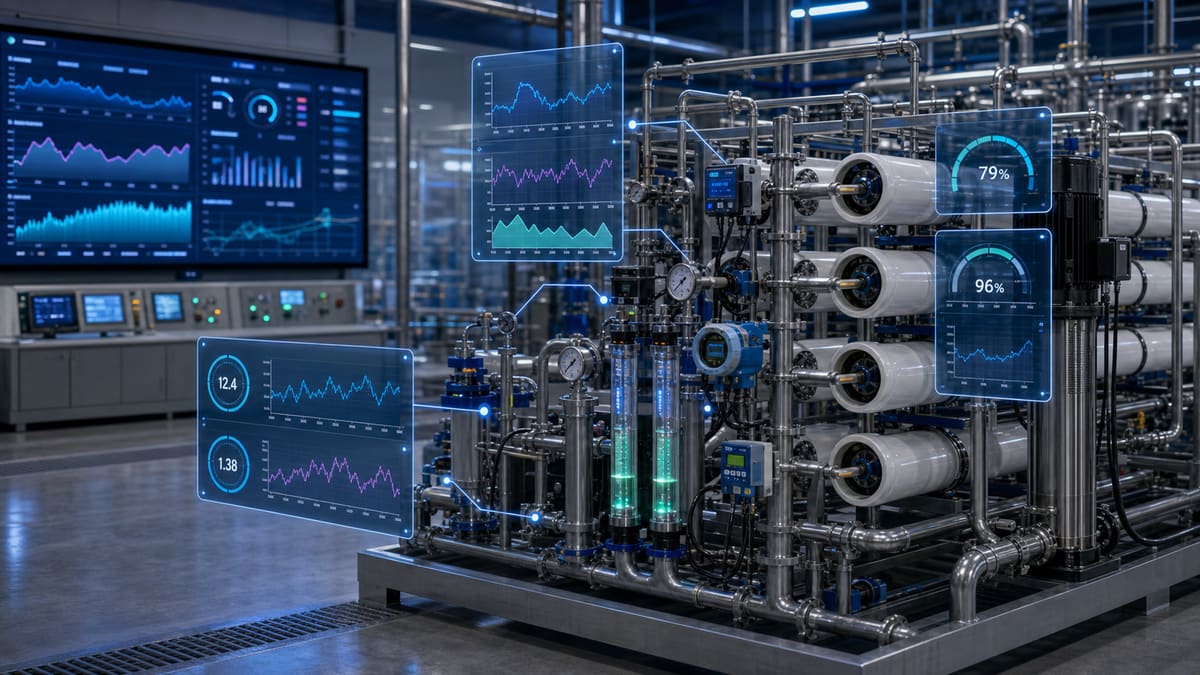
Real-time Flux & Rejection Analytics: compensating quality swings with instrument-grade discipline
Achieving consistent water quality and operational efficiency in complex industrial processes demands unwavering precision. Real-time flux and rejection analytics offer the ultimate guardrail against process variability, transforming potential quality swings into predictable, manageable events. For plant owners and EPCs, this translates directly into operational certainty, reduced downtime, and a more efficient, resilient digital supply chain.
Traditional vs engineering evaluation path
Optimizing the performance of critical filtration systems, such as Reverse Osmosis (RO) units, is a constant battle against fouling and degradation. Here’s how the approaches differ:
| Traditional way | engineering evaluation path way |
|---|---|
| Reactive maintenance: RO cleaning triggered by scheduled intervals or noticeable, significant drops in treated water quality/quantity, often too late. | Predictive optimization: AI-driven analytics continuously monitor membrane performance (flux, rejection, differential pressure), forecasting fouling trends and recommending the optimal cleaning schedule before performance plummets. |
| Manual data collection & delayed analysis: Operators record key parameters daily; lab tests for salt rejection might be weekly, creating a lag between issue onset and detection. | Automated, real-time insights: Digital twin continuously ingests data from online instruments, providing instant performance dashboards and anomaly alerts. Lab results are correlated for predictive model refinement. |
| Ad-hoc spare parts: Membrane replacement decisions are often made after catastrophic failure or prolonged underperformance, leading to urgent, expensive procurement and potential unplanned downtime while awaiting delivery. | Integrated supply chain: Performance degradation triggers automated spare part (membrane elements, cleaning chemicals) purchase requisitions. Inventory levels, lead times, and supplier performance are integrated for proactive replenishment. |
| Isolated operations: Performance data is siloed from broader supply chain and engineering teams, making root cause analysis and continuous improvement difficult across the enterprise. | Connected enterprise: Performance data, maintenance histories, and supply chain logistics are unified on a secure platform, enabling cross-functional collaboration and enterprise-wide optimization of O&M strategies. |
FAQ
Q: What kind of ROI can we expect from implementing real-time flux and rejection analytics? A: Customers typically see significant ROI through reduced chemical consumption from optimized cleaning cycles, extended membrane lifespan, fewer unscheduled shutdowns, and minimized labor costs due to predictive maintenance. Quantifiable benefits often emerge within the first 6-12 months, with ongoing improvements in operational efficiency and product quality.
Related equipment & product lines
These categories typically support the approach above—open any line to compare brands and models.
- Instrumentation & SensorsOnline measurement and control: flow, level, pressure, and water-quality sensors indexed from the Lenntech instrumentation hub.View category →
- RO MembranesReverse osmosis membrane elements for municipal and industrial desalination.View category →
- Replacement Parts / SparesGeneral replacement parts for treatment systems and subassemblies.View category →
For a closer review, use the engineering inquiry form to share feed, capacity, target, and project stage. Submission does not constitute a completed design or performance commitment.