Solutions · Digital & Smart O&M
Emergency Parts Rapid Response: response-window planning for pumps, instruments, and critical skids
Pre-agreed escalation lanes for dosing pumps, analyzers, and VFDs—so 'best effort' becomes a time-bounded commitment with named SKUs.
Use this guide within its scope
This page supports technical research and option comparison and is marked 2026. Illustrative values are not a quotation, completed process design, certification conclusion, or performance guarantee. Check current regulations, feed data, tests, and OEM records.
Problem
After-hours failures devolve into group chats and guesswork on compatible substitutes.
Technology
engineering evaluation rapid-response playbooks: validated alternates, staging locations, and customs-aware routing where applicable.
Results
Downtime windows expressed in hours—not weeks—when the failure mode is known.
Engineering decision card
Use when
After-hours failures devolve into group chats and guesswork on compatible substitutes.
Evaluate first
engineering evaluation rapid-response playbooks: validated alternates, staging locations, and customs-aware routing where applicable.
Inputs still required
Feed source and variability, capacity, target quality, operating hours, discharge or reuse boundary, available space, and utilities.
Comparison output
Downtime windows expressed in hours—not weeks—when the failure mode is known. The final decision still needs feed data, mass balance, and any necessary testing.
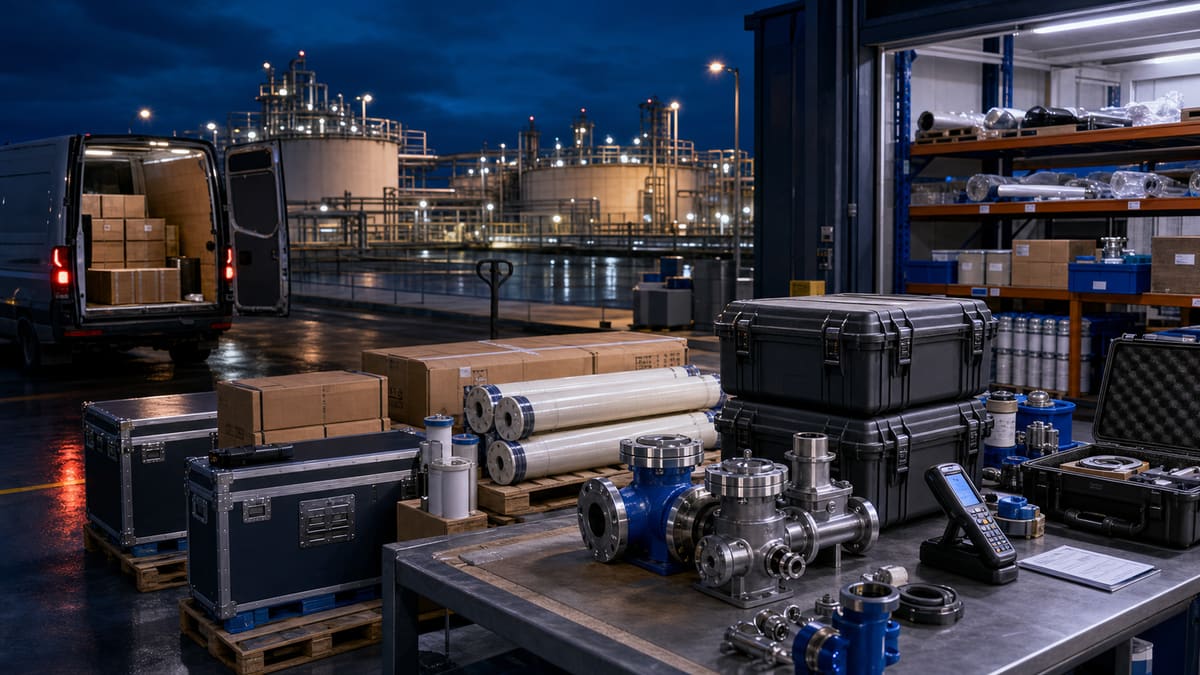
Traditional vs engineering evaluation path
When a critical component fails or shows signs of imminent failure, the difference between a minor disruption and a major crisis often boils down to how quickly and intelligently the supply chain responds. Consider a scenario where a critical chemical dosing pump on a water treatment skid begins to show erratic flow rates and increased power draw, as detected by its integrated sensors.
| Traditional way | engineering evaluation path way |
|---|---|
| * Detection: Manual observation by an operator or delayed alarm from a basic SCADA system, often after performance degradation is significant. | * Detection: Real-time analysis of integrated sensor data (flow, pressure, power) detects anomaly; AI/ML models predict imminent pump failure with high confidence, alerting maintenance before a full breakdown. |
| * Procurement: Operator reports issue, maintenance confirms, then manual search for part number, vendor contact, price quotes, and availability. Often involves multiple phone calls, emails, and potentially outdated inventory records. Lead time for order placement alone can be hours to days. | * Procurement: Digital Twin automatically identifies the exact pump model, serial number, and required spare parts. System cross-references with pre-negotiated contracts and global inventory, initiating an immediate, pre-approved order with priority shipping. Delivery initiated within minutes of confirmed need. |
| * Downtime & Risk: Plant runs in a degraded state or shuts down for days, risking regulatory non-compliance, production targets, and significant financial losses. High stress for plant personnel. | * Downtime & Risk: Proactive replacement minimizes downtime; component swap often completed within hours of part arrival. Operational continuity is maintained, risks are mitigated, and staff focus on optimizing, not firefighting. |
Data Security & Trust
- AES-256 encryption for all data communications and storage.
- Role-based access controls (RBAC) to limit data visibility to authorized personnel only.
- Continuous security audits and compliance with industry standards.
- Optional isolation architectures for sovereign data control.
engineering evaluation path Differentiation: Coordinated Action, Not Just Parts
- Smart Spares Management: We don't just ship parts; we ensure the right part, verified against your equipment's digital twin, is sourced from the optimal location in our global network. This includes ensuring correct revisions, materials, and pre-configuration where applicable.
- Engineering Expertise: Our digital tools connect your operational data with our engineering knowledge base. This allows for immediate validation of component needs and often includes remote guidance or pre-assembly instructions to accelerate on-site installation, reducing reliance on local, often overstretched, technical staff.
- Actionable Data: Every rapid response incident generates valuable data. This isn't just about what part failed, but why, under what conditions, and how quickly it was resolved. This data feeds back into our predictive maintenance models, informs future inventory optimization, and improves plant resilience, turning emergencies into learning opportunities.
FAQ
Q: What if our plant uses highly specialized or legacy equipment not typically stocked? A: Our initial setup involves ingesting your complete asset registry and bill of materials (BOMs). For highly specialized or legacy components, we work with you to establish tailored stocking agreements, identify alternative compatible parts, or even coordinate local manufacturing/3D printing options where feasible, ensuring these are integrated into your rapid response plan.
Related equipment & product lines
These categories typically support the approach above—open any line to compare brands and models.
- Instrumentation & SensorsOnline measurement and control: flow, level, pressure, and water-quality sensors indexed from the Lenntech instrumentation hub.View category →
- Replacement Parts / SparesGeneral replacement parts for treatment systems and subassemblies.View category →
- Pumps & PumpingHigh-pressure and process pump solutions for water treatment skids and plants.View category →
For a closer review, use the engineering inquiry form to share feed, capacity, target, and project stage. Submission does not constitute a completed design or performance commitment.